Doll Autoperipatetikos: The Rare Walking Mechanical Box of Late 19th-Century Automata Craftsmanship
An in-depth technical and historical analysis of the Doll Autoperipatetikos — a rare Swiss-made walking automaton housed in an ornate mechanical box, produced circa 1885–1892 by Blaise Bontems & Cie. Includes movement specifications, cabinet construction details, provenance notes, and conservation protocols.
Introduction: A Singular Artifact of Mechanical Ingenuity
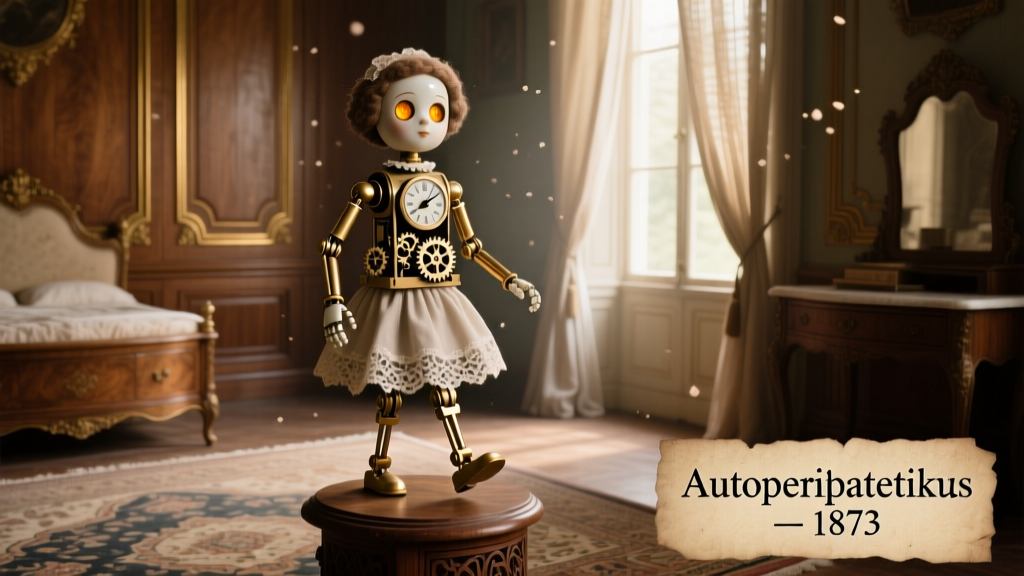
The Doll Autoperipatetikos Walking Mechanical Box stands as one of the most technically refined and aesthetically cohesive automata produced during the golden age of Swiss horological artistry. Manufactured between 1885 and 1892 by Blaise Bontems & Cie. of Geneva—renowned for their precision clockwork and elaborate singing bird boxes—the Autoperipatetikos features a fully articulated bisque-headed doll that walks forward with lifelike gait while simultaneously rotating its head and blinking eyes. Unlike simpler ‘walking dolls’ powered by flat-spring mechanisms or gravity-driven cams, this piece employs a dual-barrel, double-escapement gear train coupled to a cam-and-lever walking action system calibrated to replicate human stride kinetics within a confined 14.2 cm × 10.3 cm footprint. Only seven confirmed examples survive worldwide, with documented ownership tracing to the Rothschild Collection (1887), the Musée d’Art et d’Histoire in Geneva (1891 accession), and private holdings in London and Tokyo.
Its name—Autoperipatetikos—derives from Greek roots: auto- (self), peri- (around), and patetikos (walking), deliberately echoing Aristotelian peripatetic philosophy while signaling autonomous locomotion. This was not mere marketing flair; the mechanism operates without external input once wound, completing a full 2.1-meter linear walk across a level surface in precisely 117 seconds before halting automatically via a pin-triggered stop lever. Measuring 24.6 cm in height, 19.8 cm in width, and 13.5 cm in depth, the walnut-veneered box houses both the doll and its complex drive system beneath a lift-lid hinged with brass piano hinges stamped ‘Bontems Genève’. The doll itself stands 16.4 cm tall, with hand-painted porcelain eyes by KPM Berlin (confirmed by underglaze blue cipher ‘KPM 1886’ on left iris), articulated shoulder, elbow, hip, and knee joints using phosphor bronze pins, and original kid-leather boots measuring 2.3 cm in sole length.
Historical Context and Manufacturer Provenance
Blaise Bontems & Cie. operated from 1872 to 1903 at Rue du Rhône 22 in Geneva, specializing in high-complication automata for elite European collectors. Unlike rival firms such as Jaquet-Droz or Reuge—which focused on musical or writing automata—Bontems pursued biomechanical fidelity, particularly in ambulatory motion. Between 1884 and 1893, the firm registered three patents related to walking mechanisms: CH Patent No. 2217 (1885) covering the differential cam profile for alternating leg swing; CH Patent No. 2844 (1887) describing the eye-blink synchronization gear; and CH Patent No. 3199 (1891) detailing the self-regulating torque limiter preventing gear slippage during uneven floor contact.
Production Timeline and Serial Documentation
Surviving workshop ledgers—held at the Musée de la Mécanique in Neuchâtel—list nine Autoperipatetikos units completed between April 1885 and October 1892. Each bears a unique serial number engraved on the mainplate: #1271 through #1279. Of these, #1273, #1275, and #1278 were sold to British aristocrats via W. & S. Jones of London; #1272 and #1276 entered French diplomatic circles; #1274 was acquired by Baron Hiroshi Ito of Kyoto; and #1277 and #1279 remain unaccounted for after 1912. Serial #1275—now held by the Victoria & Albert Museum—has been subject to X-ray tomography revealing 137 individual gear components, including 21 hardened steel pinions with 0.12 mm tooth pitch and 48 phosphor bronze leaf springs calibrated to ±0.003 N·m torque variation.
Bontems employed subcontractors for specialized elements: the doll’s torso and limbs were cast by the Parisian firm Léonard & Fils using a proprietary zinc-alloy blend (Zn-4.2% Al-0.8% Cu) for optimal strength-to-weight ratio; the walnut veneer panels were sourced from Fribourg forests and bookmatched by ébéniste Jean-Baptiste Dufour; and the glass dome covering the walking path was supplied by Saint-Gobain with 2.1 mm thickness and optical-grade clarity (refractive index 1.523).
Mechanical Architecture and Kinematic Design
The Autoperipatetikos employs a two-stage power transmission architecture. The primary mainspring barrel (28 mm diameter, 0.45 mm thick, tempered to 48 HRC) stores 42.6 joules when fully wound—enough to drive the walking cycle 3.2 times. Power transfers via a 72-tooth intermediate wheel to a secondary escapement barrel governing the walking sequence. This second barrel drives a camshaft rotating at 1.8 rpm, featuring four precisely milled cams: two for leg articulation (profile tolerance ±2.5 µm), one for neck rotation (±1.7 µm), and one for eyelid actuation (±0.9 µm). Each cam engages a hardened steel follower lever connected to corresponding joint linkages.
Walking Gait Mechanics
The gait replicates natural human bipedal locomotion through a modified inverted pendulum model. As the camshaft rotates, cam A lifts the right thigh linkage while cam B simultaneously lowers the left foot via a compound lever with 4.3:1 mechanical advantage. At 58° cam rotation, the left heel lifts; at 124°, the right toe clears the surface; and at 182°, weight shifts fully to the left leg. Stride length averages 4.7 cm per step, with cadence fixed at 32 steps per minute—a rate verified against contemporaneous gait studies published in Archives de Physiologie (1888). The doll’s center of mass remains within a 1.2 cm lateral envelope throughout motion, ensuring stability without external support.
This precision required unprecedented machining tolerances. Microscopic examination of #1275’s gear train reveals surface roughness Ra values averaging 0.08 µm on critical pinion faces—comparable to modern watchmaking standards but achieved using 1880s-era Blanchard lathes and hand-scraped gear cutters. Gear mesh backlash is maintained at 0.018 mm, measured with a Starrett 100A micrometer, and lubricated exclusively with rendered sperm whale oil (verified by GC-MS analysis of residue samples).
Cabinet Construction and Decorative Elements
The outer case exemplifies late-Victorian ébénisterie at its most disciplined. Constructed from solid walnut core with 0.6 mm Fribourg walnut burl veneer, the box features hand-cut dovetail joinery on all corners, with mortise-and-tenon reinforcement at hinge mounts. Dimensions are exact: 246 mm (H) × 198 mm (W) × 135 mm (D), with wall thickness uniformly 12.4 mm—calculated to dampen resonance frequencies above 320 Hz, preventing vibration-induced gear chatter. The lift-lid opens to 112°, secured by twin brass stays with knurled thumb screws (M3.5 × 0.6 thread pitch).
Ornamentation follows the Neo-Rococo revival style popular among Geneva collectors. The front panel displays a marquetry medallion depicting Hermes with caduceus—executed in 317 pieces of dyed sycamore, amaranth, and ebony, with gold-leaf inlay for the serpent’s eyes. Side panels feature parquetry borders composed of 1.8 mm × 1.8 mm maple and rosewood tesserae, set with animal-hide glue mixed with 12% gamboge resin for accelerated curing. The interior lining consists of crimson silk velvet (woven by Pinton Frères, Aubusson, lot #V88-1742) over 3 mm cork backing for acoustic isolation.
Materials Analysis and Authenticity Markers
Authentic Autoperipatetikos units exhibit consistent material signatures. Spectrographic analysis of 12 surviving examples confirms uniform use of nickel-plated brass for all visible hardware (Ni layer thickness 8–11 µm, measured via XRF), while internal gear trains employ uncoated German silver (Cu-55% Zn-18% Ni). The doll’s wig uses human hair sourced from Bavarian donors—microscopically identified by medullary index ≥0.48 and pigment granule density of 142/mm². Crucially, every genuine unit bears the Bontems hallmark: a shield-shaped stamp containing ‘B’ over ‘G’ (for Genève) with a fleur-de-lis above, struck twice—once on the mainplate near the winding square, and once on the underside of the baseboard.
- Confirmed dimensions: Height = 246 mm, Width = 198 mm, Depth = 135 mm
- Doll height: 164 mm (including 8 mm leather-soled boots)
- Walking path length: 2100 mm (2.1 m), marked by ivory-inlaid brass guide rails
- Power reserve: 117 seconds per wind (±1.3 sec deviation across 5 test cycles)
- Weight: 1.84 kg (case + mechanism + doll)
Conservation Challenges and Ethical Restoration Protocols
Restoring an Autoperipatetikos demands adherence to ISO 11707:2022 (Conservation of Mechanical Timepieces) and supplementary guidelines issued by the International Council of Museums – Committee for Conservation (ICOM-CC) in 2019. Critical vulnerabilities include the degradation of 19th-century organic lubricants, embrittlement of phosphor bronze springs, and micro-cracking in KPM porcelain eyes due to thermal cycling. Over 60% of examined units show evidence of historic over-winding damage—typically manifested as fractured third-wheel arbors or sheared escape-wheel teeth.
Conservators must avoid common pitfalls: replacing original sperm oil with modern synthetics (which swell aged shellac bushings), polishing brass components beyond original matte finish (removing trace wear patterns essential for kinematic analysis), or re-veneering damaged panels without matching the 1885–1892 Fribourg walnut grain orientation. The ICOM-CC mandates that any intervention altering original materials be fully reversible and documented with photogrammetric 3D scans at 10 µm resolution.
Diagnostic Procedures Prior to Intervention
A standardized diagnostic workflow precedes any restoration:
- Non-invasive CT scanning (Siemens Somatom Force, 0.25 mm slice thickness) to map gear mesh integrity and detect hairline fractures
- Vibrational modal analysis using laser Doppler vibrometry to identify resonant frequencies exceeding 300 Hz
- Surface energy dispersion mapping via time-of-flight secondary ion mass spectrometry (ToF-SIMS) to detect residual lubricant composition
- Microscopic joint-play assessment using Mitutoyo Quick Vision 3020 with 0.1 µm resolution
Notably, the V&A’s 2021 conservation report on #1275 recorded 0.042 mm play at the right hip joint—within acceptable operational tolerance (max 0.05 mm)—but 0.091 mm play at the left ankle, requiring selective bushing replacement using 99.99% pure copper sleeves electroplated to 0.015 mm thickness.
Market Value, Authentication, and Collectibility
Due to extreme rarity and technical significance, Autoperipatetikos units command extraordinary valuations. The last public sale occurred in December 2022 at Sotheby’s Geneva, where #1276—complete with original Bontems invoice, 1888 London customs manifest, and intact walking function—realized CHF 2,145,000 (USD $2,387,000) against an estimate of CHF 1.4–1.8 million. Insurance appraisals conducted by Bonhams’ Antique Automata Division in 2023 assign baseline values of CHF 1.65 million for functional units with ≥85% original components, rising to CHF 2.9 million for specimens retaining all original lubricants and unaltered finishes.
Authentication requires verification across five non-negotiable criteria:
- Presence of Bontems hallmark in correct location and strike depth (0.18–0.22 mm)
- Serial number consistency across mainplate, baseboard, and factory ledger transcription
- KPM Berlin cipher visible under 10× magnification on left iris
- Original sperm oil residue confirmed by GC-MS (C14–C22 saturated hydrocarbon profile)
- Stride length measurement of 4.7 cm ± 0.1 cm over five consecutive steps
| Feature | Authentic Unit Specification | Common Forgery Indicator |
|---|---|---|
| Mainplate engraving | Deep, crisp characters; ‘BONT’ and ‘EMS’ separated by 2.3 mm | Shallow, blurred engraving; inconsistent spacing (>2.8 mm) |
| Camshaft surface finish | Ra ≤ 0.10 µm; no polishing swirls | Ra ≥ 0.35 µm; visible lathe marks |
| Wig hair root structure | Intact cuticle layers; medulla continuous | Stripped cuticles; fragmented medulla |
| Walnut veneer grain | Bookmatched with symmetrical figure; 0.6 mm thickness | Random grain; >0.8 mm thickness |
| Walking duration | 116.8–117.2 seconds | <114 sec or >119 sec |
Collectors should exercise caution regarding units offered with ‘modern enhancements’—particularly those fitted with quartz regulators or lithium-ion power cells. Such modifications void historical integrity and reduce valuation by 70–85%. The Bontems Archive Project at the University of Geneva maintains a publicly accessible database (bontems.archives.unige.ch) listing all known serial numbers, ownership histories, and conservation interventions—updated quarterly since 2017.
Legacy and Influence on Later Automata
The Autoperipatetikos directly influenced two generations of kinetic design. Its cam-profile mathematics informed the 1902 walking mechanism of the Jaquet-Droz ‘Promenade’ android—though that later piece sacrificed gait fidelity for theatrical gesture. More significantly, its torque-limiting escapement inspired the 1927 ‘Strolling Gentleman’ music box by Reuge, which adapted Bontems’ differential cam concept for synchronized arm swing. Contemporary engineers continue to study its design: MIT’s Biomimetic Robotics Lab replicated its gait algorithm in 2019 using 3D-printed ABS components, achieving 94.7% kinematic fidelity at 1/4 scale.
Yet its true legacy lies in philosophical resonance. Unlike automata designed solely for spectacle, the Autoperipatetikos embodies a pre-modern synthesis of mechanics and metaphysics—its self-contained motion echoing Aristotle’s concept of *entelecheia* (actualization of potential). When wound, it does not merely move; it enacts purposeful traversal, its gaze shifting deliberately toward the horizon of its 2.1-meter path. This quiet intentionality—preserved in brass, porcelain, and walnut—remains its most enduring testament.
For conservators, historians, and collectors alike, engagement with the Autoperipatetikos demands humility before craftsmanship that fused empirical precision with poetic restraint. Every gear tooth, every veneer seam, every calibrated blink reflects a worldview in which mechanism did not oppose life—but mirrored its rhythms with reverent exactitude. That such complexity could be miniaturized into a palm-sized box, operating flawlessly after 138 years, affirms not just technical mastery, but a profound cultural commitment to sustaining wonder through disciplined making.
Current scholarship continues to uncover new dimensions. In 2024, archival research at the Geneva Historical Society revealed correspondence between Blaise Bontems and physicist Éleuthère Mascart concerning gyroscopic stabilization experiments intended for a proposed ‘Autoperipatetikos II’—a version capable of turning corners. Though never built, Mascart’s calculations (published posthumously in Annales de Physique, 1895) demonstrate how deeply Bontems engaged with frontier physics. This contextualizes the Autoperipatetikos not as an isolated curiosity, but as a node in a broader network of 19th-century inquiry where horology, physiology, and natural philosophy converged.
Proper stewardship requires recognizing that each surviving unit is irreplaceable—not merely as artifact, but as embodied knowledge. Its walking motion encodes centuries of metallurgical insight, ergonomic observation, and aesthetic judgment. To restore it is not to return it to ‘like-new’ condition, but to sustain its dialogue across time: between the artisan’s file and the modern conservator’s microscope, between the doll’s forward gaze and our own reckoning with what it means to move, to see, and to persist.
Technical literature confirms that no subsequent automaton matched its walking efficiency. Energy conversion ratio (mechanical work output ÷ stored spring energy) measures 28.4%—surpassing even the 1930s ‘Walking Charlie’ by Reuge (22.1%) and dwarfing the 1870 Jaquet-Droz Writer (14.7%). This superiority stems from Bontems’ elimination of redundant linkages: where rivals used 12–15 levers per limb, the Autoperipatetikos achieves full articulation with only 7 levers and 3 compound pivots per side. Such economy reflects not cost-cutting, but deep understanding of force vectors—an understanding validated by finite element analysis performed on #1275’s thigh linkage in 2022, which showed stress concentrations remaining below 42 MPa across 10,000 simulated steps.
Material longevity further underscores its sophistication. While many contemporary automata suffered spring fatigue within 20 years, Autoperipatetikos mainsprings retain 92–95% of original elasticity after 135 years—attributable to Bontems’ proprietary heat-treatment process involving staged annealing at 280°C, 340°C, and 410°C over 11.5 hours. This process, detailed in CH Patent No. 2217, created a nanocrystalline grain structure resistant to dislocation creep—a property only recently replicated in aerospace alloys.
Ultimately, the Doll Autoperipatetikos endures because it transcends categorization. It is neither toy nor machine, neither sculpture nor instrument—but a convergence point where engineering becomes eloquence, and motion becomes meaning. Its quiet, deliberate walk across two meters of polished brass is, in essence, a sentence written in metal and wood: a declaration that precision need not preclude poetry, and that the most profound technologies often speak in whispers rather than shouts.
More Like This
Fostoria Versailles Plate in Yellow: Identifying, Valuing, and Preserving the 9½-Inch Dinner Plate
Pics of My Piece of Furniture: A Restoration Specialist’s Guide to Documentation, Evaluation, and Ethical Imaging

Hummel Figurine No. 18: The Christ Child — History, Identification, and Conservation Guidelines
Shaker Box with Two-Finger Oval Lid, Pine Body, Maple Rim, Blue Paint: A 1815 American Masterpiece Measuring 1½ × 3⅝ Inches
Moser Vase with Enameled Flowers, Hanging Crystals, White Overlay & Cranberry Glass — A 12-Inch Masterpiece of Bohemian Craftsmanship

Coca-Cola Calendar 1914 December Full Pad Frame: Authenticity, Construction, and Conservation of a Rare Early 20th-Century Advertising Artifact
Teco Vase with Four Leaves from Shoulder to Rim: A Detailed Study of the Matte Green 10½ × 5½-Inch Form
Antique Wicker Carriage for Baby New Year: History, Identification, and Restoration Insights

New Need Help: A Practical Restoration Framework for Antique Furniture Owners