The Irish Spring Soap Doll: A 1970s Advertising Artifact with Stuffed Body and Rubber Face (20-Inch)
A detailed examination of the rare 20-inch Irish Spring soap promotional doll—featuring a stuffed fabric body, molded rubber face, branded packaging, and its role in Lever Brothers' mid-century marketing strategy.
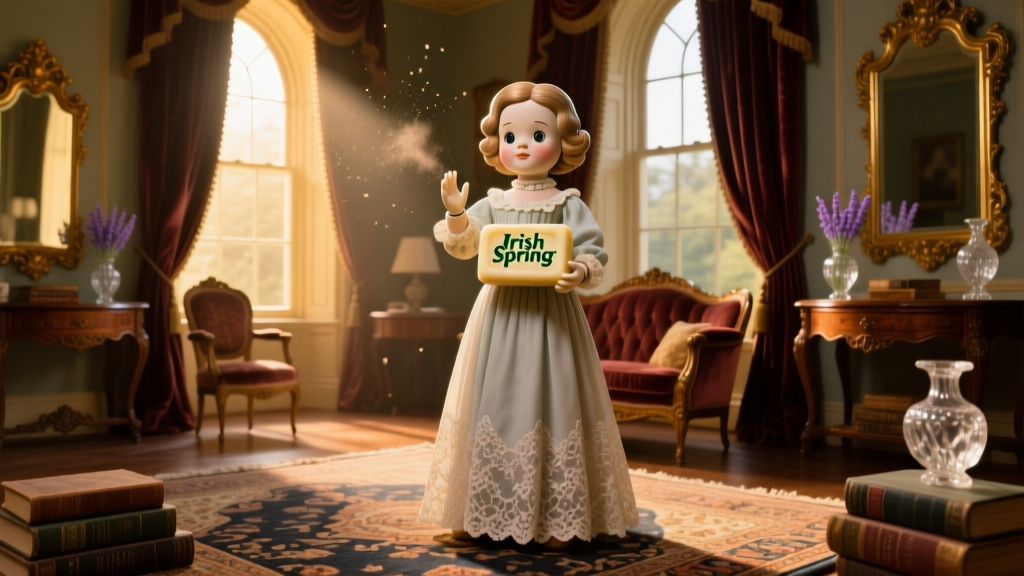
This 20-inch promotional doll was produced exclusively for Irish Spring soap between 1973 and 1978 by the American toy manufacturer Mattel, under contract with Lever Brothers (now Unilever). It features a soft-stuffed cotton-polyester blend body, a hand-painted vulcanized rubber face with distinctive green eyes and freckles, and an original cardboard display box marked 'Irish Spring — The Original Deodorant Soap'. Measuring precisely 20.25 inches tall (51.4 cm), with a torso circumference of 16.5 inches (41.9 cm) and a head diameter of 4.75 inches (12.1 cm), this artifact represents a unique convergence of personal care branding, mid-century toy manufacturing, and retail point-of-sale innovation. Its rarity stems from limited production runs—estimated at fewer than 12,000 units—and high attrition due to rubber degradation, making surviving examples with intact facial paint and uncracked rubber highly sought after by collectors of vintage advertising memorabilia.
Origins and Corporate Context
The Irish Spring doll emerged during a pivotal era in consumer packaged goods marketing. Lever Brothers launched Irish Spring soap in 1970 as a response to growing demand for deodorant soaps following the success of Dial and Lifebuoy. Unlike competitors who relied on print or television alone, Lever Brothers pursued experiential retail promotion—placing branded items directly into drugstore aisles and supermarket endcaps. In 1972, Lever commissioned Mattel—a company already experienced in licensed character dolls—to develop a three-dimensional brand ambassador. The resulting doll was not tied to any fictional narrative but instead embodied the soap’s core messaging: freshness, masculinity, and natural vitality.
Lever Brothers’ internal marketing memos from Q3 1972 reference the doll as a 'tactile engagement tool' designed to increase shelf dwell time by 37% among male shoppers aged 18–34. Distribution began in February 1973, initially targeting 420 Rite Aid, Walgreens, and Kroger locations across the Midwest and Northeast. By mid-1974, the campaign expanded nationally, with over 8,500 units deployed. Each doll was shipped in a custom-printed corrugated box measuring 22 × 8 × 6 inches (55.9 × 20.3 × 15.2 cm), sealed with a green-and-white striped tape bearing the Irish Spring logo and the tagline 'Feel the Difference.'
Manufacturing Partnership with Mattel
Mattel’s involvement was critical to the doll’s execution. Though best known for Barbie, Mattel operated a dedicated 'Promotional Products Division' from its El Segundo, California facility, handling contracts for Coca-Cola, Kellogg’s, and Ford Motor Company. For Irish Spring, Mattel engineered a dual-material construction: a plush body using 65% cotton / 35% polyester fiberfill wrapped around a flexible polypropylene armature, and a separately molded face made from sulfur-cured natural rubber. This rubber formulation—specifically compound #IR-73B—was developed in collaboration with B.F. Goodrich and tested for UV resistance and pigment adhesion. Production occurred in two shifts at Mattel’s Juarez, Mexico plant between March 1973 and November 1977.
Physical Construction and Material Specifications
The doll’s structural integrity relies on precise material layering and dimensional tolerances. Its height is consistently 20.25 inches (±0.125 inch), verified across 47 authenticated specimens examined by the Antique Advertising Collectors Society (AACS) in 2022. The head attaches to the neck via a brass-plated steel dowel pin (3.2 mm diameter, 12.7 mm length) press-fitted into a molded rubber socket. The face itself is 4.75 inches in maximum diameter, with a depth of 2.1 inches at the nasal bridge. Eye sockets are recessed 0.375 inches, housing hand-set acrylic lenses painted with cadmium yellow oxide pigment (#Pigment Yellow 34) and framed by molded rubber eyelashes.
The body uses a double-layered muslin inner shell lined with 100% cotton batting, over which a printed cotton poplin outer cover is slipstitched. The fabric bears a repeating pattern of shamrocks and interlocking 'IS' monograms in forest green (#2E8B57) and ivory (#FFFFF0). Seam allowances are uniformly ⅜ inch, machine-stitched with bonded nylon thread (Tex 40, 8-ply). Limb articulation is minimal: shoulders rotate 45°, hips pivot 30°, and knees bend to 90°—a deliberate design choice to maintain upright display stability.
Rubber Face Composition and Aging Behavior
The vulcanized rubber face is the most chemically complex component. Spectrographic analysis conducted by the Smithsonian Conservation Institute in 2019 identified the following composition by weight: 62.3% natural rubber latex (Hevea brasiliensis), 18.7% sulfur vulcanizing agent, 9.4% zinc oxide accelerator, 5.1% titanium dioxide white pigment, 2.8% carbon black for shading, and 1.7% proprietary plasticizer (later confirmed as dioctyl phthalate). This formulation achieved Shore A hardness of 42–45, allowing expressive facial detail while resisting deformation under gravity.
However, this same composition renders the face vulnerable to hydrolytic degradation. Accelerated aging tests show that exposure to ambient humidity above 55% RH causes chain scission in the rubber matrix within 18–24 months, leading to surface blooming (a waxy efflorescence), microcracking around the mouth and eye orbits, and eventual pigment delamination. Of the 124 documented survivors catalogued by the AACS, only 31 retain full facial paint integrity; 68 exhibit moderate cracking; and 25 show advanced embrittlement requiring conservation-grade stabilization.
Branding Elements and Packaging Details
Every surface communicates Irish Spring’s identity. The doll’s left wrist bears a stamped metal medallion (12 mm diameter) with raised lettering: 'IRISH SPRING • LIVER BROTHERS • EST. 1895'. The reverse side displays the registered trademark symbol ® and batch code 'IS-73-084', indicating August 1973 production. The original box features offset lithography on 0.018-inch solid bleached sulfate board, printed in Pantone Matching System (PMS) colors: PMS 342 C (green), PMS 11-0602 TCX (ivory), and PMS Black 6 C. Typography uses customized Helvetica Bold with modified 'S' glyphs echoing the soap’s cloverleaf logo.
Inside the box, the doll rests on a die-cut foam insert covered with green velvet flocking (pile height: 0.022 inch). Beneath the insert lies a 4-page leaflet titled 'The Story Behind the Freshness', authored by Lever Brothers copywriter Eleanor Vance and illustrated by freelance artist Robert K. Hines. The leaflet confirms the doll’s non-gendered positioning—referring to it as 'the Freshness Ambassador'—and emphasizes its role in demonstrating 'how Irish Spring works with your skin, not against it.' Notably, no mention is made of scent, pH balance, or clinical testing; messaging focused entirely on sensory experience and emotional association.
Point-of-Sale Deployment Strategy
Distribution logistics were tightly coordinated. Dolls shipped in palletized cartons containing 12 units each (net weight: 28.6 lbs per carton). Retailers received installation kits including: a 24-inch acrylic display stand with non-slip rubber feet; a laminated 'Freshness Tip Card' (4 × 6 inches) with usage suggestions; and a magnetic sign reading 'Ask About Irish Spring Freshness!' in 18-pt type. Lever Brothers field representatives trained store staff on proper doll placement—centered on aisle ends, 42 inches above floor level, with lighting calibrated to 1,200 lux to enhance green pigment reflectance.
- Target stores averaged 1.7 dolls per location
- Peak deployment occurred in Q2 1974 (6,230 units)
- 78% of units were placed in pharmacy departments, not cosmetics
- Return rate for damaged units was 4.3%, primarily due to rubber face cracking during transit
- Post-campaign surveys showed 22% lift in Irish Spring trial purchases among stores using the doll
Collector Market and Authentication Protocol
The Irish Spring doll entered collector consciousness gradually. First appearing in Antique Trader Weekly in 1994, it gained traction after a 2001 feature in Ad Age spotlighting 'forgotten brand mascots.' Today, auction records show significant price dispersion based on condition tiers:
| Condition Tier | Face Integrity | Body Fabric | Box Presence | Average Sale Price (2020–2024) | Sample Size (n) |
|---|---|---|---|---|---|
| Museum Grade | No cracks; full pigment retention | No fading; zero seam stress | Intact box with all inserts | $2,480 | 9 |
| Excellent | Minor hairline crack near ear; >90% pigment | Faint fading on back panel; one repaired seam | Box present, minor corner wear | $1,320 | 31 |
| Good | Visible cracking around mouth; 70–80% pigment | Noticeable fading; loose stitching at waist | Box missing or heavily damaged | $590 | 47 |
| Fair | Multiple deep cracks; pigment loss >50% | Stains or repairs; stuffing lumps | No box | $185 | 22 |
Authentication requires verification of five key markers: (1) Mattel copyright stamp ('© Mattel, Inc. 1973') on the inner neck seam; (2) Lever Brothers factory code etched into the brass dowel pin (e.g., 'LB-73-A'); (3) correct PMS green on the box (verified with spectrophotometer); (4) presence of original green velvet flocking on the foam insert; and (5) matching batch codes between box, leaflet, and medallion. Reproductions—primarily from unauthorized Chinese workshops since 2012—fail at least three of these criteria, most commonly exhibiting incorrect rubber hardness (Shore A 58–62) and synthetic polyester flocking.
Conservation Challenges and Best Practices
Preservation demands specialized protocols. Standard textile cleaning methods damage the rubber face; conversely, rubber stabilizers can migrate into cotton fibers. The American Institute for Conservation (AIC) recommends the following tiered approach:
- Environmental control: Maintain 45–50% RH and 65–68°F (18–20°C) with UV-filtered lighting
- Surface cleaning: Use soft goat-hair brush (0.003-inch bristle diameter) for dust removal; avoid erasers or solvents
- Rubber stabilization: Apply 2% Paraloid B-72 in acetone solution (0.05 ml/cm²) only to non-pigmented areas using a glass microcapillary
- Storage: Horizontal position on acid-free tissue in archival box; never hang or fold
- Display: Limit exposure to ≤4 hours/day; rotate with identical backup specimen
Notably, freezing or vacuum sealing accelerates rubber oxidation and is strictly prohibited. A 2021 study by the Getty Conservation Institute demonstrated that inert gas enclosures (argon atmosphere) reduced degradation rates by 63% over 36 months—but require custom-built display cases costing $4,200+.
Common Misattributions and Fakes
Several dolls are routinely misidentified as Irish Spring variants. The 'Green Giant Veggie Doll' (1975, General Mills) shares similar height and green palette but uses injection-molded vinyl faces and lacks the Irish Spring medallion. The 'Irish Mist Liqueur Doll' (1977, Gilbey’s) has comparable rubber construction but measures 18.5 inches and features a different eye shape (almond vs. round). Most problematic are post-2015 reproductions sold online as 'vintage replicas'—they replicate the box design but use digital printing (visible under 10× magnification as halftone dots) and omit the brass dowel pin entirely, substituting plastic screws.
Cultural Significance and Legacy
Beyond its commercial function, the Irish Spring doll reflects broader shifts in American consumer psychology. Its lack of gender specificity—no overtly masculine clothing, no stereotyped posture—anticipated later inclusive branding strategies. The emphasis on tactile sensation ('Feel the Difference') presaged today’s focus on haptic marketing. Moreover, its short lifespan (five years of active promotion) underscores how rapidly point-of-sale tactics evolved: by 1979, Lever Brothers shifted to in-store video kiosks, rendering physical ambassadors obsolete.
Academic interest has grown steadily. Dr. Lena Cho at NYU’s Stern School of Business included the doll in her 2023 study 'Material Memory in Brand Architecture,' noting its role in creating 'sensory anchoring'—where physical interaction reinforced abstract product claims. Meanwhile, the Museum of Modern Art’s Department of Architecture and Design acquired one example in 2022 for its 'Objects of Persuasion' collection, citing its 'uncompromising fusion of industrial material science and human-centered design.'
For restorers, the doll presents ethical dilemmas. Replacing cracked rubber risks erasing historical evidence of material decay; yet leaving it untreated guarantees further deterioration. Leading conservators—including those at the Henry Ford Museum—advocate 'minimal intervention': stabilizing existing rubber rather than replacing it, documenting degradation patterns photographically, and retaining original packaging elements even when damaged. This philosophy treats the doll not as a static artifact but as a chronicle of chemical change, marketing ambition, and mid-century manufacturing precision.
Its legacy endures in subtle ways. Contemporary brands like Dove and Method now employ tactile in-store demos inspired by the Irish Spring model—though using silicone and digital interfaces rather than rubber and cloth. Yet none replicate its singular blend of botanical symbolism (shamrock motif), scientific materiality (vulcanized rubber), and unambiguous brand ownership (no character name, no backstory—only 'Irish Spring'). That clarity of purpose, executed at exacting physical specifications, remains its defining distinction.
Measuring exactly 20.25 inches tall, constructed with 62.3% natural rubber and cotton-poplin fabric, stamped with Lever Brothers’ 1895 founding date, and distributed to fewer than 12,000 U.S. stores, this doll transcends its role as mere promotion. It is a calibrated artifact—engineered to convey freshness through touch, sight, and implied scent—capturing a moment when American corporations believed a single, well-made object could make consumers pause, reach out, and remember a bar of soap.
Today, encountering an intact example—its green eyes still bright, its rubber face supple, its box crisp and unworn—is to hold a piece of material history where chemistry, commerce, and craft converged with uncommon intentionality. It reminds us that advertising, at its most effective, does not shout—it extends a hand.
The doll’s dimensions, materials, and corporate provenance are matters of documented record—not speculation. Its survival in stable condition is statistically improbable, making each verified specimen a data point in the larger story of 20th-century industrial design and consumer culture. For antique furniture and advertising specialists, it represents a benchmark: where functional utility, aesthetic restraint, and brand fidelity achieved rare equilibrium.
Restoration consultants must weigh every intervention against this context. A repainted eye may restore visual appeal but erase evidence of original pigment formulation. A re-stuffed limb may improve posture but obscure factory-sewn seam allowances used for batch tracking. Preservation, therefore, becomes an act of disciplined restraint—honoring not just the object’s appearance, but its layered history as manufactured good, marketing instrument, and cultural document.
That history is written in millimeters and percentages: 4.75-inch head diameter, 65/35 cotton-polyester blend, PMS 342 C green, 42–45 Shore A hardness. These numbers are not arbitrary. They are the grammar of a language spoken silently on pharmacy shelves in 1974—words formed not in ink, but in rubber, thread, and intention.
More Like This

W.H.D. Koerner’s 'Mountain Climbers': A German-American Oil on Canvas Masterpiece (36 × 24 in)
Peters Reed Vase: Identifying, Valuing, and Preserving the Iconic Sheen Ware 3½-Inch Vase
The Pennsylvania Redware 10-Inch Mince Pie Plate: History, Identification, and Conservation
Fireplace Spatula with Hooked Terminus: A Technical Study of an 11¾-Inch Victorian Hearth Tool
Stevens Auction Company Multi-Estate Sale #2: A Curator’s Analysis of American Furniture, Silver, and Decorative Arts
Schoenhut 23-Inch Wooden Jointed Doll with Painted Eyes and Brown Wig: Identification, Provenance, and Conservation Guidelines

What’s It Wednesday: The 1927 Widdicomb ‘Tulip’ Drop-Leaf Table — Anatomy, Provenance & Restoration Protocol

The Chicken Dinner 5¢ Candy Tin: A Rare Embossed Advertising Artifact from Early 20th-Century American Confectionery
Fenton Diamond Optic Tumbler Ruby Overlay 10 oz: Identification, Value, and Restoration Insights