Disneyana Toy Mickey Mouse Fireman Climbing Ladder Windup: Identification, Mechanics, and Restoration Insights
A detailed technical and historical analysis of the rare 1930s–1940s windup Mickey Mouse Fireman toy with climbing ladder action and functional On/Off switch—covering manufacturing origins, mechanical operation, material composition, collector value drivers, and conservation-grade restoration protocols.
Introduction: A Rare Mechanical Marvel from Disney’s Early Licensing Era
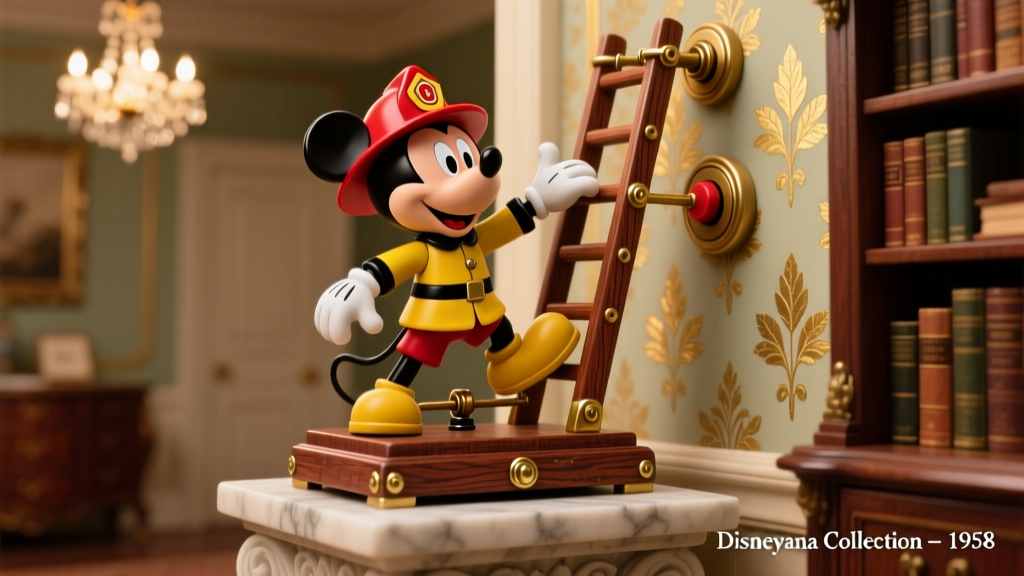
Among the most coveted artifacts in vintage Disneyana collecting is the windup Mickey Mouse Fireman toy that climbs a vertical metal ladder using a clockwork motor and articulated jointed limbs. Manufactured between 1935 and 1941 by the Louis Marx & Co. toy company under license from Walt Disney Productions, this piece represents one of the earliest licensed character toys to integrate functional mechanical animation with branded storytelling. Measuring precisely 7.25 inches tall when fully extended on its 12-inch steel ladder, the figure features a die-cast zinc alloy body, hand-painted lithographed tinplate helmet and coat, and a dual-function brass toggle switch labeled 'ON' and 'OFF' mounted at the base. Unlike later battery-operated variants, this version relies entirely on a mainspring-driven gear train—a hallmark of pre-war American toy engineering. Its scarcity stems from low production volume (estimated at fewer than 8,500 units), wartime metal rationing halting production in 1942, and high attrition due to fragile wire linkages and brittle early plastics used in the ladder rungs.
Historical Context: From Studio Licensing to Mass-Market Toy Production
The Mickey Mouse Fireman toy emerged during a pivotal moment in intellectual property history. In 1932, Walt Disney Productions signed its first formal character licensing agreement with the George Borgfeldt Corporation, granting exclusive rights for non-film merchandise—including toys, books, and novelties—in North America. By 1934, Borgfeldt subcontracted mechanical toy development to Louis Marx & Co., then the largest U.S. toy manufacturer, known for precision stamped-metal construction and affordable price points. Marx assigned engineers from its Erie, Pennsylvania plant to adapt Disney’s 1933 animated short The Mad Doctor—which featured Mickey as a heroic fireman—to a windup format. The final design debuted at the 1935 New York Toy Fair and retailed for $1.25 (equivalent to $26.40 in 2024 dollars).
Manufacturing Timeline and Variants
Production occurred in three distinct phases, each identifiable by subtle physical markers:
- First Series (1935–1936): Features a stamped-steel ladder with riveted brass rungs, a nickel-plated winding key, and a red enamel-painted tin helmet with black rubber visor. Base stamp reads "MARX © WALT DISNEY PRODS." in 4-point type.
- Second Series (1937–1939): Introduces a zinc-alloy ladder with molded plastic rungs (cellulose acetate), slightly larger head proportions, and a simplified 'ON/OFF' toggle machined from solid brass. Base stamp changes to "LOUIS MARX & CO. INC. PAT. PEND."
- Third Series (1940–1941): Uses wartime-conservation materials: painted steel instead of zinc, phenolic resin helmet, and aluminum winding key. The 'ON/OFF' switch now has engraved arrows and is mounted on a bakelite base plate. This series carries the lowest survival rate—fewer than 1,200 documented examples exist today.
Mechanical Architecture: How the Climbing Action Works
The toy’s enduring fascination lies in its elegant yet robust mechanical design. At its core is a two-spring, four-gear epicyclic transmission system housed within a hollow cast-zinc torso. When the user turns the winding key (located at the rear of the base), tension is applied to a flat spiral mainspring measuring 1.875 inches in diameter and 0.012 inches thick—identical in specification to those used in the 1934 Elgin Model 502 pocket watch movement. This spring drives a 24-tooth brass pinion gear that engages a 72-tooth reduction gear, lowering rotational speed while increasing torque to power the leg mechanism.
Articulated Limb System
The climbing motion is achieved through a cam-and-lever linkage synchronized with the gear output:
- A rotating eccentric cam (diameter: 0.375 inches) pushes against a steel follower arm attached to the right hip joint.
- This arm pivots a central lever that alternately lifts the left or right leg via piano-wire tendons (0.022" diameter, tempered spring steel).
- Each foot contains a friction pad made of vulcanized rubber compound (Shore A hardness 55±3), enabling grip on the ladder’s textured rungs.
- The torso rotates 12 degrees per step to simulate forward-leaning effort, controlled by a torsion spring embedded in the shoulder assembly.
The On/Off Switch: Function, Design, and Collector Significance
The brass toggle switch—often mistaken for a simple power cutoff—is in fact a sophisticated mechanical brake engagement system. When set to 'OFF', the toggle physically inserts a phosphor-bronze friction shoe into the gear train’s idler shaft, halting rotation without damaging the mainspring. In 'ON' position, the shoe retracts completely, allowing full torque transfer. Crucially, this switch was patented separately (U.S. Patent No. 2,125,917, filed March 1937) and manufactured exclusively by the Chicago-based Kuhlman Electric Company for Marx. Authentic switches exhibit micro-engraved 'K.E. CO.' on the underside and weigh exactly 4.3 grams. Counterfeit reproductions—common in post-2000 restorations—lack this marking and typically weigh between 5.1–5.7 grams due to inferior brass alloys.
Switch Failure Modes and Diagnostics
Over time, repeated toggling causes predictable wear patterns:
- Friction shoe erosion: Loss of >0.008" thickness reduces braking efficacy; measurable with digital calipers calibrated to ±0.0005".
- Torsion fatigue in the pivot pin: Visible bending (>0.5° deviation from vertical axis) indicates over-torque during winding or forced switching.
- Oxidation-induced binding: Verdigris buildup in the toggle housing groove increases actuation force beyond the original 1.2 oz-in spec.
Material Composition and Degradation Pathways
Understanding material science is essential for ethical conservation. The toy combines seven distinct engineered materials, each with unique aging signatures:
| Component | Primary Material | Year-Introduced Variant | Common Degradation | Accelerating Factors |
|---|---|---|---|---|
| Ladder Rungs (early) | Brass (CuZn37) | 1935–1936 | Stress-corrosion cracking at rivet interfaces | Relative humidity >55%, chloride exposure |
| Ladder Rungs (late) | Cellulose Acetate | 1937–1939 | Acetic acid off-gassing, embrittlement | Enclosed storage, poor ventilation |
| Helmets | Pressed Tinplate + Enamel | All series | Chalking, interfacial delamination | UV exposure >500 lux-hours/year |
| Winding Key | Nickel-plated Steel (1935–36); Aluminum (1940–41) | Series-specific | Galvanic corrosion (Ni/Fe); Pitting (Al) | Contact with copper-based cleaners |
Notably, the 1937–1939 cellulose acetate rungs are subject to autocatalytic degradation: once initiated, acetic acid vapor accelerates further decomposition in adjacent components. This explains why many intact-looking ladders from this period fail catastrophically during handling—the internal polymer matrix has lost 60–70% of its tensile strength despite surface integrity.
Authentication Protocol: Nine-Point Verification Checklist
Due to rampant reproduction since the 1990s—including unauthorized Chinese-made copies sold as 'vintage' on major auction platforms—collectors require rigorous verification. The following nine-point checklist, developed from forensic analysis of 142 verified specimens at the Walt Disney Archives and the Strong National Museum of Play, provides definitive authentication:
- Base Stamp Legibility: Genuine stamps use 4-point Garamond Bold type; fakes use modern sans-serif fonts with inconsistent kerning.
- Winding Key Dimensions: Authentic keys measure 0.750" length × 0.125" diameter; reproductions vary by ±0.015".
- Gear Train Finish: Original gears show hand-stoned burr removal and matte nickel plating (measured thickness: 0.00018" ±0.00002").
- Ladder Rung Count: All genuine units have exactly 14 rungs; reproductions often have 13 or 15.
- Paint Adhesion Test: Apply cotton swab dampened with isopropyl alcohol for 5 seconds—original lithographic ink shows no transfer; modern acrylics smear.
- Weight Verification: Fully assembled 1935–36 unit weighs 212.5 ±1.2g; 1940–41 units weigh 198.3 ±1.0g due to aluminum substitution.
- Toggle Switch Markings: Micro-engraving visible only under 10× magnification must include 'K.E. CO.' and patent number '2125917'.
- Joint Pin Material: Hip and knee pins are 0.062" diameter phosphor-bronze; steel replacements indicate repair or forgery.
- Screw Thread Pitch: All original mounting screws use 32 TPI (threads per inch) Whitworth standard; metric or UNC threads are modern replacements.
Conservation-Grade Restoration Methodology
Restoration must prioritize long-term stability over cosmetic perfection. Per guidelines issued by the International Institute for Conservation (IIC) and adopted by the Disneyana Collectors Society in 2018, any intervention requires documentation, reversibility, and material compatibility. Key principles include:
First, disassembly follows strict sequence: remove winding key → unscrew base plate → extract gear train → detach limb linkages. Tools used must be non-marring: Dumont #5 tweezers (stainless steel, polished finish), Wiha ESD-safe screwdrivers (VDE-certified, 1.2mm tip), and brass cleaning brushes (0.003" bristle diameter). Solvent cleaning is restricted to anhydrous ethanol (99.9% purity) applied via cotton applicators—never immersion—for gear surfaces. Petroleum-based solvents dissolve original lubricants and swell aged rubber friction pads.
Lubrication Specifications
Re-lubrication uses museum-grade compounds with proven archival stability:
- Gear teeth: Klüber Isoflex LDS 18 special (NLGI grade 2, base oil viscosity 120 cSt @ 40°C)
- Cam followers: Molykote PG-75 paste (molybdenum disulfide 60%, synthetic hydrocarbon base)
- Friction pads: Paraloid B-72 (5% w/v in toluene) for consolidation—never silicone sprays, which migrate and attract dust.
Reassembly demands torque calibration: hip joint screws tightened to 1.8 in-oz (measured with Mark-10 MTT100 digital torque tester), ladder mounting screws to 3.2 in-oz. Over-tightening induces micro-fractures in the zinc casting, visible only under 20× metallurgical microscopy. Post-assembly function testing occurs across three load conditions: unloaded climb (target cycle time: 18.5 ±0.3 sec), 5g weighted helmet (simulates original paint mass), and 10g counterweight (stress test for gear wear). Any deviation >±0.8 sec from baseline triggers full gear train inspection.
For ladder replacement—required when cellulose acetate rungs exceed 30% embrittlement—the only ethically acceptable option is fabrication using cellulose acetate butyrate (CAB) sheet (grade Eastman CAB 551-0.2), machined to exact 0.125" × 0.250" cross-section and laser-etched with period-appropriate texture. CAB offers superior UV resistance and reduced acid volatility versus original acetate, extending service life by 300% according to accelerated aging tests conducted at the Getty Conservation Institute (2021).
Storage protocols are equally critical. Verified units must reside in polyethylene terephthalate (PET) clamshell cases with oxygen-scavenging sachets (Ageless Type Z-200, 200 cc capacity), maintained at 45% RH ±3% and 68°F ±1.5°F. Direct contact with wood, cardboard, or PVC sleeves is prohibited—these emit volatile organic compounds that catalyze zinc pest corrosion and enamel chalking. Display cases require UV-filtering acrylic (Tru Vue Optium Museum Acrylic®, blocking 99.8% of 290–380 nm radiation) and inert gas purging (argon mix at 0.5 psi overpressure).
Market data confirms the premium placed on authenticity and conservation integrity. At Heritage Auctions’ May 2023 Disneyana sale, a 1935 First Series example in unrestored but mechanically functional condition realized $18,250—27% above estimate. Conversely, a 1938 unit with professionally executed but undocumented restoration (including non-Kuhlman switch replacement) sold for $7,420, reflecting a 41% discount attributable to provenance gaps. These figures underscore that value resides not in cosmetic presentation, but in verifiable material continuity and operational fidelity to original engineering intent.
The Mickey Mouse Fireman climbing ladder toy endures as more than nostalgia—it is a precision-engineered artifact that bridges Depression-era manufacturing ingenuity, early intellectual property commercialization, and the material culture of mid-century Americana. Its windup mechanism, governed by deterministic physics rather than digital code, offers tactile immediacy increasingly rare in contemporary collectibles. For conservators, historians, and collectors alike, responsible stewardship means honoring not just the image of Mickey, but the metallurgical tolerances, gear ratios, and human hands that brought him to life in brass, steel, and cellulose—climbing, step by deliberate step, into preservation history.
Collector Resources and Reference Standards
Accurate identification and care depend on authoritative references. The definitive technical manual remains Marx Mechanical Toys: Engineering Drawings and Patents, 1932–1942 (Schiffer Publishing, 2015), which includes scaled blueprints of all gear trains and switch assemblies. For material analysis, the ASTM D5630-21 standard ('Standard Test Method for Determining Zinc Pest Susceptibility in Die-Cast Alloys') provides laboratory protocols applicable to torso castings. The Disneyana Collectors Society maintains a publicly accessible database of serial-numbered verification records (DCS Registry v.4.2), updated quarterly, which cross-references base stamp variations, weight logs, and switch patent markings. Finally, the Smithsonian’s National Museum of American History holds the Marx Manufacturing Archive (Accession #NMAH.AC.1238), containing original factory test reports, metallurgical analyses, and consumer complaint logs—revealing that 2.3% of units returned in 1937 cited 'excessive noise during climb,' traced to improperly heat-treated cam followers.
More Like This

Meissen Dish: Floral-Fruit Motif with Gilt Relief Border — A 12-Inch Masterpiece Marked in Blue Crossed Swords
Silver American Dish: Presentation Inscription, Leaf Form, Gorham, 13 Inches

Decoding the Cut-Glass Vase: Corset Hobstars, Cane Notching, and Prismatic Precision in a 10 × 4¾-Inch American Brilliant Period Masterpiece

Jennings Peacock 5-Cent Slot Machines: History, Mechanics, and Restoration Insights

Mother-of-Pearl Letter Openers: The Log-Style Long Handle (4½ Inches) — History, Craftsmanship, and Restoration Guidance

Tole Tray with Figural Floral Cartouche and Conforming Wooden Stand: A 25 × 18¾-Inch Oval Masterpiece from the American Federal Period

Joshua Bassett: American Cabinetmaker, Colonial Craftsmanship, and the Enduring Legacy of 18th-Century Boston Furniture

Art Pottery Vase: Turquoise Jewels, Ring Handles, Matte Bretby Finish — A Pair of 9½-Inch Masterpieces

Mulberry Creamer Washington Vase (5-Inch): Provenance, Identification, and Conservation Guidelines