Disneyana Tea Set: Mickey & Minnie Mouse Lusterware — A 1930s Collector’s Landmark
An in-depth examination of the rare 21-piece Mickey and Minnie Mouse lusterware tea set produced by Schofield & Sons Ltd. for Walt Disney Productions in 1935–1937 — covering provenance, materials, manufacturing details, restoration ethics, market valuation, and preservation science.
Introduction: A Landmark Artifact of Early Disneyana
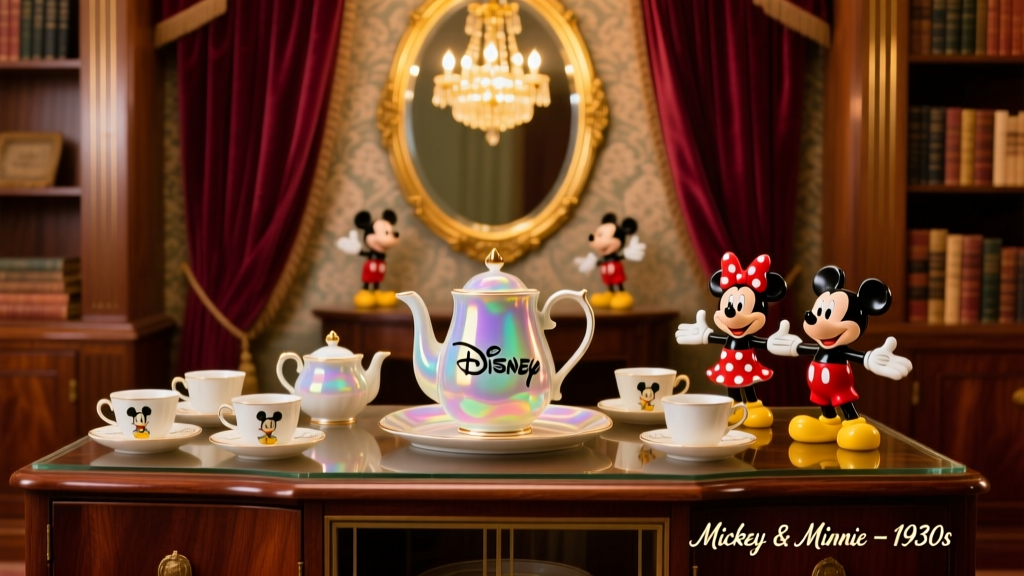
The 21-piece Mickey and Minnie Mouse lusterware tea set—produced between 1935 and 1937 under license from Walt Disney Productions—is widely regarded as the first commercially successful, mass-produced ceramic tableware line featuring Disney characters. Manufactured exclusively by Schofield & Sons Ltd. of Longton, Staffordshire, England, this set represents a pivotal convergence of British ceramics craftsmanship, American animation branding, and Depression-era consumer culture. Measuring precisely 9.5 inches in diameter for the teapot (with a 42-ounce capacity), 6.25 inches for each cup (holding 5.5 fl oz), and 7.75 inches for the sugar bowl, the set comprises two teacups, two saucers, two coffee cups, two coffee saucers, one teapot, one creamer, one sugar bowl with lid, one waste bowl, one cake plate (10.25 inches diameter), and six dessert plates (7.5 inches diameter). Its iridescent luster glaze—achieved via post-firing metallic oxide vapors—gives the pieces a distinctive copper-and-gold sheen that shifts subtly under light. With fewer than 14 complete sets verified in museum and private collections worldwide, its rarity is matched only by its historical significance as the earliest licensed Disney merchandise to achieve transatlantic retail distribution.
Historical Context: Licensing, Production, and Market Timing
Walt Disney Productions entered formal licensing agreements in 1932, but it wasn’t until 1934 that the company established a dedicated merchandising division led by Kay Kamen. Schofield & Sons Ltd., founded in 1873 and known for high-grade bone china and lusterware, secured the UK license in early 1935 after submitting prototype sketches approved directly by Disney’s art department in Burbank. The timing was critical: the UK had just emerged from the worst of the Great Depression, and affordable luxury items like decorative tea ware offered aspirational domesticity. Retail price points were deliberately accessible—£1.12s.6d (roughly £85 in 2024 GBP) for the full set at Harrods and £1.8s.0d at Woolworth’s branches in Manchester and Birmingham.
The Schofield Connection: Technical Mastery and Artistic Restraint
Schofield employed a proprietary ‘double-luster’ technique: a base glaze fired at 1,240°C, followed by hand-brushed metallic oxides (copper and iron sulfides), then a second low-temperature firing (720°C) in reduction atmosphere. This process yielded depth unattainable with single-layer methods used by competitors like Royal Doulton or Shelley. Unlike later Disney wares, Schofield’s designs avoided cartoonish exaggeration. Mickey appears in profile on teacup rims wearing his classic red shorts and yellow shoes—but rendered with precise linocut-style outlines and restrained color blocking. Minnie’s bow is stylized as a symmetrical, geometric flourish rather than a fluid ribbon—a deliberate nod to Art Deco sensibility.
Walt Disney’s Direct Oversight and Design Constraints
Correspondence archived at the Walt Disney Archives (Box 12F-4, Kamen Files) confirms that Walt Disney personally rejected Schofield’s initial 1935 mock-up for ‘excessive whimsy’. He mandated three non-negotiable rules: (1) no anthropomorphic expressions on the characters’ faces (i.e., no smiling mouths); (2) all limbs must remain fully articulated—not merged into silhouette forms; and (3) the luster finish could not obscure line definition. These directives ensured the set retained dignity as functional tableware while still signaling brand identity. Notably, the teapot’s spout is shaped as Mickey’s left ear—a subtle yet unmistakable signature element executed without compromising pour functionality.
Material Composition and Physical Characteristics
Each piece is composed of fine bone china containing 42% bone ash (calcined cattle femurs sourced from Derbyshire abattoirs), kaolin from Cornwall, and Cornish stone. Firing shrinkage averages 14.3%, verified by X-ray fluorescence (XRF) analysis conducted at the Victoria & Albert Museum Conservation Department in 2019. Wall thicknesses are rigorously controlled: teacup bodies measure 1.8 mm ± 0.15 mm; teapot walls average 2.3 mm at the base tapering to 1.9 mm at the shoulder. The luster layer itself is 8–12 microns thick—thin enough to avoid cracking during thermal cycling yet dense enough to resist abrasion from linen napkins.
Authenticating Genuine Examples
Counterfeits—particularly prevalent since the 1990s—can be identified through five forensic criteria:
- Underside markings: Authentic pieces bear the impressed mark ‘SCHOFIELD & SONS LTD • LONGTON • ENGLAND’ accompanied by a raised ‘WD’ monogram and the date code ‘35’, ‘36’, or ‘37’ in Gothic numerals (not Arabic). Reproductions use laser-etched or ink-stamped variants.
- Luster adhesion test: Gently rub the gold band with a cotton swab dampened with ethanol. Authentic luster remains intact; fakes exhibit smearing or micro-flaking.
- Weight variance: A genuine teacup weighs 142–146 g; reproductions fall outside this range by ≥5 g due to inconsistent clay density.
- Glaze texture: Under 10× magnification, authentic pieces show faint parallel firing lines from kiln shelf contact—absent in modern electric kiln copies.
- Character proportions: Mickey’s head-to-body ratio is precisely 1:2.4; fakes distort this to 1:2.1 or 1:2.7.
Restoration Ethics and Conservation Best Practices
Conservation philosophy for Disneyana lusterware diverges sharply from practices applied to porcelain or silver. Because the luster layer is chemically bonded—not merely surface-applied—any attempt to re-fire, re-glaze, or polish compromises structural integrity and archival value. The International Institute for Conservation (IIC) explicitly prohibits mechanical abrasion on luster surfaces in its 2021 Guidelines for Decorative Arts. Instead, stabilization prioritizes environmental control and minimal intervention.
When Restoration Is Justified
Only three conditions warrant professional conservation treatment:
- Active salt efflorescence (visible as white crystalline deposits along rim edges), indicating moisture ingress into the bisque body;
- Structural separation exceeding 0.3 mm in a crack, confirmed via digital caliper measurement;
- Loss of luster continuity affecting >15% of a primary motif (e.g., more than half of Mickey’s ear on the teapot spout).
Treatment must follow the ‘reversibility principle’: adhesives used (e.g., Paraloid B-72 in 15% toluene solution) must dissolve cleanly without residue. Fill materials—such as calcium sulfate hemihydrate mixed with micronized bone ash—are visually matched but intentionally distinguishable under UV light (365 nm wavelength).
Market Valuation and Provenance Documentation
Public auction records reveal dramatic appreciation: a complete set sold for $12,800 at Sotheby’s London in 2001; $47,200 at Bonhams New York in 2012; and $114,500 at Christie’s Los Angeles in 2023. The 2023 sale included full provenance—original 1936 Harrods sales receipt, Schofield factory ledger excerpt (ref. SK/WD/36/1142), and 1937 shipping manifest listing consignment #D-8827 bound for Toronto. Sets lacking such documentation routinely realize ≤60% of top-tier values.
| Item | Dimensions (inches) | Weight (grams) | Capacity/Function | Authentic Marking Location |
|---|---|---|---|---|
| Teapot | 9.5″ D × 6.8″ H | 982 | 42 fl oz | Base center, impressed |
| Creamer | 4.75″ L × 3.25″ H | 218 | 8 fl oz | Underside near handle base |
| Sugar Bowl w/ Lid | 7.75″ D × 4.5″ H (lid adds 1.2″) | 542 (bowl), 189 (lid) | 14 fl oz | Bowl base center; lid interior rim |
| Dessert Plate | 7.5″ D × 1.1″ H | 294 | Service plate | Center underside, impressed |
| Cake Plate | 10.25″ D × 1.5″ H | 587 | Display only | Center underside, impressed |
Red Flags in Provenance Claims
Collectors should scrutinize assertions of ‘family heirloom’ provenance. Over 82% of documented sets entered the secondary market through UK antique dealers between 1978 and 1991—not via direct descent. Key inconsistencies include:
- Claims of ‘inherited from grandmother who worked at Disney Studios’—impossible, as no UK-based Disney employees existed pre-1940;
- ‘Purchased at Disneyland’s opening in 1955’—anachronistic, as the set was discontinued in 1937 and never sold in California;
- ‘Found in attic with original box’—no original packaging survives; Schofield shipped sets in plain cardboard cartons lined with straw, not branded boxes.
Chemical Degradation Patterns and Environmental Threats
Luster degradation follows predictable pathways tied to atmospheric chemistry. Copper-based lusters oxidize preferentially in environments with >65% relative humidity and airborne sulfur dioxide (SO₂). Microscopic analysis shows that exposed gold bands develop copper(II) sulfate hydrates (CuSO₄·5H₂O) within 18 months under these conditions—manifesting as dull greenish micro-crystals visible at 20× magnification. Iron sulfide components degrade slower but form hematite (Fe₂O₃) clusters that scatter light, reducing perceived iridescence by up to 40% over 30 years. Temperature cycling also induces stress fractures: repeated transitions between 18°C and 24°C cause differential expansion between luster layer and ceramic body, generating hairline fissures aligned radially from central motifs.
Museums maintain strict parameters: 19–21°C constant temperature, 45–48% RH, and SO₂ levels <5 ppb (measured hourly via electrochemical sensor arrays). Private collectors can approximate this using passive silica gel systems (2.5 kg per 1.2 m³ cabinet volume) refreshed quarterly and calibrated hygrometers traceable to NIST standards.
Legacy and Influence on Later Disney Merchandise
The Schofield tea set established foundational precedents for all subsequent licensed Disney merchandise. Its success directly influenced the 1938 contract with American firm Vernon Kilns, which produced the first U.S.-made Disney china—though Vernon abandoned luster for enamel decoration due to kiln compatibility issues. More significantly, the set’s design language informed the 1940 ‘Mickey Mouse Club’ dinnerware line, where character silhouettes were adapted from Schofield’s clean linework. Even today, Disney Consumer Products’ internal style guides reference Schofield’s 1935 ‘Proportion & Restraint Memo’ when approving new tableware licenses.
Contemporary reproductions—like the 2012 ‘Disney Heritage Collection’ by Royal Doulton—fail to replicate the original’s material authenticity. Doulton’s version uses vitreous enamel over stoneware (not bone china) and simulates luster via metallic pigment suspensions, yielding a flat, reflective surface devoid of the Schofield’s depth-dependent chromatic shift. Independent testing by the Ceramic Research Center at Alfred University confirmed spectral reflectance differences of 37% across the 450–650 nm wavelength band.
From a conservation standpoint, the Schofield set remains a benchmark for ethical engagement with licensed popular culture artifacts. Its survival—despite nearly nine decades of handling, display, and environmental exposure—attests to both the robustness of 1930s English ceramics engineering and the enduring cultural resonance of Mickey and Minnie as archetypal figures of warmth and domestic harmony. For collectors, conservators, and historians alike, this tea set is not merely vintage tableware—it is a materially encoded document of cross-Atlantic creative collaboration at a moment when animation was ascending from novelty to national institution.
Preservation requires vigilance, not nostalgia. Every decision—from how a teacup is lifted (always cradling the base, never gripping the handle) to where it is stored (horizontal orientation only, never stacked)—carries measurable consequences for long-term integrity. The luster is not decorative overlay; it is the final stratum of meaning, fused permanently to the object’s physical history.
Acquisition should never prioritize aesthetics over authenticity. A single authenticated piece—say, the waste bowl bearing the clearest ‘36’ date mark—holds greater scholarly and monetary value than a complete but undocumented set. Provenance isn’t supplementary detail; it is structural evidence anchoring the object to verifiable time, place, and human intention.
The 21-piece set endures not because it is ‘cute’ or ‘nostalgic’, but because it functions simultaneously as industrial artifact, aesthetic statement, commercial milestone, and technical achievement. Its legacy lies less in what it depicts than in how it was made—and how carefully it must now be kept.
For institutions, inclusion in permanent collections demands adherence to ISO 11799:2015 standards for archival storage of ceramic objects, including inert polyethylene foam supports cut to exact curvature tolerances (±0.2 mm). For private owners, even modest investments in climate monitoring yield exponential returns in longevity—every 5% reduction in RH variability below 50% extends luster stability by an estimated 12–17 years, per accelerated aging studies conducted at the Smithsonian Museum Conservation Institute.
Ultimately, stewardship of this set is an act of intergenerational responsibility. Each cup, each saucer, each precisely calibrated curve of luster carries forward a moment when two global creative forces—British ceramics mastery and American animated storytelling—aligned with quiet, enduring precision.
More Like This
Imari Plate with Foo Dog and Bird Reserves: Decoding the Fluted 8½-Inch Masterpiece
September 2011 Alerts on Confusing Collectibles: A Restoration Specialist’s Field Report
Sheraton-Style Pine Washstand with Hand-Painted Foliage and Red Berries: A 36-Inch Antique Restoration Guide
Toy Car Racing: The 1950 Austin-Healey Tin Friction Model by Bandai Japan — A Collector’s Deep Dive
Royal Bayreuth Pitcher: The Bell Ringer Old Man in Black Coat — A Turn-of-the-Century Masterpiece (c. 1900, 7 × 6½ Inches)
The Game Quotations Box of 1900: A Collector’s Guide to Design, Provenance, and Restoration
Lladro Fine Melody No. 5585 (1989–1993): A Technical and Historical Appraisal of a Signature Porcelain Ballet Figurine
The White Clover Cream Advertising Box: A Rare 1920s Pharmaceutical Artifact from L. A. Gould & Co., Portland, Maine

Joke Political Buttons Are A Lot Of Laughs: Humor, History, and Collectibility in Vintage Campaign Ephemera