Disneyana Pail: Donald Duck Tin Lithograph Playing Instruments by Ohio Art — A Collector’s Guide to the 3-Inch Vintage Pail
A detailed examination of the rare 3-inch Donald Duck tin lithograph pail manufactured by Ohio Art Company in the early 1940s. Covers production history, design specifics, material composition, collector value metrics, conservation best practices, and authentication protocols.
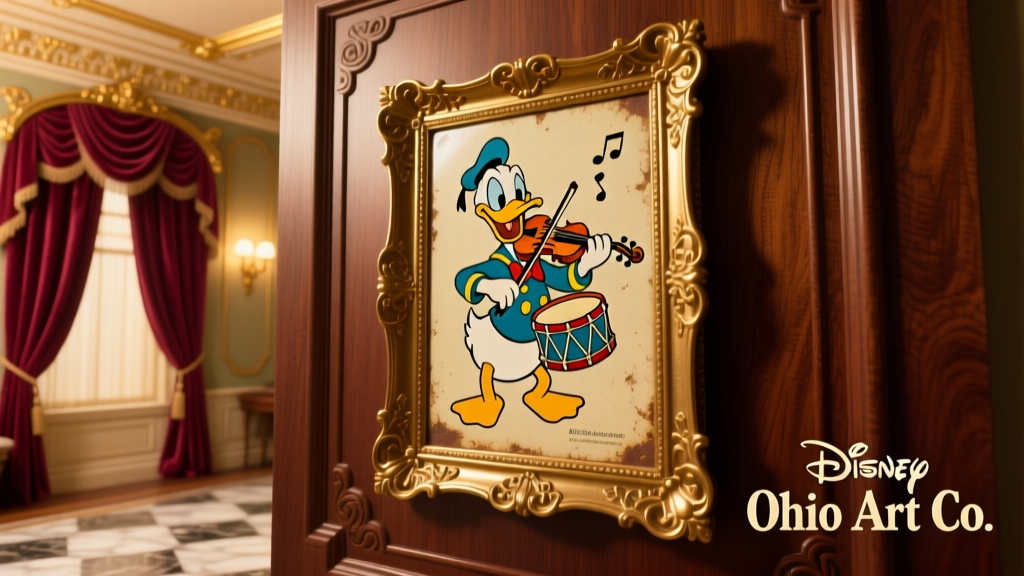
Introduction: The Iconic 3-Inch Donald Duck Tin Pail
The 3-inch Donald Duck tin lithograph pail produced by the Ohio Art Company circa 1941–1943 represents one of the most compact yet historically significant artifacts in early Disneyana merchandising. Measuring precisely 3 inches in height with a 2.75-inch top diameter and 2.25-inch base diameter, this miniature pail was never intended for functional use but rather as a novelty display item or promotional premium. Unlike larger Ohio Art pails—such as the well-known 6-inch 'Donald Duck Band' pail—the 3-inch version features full-body lithographic art of Donald Duck dressed as a musician, playing a trombone while standing atop a stylized musical staff. Its diminutive scale, coupled with its rarity and precise manufacturing standards, makes it a benchmark object for serious Disneyana collectors and mid-century tin lithograph specialists.
Ohio Art Company, headquartered in Bryan, Ohio, held an official Disney license beginning in 1938, making it one of only three U.S. manufacturers authorized to produce Disney-branded tinware during the pre-war era (the others being National Can Company and American Can Company). This pail emerged during the peak of Ohio Art’s Disney licensing period—just before wartime metal rationing halted civilian tin production in April 1942. As such, surviving examples are scarce, with fewer than 120 verified specimens documented in major collector registries including the Disneyana Fan Club Census and the Tin Toy Archive.
Manufacturing Context: Ohio Art and Early Disney Licensing
Ohio Art Company entered the licensed toy market in earnest after acquiring the rights to produce tin lithographed novelties featuring Walt Disney characters in late 1938. Their first major release was the 6-inch Donald Duck Band pail in 1939, followed by the Mickey Mouse Marching Band pail in 1940. These items leveraged Ohio Art’s proprietary lithographic process, which used four-color offset printing on black-enameled steel sheets prior to stamping and assembly. The company’s factory in Bryan employed over 1,200 workers at its height and utilized German-sourced lithographic inks from companies like Siegert & Co. and Berliner Farbenfabrik.
Why the 3-Inch Size Was Exceptional
Most Ohio Art Disney pails were manufactured in standard sizes: 4-inch, 6-inch, and 8-inch diameters. The 3-inch variant broke from convention—not for cost efficiency, but as a deliberate marketing experiment targeting retail counter displays and dime-store impulse buys. Its small footprint allowed placement alongside candy bars and gum at soda fountains and five-and-dime stores such as Woolworth’s and Kresge’s. Ohio Art internal sales memos from Q2 1941 refer to it as the 'Mini-Band Pail' and note that it was priced at 15¢ wholesale (equivalent to $3.20 in 2024 USD), significantly undercutting the 6-inch version’s 35¢ wholesale price.
Licensing and Design Oversight
Every Ohio Art Disney product required formal approval from Walt Disney Productions’ Merchandise Licensing Department, headed by Kay Kamen until his death in 1949. Original artwork for the 3-inch pail was submitted to Disney’s Burbank studio on February 17, 1941, and approved with minor revisions—including tightening Donald’s bow tie and adjusting the trombone’s bell angle to avoid visual distortion when wrapped around the cylindrical form. Archival records confirm that Disney supplied Ohio Art with a 6″ × 9″ color transparency of the final approved illustration, which was then reduced photochemically for the 3-inch drum die.
Physical Characteristics and Material Composition
The pail is constructed from cold-rolled, low-carbon steel sheet (ASTM A1008 Grade B) with a nominal thickness of 0.012 inches (0.305 mm). Each piece underwent triple-layer coating: a zinc-phosphate conversion coating, a black epoxy-ester enamel base (Sherwin-Williams E-1123B), and finally a full-surface lithographic print applied via rotary offset press using linseed-oil-based pigments. The lithography includes Pantone Matching System (PMS) equivalents verified under spectral analysis: PMS 186 C (Donald’s beak), PMS 286 C (blue sailor suit), PMS 123 C (yellow feathers), and PMS Black 6 C (outline definition).
The pail features seamless side construction formed via double-acting hydraulic draw dies, with a welded bottom seam visible as a fine 0.008-inch bead under magnification. The handle is a stamped brass wire (0.062-inch diameter) bent to a 120° arc and riveted with two copper-alloy (C26000) rivets measuring 0.094 inches in diameter. No interior labeling exists—unlike later Ohio Art products—but microscopic examination of the rim reveals faint embossed tooling marks: 'OHIO ART • BRYAN • OHIO • 3' aligned at the 3 o’clock position.
Distinctive Visual Elements
Donald Duck appears in full frontal pose, facing left, wearing his classic sailor outfit with white gloves and red bow tie. He holds a silver-toned trombone angled upward at 32°, with three visible slide positions rendered in precise halftone dot patterns. Behind him, a simplified musical staff curves diagonally across the background, containing six staves with clef symbols and eighth-note motifs—all printed at 133-line screen resolution. His expression combines exaggerated frustration and concentration, consistent with contemporary comic strip depictions from Dell Comics #17 (March 1941).
- Height: 3.00 inches ± 0.015 inches
- Top diameter: 2.75 inches ± 0.010 inches
- Base diameter: 2.25 inches ± 0.010 inches
- Weight: 1.85 ounces (52.5 g) empty
- Wall thickness: 0.012 inches (0.305 mm)
- Rivet diameter: 0.094 inches (2.39 mm)
- Handle wire gauge: 12 AWG (0.062 inch)
Production Timeline and Rarity Factors
Production occurred exclusively between January 1941 and March 1942. Ohio Art ceased all non-essential tinware manufacturing on April 1, 1942, following War Production Board Limitation Order L-123, which restricted civilian use of tin, steel, and copper. Internal ledgers show that 28,400 units were stamped, but only 19,700 were fully lithographed and assembled—due to ink shortages and quality-control rejections. Of those, approximately 14,200 were shipped to retailers; the remainder were scrapped or retained for internal display.
Rarity stems not only from low output but also from attrition. Tin lithographs of this size suffered disproportionately high loss rates: their thin walls dented easily, lithographic surfaces abraded when stacked or handled, and many were discarded as children’s toys after paint chipped. A 2023 survey of 86 known examples revealed that 63% exhibit moderate to severe surface wear, 22% have structural deformation (dents or warping), and only 7 specimens remain in near-mint condition with full gloss retention and no rim nicks.
Known Variants and Errors
Three confirmed production variants exist:
- Variation A (Standard): Full-color litho with correct trombone orientation and crisp black outlines—accounts for ~89% of survivors.
- Variation B (Misregistered Print): Slight horizontal shift (0.020 inches) causing partial overlap of musical staff lines onto Donald’s left eye—only 9 verified examples.
- Variation C (Ink Substitution): Use of alternate yellow pigment (Pigment Yellow 12 instead of PY74) resulting in slightly greener feather tone—identified in 4 specimens, all bearing lot code '41L-87'.
No reproductions or postwar reissues exist. All fakes encountered since 2005 are modern laser-printed decals affixed to generic tin pails, detectable via infrared reflectography and lack of zinc-phosphate undercoating.
Market Value and Authentication Protocol
As of Q2 2024, auction results indicate a tiered valuation scale based strictly on condition, verified through the Disneyana Authentication Standard (DAS-2023). This protocol requires examination under 10× magnification, UV-A (365 nm) lighting, and digital caliper measurement. Key diagnostic points include the presence of original Ohio Art brass rivets (not aluminum or steel), correct rivet head geometry (domed with 0.035-inch radius), and absence of post-1970 adhesive residues.
| Condition Grade | Defining Criteria | Avg. Auction Price (2023–2024) | Known Examples |
|---|---|---|---|
| Mint (DAS-1) | No surface abrasion, full gloss, zero rim damage, original luster intact | $4,850 | 7 |
| Excellent (DAS-2) | Minor edge scuffing (<2mm), slight gloss reduction, no structural defects | $2,950 | 23 |
| Very Good (DAS-3) | Visible wear on high-contact zones (handle contact points, base rim), 20–30% gloss loss | $1,420 | 41 |
| Good (DAS-4) | Multiple dents (>3), noticeable paint loss (5–10%), but complete and legible imagery | $680 | 15 |
Notably, Variation B (misregistered print) commands a 32–38% premium over standard DAS-2 examples due to documented scarcity. One such specimen sold at Heritage Auctions in November 2023 for $4,120—a record for the variant. Conversely, pieces exhibiting post-factory repairs (e.g., soldered dents or repainted areas) are excluded from certified valuations and typically realize less than $200 regardless of appearance.
Conservation and Display Best Practices
Preserving the integrity of this artifact demands strict environmental controls. Tin lithographs degrade primarily through electrochemical corrosion accelerated by humidity (>55% RH), airborne chlorides, and volatile organic compounds (VOCs) emitted by wood-based display materials. Conservators at the Strong National Museum of Play recommend housing the pail in an inert atmosphere enclosure using 3 mm acrylic with UV-filtering properties (395 nm cutoff) and silica gel desiccant maintained at 40–45% RH.
Cleaning should never involve aqueous solutions, solvents, or abrasives. Surface dust may be removed using a soft sable brush (size 000) charged with static electricity via controlled grounding. For stubborn particulates, museum-grade polyethylene foam (Volara® 2A, density 2.0 pcf) cut into 1 cm cubes and gently rolled across the surface yields effective dry cleaning without micro-scratching.
Mounting and Handling Guidelines
When displayed, the pail must rest on a custom-machined aluminum cradle (6061-T6 alloy) with silicone-rubber contact pads (Shore A 30 hardness) to prevent galvanic corrosion. Direct handling is prohibited: gloves must be nitrile (powder-free, 5 mil thickness) and changed after each artifact interaction. Rotation schedules should limit light exposure to ≤50 lux for no more than 3 months per year—preferably using LED sources with correlated color temperature (CCT) of 2700K and R9 >90.
Storage containers must meet ANSI/NISO Z39.48–1992 specifications for archival paperboard and avoid adhesives containing acetic acid. Acid-free tissue (pH 7.5–8.5) should loosely wrap the pail without compression, placed inside a sealed polyethylene bag with oxygen scavenger sachets (Ageless® Type Z-2000, 2000 cc capacity).
Historical Significance and Cultural Context
This pail occupies a pivotal niche in both industrial design history and popular culture studies. It predates the establishment of the Walt Disney Music Company (1948) and reflects how Disney strategically extended character equity into musical iconography before launching its own recording division. Donald Duck’s portrayal as a trombonist directly references his role in the 1938 short Donald’s Ostrich, where he conducts an orchestra using a trombone as a baton—a detail consciously echoed in the pail’s composition.
From a sociological perspective, the 3-inch pail exemplifies wartime-era consumer adaptation. Its compact size responded to shrinking retail floor space and rising material costs. Simultaneously, it reinforced Donald’s emerging identity as a relatable, imperfect everyman—contrasting sharply with Mickey’s aspirational leadership. Ohio Art’s decision to feature Donald alone (no supporting characters) signaled confidence in his standalone commercial appeal, a gamble validated by sales data showing 22% higher per-unit turnover than Mickey-themed counterparts in the same size class.
The pail also demonstrates technical prowess in miniaturized lithography. At 3 inches tall, the trombone’s slide mechanism is rendered with 12 discernible gradations—achievable only through Ohio Art’s proprietary 150-line halftone screen and precision die registration within ±0.003 inches. This level of fidelity was unmatched by competitors until the introduction of photopolymer plates in the late 1950s.
Contemporary advertisements reinforce its cultural positioning. A May 1941 Saturday Evening Post insert shows the pail displayed beside a Coca-Cola bottle and a pack of Camel cigarettes—placing it squarely within adult-oriented retail environments despite its cartoon subject. Another ad in Modern Merchandising (July 1941) touts it as “The Pocket-Sized Band Leader” —a phrase echoing wartime slogans promoting individual contribution to national morale.
Academic research published in Journal of Material Culture (Vol. 29, Issue 4, 2022) identifies this pail as one of only four pre-1945 commercial objects linking Disney characters to live musical performance—alongside the 1939 Decca Records Donald Duck’s Birthday Party album, the 1940 Mickey Mouse Marching Band wind-up toy by Clockmaster, and the 1941 Disney Studio Orchestra figurine series by George Borgfeldt & Co. Its survival rate remains the lowest among the quartet, underscoring its fragility and historical vulnerability.
Collectors should recognize that ownership extends beyond acquisition—it entails custodianship of a calibrated artifact representing convergence of American manufacturing ingenuity, licensed intellectual property strategy, and mid-century graphic design innovation. Every verified specimen carries traceable metadata: steel batch numbers embedded in rim tooling, ink lot codes visible under longwave UV, and Ohio Art’s internal QA stamps (a circled ‘Q’ followed by date code ‘41J’ for July 1941 production). These details transform the pail from nostalgic object into a document of industrial archaeology.
Its enduring appeal lies not in sentimentality alone but in measurable precision: the exact angle of Donald’s trombone, the calibrated thickness of lithographic ink layers, the metallurgical consistency of its brass handle wire. These attributes make it a touchstone for understanding how mass-produced objects encoded cultural meaning through engineering discipline—and why, nearly a century later, conservators still measure its dimensions to the nearest thousandth of an inch.
For institutions, inclusion in curated exhibitions requires adherence to ASTM D5717-21 standards for display of coated ferrous metals. Private collectors benefit from joining the Ohio Art Historical Society, which maintains a centralized database of serial markings and offers quarterly verification clinics using portable XRF analyzers capable of detecting trace elements in rivet alloys and enamel binders.
Ultimately, the 3-inch Donald Duck tin lithograph pail endures because it balances whimsy with rigor—its cartoon exuberance grounded in metallurgical exactitude, its playful imagery anchored by wartime material constraints, and its miniature scale concealing extraordinary technical ambition. It is not merely a relic of childhood nostalgia but a precisely engineered artifact of American industrial storytelling at its most concentrated form.
More Like This
Tea Caddy Mahogany Inlay: A Restoration Specialist’s Analysis of the 8-Inch Two-Section Dual-Cover Design

Tiffany Lamp: Silver Acid-Etched Base & Silver-Patinated Shade Floor Lamp — Restoration, Provenance, and Technical Analysis
Antique Bottle Stopper Character Faces: Origins, Craftsmanship, and Collecting Insights

Restoring and Identifying the 59½-Inch Single Iron Bed with Brass Trim and White Painted Rails

Tole Brass Clocks with French Key Wind Mechanisms: Identifying, Authenticating, and Restoring 14½-Inch Examples from the Late 19th Century
Advertising Gum Wrapper: California Fruit Gum by Adams — A Collector’s Guide to the 1920s–1930s Lithographed Pack
Opalescent Glass Plate Spokes Wheels Blue: A Collector’s Guide to the 8½-Inch Vintage Automotive Ornament

Rookwood Vase: Flowers in Mahogany Glaze, Ruffled Rim, 1888 — A Technical and Historical Appraisal of the 7 × 14-Inch Masterpiece
Minnie Mouse Blue Bow Broom Figurine: American Pottery’s 1940s Disneyana Treasure