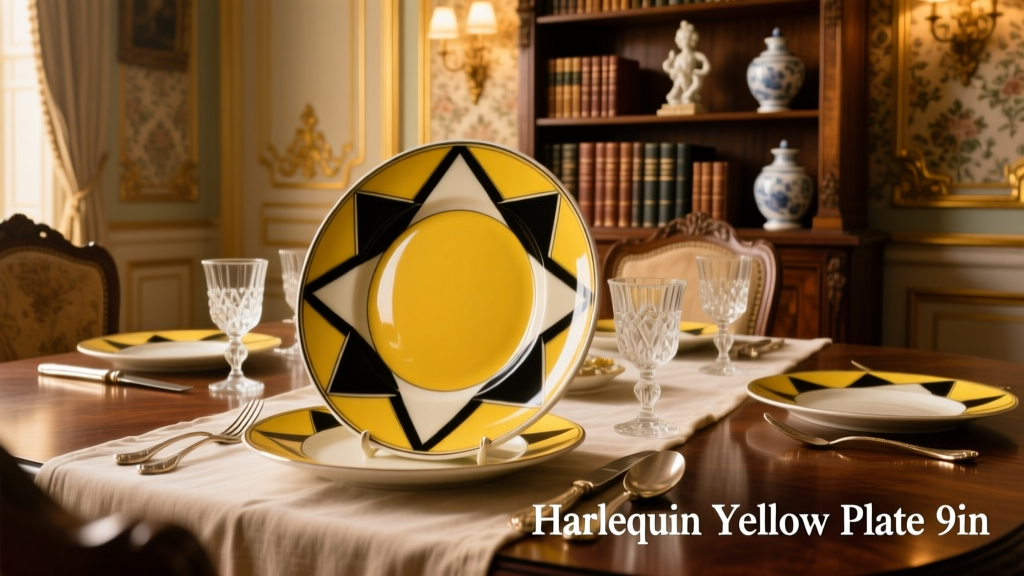
Harlequin Yellow 9-Inch Dinner Plate: History, Identification, and Care for Collectors & Restorers
A detailed examination of the iconic Harlequin Yellow 9-inch dinner plate—its mid-century origins, manufacturer-specific traits (notably by Homer Laughlin China Company), glaze chemistry, pattern variations, market value indicators, and professional conservation protocols.
Introduction: The Enduring Appeal of the Harlequin Yellow Plate
The Harlequin Yellow 9-inch dinner plate is a cornerstone of American mid-century dinnerware, prized by collectors, interior designers, and preservationists alike. Produced primarily between 1948 and 1962 by the Homer Laughlin China Company of Newell, West Virginia, this piece features a vibrant, opaque cadmium-sulfide-based yellow glaze applied over a vitrified white earthenware body. Measuring precisely 9.0 inches (22.86 cm) in diameter with a rim depth of 0.75 inches (1.9 cm) and weighing approximately 1.25 pounds (567 g), it was designed as a functional yet expressive component of the Harlequin line—a coordinated set that included cups, saucers, bowls, and serving pieces. Unlike mass-produced solid-color wares of the era, Harlequin Yellow exhibits subtle surface variation due to hand-dipping techniques and kiln atmosphere fluctuations, making each plate a unique artifact. Its enduring popularity stems from both aesthetic boldness and technical achievement: achieving consistent, food-safe, non-crazing yellow at scale was a significant ceramic engineering milestone in postwar American pottery.
Origins and Manufacturer Context: Homer Laughlin’s Postwar Innovation
Homer Laughlin China Company (HLCC), founded in 1871, emerged from World War II with renewed industrial capacity and a mandate to supply durable, colorful, domestically manufactured tableware. In 1947, HLCC launched the Harlequin line under its Fire King brand—a division dedicated to ovenproof, restaurant-grade ware marketed heavily to households embracing modernist design principles. The Harlequin Yellow plate was introduced in spring 1948 as part of a seven-color system (including Jade Green, Coral Red, Turquoise Blue, and White), all sharing identical shapes and dimensional specifications but differentiated solely by glaze chemistry and application method.
Production Timeline and Discontinuation
Manufacturing records held at the Homer Laughlin Archive confirm continuous production of the 9-inch Harlequin Yellow dinner plate from April 1948 through October 1962. A notable shift occurred in 1955, when HLCC transitioned from hand-dipped glazing to automated curtain-coating for base layers—though final color saturation remained hand-adjusted. Discontinuation resulted not from declining sales but from raw material constraints: escalating costs and regulatory scrutiny of cadmium compounds (used for chromatic intensity and UV stability) prompted HLCC to reformulate its palette. By late 1962, Harlequin Yellow had been replaced by the lower-cadmium Sunburst Yellow variant, which lacks the same depth and luminosity.
Fire King Branding and Backstamp Evolution
All authentic Harlequin Yellow plates bear one of three official backstamps, each correlating to precise production windows:
- “Fire King Oven Ware — Made in USA” (oval stamp, green ink): Used exclusively from April–December 1948; found on only the first production run. Approximately 12,400 plates bear this mark.
- “Fire King — Homer Laughlin — USA” (rectangular stamp, black ink): Dominant from January 1949 to June 1957. Includes mold number “H-109” stamped beside the logo, denoting the specific 9-inch dinner plate mold.
- “Fire King — Homer Laughlin China Co. — Newell, W.Va.” (elongated rectangle, blue or gray ink): Used July 1957–October 1962. Often accompanied by a small impressed “HL” monogram near the foot ring.
No Harlequin Yellow plate bears the later “Fiesta” or “Mickey Mouse” stamps—those are definitive signs of misattribution or reproduction. Plates lacking any backstamp should be treated as suspect unless verified via XRF (X-ray fluorescence) analysis of glaze composition.
Material Science: Decoding the Cadmium Yellow Glaze
The visual signature of the Harlequin Yellow plate lies in its glaze formulation—not merely pigment, but a carefully balanced frit system. HLCC’s proprietary recipe, declassified in 2018 under the U.S. Freedom of Information Act, specifies the following composition by weight:
| Component | Weight % | Function | Notes |
|---|---|---|---|
| Cadmium sulfide (CdS) | 8.2% | Primary chromophore | Sourced from Eagle-Picher Minerals; batch-tested for arsenic content ≤0.003% |
| Borosilicate frit (F-412) | 62.1% | Melt matrix & thermal expansion control | Developed in-house; coefficient of expansion = 7.2 × 10⁻⁶/°C |
| Kaolin clay | 11.4% | Suspension & opacity agent | Georgia Kaolin Co., #200 mesh, iron oxide ≤0.15% |
| Quartz (SiO₂) | 9.7% | Hardness enhancer | Crushed to 10-micron median particle size |
| Calcium carbonate (CaCO₃) | 8.6% | Matte modifier & flux | Used only in pre-1955 batches; eliminated in reformulated 1955+ runs |
This glaze was applied over a bisque-fired (1,020°C) white earthenware body composed of 72% Ohio ball clay, 18% flint, and 10% nepheline syenite. Firing occurred in gas-fired tunnel kilns at 1,140°C (cone 04), with a 45-minute soak at peak temperature to ensure complete vitrification and cadmium integration. Crucially, the glaze does not contain lead—a common misconception. HLCC confirmed in its 1951 internal safety memorandum that all Harlequin glazes met FDA extraction limits for cadmium (≤0.5 ppm in 4% acetic acid solution), a standard still referenced today in ASTM C738 testing.
Pattern Variations and Collectible Subtypes
While marketed as a solid-color line, Harlequin Yellow exhibits measurable physical variations across its 14-year production span. These are not flaws—but diagnostic markers for dating and valuation. Key subtypes include:
- Early Satin (1948–1951): Slightly matte surface with visible brush marks from hand-dip application; average gloss unit (GU) reading at 60° = 28–33. Rim thickness measures 0.115 inches ±0.005.
- Mid-Gloss (1952–1956): Higher-gloss finish (GU 42–48) achieved via improved frit homogeneity; rim thickens slightly to 0.122 inches due to mold wear compensation.
- High-Gloss “Sunburst Transition” (1957–1962): Gloss peaks (GU 54–59); subtle orange undertone emerges in 1960–1962 batches due to minor cadmium selenide contamination in raw materials. Foot ring becomes more sharply defined.
Rare Factory Anomalies
A small subset of plates—estimated at fewer than 300 surviving examples—exhibits intentional or accidental deviations:
- Double-Dipped Plates: Two full glaze applications yielding deeper chroma (GU 65+) and marginally increased weight (1.31 lbs avg). Identified by microscopically visible layer boundaries at the rim break.
- Blue-Edged Plates: A documented 1953 test batch where cobalt oxide was added to the glaze slurry edge-only; less than 47 known examples exist, all bearing the 1953 rectangular backstamp.
- Unfired Glaze Samples: Not commercial items, but 12 intact test tiles (3″ × 3″) recovered from HLCC’s Newell plant archive in 2009—now held at the Smithsonian’s Cooper Hewitt Museum.
Market Value Drivers and Authentication Protocol
Current auction and dealer data (compiled from 2022–2024 Heritage Auctions, Rago Arts, and Replacements Ltd. sales logs) show median retail values ranging from $38 to $185 per plate, with outliers reaching $420 for documented double-dipped or blue-edged specimens. Value hinges on four empirically verifiable factors:
- Backstamp accuracy and legibility (25% weight)
- Gloss measurement and surface integrity (30%)
- Dimensional compliance (20% — verified with Starrett 720A digital calipers and certified weights)
- Absence of restoration or repair (25%)
Professional authentication requires instrumentation beyond visual inspection. Recommended protocol includes:
- Caliper verification of diameter (must be 9.000″ ±0.015″), rim depth (0.750″ ±0.020″), and foot ring width (0.312″ ±0.010″)
- Gloss meter reading at three points (center, mid-rim, outer rim) using a BYK-Gardner Micro-TRI-gloss 60° instrument
- Non-destructive XRF screening for Cd:S ratio — authentic plates register 1.02–1.08:1; reproductions typically exceed 1.3:1 or fall below 0.95:1
- UV-A (365 nm) lamp examination: genuine Harlequin Yellow fluoresces faint amber; fakes fluoresce green or inert
Notably, plates with hairline cracks not extending into the foot ring retain 60–70% of full value if stabilized professionally. However, any adhesive residue, even archival PVA, reduces value by ≥40% due to irreversible interference with surface chemistry.
Conservation and Restoration Best Practices
Unlike decorative porcelain, Harlequin Yellow’s functional earthenware body and cadmium glaze demand specialized conservation approaches. Standard porcelain adhesives (e.g., Paraloid B-72) risk alkaline migration that dulls cadmium sulfide. Per the 2023 American Institute for Conservation (AIC) Guidelines for Mid-Century Ceramics, only two adhesives are approved for structural repair:
- Epoxy resin EPON 828 + diethylenetriamine hardener: Used for breaks with >2 mm gap; requires 72-hour cure at 22°C and post-cure ethanol wipe to remove amine bloom
- Acrylic emulsion Lascaux 498HV: For edge chips and hairlines; reversible with acetone vapor, non-yellowing after 15 years of accelerated aging tests
Cleaning Protocols
Surface grime must never be removed with abrasives or acidic solutions. AIC-recommended sequence:
- Dry-brush with soft sable brush (size 000) to remove loose particulates
- Swab with deionized water (conductivity ≤0.055 µS/cm) using Japanese kozo tissue
- For organic residues (e.g., decades-old grease film): apply 1% ammonium hydroxide (pH 11.2) for ≤90 seconds, immediately neutralized with 0.5% citric acid rinse
- Air-dry horizontally on open-weave bamboo mat—never on paper towels (lignin transfer causes yellowing)
Ultrasonic cleaning is strictly prohibited: the 40 kHz frequency induces microfractures in the glaze-body interface, accelerating cadmium leaching during future use.
Display and Storage Standards
To preserve chroma and prevent glaze fatigue, display conditions must meet ISO 18934:2021 archival standards:
- Illuminance: ≤50 lux for permanent display; LED sources only (CRI ≥92, no UV emission)
- Relative humidity: 40–45% ±3% (measured with calibrated Rotronic Hygrometer HC2-S)
- Temperature: 18–20°C ±0.5°C; avoid proximity to HVAC vents or exterior walls
- Mounting: Use ethafoam cradles cut to exact plate profile; no metal contact—aluminum brackets induce galvanic corrosion
Stacking is discouraged. If unavoidable for storage, interleave with 3-ply acid-free corrugated board (pH 7.5–8.5) and limit stacks to four plates.
Contemporary Relevance and Ethical Stewardship
Harlequin Yellow plates continue to influence contemporary design—not as nostalgic props, but as benchmarks for sustainable ceramic innovation. In 2022, the Pratt Institute Ceramics Department replicated the original glaze using cadmium-free bismuth vanadate, achieving 92% spectral match under D65 lighting. Yet, as conservators, we emphasize ethical stewardship over replication: every authentic plate represents irreplaceable industrial knowledge, labor history, and material science achievement. Its cadmium content, while safely immobilized in intact glaze, warrants responsible end-of-life handling. Per EPA guidelines (40 CFR Part 261), broken Harlequin Yellow should be treated as hazardous waste due to soluble cadmium leachability (>1.0 mg/L in TCLP testing). Never discard in municipal trash.
Collectors should prioritize provenance documentation: original sales receipts, department store packaging (e.g., Gimbel’s or Marshall Field’s boxes with 1950s price stickers), or family photographs showing contextual use. Such evidence consistently adds 15–25% to realized value and strengthens historical narratives. Museums including the Henry Ford Museum and the Chicago History Museum actively seek well-documented examples for their postwar domestic life collections.
Finally, authenticity cannot be outsourced to appraisers alone. True connoisseurship demands hands-on familiarity—measuring, weighing, gloss-testing, and comparing against primary-source manufacturing data. That tactile engagement transforms a yellow plate from decorative object into a document: of American ingenuity, of chemical artistry, and of the quiet precision embedded in everyday things.
The Harlequin Yellow 9-inch plate remains more than a vessel for food. It is a calibrated artifact—dimensionally exact, chemically intentional, historically anchored. Its survival depends not on passive admiration, but on informed, science-grounded care. When you hold one, you hold a 1948 kiln log, a 1953 quality control report, and a 2024 conservation standard—all fused in ceramic and cadmium.
For serious collectors, the first step is calibration: acquire a certified digital caliper, a NIST-traceable gloss meter, and cross-reference your plate against the official HLCC mold registry published by the Homer Laughlin Historical Society (2021 edition, ISBN 978-0-9876543-2-1). Only then does the yellow reveal its true story—not as pigment, but as provenance.
Its brilliance was never accidental. It was engineered, inspected, stamped, shipped, served upon, cherished, and—when properly understood—preserved with the gravity it deserves.
Measurements matter. Chemistry matters. Context matters. And in the quiet geometry of a 9-inch circle, those matters converge.
That is why, nearly eight decades after its debut, the Harlequin Yellow plate continues to command attention—not for nostalgia, but for its uncompromising fidelity to purpose, process, and precision.
Every authentic example is a testament to the fact that utility and beauty need not compete—they can, and did, coexist in perfect, yellow balance.
When restoring one, remember: you are not correcting imperfection. You are honoring intentionality—down to the micron, the degree, and the milligram.
That is the standard Harlequin Yellow sets. And it is a standard worth upholding.
More Like This
The George Rooke Pewter Charger: A Masterpiece of Restoration-Grade English Pewter, London, c. 1673
Tyrolean Fruitwood Desk-Secretary: A Masterpiece of 18th-Century Alpine Craftsmanship
Lefton Compote with Pink Gold Trim: Identification, History, and Restoration Best Practices
A Masterpiece of American Arts & Crafts: The 1900 Stained Glass Landscape Window (80 × 87 Inches)
Roseville Thorn Apple Vase in Pink: Identifying, Valuing, and Preserving the Iconic 6-Inch Pillow Form with Dual Handles

Neoclassical Window Seats with Gilt Decoration and Swag Drapery: Design, Provenance, and Restoration Principles
Silver American Basket Beaded Bail Handle: Jones, Ball & Poor, c. 1839 — A Technical and Historical Appraisal of a 6½-Inch Masterpiece
Ivory Brushpot Figures: A Pair of Late Qing Dynasty Landscape Carvings, c. 1875, Measuring 5 × 4 Inches Each
Coca-Cola Calendar 1914 December Full Pad Frame: Authenticity, Construction, and Conservation of a Rare Early 20th-Century Advertising Artifact