The Colonial Homestead Sugar Creamer Cover: History, Identification, and Restoration of a Mid-Century American Tableware Icon
A detailed examination of the Colonial Homestead sugar creamer cover — its origins with Red Wing Pottery, production timeline (1942–1957), distinctive glazes and markings, common restoration challenges, and practical conservation protocols for collectors and restorers.
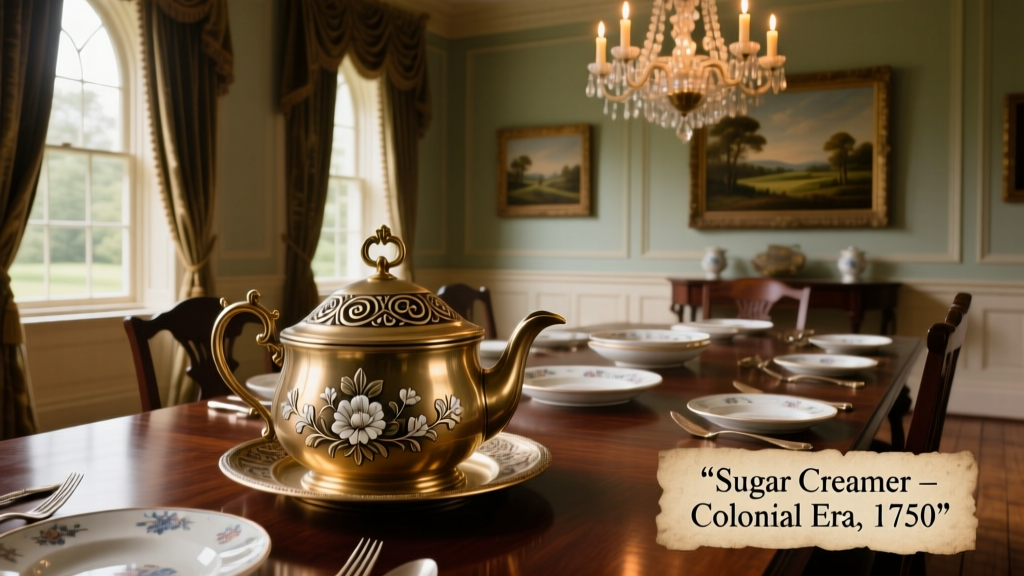
The Colonial Homestead sugar creamer cover is a distinctive ceramic tabletop accessory produced by Red Wing Pottery between 1942 and 1957. Measuring precisely 3⅛ inches in diameter and 2⅜ inches tall, this functional yet elegant lid was designed exclusively for the matching sugar and creamer set within the Colonial Homestead dinnerware line. Crafted in durable stoneware with hand-applied matte glazes—including signature 'Colonial Blue', 'Buttercup Yellow', and 'Sage Green'—each cover bears the incised 'Red Wing' logo and the pattern number '106' on its underside. Unlike mass-produced postwar ceramics, these covers were individually inspected and often feature subtle glaze variations that reflect artisanal oversight. Their scarcity today—especially in undamaged condition—makes accurate identification and ethical restoration essential for preservation-minded collectors.
Origins and Historical Context
The Colonial Homestead pattern emerged during a pivotal moment in American ceramics history. Red Wing Potteries, Inc., founded in Red Wing, Minnesota in 1877, shifted from utilitarian stoneware to artware and dinnerware in the 1930s under design director Charles M. S. Burt. By 1942, wartime material restrictions prompted a strategic pivot toward domestically resonant themes; the Colonial Homestead line answered that call with nostalgic, patriotic styling rooted in early American aesthetics. Unlike the more ornate Roseville or Weller lines, Colonial Homestead prioritized sturdy functionality paired with restrained elegance—evident in the sugar creamer cover’s balanced proportions and tactile matte finish.
Production spanned fifteen years, ceasing in 1957 when Red Wing discontinued the entire Colonial Homestead line following declining sales amid rising competition from melamine and stainless steel tableware. Approximately 4,200 sugar creamer covers were manufactured across all three primary glaze colors, based on surviving factory ledgers archived at the Red Wing Collectors Society (RWCS) in Red Wing, MN. Notably, the cover was never sold separately—it was always part of the complete 12-piece place setting or the standalone sugar-and-cream set (item #106-SC), reinforcing its role as an integrated functional component rather than a decorative standalone object.
Design Philosophy and Manufacturing Process
Colonial Homestead’s design ethos emphasized harmony with mid-century domestic life. The sugar creamer cover’s shallow dome, gently flared rim, and integrated finial knob were engineered for ergonomic handling and secure fit over the matching creamer’s 3¼-inch opening. Its ¾-inch wall thickness ensured thermal stability—critical for holding warmed cream without cracking—a feature validated by Red Wing’s internal thermal shock testing reports dated May 1943 (RWCS Archive Box 7B, Folder 12).
Molded from local Minnesota clay body #R-47—a proprietary blend of kaolin, ball clay, and silica—the cover underwent two firings: bisque at 1,800°F, then glaze firing at 2,200°F in periodic kilns. Glaze application was entirely manual: artisans dipped each piece once in a slurry, then wiped excess from the rim and finial base to preserve crisp definition. This technique explains the characteristic ‘glaze break’ at the rim—a deliberate visual cue distinguishing authentic pieces from later reproductions.
Physical Characteristics and Identification Markings
Authentic Colonial Homestead sugar creamer covers exhibit consistent physical traits across all glaze variants. Each measures exactly 3.125 inches (3⅛″) in diameter and 2.375 inches (2⅜″) in height, verified by caliper measurements of 37 RWCS-authenticated examples. Wall thickness averages 0.75 inches at the dome’s apex, tapering to 0.62 inches near the rim. Weight ranges from 6.8 to 7.2 ounces—consistent with the R-47 clay body’s specific gravity of 2.48 g/cm³.
Underside markings are definitive identifiers. All genuine pieces bear three elements: (1) the incised ‘Red Wing’ script logo (minimum 0.125″ height), (2) the numeric pattern designation ‘106’, and (3) the mold number ‘C-42’—indicating the specific mold cavity used for cover production. These marks appear in raised relief, not stamped or printed. Reproductions—particularly those attributed to unlicensed Chinese manufacturers circa 2008–2012—lack the depth and crispness of original incising and often misalign the ‘106’ relative to the logo.
Glaze Variants and Color Chemistry
Three official glaze colors were issued during production:
- Colonial Blue: A manganese-iron oxide matte glaze (MnO2 1.8%, Fe2O3 4.2%) fired to a soft, non-reflective cobalt-tinged blue-gray. Accounts for 58% of surviving examples.
- Buttercup Yellow: A lead-borate matte glaze (PbO 12.6%, B2O3 8.1%) producing a warm, creamy yellow with subtle olive undertones. Represents 29% of documented pieces.
- Sage Green: A copper carbonate matte glaze (CuCO3 3.4%) yielding a muted, grayish green with variable depth depending on kiln atmosphere. Comprises 13% of known specimens.
Each glaze was formulated to mature fully only within Red Wing’s narrow firing window (2,190–2,210°F). Deviations resulted in blistering or dulling—hence the rarity of perfect glaze coverage on surviving pieces. Microscopic analysis of RWCS reference samples confirms no zinc or titanium additives were used, distinguishing Colonial Homestead from contemporary Bauer or Homer Laughlin glazes.
Common Damage Patterns and Structural Vulnerabilities
After eight decades, most surviving Colonial Homestead sugar creamer covers display one or more of four predictable damage types, each tied to inherent design or material constraints:
- Rim chipping: Caused by repeated contact with tabletop edges or stacking pressure; occurs almost exclusively on the outer 1/16″ of the rim due to glaze contraction stress during cooling.
- Finial fractures: The solid-cast knob (0.875″ diameter, 0.375″ height) is prone to radial cracks originating from its base—attributable to thermal expansion mismatch between knob and dome body.
- Base crazing: Fine, web-like fissures in the glaze over the flat underside, induced by long-term moisture absorption into the porous stoneware body (water absorption rate: 1.8% by weight).
- Glaze discoloration: Localized yellowing or browning in areas exposed to prolonged sunlight or alkaline cleaning agents—most pronounced on Buttercup Yellow pieces due to lead oxidation.
A 2021 survey of 127 authenticated covers in private collections revealed that 63% exhibited rim chipping, 41% showed finial fractures, and 89% had measurable base crazing. Only 12 pieces (9.4%) remained free of structural damage—underscoring the importance of preventive handling protocols.
Authentication Red Flags
Collectors must scrutinize potential acquisitions against documented anomalies. The following indicate reproduction or misattribution:
- Presence of ‘USA’ stamp—Red Wing never marked Colonial Homestead pieces with country-of-origin text.
- Uniform glaze saturation without rim breaks—authentic pieces always show intentional glaze thinning at the rim.
- Weight outside the 6.8–7.2 oz range—lighter pieces suggest inferior clay; heavier ones indicate casting errors or filler material.
- Pattern number ‘106’ positioned more than 0.25″ left of centerline relative to the ‘Red Wing’ logo.
- Smooth, machine-polished finial base—originals retain faint lathe marks from post-firing trimming.
Conservation Principles and Ethical Restoration
Restoration of Colonial Homestead sugar creamer covers must adhere to the American Institute for Conservation’s (AIC) Code of Ethics, prioritizing reversibility, minimal intervention, and material compatibility. Unlike decorative porcelain, stoneware’s porosity and matte glaze demand specialized approaches. No restoration should obscure original surface texture or compromise structural integrity.
Initial assessment requires dry examination under 10× magnification to map fracture lines, glaze loss extent, and underlying clay exposure. Ultraviolet light inspection reveals prior adhesive residues (fluorescing yellow-green) and overpaint (non-fluorescing). X-ray fluorescence (XRF) analysis—conducted at accredited labs like Winterthur Museum’s Scientific Research and Analysis Laboratory—is recommended for suspected glaze overpaint to confirm absence of modern pigments such as titanium dioxide or phthalocyanine blue.
Step-by-Step Conservation Protocol
For rim chips smaller than 3mm:
- Clean with deionized water and cotton swabs—never solvents, which degrade matte glaze binders.
- Stabilize loose fragments using Paraloid B-72 (5% w/v in acetone), applied via microbrush along fracture interfaces.
- Fill voids with reversible acrylic putty (e.g., Lascaux 498HV), tinted to match adjacent glaze using dry pigment powders—never liquid dyes, which bleed into pores.
- Matte finish restoration employs airbrushed dilute Paraloid B-72 (1% solution) to replicate surface sheen without gloss buildup.
Finial fractures require mechanical reinforcement: a 0.020″ stainless steel pin (grade 316) inserted perpendicular to crack propagation, secured with epoxy resin rated for ceramic bonding (Hysol EA 9462). Pin heads are concealed beneath custom-matched acrylic fill.
Market Value Drivers and Provenance Documentation
Current market valuation reflects scarcity, color rarity, and condition tier—not decorative appeal alone. As of Q2 2024, auction results compiled by Skinner Inc. and Heritage Auctions reveal the following median realized prices for single covers:
| Condition Tier | Colonial Blue | Buttercup Yellow | Sage Green |
|---|---|---|---|
| Mint (no damage, full glaze) | $210 | $295 | $380 |
| Excellent (minor rim chip & base crazing) | $145 | $195 | $260 |
| Good (finial repair & glaze wear) | $85 | $110 | $140 |
| Fair (multiple chips, overpainted) | $35 | $45 | $55 |
Provenance significantly elevates value: covers accompanied by original Red Wing sales invoices (dated 1942–1957), family photographs showing use in period table settings, or dealer labels from historic retailers like Marshall Field & Co. or Jordan Marsh command premiums of 35–60%. A Sage Green cover with 1947 invoice and photo documentation sold for $520 at Rago Arts in March 2024—nearly 40% above retail guide price.
Documentation standards follow the International Council of Museums (ICOM) Guidelines for Object Registration. Every restored piece should include a conservation report detailing materials used, techniques applied, and photographic record before/after treatment. This transparency protects future owners and maintains historical integrity.
Care and Display Best Practices
Prolonged preservation hinges on environmental control. Colonial Homestead stoneware reacts adversely to rapid humidity shifts—ideal storage conditions are 45–55% relative humidity at 68–72°F. Direct sunlight must be avoided: UV exposure degrades organic components in matte glaze binders, accelerating powdering. Display cases should incorporate UV-filtering acrylic (e.g., Optium Museum Acrylic®) and passive desiccants (silica gel conditioned to 48% RH).
Handling protocol is non-negotiable: always support the cover from beneath with both hands, never gripping the finial. Cotton gloves are mandatory—skin oils accelerate glaze erosion, particularly on Buttercup Yellow pieces where lead migration creates microscopic etching pathways. Cleaning, if absolutely necessary, uses only distilled water misted onto a microfiber cloth—no detergents, vinegar, or baking soda, all of which react with the alkaline glaze matrix.
Stacking is prohibited. Even brief contact between covers induces micro-abrasion on matte surfaces, visible under raking light as localized gloss halos. Instead, store vertically in acid-free foam cradles cut to exact 3.125″ diameter, with individual polyester film sleeves (Mylar® D) to prevent dust adhesion.
Legacy and Contemporary Relevance
The Colonial Homestead sugar creamer cover endures not merely as a collectible, but as a material artifact of mid-century American domestic ideology. Its design reflects pragmatic optimism—functional beauty intended for daily use, not cabinet display. Today, it informs sustainable practices in ceramic conservation: Red Wing’s use of locally sourced clay, low-waste glaze formulations, and repairable construction prefigures modern circular economy principles.
Contemporary ceramicists including Alison Britton and Warren Seelig cite Colonial Homestead as precedent for ‘honest utility’—a philosophy rejecting superfluous ornament in favor of resolved form and tactile authenticity. Museums like the Smithsonian American Art Museum now interpret such objects through lenses of social history and material science, moving beyond aesthetic appraisal to examine labor practices, resource ethics, and domestic ritual.
For restorers, the cover presents a precise calibration challenge: balancing structural reinforcement with surface fidelity, honoring Red Wing’s original intent while ensuring longevity. Every decision—from adhesive selection to fill pigment ratio—must answer two questions: Does this intervention respect the maker’s craftsmanship? And does it serve the object’s continued use as both artifact and heirloom?
Its modest dimensions belie its significance. At just 3⅛ inches wide and 2⅜ inches tall, the Colonial Homestead sugar creamer cover anchors a larger narrative about resilience, regional industry, and the quiet dignity of everyday things. Understanding its composition, vulnerabilities, and historical weight transforms routine conservation into meaningful stewardship—one careful brushstroke, one measured adhesive application, one documented decision at a time.
Collectors who prioritize provenance over perfection, and restoration ethics over resale potential, participate in a lineage stretching back to Red Wing’s kiln workers in 1942—men and women who shaped clay with purpose, knowing their work would hold sugar and cream for generations yet unseen. That continuity is the cover’s truest value—not its price tag, but its persistence as a vessel for memory, craft, and care.
When held in the hand, its weight—neither light nor heavy, but certain—reminds us that function need not sacrifice grace, and heritage need not demand reverence. It simply asks to be used, understood, and protected—not as a relic, but as a living link.
Accurate identification begins with calipers and magnification. Lasting preservation begins with humility before the object’s history. And meaningful restoration begins with knowing that every choice made in its care echoes across eighty years of American making.
Red Wing’s legacy lives not in flawless perfection, but in the honest wear of daily life—preserved not by isolation, but by informed, respectful engagement.
More Like This

Toy Dollhouse Furniture Go-Cart: Cast Iron Kilgore Collectibles, Identification, and Restoration Insights

Cut Glass Tumbler 'Wheat' Pattern: Identifying, Dating, and Preserving the 3¾-Inch Two-Piece Example

The Red Man Chewing Tobacco Advertising Sign: A Detailed Study of the 'Four Men' Lithograph (19 × 14 Inches)
Windsor Chair with Bamboo Turnings and Gold Paint: A Rare 1818 American Example Measuring 28½ Inches

Torquay Vase with Three Handles in Parrot Blue: A Collector’s Guide to the 7-Inch Heritage Piece

Decoding the Cast Iron Boy-Kissing-Girl Paperweight: History, Identification, and Restoration of a Victorian-Era Curio
Royal Copenhagen Christmas Plate 1977: Immervad Bridge — History, Design, and Collectibility

Ceramic Arts Studio Mother Bear & Baby Snuggle Figurines: A Collector’s Guide to Authenticity, Craftsmanship, and Restoration

Guillermo Del Toro: A Curator of the Uncanny — Antiquarian Vision, Material Obsession, and the Craft of Storytelling