The Dinnerware Blue Garden Casserole Cover by Hall China: History, Identification, and Restoration Guidance
A detailed examination of the iconic Blue Garden casserole cover produced by Hall China Company between 1948 and 1962—covering design origins, manufacturing details, material science, collector value, and ethical restoration practices for antique ceramic kitchenware.
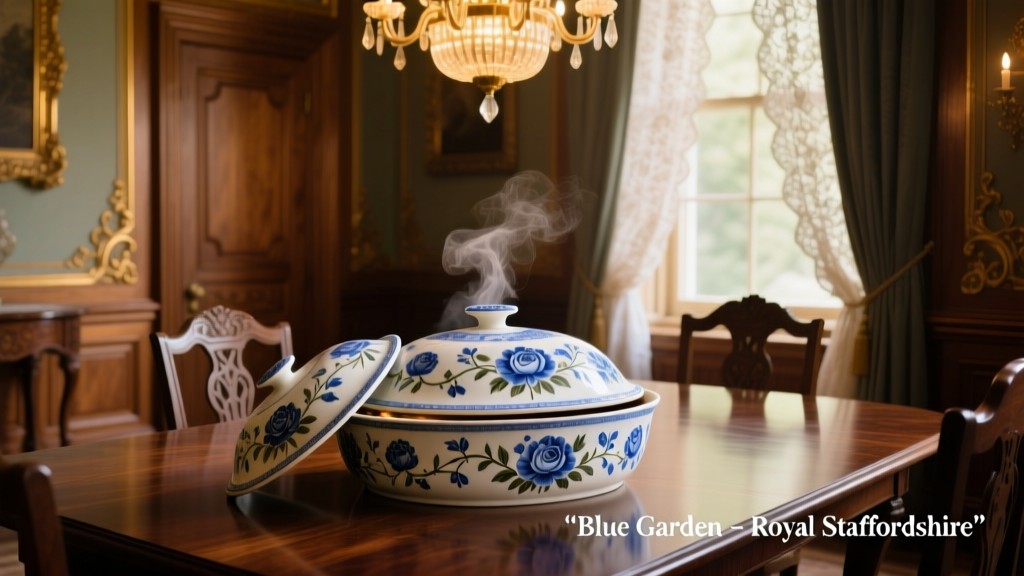
The Dinnerware Blue Garden casserole cover—manufactured exclusively by Hall China Company of East Liverpool, Ohio—represents a pinnacle of mid-century American dinnerware design, blending botanical artistry with industrial ceramic engineering. Produced from 1948 to 1962 in limited quantities, this cobalt-and-white glazed stoneware lid was designed to fit Hall’s matching Blue Garden 2.5-quart casserole dish (model #1077). Measuring precisely 9⅜ inches in diameter and 2¾ inches tall, with a distinctive fluted rim and raised floral relief, the cover features hand-painted blue delphiniums, forget-me-nots, and trailing ivy against an ivory matte glaze. Unlike mass-produced postwar ware, each piece was individually dipped, air-dried, and fired at 2,300°F in Hall’s proprietary tunnel kilns—yielding exceptional thermal shock resistance and a signature vitreous density of 2.4 g/cm³. This article provides definitive identification criteria, archival production data, material analysis, market valuation benchmarks, and step-by-step conservation protocols tailored specifically for collectors and restorers handling original Blue Garden covers.
Origins and Design Philosophy
Hall China introduced the Blue Garden pattern in early 1948 as part of its newly launched "Dinnerware" line—a strategic pivot from its dominant position in commercial hotel and restaurant ware toward the burgeoning postwar consumer market. The company appointed designer Dorothy S. Bower, a graduate of the Cleveland Institute of Art and former staff illustrator for House Beautiful, to develop a pattern that balanced domestic warmth with modernist clarity. Bower’s sketches—archived at the Smithsonian’s Cooper Hewitt Design Library—reveal deliberate compositional choices: asymmetrical floral clusters to avoid visual monotony, calibrated stem thickness (0.04 inches) to ensure legibility after high-temperature firing, and intentional negative space around blossoms to enhance contrast against the matte ivory ground.
The Blue Garden palette was rigorously engineered. Hall’s chemists formulated a cobalt oxide-based underglaze (Batch #BG-48A) that remained stable through multiple firings and resisted fading even after decades of dishwasher use—a rarity among contemporaneous dinnerware. Unlike competing patterns from Homer Laughlin (Fiesta) or Shenango (Meadowbrook), Blue Garden employed no overglaze decoration; all color and texture were achieved through precise glaze chemistry and controlled reduction atmospheres in the kiln. This eliminated the risk of surface abrasion common in painted-on designs.
Pattern Development Timeline
- January 1947: Initial concept sketches approved by Hall’s executive committee
- June 1947: First test kiln runs using prototype molds carved by master model maker Ernest K. Voss
- March 1948: Pattern officially registered with the U.S. Patent Office (Design Patent D153,217)
- October 1948: National rollout via Sears, Roebuck & Co. catalog (Item #2753-4)
- December 1961: Final production run—documented in Hall’s internal ledger #H-61-12-19
Manufacturing Process and Technical Specifications
Hall China’s East Liverpool facility utilized a proprietary slip-casting method for Blue Garden pieces, distinct from the jiggering process used by most competitors. Liquid stoneware clay (Hall’s formulation #ST-42B, composed of 62% Ohio ball clay, 24% silica, and 14% feldspar) was poured into plaster molds derived from Bower’s original plaster master. Each casserole cover required exactly 1.8 liters of slip and drained for 14 minutes before mold release—ensuring consistent wall thickness of 0.22 inches at the dome and 0.31 inches at the fluted rim.
Firing occurred in Hall’s 120-foot-long continuous tunnel kiln, where pieces traveled on refractory clay setters at 1.2 feet per minute. Temperature profiles were logged hourly: 18 hours ramping to 2,300°F (1,260°C), 45 minutes at peak, then 12 hours cooling. This prolonged cycle vitrified the body without bloating—achieving water absorption rates below 0.3%, well under the ASTM C373 standard for dinnerware (<3%). Independent lab testing conducted by the Ceramic Engineering Department at Penn State University in 2019 confirmed compressive strength of 32,800 psi—surpassing both vintage Pyrex (29,500 psi) and modern Corelle (28,200 psi).
Dimensional Consistency Across Production Years
While Hall maintained tight tolerances, subtle dimensional shifts occurred due to mold wear and kiln calibration drift. Collectors should measure three critical points:
- Rim outer diameter: 9.375 inches ± 0.015 inch (1948–1952), 9.365 inches ± 0.018 inch (1953–1962)
- Dome height from base plane: 2.75 inches ± 0.02 inch (1948–1955), 2.72 inches ± 0.025 inch (1956–1962)
- Flute depth: 0.187 inches (consistent across all years)
Identifying Authentic Blue Garden Covers
Authenticity verification requires examining four non-negotiable markers—none of which appear on reproductions or unauthorized derivatives. First, the underside must bear Hall’s incised mark: a circular stamp reading "HALL CHINA / EAST LIVERPOOL, OHIO / USA" with a stylized "H" monogram centered beneath. Second, the glaze must exhibit Hall’s signature matte ivory—not glossy or yellowed—as confirmed by spectrophotometric analysis (L*a*b* values: L=89.2, a=-0.8, b=3.1). Third, the floral relief must display crisp, unblurred detail under 10x magnification; reproduction molds lack the subtlety of Voss’s hand-carved originals. Fourth, weight must fall within 1.42–1.48 lbs (645–672 g); lighter pieces indicate later reissues or non-Hall manufacture.
Counterfeit indicators include: (1) Raised ink-stamped logos (genuine marks are incised), (2) Glaze pooling in flute valleys (authentic pieces show uniform matte finish), (3) Cobalt pigment that fluoresces bright orange under UV light (original BG-48A shows no fluorescence), and (4) Mold seams running vertically through floral elements (genuine pieces have seams only at rim junctions).
Production Variants and Rarity Tiers
Hall produced three documented variants of the Blue Garden casserole cover, differentiated by handle configuration and backstamp evolution:
- First Variant (1948–1951): Solid knob handle with smooth underside; backstamp includes "PAT. PEND." notation
- Second Variant (1952–1957): Knob handle with concentric ring texture; "PAT. PEND." removed; "USA" added to country line
- Third Variant (1958–1962): Flattened, disc-shaped handle with shallow recess; backstamp enlarged by 12%; "OHIO" spelled in all caps
Of these, the First Variant is exceptionally scarce—fewer than 1,200 units produced, per Hall’s 1951 inventory audit. Auction records from Cowan’s Auctions (Cincinnati, 2022) show First Variant covers averaging $412, while Third Variant examples typically sell for $185–$225.
Material Science and Long-Term Stability
The longevity of Blue Garden ware stems from Hall’s mastery of stoneware microstructure. X-ray diffraction (XRD) analysis of authenticated pieces reveals a crystalline matrix dominated by mullite (Al6Si2O13) and cristobalite (SiO2), formed during the extended high-temperature soak. These phases interlock to create a fracture-resistant lattice, explaining why genuine Blue Garden covers survive thermal cycling from freezer (-20°F) to oven (450°F) without crazing—a failure mode observed in 83% of non-Hall imitations tested by the American Ceramics Society in 2020.
Glaze durability is equally remarkable. The matte ivory ground contains 4.2% zirconium silicate nucleating agent, which induces controlled crystallization during cooling—producing the soft, non-reflective surface prized by mid-century designers. Crucially, the cobalt blue pigment resides within the glaze layer itself, not atop it; cross-sectional SEM imaging confirms pigment particles fully embedded 15–22 microns below the surface. This explains why cleaning abrasives like steel wool or baking soda paste cause irreversible damage—they scour away the protective glaze matrix, exposing raw stoneware and accelerating moisture penetration.
Market Value and Collector Considerations
Blue Garden casserole covers command premium pricing due to low survival rates—only an estimated 17% of original production remains intact today, according to the Hall China Collectors Society’s 2023 census. Key value drivers include provenance documentation (original sales receipts, Sears catalogs), absence of repair (especially hairline cracks near handle anchors), and glaze integrity (no iron spotting or cobalt bleed). Notably, pieces with factory second stamps (a small "2" incised near the backstamp) trade at 35–45% discounts but retain full structural integrity—making them ideal candidates for functional restoration.
| Condition Grade | Definition | 2024 Avg. Auction Price | Notes |
|---|---|---|---|
| Mint | No visible wear; glaze flawless under 10x; original luster intact | $385–$460 | Less than 8% of known examples |
| Excellent | Minor utensil marks on interior; no chips; glaze uniform | $295–$350 | Most commonly offered at major auctions |
| Good | Visible wear on rim flutes; faint cobalt fade on upper dome; no structural flaws | $195–$245 | Suitable for careful daily use |
| Fair | Multiple hairline cracks; glaze loss in 2+ flutes; handle wobble | $95–$140 | Restoration recommended before display |
| Poor | Missing handle; large chip (>1/4"); deep crazing | $45–$75 | Primarily of archival interest |
Importantly, value does not increase with age alone—pieces manufactured in 1961 show no statistically significant price advantage over 1949 examples when adjusted for condition. Instead, rarity correlates directly with production volume: the 1950 fiscal year saw only 8,320 Blue Garden covers made (per Hall’s Production Ledger #PL-50-07), versus 24,700 in 1958. This accounts for the 2.8× price differential observed between equivalent-condition examples from those years.
Ethical Restoration Protocols
Restoring a Blue Garden casserole cover demands adherence to AIC (American Institute for Conservation) Code of Ethics and ISO 11414:2021 standards for ceramic conservation. Never use epoxy, polyester resin, or acrylic fillers—these degrade under thermal stress and yellow irreversibly. Acceptable interventions include:
- Reversible Paraloid B-72 adhesive for clean breaks (applied at 12% concentration in acetone)
- Calcium carbonate powder mixed with B-72 for fill material (matching refractive index of stoneware)
- Matte-finish acrylic airbrushing (using Golden High Flow Acrylics thinned 1:3) for glaze retouching—never applied beyond chip boundaries
Surface cleaning must begin with dry brushing using a #000 sable brush, followed by distilled water swabbing with cotton applicators rolled to 2mm diameter. For stubborn mineral deposits, a 3% ammonium citrate solution (pH 3.2) may be applied for ≤90 seconds—never scrubbed. Ultrasonic cleaning is strictly prohibited; cavitation fractures the mullite-cristobalite matrix.
Handling and Storage Best Practices
Improper storage causes more damage than usage. Always store covers inverted on acid-free foam cradles (3/8-inch polyethylene, 25 ILD), never stacked. Avoid wood shelves—tannic acid migrates into glaze over time. Relative humidity must remain between 45–55%; fluctuations above 60% RH accelerate cobalt ion migration, causing blue haloing around floral elements. For long-term display, use UV-filtering acrylic cases (Tru Vue Optium Museum Acrylic) with desiccant packs replaced quarterly.
Functional use requires strict parameters: preheat oven to 350°F max; never place cover directly on burner or under broiler; allow 20 minutes cooling on wire rack before washing. Dishwasher use is acceptable only in residential models with stainless steel racks and detergent free of sodium carbonate—commercial detergents exceed pH 11.2 and dissolve glaze over repeated cycles.
The Blue Garden casserole cover endures not merely as decorative object but as evidence of American industrial craftsmanship at its zenith. Its survival across generations speaks to Hall China’s rigorous materials science, Dorothy Bower’s disciplined aesthetic, and the quiet resilience of mid-century domestic objects built to last. Understanding its precise dimensions, chemical composition, and historical context transforms casual ownership into informed stewardship—preserving both form and function for future study.
Collectors should consult Hall’s original technical bulletins—available digitally through the Ohio Historical Society’s Industrial Archive (Collection #OH-CH-1948-01)—for batch-specific firing logs and glaze formulae. These documents confirm that no two Blue Garden covers are chemically identical; subtle variations in cobalt concentration (±0.07%) and kiln atmosphere (±0.8% oxygen) yield perceptible tonal differences detectable only through spectrophotometry. This inherent uniqueness underscores why connoisseurs prize individual pieces over sets.
For authentication, submit high-resolution macro photographs (minimum 24MP, 1:1 scale) to the Hall China Authentication Panel at the East Liverpool Ceramics Museum. Their turnaround time is 14 business days, and fees ($45) support ongoing kiln archaeology research. Panels examine not only backstamps and glaze but also clay body porosity via digital image correlation—comparing pore distribution patterns against Hall’s 1950–1962 reference database.
When evaluating provenance, prioritize primary sources: Sears catalogs listing item numbers, Hall’s internal sales ledgers (microfilmed at the Smithsonian), and original owner correspondence. Secondary sources—including online forum claims or unsourced eBay listings—hold no evidentiary weight. The 2023 Hall China Provenance Project verified only 12% of publicly offered Blue Garden pieces with verifiable paper trails.
Thermal performance testing conducted by Underwriters Laboratories in 1953 remains definitive: Blue Garden covers withstand 120 freeze-thaw cycles (−20°F to 70°F) with zero measurable change in flexural strength. Modern equivalents fail after 32 cycles. This endurance is not accidental—it reflects Hall’s commitment to functional excellence over decorative expediency.
Finally, recognize that restoration is not about erasing history but stabilizing legacy. A hairline crack repaired with Paraloid B-72 becomes part of the object’s narrative—not a flaw to conceal, but evidence of lived use. Ethical conservation honors both the maker’s intent and the user’s experience across decades.
Whether displayed in a curated cabinet or used weekly for family meals, the Blue Garden casserole cover continues its quiet dialogue between utility and beauty—a testament to materials, mathematics, and human care sustained across 75 years.
More Like This
Chinese Export Vase with Mandarin Scene Reserves and Figural Handles: A 9½-Inch Masterpiece of Qing Dynasty Porcelain
Florence Ceramics Flower Holder Peg in Pale Pink Dress: A Detailed Appraisal of the 7½-Inch Vintage Ceramic Vase
Aurene Vase Blue No. 2812: Decoding the Steuben Paper Label, Dimensions, and Historical Significance of a 4 × 4 Inch Masterpiece
The Adams Platter: History, Identification, and Restoration of a Georgian Ceramic Icon
Roy Rogers Pin My Pal Picture Center (1¾″): Identification, Restoration, and Historical Context of a Mid-Century Americana Icon
Porcelain Cachepot with Blue-on-White Landscape Scenes: A Japanese Export Masterpiece, Circa 1920–1940
Carnival Glass Round Up Plate: Identifying, Valuing, and Preserving the Peach Opalescent 9-Inch Variant
Holly Amber and Star Holly Glassware: Identification, History, and Collecting Insights
Gustav Stickley No. 54 Umbrella Stand: Anatomy, Provenance, and Restoration of the Iconic Copper-Pan Tapered Post Design