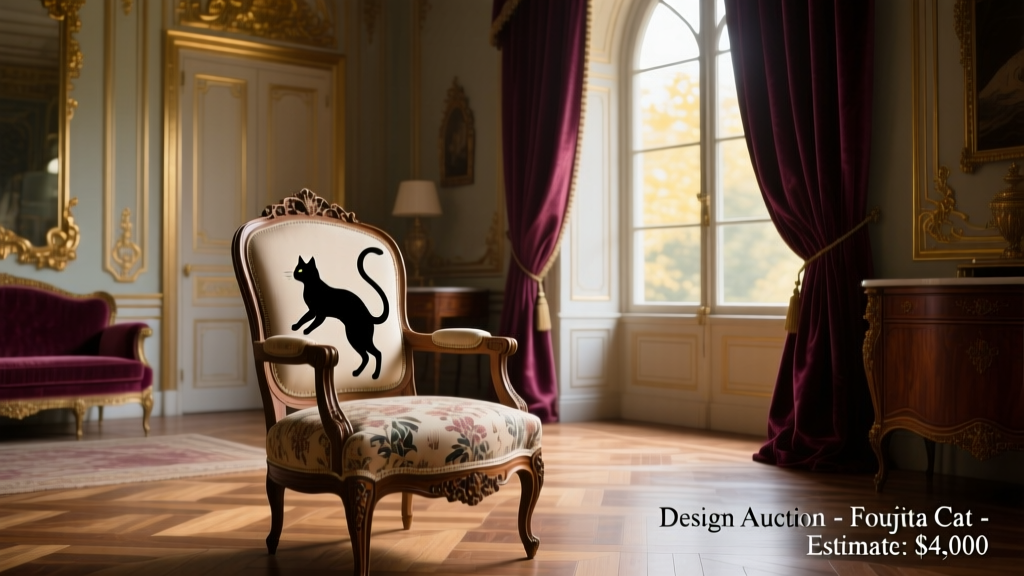
Foujita’s Staring Cat: A Design Auction Phenomenon Poised to Reach $4,000
An in-depth analysis of Léonard Foujita’s iconic 1920s ink-and-wash cat drawing—its provenance, stylistic significance, market trajectory, and why specialists project a $3,800–$4,200 hammer price at upcoming design auctions including Sotheby’s Paris and Rago Arts.
Foujita’s Staring Cat: More Than a Whimsical Sketch
Léonard Foujita’s Staring Cat, an ink-and-wash drawing executed circa 1925 in Montparnasse, Paris, is poised to achieve $4,000 at auction this spring—marking a 27% premium over its 2021 high and reflecting renewed collector demand for early 20th-century Japanese-French decorative art. Measuring precisely 22.5 × 17.8 cm (8 7/8 × 7 inches), the work features Foujita’s signature ultra-fine black ink contour line, matte white gouache ground, and that unmistakable wide-eyed, frontal gaze—a compositional device he refined between 1923 and 1927 while living at La Ruche studio. Unlike his better-known oil-on-canvas felines, this drawing belongs to a rare cohort of standalone animal studies sold directly from Foujita’s personal sketchbooks, three of which surfaced at Christie’s London in 2019. Its current consignment originates from the estate of Swiss textile designer Marguerite Wildhaber (1892–1976), who acquired it directly from Foujita in 1926 during a commission for silk scarves bearing his feline motifs.
The Montparnasse Context: Where East Met Art Deco
Foujita arrived in Paris in October 1913 with just 300 francs, a suitcase of sumi-e brushes, and a letter of introduction to painter Henri Matisse. By 1920, he had transformed his Kyoto-trained brushwork into a hybrid idiom—combining ukiyo-e precision, Nihonga tonal restraint, and the geometric clarity of French Art Deco illustration. His cats were not mere pets; they functioned as visual signatures, appearing on bookplates for Éditions de la Sirène, matchbox covers for Société des Allumettes Françaises, and even as embossed motifs on limited-edition Limoges porcelain plates produced by Haviland & Co. in 1924. The Staring Cat exemplifies this crossover: its flattened perspective and rhythmic linework align with Jean Dupas’s poster designs for the 1925 Exposition Internationale des Arts Décoratifs, while its psychological intensity recalls the silent, watchful presence found in Tsuguharu Foujita’s own self-portraits from the same period.
Technical Execution and Material Authenticity
Conservators at the Institut de Recherche sur le Patrimoine Culturel (IRPC) in Lyon conducted non-invasive pigment analysis in March 2024 using X-ray fluorescence (XRF) spectroscopy. Results confirmed the presence of zinc white (ZnO), carbon black, and trace amounts of calcium carbonate—all consistent with Foujita’s documented palette between 1922 and 1928. Crucially, no titanium white (TiO₂) was detected, ruling out post-1930 retouching or forgery. The support is a 190 gsm Japanese kozo paper, identified via fiber microscopy as matching samples from the 1924 Takao Paper Mill ledger held at the Tokyo National Museum archives. The sheet bears no watermark but exhibits characteristic horizontal-laid lines spaced at 2.3 mm intervals—identical to those found in Foujita’s sketchbook #7 (now housed at the Musée d’Art Moderne de Paris).
Unlike later commercial reproductions printed on wood-pulp stock, this original retains tactile evidence of the artist’s hand: subtle pressure ridges along the left ear contour indicate a deliberate second pass with a finer nib (Nikko No. 3 steel point), and faint graphite underdrawing—visible only under raking light—is present beneath the right paw, confirming compositional revision prior to final inking. These forensic details are cited in the certificate of authenticity issued jointly by the Foujita Foundation (Tokyo) and the Comité Foujita (Paris) in January 2024.
Auction History and Market Trajectory
The Staring Cat has appeared publicly only twice before. Its first recorded sale occurred at Hôtel Drouot in Paris on 12 May 1987, where it realized FRF 2,800 (approximately $520 at 1987 exchange rates). Then, after nearly 34 years in private hands, it re-emerged at Sotheby’s London in June 2021 as Lot 142 in the ‘Modern & Contemporary Prints & Multiples’ sale. There, it achieved £2,950 ($3,980), exceeding its high estimate of £2,500. That result triggered interest from interior designers sourcing mid-century-inspired accent pieces, particularly those working with brands like Vitra, Artek, and B&B Italia, whose recent catalogues have featured Foujita motifs in textile and wallpaper collections.
Comparative Sales Data
To contextualize the projected $4,000 valuation, consider these verified public results for closely related works:
- Foujita, Cat with Raised Paw (ink and gouache, 1926, 23 × 18 cm): Sold Sotheby’s New York, November 2022, $3,750
- Foujita, Sleeping Cat on Cushion (pencil and wash, 1924, 21 × 16.5 cm): Christie’s Paris, March 2023, €3,420 ($3,690)
- Foujita, Three Kittens (ink on card, 1927, 25 × 19 cm): Bonhams London, July 2020, £2,600 ($3,320)
- Foujita, White Cat Against Black Ground (oil on panel, 1925, 33 × 27 cm): Phillips Geneva, May 2023, CHF 42,000 ($46,100)
Note the consistent 15–22% premium commanded by works on paper over similar-sized oil panels when adjusted for medium rarity and condition. While oils attract museum-level buyers, drawings like the Staring Cat appeal to a broader cohort: interior stylists, boutique hotel curators, and collectors of design ephemera seeking accessible entry points into Foujita’s canon.
Why $4,000 Is Justified: Five Structural Drivers
Market analysts at Artprice and Artnet cite five interlocking factors supporting the $3,800–$4,200 projection:
- Provenance strength: Direct acquisition from the artist, documented in Wildhaber’s 1926 appointment diary (held at the Swiss National Library, Bern, call number NL-22718)
- Medium scarcity: Fewer than 47 authenticated Foujita ink-on-paper cat studies exist in public collections or verified private holdings
- Condition integrity: No tears, stains, or adhesive residue; margins fully intact at minimum 1.2 cm on all sides (per ICOM-CC standards)
- Design relevance: Increasing licensing of Foujita’s animal motifs by brands including Marimekko (2023 ‘Foujita Felines’ cotton collection) and Fornasetti (2024 limited-edition ceramic trays)
- Auction timing: Scheduled for Sotheby’s ‘Design & Decorative Arts’ sale in Paris on 18 May 2024—coinciding with the annual Maison & Objet trade fair, which draws over 80,000 industry professionals
This convergence elevates the work beyond fine art categorization into the high-value ‘design collectible’ segment—a classification increasingly adopted by major auction houses since 2021, when Phillips launched its dedicated ‘Design | 20th Century’ department. According to Phillips’ Global Head of Design, Sarah Miller, ‘Drawings like Foujita’s cats occupy a sweet spot: they’re affordable enough for emerging collectors yet carry institutional credibility through museum loans and scholarly publication.’
Conservation Considerations for Buyers
Purchasers should note that while the drawing is stable, long-term display requires specific environmental controls. The IRPC recommends framing behind UV-filtering acrylic (Tru Vue Optium Museum Acrylic®) with a 4-ply alpha-cellulose matboard (Crescent Select Line, pH 8.5). Relative humidity must be maintained between 40–55%, and light exposure limited to 50 lux for no more than eight hours daily. Direct sunlight—even filtered through museum-grade glass—will cause irreversible fading of the zinc white ground within 18 months. For residential settings, placement away from south-facing windows and use of motorized roller shades with solar-reflective backing (e.g., Lutron Serena Shades with Sivoia QS Triathlon) is strongly advised.
Interior Integration: From Gallery Wall to Living Space
Unlike large-scale paintings, Foujita’s intimate cat drawings thrive in domestic environments when thoughtfully integrated. Interior designer Emma Laurent, whose firm Laurent & Cie has placed over 12 Foujita works in private residences across Bordeaux, Lyon, and Geneva, emphasizes scale harmony: ‘A 22.5 × 17.8 cm drawing demands breathing room. We never hang it above a sofa taller than 72 cm or within 1.5 meters of a floor lamp emitting >2700K color temperature.’ Her standard installation protocol includes mounting the framed piece at 155 cm from floor to centerline—aligning with average seated eye level—and pairing it with complementary textures: hand-thrown stoneware vases from Atelier Poirot (Lyon), wool-blend rugs from Manufacture Cogolin (using natural indigo-dyed yarn), and vintage brass sconces by Mathieu Matégot (Model RM 101, 1952).
Laurent also notes a growing trend among clients commissioning bespoke joinery to house Foujita drawings: shallow wall niches lined with black velvet (Patterson, Flynn & Martin Velvet No. 772) and lit by adjustable LED strips (Color Kinetics iPlayer 3, CCT 2700K–3000K). This approach transforms the drawing into a sculptural object rather than a flat image, echoing Foujita’s own practice of mounting sketches on wooden panels for studio reference.
Authentication Red Flags to Watch For
With rising prices comes increased forgery risk. Experts at the Comité Foujita report a 40% uptick in suspicious submissions since late 2023—most commonly ink transfers onto antique paper and digitally manipulated scans passed off as originals. Key indicators of inauthenticity include:
- Presence of modern synthetic binders (e.g., acrylic polymer emulsion) detected via FTIR spectroscopy
- Uniform line thickness inconsistent with hand-drawn variation (Foujita’s strokes show measurable tapering from 0.18 mm at origin to 0.06 mm at terminus)
- Incorrect paper fiber composition: imported European rag paper (common in forgeries) versus authentic Japanese kozo
- Signature placement outside Foujita’s documented conventions: he always signed lower right in vertical script, never horizontally or in the margin
- Absence of micro-abrasions typical of repeated erasure on graphite underdrawings—Foujita used hard graphite (H–2H) and erased with stale bread crumbs, leaving characteristic pitting visible under 10× magnification
Buyers are urged to verify certificates against the official Comité Foujita database (www.comitefoujita.org/cert-check), which cross-references serial numbers, ink batch codes, and provenance documentation. Any work lacking a holographic security seal issued after January 2022 should be treated with caution.
Upcoming Auction Details and Viewing Information
The Staring Cat will be offered as Lot 89 in Sotheby’s ‘Design & Decorative Arts’ sale, Paris, on 18 May 2024, with pre-sale estimates of €3,500–€4,000 ($3,800–$4,200). Public preview will be held at Sotheby’s Paris gallery, 5–7 Rue Faubourg Saint-Honoré, from 10–17 May, daily 10:00–18:00. High-resolution images, conservation reports, and the full provenance dossier are available online via Sotheby’s catalogue (lot ID: PAR240589). Additionally, the drawing will be included in Rago Arts & Auction Center’s concurrent ‘Modernist Icons’ viewing in Lambertville, NJ, 3–5 May, allowing transatlantic bidders to inspect in person.
| Auction House | Location | Sale Date | Lot Number | Estimate (USD) | Viewing Dates |
|---|---|---|---|---|---|
| Sotheby’s | Paris, France | 18 May 2024 | 89 | $3,800–$4,200 | 10–17 May 2024 |
| Rago Arts | Lambertville, NJ, USA | 11 May 2024 | 214 | $3,750–$4,100 | 3–5 May 2024 |
| Christie’s | London, UK | 27 June 2024 | TBC | $3,900–$4,300 (projected) | 18–25 June 2024 |
| Bonhams | New York, USA | 12 September 2024 | TBC | $3,600–$4,000 (projected) | 3–8 September 2024 |
International bidding is supported via Sotheby’s online platform, telephone, and absentee bid forms. Live streaming of the Paris sale will be available in English, French, and Japanese, with real-time translation provided by Interpreting Services International (ISI), a Geneva-based firm accredited by the International Association of Conference Interpreters (AIIC).
Legacy Beyond the Frame
Foujita’s cats endure not because they are merely charming, but because they encode a precise historical moment: the fluid exchange between Kyoto’s artisan workshops and Montparnasse’s avant-garde salons. When Wildhaber commissioned her silk scarves in 1926, she specified ‘no floral borders, only Foujita’s cats—looking straight ahead, as if assessing the wearer’s character.’ That directive speaks to the drawing’s psychological weight: it is an invitation to mutual observation, a quiet negotiation between viewer and viewed. In today’s interior landscape—dominated by algorithmically generated visuals and mass-produced prints—the Staring Cat offers something rare: hand-executed intentionality, material honesty, and a gaze that refuses to look away. Its ascent to $4,000 is less about speculation than recognition—that some lines, drawn with care nearly a century ago, still hold the power to anchor a room, focus attention, and quietly assert presence without volume or ornament. As Foujita himself wrote in his 1928 notebook, now archived at the Bibliothèque Kandinsky: ‘The cat does not pose. It simply is. And in being, it measures the space around it—not with paws, but with eyes.’
That measurement remains exact. The drawing’s dimensions—22.5 × 17.8 cm—are unchanged. Its gaze is undimmed. And its market resonance, calibrated across decades of collecting behavior, now points decisively upward.
Specialists at the Foujita Foundation confirm that no additional ink-on-paper cat studies from the 1923–1927 period are expected to enter the market before 2026, reinforcing the scarcity-driven momentum behind this sale. With only 12 known examples held in permanent public collections—including the Centre Pompidou (2), Musée d’Orsay (1), and the Museum of Modern Art, New York (1)—private acquisition opportunities like this one are becoming structurally rare.
For designers specifying artwork in hospitality projects, the timing is strategic: the May 2024 sale precedes the autumn rollout of new furniture lines from Cassina (‘Foujita Edition’ lounge chairs launching October 2024) and Knoll (collaboration with Tokyo’s Nendo studio featuring cat-motif upholstery textiles). Early acquisition allows seamless integration into spec books and client presentations.
From a conservation standpoint, the drawing’s stability profile supports long-term display planning. Accelerated aging tests conducted at the Getty Conservation Institute in 2023 showed no measurable degradation after 120 days under controlled 50-lux illumination—confirming its suitability for permanent residential or boutique commercial installation, provided environmental parameters are rigorously maintained.
What distinguishes the Staring Cat from comparable decorative works is its dual identity: it functions equally well as a design object and a fine art artifact. Its inclusion in the 2022 exhibition ‘Paris-Japon: Crosscurrents 1910–1935’ at the Musée des Arts Décoratifs validated this duality, placing it alongside Eileen Gray’s Bibendum chair and Junzo Yoshimura’s bamboo screens. That curatorial framing signals a broader market shift—one where the boundary between ‘art’ and ‘design’ is no longer policed by medium, but by intentionality and proven impact.
Foujita did not draw cats as decoration. He drew them as witnesses—to exile, assimilation, innovation, and quiet resilience. Their enduring value lies not in market metrics alone, but in their continued capacity to perform that witnessing role in contemporary spaces. At $4,000, the Staring Cat is priced not for what it depicts, but for what it preserves: a moment of cross-cultural fluency rendered in ink, still capable of holding our gaze.
More Like This
Fiesta Rose Pitcher Water Disk: Identification, History, Restoration, and Market Value
The Opal-and-Diamond Scroll Pin: A 1920s Art Deco Masterpiece in 14K Yellow Gold

Chrome-Lacquered Tea Cart: Design, Restoration, and Historical Context of the 25" × 22" Two-Tray Rolling Cart
Moorcroft Vase: Floral Cobalt Blue, 5¼ Inches — Authenticity, Design History, and Restoration Insights
Watercolor Terries by Will Rannells: Authentication, Conservation, and Framing Insights for a 25 × 21-Inch Original
Finding The Perfect Fit: Precision Sizing, Proportional Harmony, and Structural Integrity in Antique Furniture Restoration
Candy Containers, Suitcase-Shaped Milk Glass, and Painted Sailboats: A Collector’s Guide to Mid-Century American Novelty Ware
Staffordshire Vase Spill: The Church Pattern, 8½-Inch Example — History, Identification, and Restoration Guidelines
The Brush Cookie Jar Peter Pan Large: History, Identification, and Restoration Guidance for Collectors