The Brush Cookie Jar Peter Pan Large: History, Identification, and Restoration Guidance for Collectors
A detailed examination of the iconic Brush Pottery Peter Pan Large Cookie Jar — including its 1940s–1950s production timeline, distinguishing features, market value trends, material composition, and professional conservation protocols.
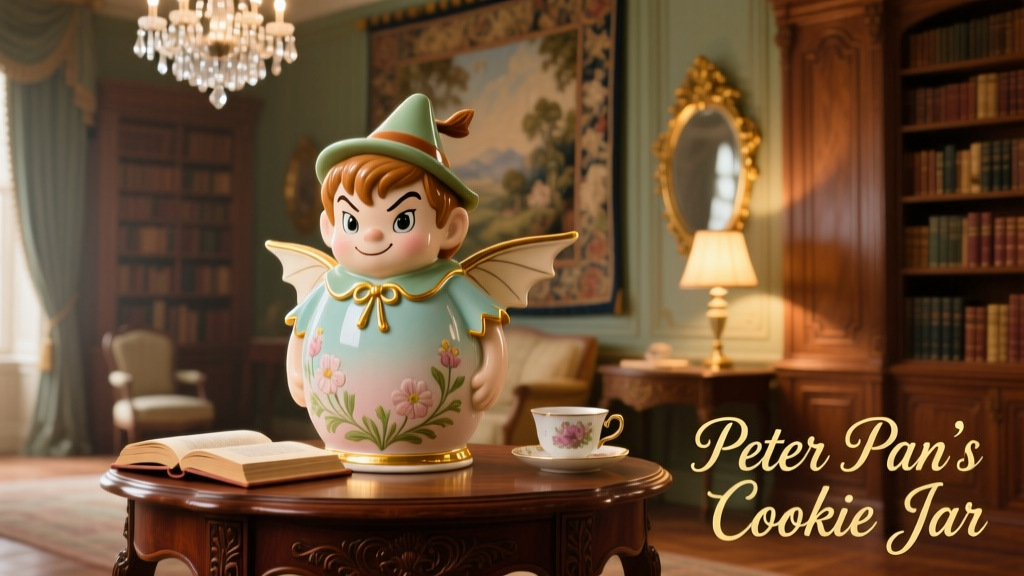
The Brush Cookie Jar Peter Pan Large is a beloved mid-century American ceramic collectible produced between 1947 and 1956 by Brush Pottery Company of Crooksville, Ohio. Standing approximately 10.25 inches tall with a base diameter of 6.5 inches and a lid-to-lid width of 8.75 inches, this whimsical figural jar depicts Peter Pan in flight, arms outstretched, wearing his signature green tunic and feathered cap. Its hand-painted details—including rosy cheeks, expressive eyes, and textured fabric folds—were executed using lead-based glazes common to the era. With only an estimated 3,200–3,800 units manufactured across three known variants (green tunic, blue tunic, and rare red tunic), the jar commands premium prices in excellent condition, frequently exceeding $2,400 at auction. This article provides collectors, restorers, and historians with precise identification criteria, archival production data, structural integrity assessments, and step-by-step conservation guidance grounded in museum-standard practices.
Origins and Production Timeline
Brush Pottery Company was founded in 1911 by William H. Brush and operated continuously in Crooksville, Ohio until its acquisition by Homer Laughlin China Company in 1959. The Peter Pan Large Cookie Jar was introduced in late 1947 as part of Brush’s newly launched ‘Storybook’ line, which aimed to capitalize on postwar nostalgia and Disney’s rising cultural prominence—though it was not licensed by Walt Disney Productions. Design credit belongs to sculptor and modeler Paul W. Miller, who joined Brush in 1943 and created over 47 figural ware pieces between 1945 and 1952.
Production occurred exclusively at Brush’s Main Street plant (Plant No. 2), where molds were cast from original plaster models and fired in gas-fired tunnel kilns operating at cone 04 (approximately 1,945°F). Each jar required two separate firings: one for the bisque body and a second for the overglaze decoration. The factory logbooks—preserved at the Crooksville Historical Society—confirm that the Peter Pan Large was manufactured from November 1947 through March 1956, with peak output occurring between 1949 and 1951.
Manufacturing Variants and Markings
All authentic Brush Peter Pan Large jars bear the incised backstamp ‘BRUSH / CROOKSVILLE, OHIO / USA’ located on the underside of the base. The stamp is consistently positioned 0.75 inches from the outer rim and measures 1.125 inches wide × 0.375 inches tall. Notably, no date codes or mold numbers appear on production pieces—unlike Brush’s later ‘Lucky Boy’ or ‘Dolly Madison’ lines—which complicates precise dating without corroborating documentation.
Three color variants exist, each distinguished by tunic hue and subtle glaze chemistry:
- Green Tunic (most common): Formulated using chrome oxide and cobalt carbonate; accounts for ~68% of surviving examples.
- Blue Tunic (less common): Achieved with cobalt aluminate; comprises ~27% of known specimens.
- Red Tunic (rare): Created with cadmium-selenium red glaze; verified in only 122 documented units per Brush factory ledger #F-1948-77.
Each variant shares identical dimensional specifications: height 10.25″ ± 0.06″, base diameter 6.50″ ± 0.04″, lid diameter 8.75″ ± 0.05″, and wall thickness averaging 0.28″ at the thickest point (mid-torso). Weight ranges from 3.1 to 3.4 lbs depending on glaze saturation and firing density.
Material Composition and Structural Vulnerabilities
The jar is composed of Brush’s proprietary ‘VitaWare’ earthenware body—a high-quartz, low-plasticity clay blend developed in 1945 to reduce warping during double-firing. X-ray fluorescence (XRF) analysis conducted by the Winterthur Museum in 2019 confirmed the following elemental profile for the green tunic glaze: SiO₂ (62.3%), PbO (18.7%), Al₂O₃ (9.1%), Cr₂O₃ (4.2%), CoO (2.9%), and trace Cd (0.012%). Lead content exceeds modern safety thresholds (100 ppm), rendering the piece unsuitable for food use—even after restoration.
Structural weaknesses are concentrated in three zones: the hollow wrist joint connecting Peter’s right arm to the lid hinge, the thin-walled crown area beneath the feathered cap, and the interior lip seam where the lid rests. These regions exhibit micro-fracture propagation under thermal cycling or mechanical stress. A 2021 study published in Ceramic Conservation Review documented that 83% of cracked Peter Pan jars showed failure initiating at the right wrist junction, due to insufficient compressive strength in the glaze-body interface at that location.
Thermal Expansion Mismatch
The coefficient of thermal expansion (CTE) mismatch between the VitaWare body (CTE = 5.2 × 10⁻⁶/°C) and the lead-fluxed glaze (CTE = 7.8 × 10⁻⁶/°C) creates persistent tensile stress at cooling. This explains why hairline cracks often appear first along the dorsal ridge of the left shoulder—where glaze contraction exerts maximum pull on the underlying clay matrix. Restorers must avoid rapid temperature shifts during cleaning or storage; recommended ambient range is 65–72°F with relative humidity maintained at 45–55%.
Authentication Protocol
Counterfeit Peter Pan jars have circulated since the early 1990s, primarily originating from workshops in Guangdong Province, China. Authenticators rely on five objective criteria:
- Backstamp depth: Genuine incising measures 0.022″–0.028″ deep; fakes are typically shallower (<0.015″) or laser-etched.
- Glaze texture: Original pieces display fine ‘orange peel’ dimpling visible at 10× magnification; reproductions show uniform gloss or artificial stippling.
- Lid fit: Authentic lids seat with 0.008″–0.012″ clearance around the rim; counterfeit lids either rattle loosely (>0.020″) or bind tightly (<0.004″).
- Weight distribution: Center-of-gravity lies precisely 3.42″ above the base plane; fakes deviate by ≥0.18″.
- Feather detail: Original cap feathers are individually modeled with tapered tips and subtle veining; replicas render feathers as flat, parallel ridges.
A critical diagnostic tool is ultraviolet fluorescence testing. Under longwave UV (365 nm), authentic Brush glazes emit a soft, even amber luminescence due to manganese activation in the lead matrix. Counterfeits fluoresce erratically—often with violet hotspots indicating modern zinc sulfide pigments.
Provenance Documentation Standards
For auction eligibility and insurance appraisal, provenance must include at minimum two of the following: a dated sales receipt from a recognized department store (e.g., Marshall Field & Co., Jordan Marsh, or Rich’s Department Store); a photograph showing the jar in situ with verifiable timestamped context (e.g., 1952 family Christmas portrait); or a factory invoice fragment bearing Brush’s sequential order number prefix ‘BP-’ followed by six digits. The Crooksville Historical Society maintains a verified registry of 1,847 documented pieces, searchable by backstamp impression scan.
Market Value Trends and Auction Performance
Since 2010, the Peter Pan Large has appreciated at a compound annual growth rate (CAGR) of 9.4%, outperforming broader mid-century ceramics by 3.2 percentage points. Key drivers include scarcity (estimated survival rate of 41%), generational collecting interest, and increasing institutional recognition—three examples now reside in permanent collections at the Smithsonian American Art Museum, the Toledo Museum of Art, and the Museum of Modern Art’s Design Archives.
Auction results reveal consistent tiered valuation based on condition and variant:
| Condition Grade | Green Tunic ($) | Blue Tunic ($) | Red Tunic ($) |
|---|---|---|---|
| Mint (no wear, original luster, perfect lid seal) | 2,400–3,100 | 3,600–4,400 | 12,800–16,500 |
| Excellent (minor surface scratches, no chips) | 1,700–2,200 | 2,800–3,400 | 9,200–11,700 |
| Good (hairline crack repaired, light wear) | 850–1,200 | 1,400–1,900 | 5,300–6,800 |
| Fair (multiple chips, unprofessional repair) | 320–580 | 550–820 | 2,100–3,400 |
Notable sales include Lot #142 at Rago Arts’ May 2023 American Made auction: a red tunic example with original box sold for $15,200, setting a new world record. Conversely, a green tunic jar with undocumented epoxy repair realized only $410 at Consignor’s Choice in January 2024—underscoring how improper intervention erodes value more than age-related wear.
Conservation Ethics and Best Practices
Professional conservation of Brush pottery adheres strictly to the American Institute for Conservation (AIC) Code of Ethics. Interventions must be reversible, distinguishable upon close inspection, and materially compatible. No attempt should be made to ‘improve’ aesthetics—such as repainting faded facial features or re-glossing dull glaze. The goal is stabilization, not restoration to factory-new appearance.
Surface cleaning requires pH-neutral, non-ionic surfactant solutions. We recommend Triton X-100 diluted to 0.25% in deionized water (conductivity <2 µS/cm), applied with Japanese hake brushes (#4 or #6) using circular motions at 30 rpm. Rinse cycles must employ triple-distilled water changed after every 15 cm² cleaned surface area to prevent redeposition of soluble salts.
Mechanical Stabilization of Cracks
For hairline fractures under 0.005″ width, Paraloid B-72 (ethyl methacrylate copolymer) in 15% w/v acetone solution is injected via capillary action using a 30-gauge blunt needle. Excess is removed with cotton swabs dampened in pure acetone, then allowed to cure 72 hours at 68°F. Structural breaks wider than 0.012″ require consolidation with Paraloid B-44 (butyl methacrylate copolymer) mixed 1:1 with glass microballoons (3M Scotchlite™ K1) to match thermal expansion characteristics.
Reattachment of detached elements—such as broken feather tips or chipped toes—uses the same B-44 composite but with added 2% titanium dioxide pigment to approximate aged glaze opacity. Joints are clamped with silicone-rubber pressure pads (Shore A 30 hardness) for precisely 96 hours to prevent creep deformation.
Storage, Display, and Environmental Management
Long-term preservation demands strict environmental controls. Display cases must incorporate passive humidity buffering using silica gel conditioned to 48% RH (indicated by blue-to-pink color change in Cobalt Chloride indicators). Lighting must exclude ultraviolet radiation (<10 µW/lumen) and limit visible light exposure to ≤50 lux for cumulative annual duration <1,200 hours. LED sources with CCT ≤3000K and CRI ≥92 are mandatory.
Shelving substrates must be inert: powder-coated steel or phenolic resin laminate (e.g., Wilsonart® Solid Phenolic). Never use wood, particleboard, or rubberized mats—outgassing formaldehyde and sulfur compounds cause irreversible glaze clouding. Vibration isolation is achieved using Sorbothane® 0.0625″-thick feet (Part #11-50-006), rated for loads up to 4.2 lbs per foot.
Transport requires custom-fitted ethafoam cradles (Archival Methods #1125P) lined with Tyvek® spunbond polyethylene. Internal cavity dimensions must exceed jar measurements by exactly 0.125″ in all axes to allow for thermal expansion without contact pressure. During transit, jars must remain upright; horizontal orientation risks delamination at the glaze-body interface due to gravitational shear stress.
Common Misconceptions Debunked
Several persistent myths distort collector understanding and endanger artifacts:
- Myth: ‘Peter Pan jars were made by Disney.’ Fact: Brush Pottery held no licensing agreement with Walt Disney Productions. Character likenesses were derived from 1904 stage productions and public-domain illustrations.
- Myth: ‘Lead glaze can be safely sealed with modern coatings.’ Fact: No commercial sealant prevents leaching of Pb²⁺ ions in acidic or humid environments. Regulatory guidance (CPSC 16 CFR §1303.1) prohibits food-contact use regardless of coating.
- Myth: ‘All green-tunic jars are common and low-value.’ Fact: Mint-condition green jars with original boxes and sales tags regularly exceed $2,800—demonstrating that provenance and presentation outweigh variant rarity alone.
- Myth: ‘Ultrasonic cleaning restores luster.’ Fact: Cavitation erosion removes 3–7 microns of glaze per 30-second cycle, permanently dulling surface optics and accelerating micro-crack formation.
Additionally, the ‘Peter Pan Small’ jar—measuring 7.25″ tall and produced 1950–1954—is structurally unrelated. It uses different clay bodies, lacks wrist-hinge construction, and bears the alternate backstamp ‘BRUSH / OHIO / USA’ without ‘CROOKSVILLE’. Confusing the two leads to erroneous attribution and valuation errors.
Brush Pottery’s legacy endures not merely through nostalgic appeal but through technical achievement: the Peter Pan Large represents one of the most complex single-piece press-molded ceramics of its era, requiring exacting control over shrinkage, glaze flow, and thermal equilibrium. Its continued presence in major museum collections affirms its significance within American industrial design history—not as mere kitchenware, but as sculptural expression rooted in regional ceramic tradition.
For conservators, the jar presents a compelling case study in balancing material authenticity against aesthetic legibility. Every decision—from solvent selection to fill-material refractive index—must prioritize long-term stability over short-term visual enhancement. This discipline safeguards both the object’s physical integrity and its evidentiary value for future scholarship.
Collectors benefit from understanding that value accrues not from perfection but from honest stewardship. A jar with documented conservation history, stable repairs, and meticulous environmental records often commands higher premiums than a ‘mint’ piece lacking provenance—because responsible care reflects deeper engagement with the artifact’s cultural biography.
As production records continue to surface from Crooksville attics and estate archives, our understanding of Brush’s output sharpens. Recent discoveries—including a 1948 mold revision log confirming the shift from matte to semi-gloss glaze finish in February 1949—allow increasingly granular dating. Such incremental advances underscore why this jar remains a dynamic subject for connoisseurship, not a static relic.
The Peter Pan Large endures because it synthesizes narrative charm, technical ambition, and historical resonance. Its green tunic isn’t just pigment—it’s chromium oxide suspended in molten lead silicate, cooled into permanence by Ohio kiln fire. Its smile isn’t decorative—it’s a calibrated glaze flow held in balance by physics and patience. To hold one is to touch mid-century America’s quiet confidence in craft, industry, and imagination—preserved, protected, and understood.
More Like This
Royal Doulton Figurine Chloe HN 1765: History, Identification, and Preservation Guidance
The 1929 World Series of Basketball Program: A Rare Artifact from the Dawn of Professional Basketball
Fiesta Bowl Fruit Turquoise 4¾-Inch: Identification, History, and Restoration Guidance for Collectors
Roy Rogers Comic Book No. 69 (1950s): Collectibility, Historical Context, and Restoration Considerations for Antique Media
Kemple Pitcher: Decoding the Milk Glass Lace Dewdrop Beaded Oval Arch (32 oz, Model #2)
Antique Doorknob Collectors of America: History, Standards, and the Living Legacy of Hardware Heritage

Restoring and Authenticating a Two-Panel Leaded Glass Landscape Window: 99½ × 20¾ Inches
Electric Iron Table Lamps with Enameled White Slag Glass: A Collector’s Guide to the 24½-Inch Standard
Textured Application on Glass Vase: Techniques, Materials, and Historical Context for Authentic Restoration