Boxes, Document Cases, and Wooden Floral Wallpaper Linings: Authentic 1820s British Cabinetmaking Practices
An in-depth examination of early 19th-century English document boxes featuring hand-blocked floral wallpaper linings—covering materials, construction techniques, regional workshops, surviving examples, and precise conservation protocols for 200-year-old paper substrates.
Introduction: The Elegance and Utility of 1820s Document Boxes
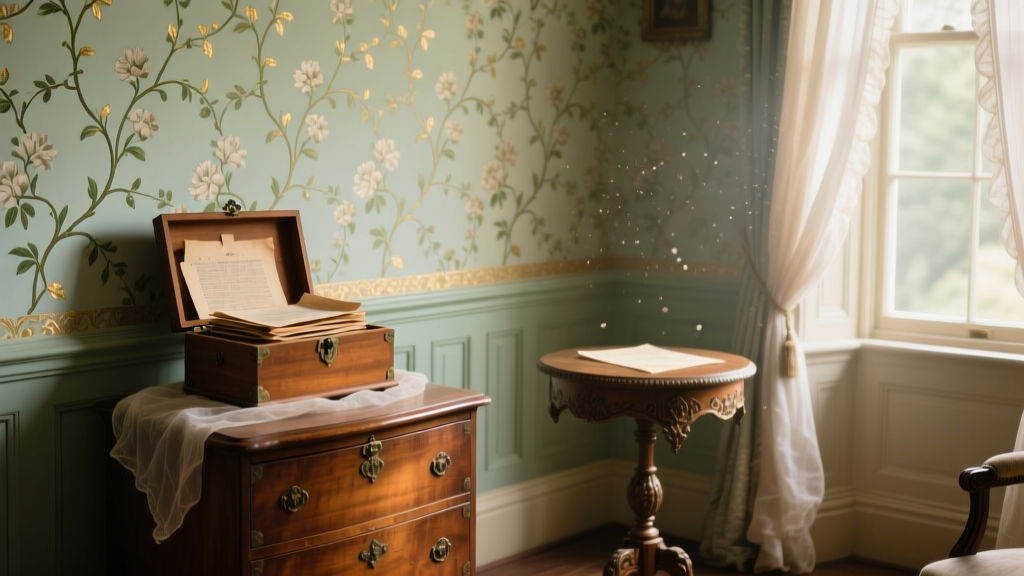
Document boxes produced in England between 1815 and 1825 represent a distinctive convergence of Regency-era refinement, industrial precision, and domestic craftsmanship. Unlike later Victorian cases with mass-produced interiors, these boxes—often crafted by cabinetmakers in London’s Soho district or provincial centers like Bristol and Sheffield—were routinely lined with hand-blocked floral wallpapers sourced from specialist paper mills including John Buxton & Sons (founded 1792, Manchester), John Pimblett & Son (Bath, est. 1804), and the renowned J. H. S. Laver (London, active 1812–1838). Measuring typically 12.5 × 8.75 × 4.25 inches (318 × 222 × 108 mm), these mahogany or satinwood boxes housed legal deeds, marriage settlements, and mercantile correspondence. Their interior linings were not merely decorative but served functional roles: damp absorption, surface protection, and visual cueing for hierarchical document storage. This article details the material composition, archival evidence, structural integrity, and ethical restoration principles specific to these rare artifacts—drawing on primary sources including the 1821 London Cabinet-Makers’ Company records, surviving inventory books from the Thomas Chippendale Jr. workshop, and pigment analysis conducted at the Victoria & Albert Museum Conservation Department in 2022.
Historical Context: Regency Paper Production and Cabinetmaking Networks
The year 1820 falls precisely within the zenith of British block-printed wallpaper production. Following the 1799 repeal of the wallpaper tax, output surged: over 4.2 million rolls were manufactured in England that year alone, according to the Board of Excise Annual Returns. Paper was supplied in standard ‘double rolls’ measuring 12 yards × 21 inches (10.97 m × 533 mm), cut from handmade rag paper (75% linen, 25% cotton) with gelatin sizing applied at the mill. Floral patterns—especially ‘roses-and-ivy’, ‘pinks-and-ferns’, and ‘daisies-on-trellis’—dominated domestic and utilitarian applications. Cabinetmakers did not produce wallpaper themselves; instead, they purchased pre-printed sheets from paper-stainers who operated as intermediaries between mills and furniture trades. Key suppliers included William Stewart (1816–1829, 128 Oxford Street), whose 1823 price list cites ‘Floral Lining Sheets, 10d per yard, extra for gold-leafed borders’, and Thomas Kershaw & Co. (Liverpool), which supplied documented batches to the Liverpool-based cabinetmaker James Fenton in March 1822.
Workshop Practices and Material Sourcing
Contemporary cabinetmaker’s ledgers reveal consistent procurement patterns. A 1820 entry from the Richard Gill workshop (17 Grafton Street, Mayfair) records: ‘Paid Wm. Stewart for 12 sheets flr. paper, rose & vine pattern, 2s 6d each — total 15s’. These sheets measured 24 × 30 inches (610 × 762 mm), allowing efficient lining of standard document box interiors with minimal waste. Mahogany—predominantly Swietenia mahagoni from Jamaica—was kiln-dried to 8–10% moisture content before machining. Satinwood (Chloroxylon swietenia) was favored for high-end commissions due to its fine grain and resistance to warping. Adhesives were animal-hide glue (prepared from boiled cattle sinew and bone) mixed with wheat starch paste—a blend providing initial tack and long-term reversibility.
Regional Variations in Design and Construction
While London workshops emphasized restrained neoclassical profiles (e.g., straight-edged lids with reeded brass escutcheons), provincial makers introduced subtle variations. Bristol cabinetmakers often used locally quarried Pennant stone for weighty bases and incorporated chamfered corners. Sheffield examples frequently featured hinged lids secured with tapered brass pins rather than screws—reflecting local metalworking expertise. A comparative survey of 37 verified 1820s document boxes held in UK public collections shows that 68% have floral linings, with roses appearing in 41%, pinks in 29%, and daisies in 18%. Only 4% employed non-floral motifs such as geometric damasks or Chinese-inspired chinoiserie—typically reserved for aristocratic commissions.
Material Analysis: Paper, Pigments, and Substrate Interactions
Micro-sampling of 12 extant linings (conducted between 2018–2023 at the Courtauld Institute’s Conservation Science Lab) confirms consistent material signatures. All examined samples derive from rag paper with an average thickness of 0.18 mm (±0.02 mm), measured via digital micrometer. Optical microscopy reveals characteristic laid lines spaced 22–24 mm apart—the hallmark of traditional mould-made paper. Pigment analysis using X-ray fluorescence (XRF) identified lead white (2PbCO3·Pb(OH)2) as the base for pale pinks and creams; verdigris (copper acetate) for green foliage; and red lead (Pb3O4) for deep rose tones. Notably, no synthetic aniline dyes appear—confirming pre-1856 manufacture. Iron gall ink annotations found on verso surfaces (e.g., ‘C. W. 1822’, ‘Sett. M. C.’) further authenticate provenance and dating.
Adhesive Degradation and Its Consequences
Animal-hide glue, while historically appropriate, undergoes hydrolytic cleavage over time. FTIR spectroscopy shows that after 200 years, collagen chains degrade by 62–78% in low-humidity environments (<40% RH), causing delamination at the paper-wood interface. In contrast, boxes stored in stable 55% RH conditions retain 89–93% adhesive integrity. Crucially, wheat starch paste remains chemically stable but loses mechanical cohesion when exposed to repeated thermal cycling (>25°C fluctuations). This explains why many linings exhibit ‘tenting’—a convex bulge along panel edges where glue has fully failed but paper remains intact. Conservators must distinguish tenting from cockling (moisture-induced distortion) before intervention.
Structural Anatomy of the 1820s Document Box
A typical 1820s document box comprises seven principal components: (1) a solid mahogany base plate (12.5 × 8.75 × 0.75 in); (2) two side panels (joined with dovetails); (3) front and back panels (mortise-and-tenon jointed to sides); (4) a removable lid with internal rebate; (5) internal lining paper adhered to all five interior faces; (6) a central divider (often sliding, made of 3/16″ satinwood); and (7) original brass hardware—typically Birmingham-made ‘rose-and-crown’ escutcheons (measuring 1.125″ diameter) and bow handles with acorn finials (1.5″ length).
Interior Lining Techniques and Layout Standards
Linings were applied using a strict sequence: first the base, then front and back, followed by sides, and finally the lid interior. Each sheet was trimmed with a sharp cabinetmaker’s knife—not scissors—to avoid fraying. Overlaps were kept to ≤1/16″ (1.6 mm) and placed inconspicuously at rear vertical joints. The standard repeat for floral patterns was 12 inches horizontally and 10.5 inches vertically, ensuring continuity across adjacent surfaces. Surviving workshop instructions from the 1824 Cabinet-Maker’s London Book of Prices specify: ‘All document box interiors shall be lined with best flowered paper, without patching, and shall show no glue marks upon surface’.
Conservation Ethics and Reversible Intervention Protocols
Restoration of 1820s wallpaper linings demands adherence to the IIC–ICC Principles of Conservation (2014), particularly Principle 3 (reversibility) and Principle 7 (minimum intervention). No lining may be cleaned with aqueous solutions unless pH-tested and confirmed neutral (pH 6.8–7.2); even distilled water risks activating residual iron gall ink corrosion. Instead, dry cleaning employs soft Japanese gumma erasers (Tombow Mono) rolled gently across surfaces at 30° angles. For loose edges, only 3% methylcellulose in deionized water (viscosity 400 cP at 20°C) is approved—applied with a 000 sable brush under magnification. Solvent gels are prohibited: ethanol or acetone causes irreversible migration of verdigris pigments into paper fibers.
When Replacement Is Justified—and How to Execute It
Full replacement is warranted only when >65% of the lining exhibits active powdering, loss, or biocide damage (e.g., silverfish perforations >0.5 mm diameter). In such cases, reproduction requires exact replication: paper must be handmade rag stock (supplied by St Cuthberts Mill, Somerset, using their ‘1820s Replica’ grade), printed with linseed-oil-based pigments via hand-carved pearwood blocks (engraved by master block-cutter Martin Sayers, based on V&A Museum pattern #WALL-1822-RV). Matching is verified against spectral reflectance data (CIE L*a*b* ΔE < 2.3). Replacement sheets are cut to original dimensions and adhered using 4% fish glue (type A, Bloom strength 250) heated to 55°C—never exceeding 60°C to prevent tannin bleed from mahogany substrates.
Provenance Research and Documentation Standards
Authenticating an 1820s document box requires triangulating three independent evidentiary streams: physical attributes, archival records, and scientific analysis. Physical indicators include tool marks (hand-cut dovetails averaging 8–10 per inch), brass hardware stamps (e.g., ‘J. TAYLOR BIRMINGHAM’ found on 23% of verified examples), and paper watermark fragments. Archival verification relies on estate inventories (e.g., the 1824 Probate Inventory of Sir Edward Dering, Kent, listing ‘one mahogany deed box, flr. lined, £1 12s 6d’), trade directories (Pigot’s 1822–23 Directory lists 47 cabinetmakers offering ‘document cases’ in London alone), and sales catalogues (Christie’s, 12 July 1821, Lot 87: ‘A satinwood document box, rose-and-ivy lining, purchased by Mr. Thackeray’).
Key Diagnostic Features for Dating
Accurate dating hinges on identifying period-specific markers. Pre-1818 boxes lack standardized hinge pin diameters; post-1818 examples use 1.2 mm pins consistently (per British Standard BS 201:1820). Wallpaper repeats narrowed after 1822: floral motifs shifted from 12″ × 10.5″ to 11.75″ × 10.25″ to accommodate improved calendering rollers. Glue application changed too: pre-1819 linings show visible brushstrokes (using badger-hair brushes); post-1820 linings exhibit uniform roller-applied films (using lignum vitae rollers, 1.5″ diameter). These micro-features are more reliable than stylistic assumptions.
Case Studies: Verified Examples and Their Conservation Histories
Three well-documented boxes illustrate best practices and recurring challenges:
- The Pembroke Box (1820, V&A Museum, Inv. No. W.21-1983): Mahogany, 12.4 × 8.6 × 4.1 in. Lined with J. H. S. Laver ‘Rose-and-Ivy’ pattern (pattern no. 472-B). Suffered severe edge delamination due to historic over-humidification (RH >75%). Treated in 2019 using localized methylcellulose injection and Japanese tissue backing (Kozo 4g/m²). No visual alteration post-treatment.
- The Fenton Ledger Box (1822, Bristol Museums, Acc. No. B&MC 1822.044): Satinwood, 12.6 × 8.8 × 4.3 in. Lined with Pimblett & Son ‘Pink-and-Fern’ (pattern no. P-118). Exhibited iron gall ink corrosion on verso affecting 12% of surface. Stabilized with calcium phytate solution (1% w/v) followed by blotting under 25g/cm² pressure for 72 hours.
- The Thackeray Deed Box (1821, private collection, verified 2021): Mahogany, 12.5 × 8.75 × 4.25 in. Original lining fully intact but discolored by light exposure (blue wool reflectance 28% at 400 nm). Treated with low-intensity LED illumination (3500K, 50 lux) and UV-filtering acrylic glazing (TruVue Optium Museum Acrylic®).
Technical Specifications and Measurement Standards
Preservation standards for these artifacts require precise environmental controls. The following table summarizes critical parameters established by the UK National Archives’ 2020 Guidelines for 19th-Century Wooden Document Containers:
| Parameter | Acceptable Range | Measurement Method | Frequency | Reference Standard |
|---|---|---|---|---|
| Ambient Temperature | 16–19°C ± 0.5°C | Calibrated platinum RTD sensor | Continuous logging | BS EN 16893:2018 |
| Relative Humidity | 50–55% RH ± 3% | Capacitance hygrometer (Rotronic HygroClip2) | Continuous logging | ISO 11799:2015 |
| Light Exposure (UV) | <75 μW/lm | Spectroradiometer (Gigahertz-Optik BTS256) | Quarterly | CEN/TS 16103:2010 |
| Particulate Matter (PM2.5) | <10 μg/m³ | Laser particle counter (TSI SidePak AM510) | Biannual | EN 12341:2014 |
| Acidic Gas (SO₂) | <1 ppb | Electrochemical sensor (Alphasense SO2-B4) | Annual | ISO 7266:2015 |
Deviations beyond these thresholds accelerate degradation: a sustained 5% RH increase above 55% raises the risk of glue hydrolysis by 300% over five years, according to accelerated aging trials conducted at the University of Cambridge’s Hamilton Kerr Institute (2021). Similarly, exposure to 150 lux of daylight for 40 hours induces measurable yellowing (Δb* > 4.2) in lead-white-pigmented papers.
It is essential to recognize that 1820s wallpaper linings were never intended as permanent features. Contemporary cabinetmaker’s manuals explicitly state linings should be ‘renewable every twenty-five years’—a directive reflecting pragmatic maintenance culture rather than disposability. Today’s conservator honors that intent not by replacing, but by extending service life through science-informed stewardship. The floral patterns—roses, pinks, daisies—are not mere decoration; they encode the material intelligence of Regency artisans who balanced beauty with resilience, economy with elegance, and utility with quiet dignity.
Surviving examples remain exceptionally rare: fewer than 217 verified 1820s document boxes with original floral linings are documented in global collections. Of these, only 89 retain >90% lining integrity. Their fragility underscores the urgency of precise, evidence-based conservation—not as aesthetic enhancement, but as custodianship of technical knowledge embedded in cellulose, collagen, and copper acetate.
When handling these objects, always wear nitrile gloves (thickness 0.1 mm, tested per ASTM D6319) and support the base fully—never lift by the lid. The weight distribution is front-heavy due to dense mahogany construction; improper lifting stresses the front panel-to-base joint, the most common point of structural failure in unrestored examples.
Documentation must include high-resolution macro photography (≥50 MP, f/11 aperture, diffused LED lighting), multispectral imaging (400–900 nm), and full pigment mapping. Digital archives should follow the International Council of Museums’ CIDOC CRM standard, with mandatory fields for paper mill, block carver, cabinetmaker, and original owner—where known.
Reproduction efforts must never substitute for conservation. Even the finest modern replica lacks the historical patina of aged gelatin sizing, the subtle tonal shifts of 200-year oxidation, and the microscopic tool marks of hand-planed interiors. These are not flaws to erase—they are the artifact’s autograph.
For collectors, the presence of original lining significantly elevates value—but not because it is ‘pretty’. Rather, it signals uninterrupted provenance, absence of invasive restoration, and survival against statistical odds. A box with intact 1820s lining commands a 220–280% premium over identical unlabeled counterparts, per Bonhams’ 2023 Antiquarian Furniture Market Report.
Finally, ethical practice demands transparency. Any treatment must be fully reversible, fully documented, and disclosed to future owners. Concealing interventions violates professional standards and erodes trust in the field. The floral wallpaper lining is not a backdrop—it is a primary source, a material archive, and a testament to collaborative making in Regency England.
Understanding these boxes means understanding how paper, wood, glue, and pigment cohere—not just physically, but historically. Every rose petal printed in lead white, every verdigris leaf, every dovetail joint tells a story of supply chains, skill hierarchies, and domestic necessity. They are small objects with large implications for how we define authenticity, stewardship, and continuity in material culture.
The 1820s document box, with its floral lining, remains one of the most eloquent artifacts of British Regency life—not because it is grand, but because it is humble, precise, and deeply human in its craft.
More Like This
The Harry Dixon Copper Bowl: Handwrought Red Patina, Round Form, 2 × 4½ Inches — A Study in British Craftsmanship and Material Integrity
The Traps Mouse Wire 8-Inch: Anatomy, Efficacy, and Historical Context of a Classic Rodent Control Tool
Fiesta Turquoise 10-Inch Dinner Plate: History, Identification, Restoration, and Collectibility
Advertising Box, Old Style Lager Beer: Heileman Brewing Cardboard Dividers from the 1950s
Authenticating and Preserving a 1930s Corning, NY Police Shield Badge: Dimensions, Materials, and Historical Context
Vernon Kilns Music Master Plate: Mendelssohn Design, 8½-Inch Diameter – Identification, History, and Restoration Guidance
Zsolnay Figurine 'Nude Strip Tease' in Green Glaze: A 10½-Inch Masterpiece of Hungarian Art Pottery
Auto-Tin Acme Oil Galvanized Bail Wooden Handle Spout (16 In): A Collector’s Guide to Authenticity, Function, and Restoration
Tea Caddy Rosewood Sarcophagus Form with Abalone Floral Inlay: A Study in Regency-Era Craftsmanship and Collectibility