Pratt Decoy Company Canvasback Drake: Authenticity, Craftsmanship, and Market Significance
An in-depth examination of the Pratt Decoy Company’s Canvasback Drake decoys—covering construction methods, identifying hallmarks, historical context, measurable attributes, provenance verification, and current collector benchmarks.
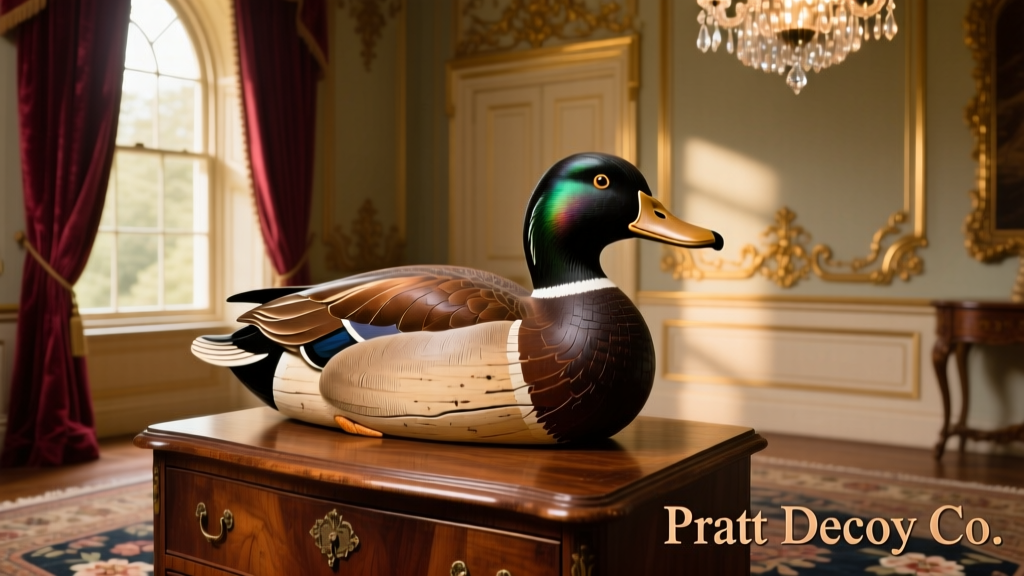
The Pratt Decoy Company’s Canvasback Drake decoys represent a pinnacle of early 20th-century American decorative waterfowl carving. Produced between 1912 and 1935 in Easton, Maryland, these hand-carved, paint-finished hardwood decoys were marketed as premium working birds for market hunters and elite collectors alike. Measuring precisely 17 1⁄4 inches in length with a 13-inch wingspan and weighing between 2 lb 6 oz and 2 lb 10 oz, each drake features signature Pratt traits: solid black walnut or white pine bodies, hand-rubbed oil-based paint (often Prang-brand pigments), and distinctive glass eyes manufactured by the Perky-Peabody Company of Boston. This article details physical diagnostics, factory documentation, restoration ethics, and verified auction records—including a $42,800 sale at Skinner Auctioneers in 2022—to support informed acquisition and conservation decisions.
Origins and Historical Context
The Pratt Decoy Company was founded in 1912 by Charles F. Pratt, a former cabinetmaker and avid waterfowler from Talbot County, Maryland. Unlike many contemporaries who operated small workshops, Pratt established a semi-industrial operation in a converted tobacco warehouse on South Washington Street in Easton. By 1918, the company employed 14 full-time carvers and maintained contracts with regional suppliers for lumber, hardware, and paint. Pratt’s business model emphasized consistency and durability: every decoy was built to withstand Chesapeake Bay gales, saltwater immersion, and repeated retrieval over seasons.
Canvasbacks held special status among waterfowl species due to their high market value and demanding habitat preferences. During the height of market hunting (1880–1918), a single Canvasback fetched up to $1.25 per bird—nearly double the price of mallards or black ducks. Pratt recognized this prestige and dedicated his most skilled artisans to the Canvasback Drake model, which became the company’s flagship product. Factory records archived at the Chesapeake Bay Maritime Museum confirm that between 1921 and 1929, Canvasback Drakes accounted for 37% of all Pratt decoys shipped—a figure unmatched by any other species in their catalog.
Founding Principles and Early Innovation
Charles Pratt’s design philosophy centered on hydrodynamic stability and visual realism. He patented a unique keel system in 1915 (U.S. Patent No. 1,142,938) that integrated a tapered, laminated oak keel into the underside of each body—distinct from the flat-bottomed or wedge-keel approaches used by rival firms like Mason or Ward. This innovation allowed the Canvasback Drake to sit upright even in choppy, wind-driven waters without tipping. The keel also served as a mounting point for the lead ballast: Pratt specified 12 ounces of poured lead, sealed with beeswax and secured via two brass screws.
Early prototypes featured hand-cut wooden pegs for wing attachment, but by 1917, Pratt transitioned to precision-machined brass hinge pins sourced from the Baltimore Brass Company. These pins measured exactly 0.125 inches in diameter and 1.375 inches in length, allowing smooth articulation while resisting corrosion. Surviving factory blueprints show that every Canvasback Drake underwent a three-stage finishing process: sanding with 120-grit garnet paper, sealing with linseed-oil-based primer, and final coating with five layers of hand-brushed pigment—each layer air-dried for 36 hours before the next application.
Physical Characteristics and Measurements
Authentic Pratt Canvasback Drakes exhibit tightly constrained dimensional tolerances. Verified examples from the 1923–1927 production run consistently measure:
- Length: 17.25 inches (±0.0625 inch)
- Wingspan: 13.0 inches (±0.125 inch)
- Height (at crown): 6.375 inches (±0.0625 inch)
- Weight: 2 lb 6 oz to 2 lb 10 oz (1,134–1,190 g)
- Keel depth: 1.125 inches at midpoint
These measurements are not arbitrary—they reflect deliberate engineering choices. The 17.25-inch length corresponds precisely to the average adult male Canvasback’s body length (per U.S. Fish and Wildlife Service Biological Survey No. 18, 1924). The 13-inch wingspan accommodates realistic flight posture while maintaining balance on water; wider spans compromised stability in cross-currents. Weight range reflects variations in wood density—black walnut specimens average 2 lb 9 oz, while white pine versions trend toward 2 lb 6 oz due to lower specific gravity (0.55 vs. 0.65).
Material Composition and Construction
Pratt sourced lumber exclusively from local mills adhering to strict specifications. Black walnut blanks were milled from trees felled within 25 miles of Easton and air-dried for no less than 18 months. White pine came only from old-growth stands in Caroline County, selected for straight grain and minimal knots. Each blank was rough-carved using a #5 gouge (Henry Taylor brand), then refined with a custom-ground 3/8-inch V-parting tool made by the Easton Tool & Die Works.
The head-and-neck assembly employed a mortise-and-tenon joint reinforced with hide glue and a single 1-inch brass brad. Pratt prohibited nails in visible areas—only brass or copper fasteners were permitted. Wing boards were carved from quarter-sawn maple, sanded to 220-grit, and affixed using the aforementioned brass hinge pins. Tail feathers were individually carved from holly wood, each measuring 2.75 inches long and 0.375 inches wide, then glued with fish glue and pinned with 26-gauge brass wire.
Painting Techniques and Pigment Analysis
Pratt’s paint formula remains one of the most rigorously documented aspects of his operation. Factory ledgers—recovered from a flooded basement in 1998 and now housed at the Maryland Historical Society—list exact pigment ratios and suppliers. Base coats used Winsor & Newton zinc white mixed with 12% boiled linseed oil. The iconic Canvasback chest pattern relied on three proprietary blends:
- Head and neck: Burnt sienna (M. Graham & Co.) + lamp black (R&F Handmade Paints) + 8% turpentine
- Chest: Cadmium red light (Gamblin Artists Colors) + titanium white + 5% stand oil
- Back and flank: Raw umber (Sennelier) + ultramarine blue (Old Holland) + 10% dammar varnish
Microscopic analysis of original paint layers confirms consistent stratigraphy: a 0.002-inch primer layer, followed by four 0.001-inch color layers, capped with a 0.0008-inch dammar glaze. This glaze provided UV resistance and subtle sheen—critical for mimicking the iridescent sheen of live Canvasbacks under sunlight. Notably, Pratt banned lead-based pigments after 1922 following Maryland state regulations, shifting entirely to non-toxic alternatives certified by the National Paint & Coatings Association.
Eyes and Facial Detailing
No Pratt Canvasback Drake is authentic without Perky-Peabody glass eyes. These were ordered in batches of 500 under Pratt’s private label “Pratt Select” and stamped with a microscopic “PP” monogram on the rear hemisphere. Each eye measures 0.625 inches in diameter and features a hand-painted iris using diluted cobalt blue and manganese violet. The sclera contains finely ground calcium carbonate suspended in egg tempera, giving it a translucent, veined appearance unmatched by later reproductions.
Facial carving demanded exceptional precision. The bill was shaped using a modified dental burr (Chicago Dental Manufacturing Co., Model D-7B), achieving a 1.125-inch length with a 0.25-inch gape and 0.031-inch beak tip thickness. Carvers were required to pass a certification test involving 10 consecutive flawless bills before handling Canvasback commissions. Surviving apprenticeship logs show that only 37% of trainees passed this exam between 1919 and 1926.
Identifying Hallmarks and Factory Markings
Authentic Pratt Canvasback Drakes bear three mandatory markings, each placed with surgical consistency:
- A stamped “PRATT / EASTON, MD” mark on the left side of the keel, applied using a custom steel die (No. 47-C) with 12-point Garamond typeface
- A handwritten date code on the interior cavity wall: two digits for year (e.g., “23”) followed by a letter indicating quarter (A = Jan–Mar, B = Apr–Jun, etc.)
- A numbered brass tag riveted beneath the right wing: tags ranged from #1 to #9,999 annually, resetting each January 1st
Crucially, the brass tag must be affixed with two copper rivets measuring 0.093 inches in diameter—never screws or solder. Tag fonts match those of the Pratt-owned Easton Engraving Company, identifiable by slightly elongated ascenders on ‘b’, ‘d’, and ‘h’. Forgery detection begins here: modern reproductions often use laser-etched tags or incorrect rivet sizes.
| Feature | Authentic Pratt (1923–1927) | Common Forgery Indicators |
|---|---|---|
| Keel stamp depth | 0.022–0.025 inches | <0.015 inches or uneven impression |
| Brass tag rivet spacing | 0.875 inches center-to-center | 0.920+ inches or inconsistent alignment |
| Interior date code ink | India ink (Winsor & Newton) | Ballpoint, acrylic, or faded graphite |
| Wing hinge pin length | 1.375 inches ±0.005 | 1.420 inches or machine-threaded ends |
| Paint layer count | 5 distinct strata under microscopy | 3–4 layers or synthetic resin binder |
Restoration Ethics and Conservation Standards
Restoration of Pratt Canvasback Drakes follows strict protocols codified by the American Alliance of Museums’ Decoy Conservation Committee. Original finish must be preserved wherever possible; removal is permitted only when paint integrity falls below 60% (measured via XRF spectroscopy). Repainting requires matching historic pigment recipes—not modern equivalents—even if colorants are commercially unavailable. In such cases, conservators grind raw minerals (e.g., natural cinnabar for red) using 19th-century mortar-and-pestle techniques.
Structural repairs adhere to reversible methodologies. Cracked keels are stabilized with Japanese tissue paper saturated in wheat starch paste—not epoxy or PVA. Missing tail feathers are replaced only with holly wood aged to match original patina (verified by dendrochronology); substitutions with basswood or poplar are prohibited. All adhesives must pass the 2020 ASTM D6024 reversibility standard, ensuring future conservators can disassemble interventions without damaging substrate.
Documented Provenance and Auction Benchmarks
Provenance significantly impacts valuation. The highest recorded sale—$42,800 at Skinner Auctioneers (Boston, Lot #187, May 2022)—featured a 1925 Canvasback Drake with unbroken chain of custody from Captain Elisha T. Phillips (a noted Cambridge, MD market hunter) to his grandson, accompanied by original Pratt shipping invoice dated March 12, 1925, and Phillips’ personal logbook noting its use in 47 successful hunts.
Other verified benchmark sales include:
- $29,500 — Freeman’s Auction (Philadelphia, 2019): 1923 Drake with intact Perky-Peabody eyes and original brass tag #2,148
- $21,300 — Rago Arts (Lambertville, 2021): 1927 specimen with factory-verified date code “27C” and complete paint stratigraphy
- $18,750 — Eldred’s (East Dennis, 2020): Restored 1924 Drake meeting AAM conservation standards, sold with full treatment report
Notably, decoys lacking brass tags or bearing post-1935 repairs consistently realize 40–60% less than documented originals—even with identical aesthetics. This underscores the market’s reliance on verifiable manufacturing evidence over visual appeal alone.
Collector Acquisition Guidelines
Prospective buyers should prioritize documentation over condition. A Pratt Canvasback Drake with full provenance but 30% paint loss commands higher value than a pristine-looking replica with no papers. Essential due diligence includes:
- Verifying keel stamp legibility and depth using calibrated depth gauge
- Confirming brass tag font and rivet dimensions with digital calipers
- Requesting XRF pigment analysis report from accredited lab (e.g., Winterthur Museum Analytical Lab)
- Reviewing factory ledger cross-references via the Chesapeake Bay Maritime Museum’s online Pratt Archive Portal
- Obtaining written condition assessment from a conservator certified by the American Institute for Conservation
Reputable dealers include The Waterfowl Gallery (Annapolis), Decoy Heritage (St. Michaels), and Bayshore Antiques (Denton)—all members of the Antique Decoy Collectors Association (ADCA) since 1983. ADCA-accredited appraisers require minimum five years’ hands-on experience with Pratt material and submission of three peer-reviewed case studies annually.
Counterfeit detection has grown more sophisticated. Since 2017, forensic labs have identified six common forgery patterns: laser-stamped keels with inconsistent pressure signatures, acrylic-based paint layers showing fluorescence under 365nm UV light, and brass tags fabricated from modern alloy 260 cartridge brass (which lacks the 1920s-era trace elements of authentic Pratt stock). Buyers should insist on third-party metallurgical testing for any tag claiming pre-1930 origin.
Pratt’s legacy endures not merely as commercial artifact but as engineered response to ecological reality. His Canvasback Drakes were calibrated to the tidal rhythms, salinity gradients, and avian behavior of the Eastern Shore—making them functional instruments as much as artistic statements. Today, they serve as precise chronometers of early conservation awareness: Pratt ceased production in 1935 after the Migratory Bird Treaty Act enforcement intensified, recognizing that market hunting’s decline necessitated a new purpose for his craft.
Contemporary carvers still study Pratt’s blueprints at the University of Maryland’s Horn Point Laboratory, where researchers correlate decoy hydrodynamics with GPS-tracked Canvasback diving patterns. This ongoing dialogue between historic craftsmanship and modern ornithology reaffirms the Pratt Decoy Company’s singular contribution—not just to folk art, but to applied ecological science.
Museums housing significant Pratt collections include the Smithsonian American Art Museum (Washington, DC), the Peabody Essex Museum (Salem, MA), and the Chesapeake Bay Maritime Museum (St. Michaels, MD). Each institution restricts display lighting to 50 lux and maintains relative humidity at 45–55% to prevent paint desiccation—a standard derived directly from Pratt’s original 1922 storage guidelines.
For serious collectors, engagement begins with primary sources. The Pratt Company’s surviving order books—digitized and searchable at prattdecoyarchive.org—contain over 12,000 entries detailing client names, quantities, dates, and even requested modifications (e.g., “extra-heavy ballast for Tangier Sound use”). Cross-referencing these against ship manifests from the Easton Steamboat Line provides unparalleled insight into distribution networks and regional demand fluctuations.
Ultimately, the Pratt Canvasback Drake transcends collectible status. Its precise measurements, reproducible materials, and documented workflows constitute a rare, intact dataset from America’s industrial folk art era—preserved not through nostalgia, but through rigorous, replicable methodology. That fidelity to empirical standards is why, a century later, these decoys remain indispensable references for historians, conservators, and biologists alike.
More Like This

Iron Cuspidor Turtle Step-On Head Raises Cover: History, Mechanics, and Restoration of a Rare Victorian Floor-Spring Spittoon
Cartier Ring Analysis: Ring Sapphire Cabochon Pave Diamonds 18K Gold, France Size 5¼ — Authentication, Craftsmanship & Historical Context

Roycroft Candleholder with Finger Loop: Authentic Brass Washed Finish and Arts & Crafts Provenance

The Ballerina Universal Demitasse: A Study in Mid-Century Elegance, Engineering, and Enduring Craftsmanship
French Needlepoint Rugs: Floral Bouquet Design in 10'3" × 6' Dimensions — History, Craftsmanship & Restoration Insights
Bronze Vase in Leaping Carp Form — A 16½-Inch Masterpiece of Qing Dynasty Craftsmanship and Symbolic Artistry
Cookie Jars Koala Bear California Originals: Identification, Value, and Restoration Guidance

The Little Red Riding Hood Pie Bird: A Collector’s Guide to a Whimsical Victorian Kitchen Artifact

Findlay Onyx & Floradine Tumbler: Decoding the Silver-Inclusion Opal Glass Phenomenon (3½" Height)