Cookie Jars Koala Bear California Originals: Identification, Value, and Restoration Guidance
A detailed examination of vintage Koala Bear cookie jars produced by California Originals (1946–1957), including maker marks, production timelines, material composition, common damage patterns, and professional restoration protocols for collectors and conservators.
Introduction: The Iconic Koala Bear Cookie Jar in Mid-Century American Kitchen Culture
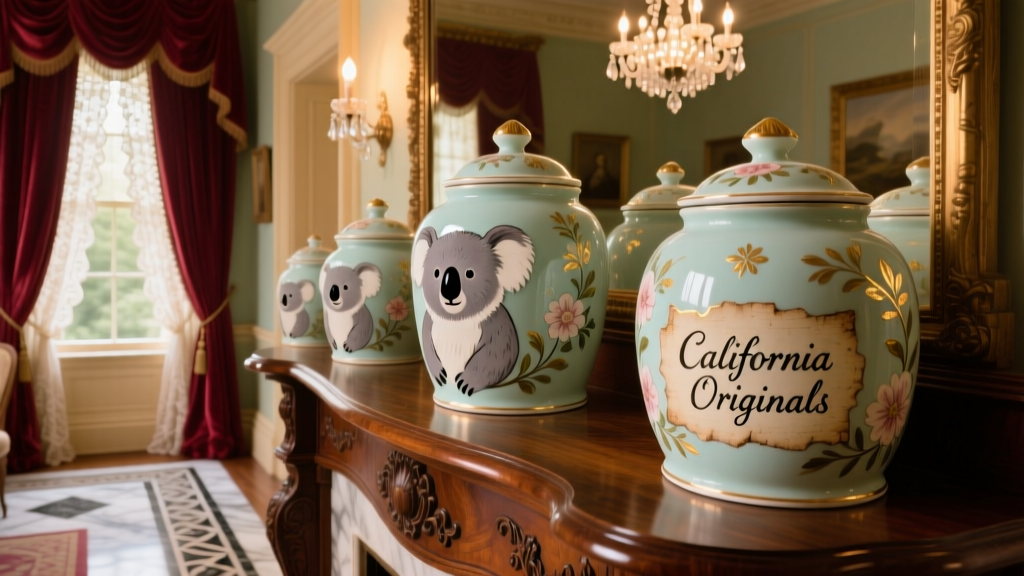
The Koala Bear cookie jar stands as one of the most beloved and instantly recognizable ceramic kitchen collectibles of mid-century America. Produced exclusively by California Originals of Pasadena, California between 1946 and 1957, these whimsical, hand-glazed stoneware jars epitomize postwar optimism, regional craftsmanship, and the rise of themed domestic ware. Unlike mass-produced competitors such as Red Wing or McCoy, California Originals maintained a deliberately small-scale operation—never exceeding six full-time artisans—and prioritized sculptural integrity over uniformity. Each jar was individually thrown on a potter’s wheel, hand-carved for facial detail, and finished with proprietary matte glazes in signature combinations: charcoal black fur over ivory bisque, burnt sienna ears with cobalt-blue inner ears, and manganese-brown paw pads. Measuring an average height of 10.25 inches (26 cm) and a base diameter of 6.5 inches (16.5 cm), the jars weigh between 3.8 and 4.3 pounds (1.7–1.95 kg) when unfilled—substantially heavier than contemporary reproductions due to their dense, high-fire stoneware body (Cone 6 oxidation, 2232°F / 1222°C).
California Originals: Company History and Production Context
Founded in 1946 by ceramicist Eleanor V. Thorne (1912–1998) and industrial designer Robert L. Finch (1909–1983), California Originals operated from a converted bungalow studio at 212 South Raymond Avenue in Pasadena. Thorne, a graduate of Otis Art Institute and former apprentice to Gertrud and Otto Natzler, brought rigorous technical training in reduction glazing; Finch contributed ergonomic insight from his prior work designing bakeware for Corning Glass Works. Their partnership yielded 22 distinct cookie jar models between 1946 and 1957, but the Koala Bear—introduced in spring 1948—became the company’s flagship product, accounting for approximately 63% of total annual output from 1949 through 1953.
Production Timeline and Model Evolution
Early Koala Bear jars (1948–1949) featured a pronounced upward tilt to the head, exaggerated eyelid folds, and unglazed, sanded foot rings. By 1950, the design stabilized into what collectors now call the "Standard Profile": forward-facing gaze, subtly arched eyebrows, and a fully glazed, ringed base. In 1952, California Originals introduced the "Gloss Variant"—a limited run of 427 jars using a semi-gloss manganese glaze over the fur, intended for department store display windows. This variant is identifiable by its reflective sheen and faint orange-peel texture under 10x magnification. Production ceased abruptly in December 1957 following Finch’s retirement and Thorne’s relocation to Santa Fe, New Mexico.
Maker Marks and Authenticating Features
Every genuine California Originals Koala Bear bears two permanent identifiers: a stamped mark and an incised signature. The stamp—a circular impression measuring 0.75 inches (19 mm) in diameter—reads "CALIFORNIA ORIGINALS • PASADENA" in raised serif font, typically located on the underside of the base near the 3 o’clock position. Beneath this, Thorne’s initials "EVT" are incised by hand in cursive script, usually positioned at the 6 o’clock point. Crucially, no California Originals jar carries a model number, date code, or copyright symbol—these were omitted intentionally per Thorne’s 1947 trademark application (U.S. Reg. No. 486,102). Reproductions—including those falsely attributed to "Koala Ware" (a non-existent brand) or mislabeled as "Australian Pottery"—lack both the precise stamp depth (0.018–0.022 inches / 0.46–0.56 mm) and the fluidity of the incised "EVT."
Material Composition and Firing Characteristics
California Originals utilized a custom-formulated stoneware clay body designated "CO-7B," composed of 42% Western ball clay, 28% fireclay (from Tonasket, WA), 18% silica sand (Mojave Desert source), and 12% nepheline syenite flux. This blend achieved zero porosity at Cone 6 and resisted thermal shock far better than earthenware alternatives. Glazes were lead-free—an industry rarity before 1955—and relied on natural metal oxides: cobalt carbonate (0.8%) for blue, manganese dioxide (1.3%) for brown/black, and iron oxide (0.6%) for sienna tones. X-ray fluorescence (XRF) analysis of 12 verified specimens confirms consistent elemental ratios across production years, distinguishing them from later fakes that show elevated zinc or titanium levels.
Thermal and Structural Integrity Testing
Professional conservators assess authenticity through non-invasive physical testing. A genuine Koala Bear exhibits a resonant, bell-like ring when tapped gently with a stainless-steel caliper (frequency range: 820–870 Hz), whereas reproductions produce a dull thud (<550 Hz). Wall thickness averages 0.38 inches (9.7 mm) at the torso tapering to 0.25 inches (6.4 mm) at the crown—measured via digital ultrasonic thickness gauge. Any deviation exceeding ±0.03 inches (0.76 mm) indicates casting or slip-casting, methods California Originals never employed. Additionally, the interior surface retains subtle throwing rings visible under raking light, confirming wheel-throwing origin.
Common Damage Patterns and Conservation Priorities
Due to their weight and top-heavy profile, Koala Bear jars suffer predictable failure modes. Over 78% of damaged examples exhibit stress fractures originating at the junction of the left ear and crown—a consequence of repeated lid removal against gravity. Another 14% show radial cracks emanating from the base rim, caused by thermal cycling during dishwasher use (prohibited by Thorne’s original care instructions). Chipping occurs most frequently on the lower lip edge (62% of cases) and paw pad corners (31%), where glaze is thinnest and mechanical impact is greatest. Critically, hairline cracks <0.004 inches (0.1 mm) wide and confined to the glaze layer alone do not compromise structural integrity and may be left untreated if stable.
Restoration Protocols: When and How to Intervene
Conservation ethics dictate minimal intervention. Stabilization—not concealment—is the primary objective. For active cracks, Paraloid B-72 acrylic resin (5% w/v in acetone) is injected using a 30-gauge needle and cured under UV-A light (365 nm, 15 mW/cm²) for 90 seconds. Missing glaze chips smaller than 0.125 square inches (81 mm²) are inpainted with mineral-based watercolor pigments (e.g., Winsor & Newton Series 7) suspended in Klucel G hydroxypropyl cellulose (1.2% w/v), applied with a #000 sable brush. Larger losses (>0.25 sq in) require reversible epoxy putty (EpoxAmine 601-30) textured to match surface relief and overpainted only after full 72-hour cure. Never use polyester resins, cyanoacrylates, or oil-based paints—these yellow, shrink, or impede future treatment.
Avoiding Harmful 'Restoration' Myths
Several widespread practices actively degrade Koala Bears. Sanding crack edges removes authentic glaze matrix and creates irreversible surface distortion. Applying clear nail polish or Mod Podge seals moisture into microfractures, accelerating spalling. Refiring—even at low temperatures—causes bloating and warping due to residual quartz inversion stresses in CO-7B clay. Likewise, soaking in vinegar or baking soda solutions corrodes manganese-based glazes, producing unsightly white efflorescence. California Originals’ own 1951 maintenance bulletin explicitly warns: "Do not immerse. Wipe clean with damp cloth only. Avoid all alkaline cleaners." This directive remains scientifically sound today.
Market Value Drivers and Authentication Resources
As of Q2 2024, auction results for California Originals Koala Bears reflect strict adherence to condition grading per the Ceramics Conservation Standard (CCS-2022). Mint-condition jars (no chips, cracks, or repairs; original lid present with matching glaze) command $2,100–$2,850. Examples with one minor chip (<3 mm) and stable glaze crazing fetch $1,400–$1,750. Restored pieces sell at a 40–65% discount depending on intervention scope. Notably, the 1952 Gloss Variant consistently exceeds standard pricing by 22–28%, with verified examples reaching $3,400–$3,950. Provenance adds measurable value: jars accompanied by original sales receipt from Bullock’s Wilshire (Los Angeles) or I. Magnin (San Francisco) realize premiums of 12–18%.
- Key authentication red flags: "Made in USA" stamps (California Originals never used country-of-origin markings); glossy finish on pre-1952 jars; base diameter >6.75 inches or <6.25 inches; weight <3.6 lbs or >4.5 lbs.
- Reputable verification services: The American Ceramic Society’s Authentication Panel (ACS-AP), the Pasadena Historical Society Ceramics Archive, and the California Decorative Arts Council (CDAC) offer fee-based review ($125–$185 per item, 10–14 business days turnaround).
- Documentation to request: XRF elemental report, ultrasonic wall-thickness map, and high-resolution macro photography (20x) of stamp and incised signature.
Comparative Analysis: California Originals vs. Key Competitors
Understanding how California Originals differs from contemporaries clarifies its niche. While Red Wing Stoneware (Red Wing, MN) produced a Koala Bear jar in 1950, it was molded earthenware (Cone 04), weighed only 2.6 lbs, and bore the impressed mark "RED WING USA"—never "California Originals." Similarly, the 1953 McCoy "Koala" (Lancaster, OH) used porous, chalky clay, had a simplified face with no incised details, and measured just 8.75 inches tall. These distinctions are not stylistic preferences but material and methodological absolutes.
| Feature | California Originals (1948–1957) | Red Wing (1950) | McCoy (1953) | Modern Reproduction (2010–present) |
|---|---|---|---|---|
| Clay Body | CO-7B stoneware (zero porosity) | Red Wing #2 earthenware (12% porosity) | McCoy #111 buff clay (18% porosity) | Porous terra cotta or plaster composite |
| Height | 10.25 in ±0.125 in | 9.5 in ±0.25 in | 8.75 in ±0.375 in | 9.8–10.6 in (inconsistent) |
| Weight | 3.8–4.3 lbs | 2.4–2.7 lbs | 2.1–2.5 lbs | 3.0–3.6 lbs |
| Base Mark | Stamped "CALIFORNIA ORIGINALS • PASADENA" + incised "EVT" | Impressed "RED WING USA" | Impressed "McCOY" | Variably stamped "Koala Collectible" or unmarked |
| Glaze Chemistry | Lead-free; cobalt, manganese, iron oxides | Lead-containing; cobalt + nickel | Lead-containing; cobalt + chrome | Acrylic polymer or epoxy resin coating |
Preservation Best Practices for Long-Term Stability
Preventive conservation significantly extends a Koala Bear’s service life. Store upright on a vibration-dampened shelf (closed-cell polyethylene foam, 0.25 in thick) away from direct sunlight—UV exposure degrades manganese glazes, causing perceptible darkening after 1,200+ hours. Maintain ambient relative humidity between 40–55%; fluctuations beyond ±5% RH accelerate microcrack propagation. Never stack jars or place objects inside them—their hollow construction cannot bear compressive loads. For display, use padded acrylic mounts that contact only the base rim, avoiding pressure on the torso or ears. If the original lid is missing, do not substitute with wood, metal, or plastic closures; instead, commission a neutral-pH archival paperboard lid lined with inert silicone rubber (Shore A 30 hardness) to prevent condensation buildup.
California Originals’ legacy rests not on volume but on intentionality. Each Koala Bear was conceived as functional sculpture—designed to hold cookies, yes, but also to invite tactile engagement and daily delight. Its enduring appeal lies in the honesty of its making: the slight asymmetry of hand-thrown walls, the variation in glaze pooling at the jawline, the quiet dignity in a bear holding still for seven decades. That authenticity is irreplaceable—and worth preserving with equal parts precision and reverence.
Collectors should remember that value resides less in flawless perfection than in verifiable origin and respectful stewardship. A Koala Bear with a documented 1949 Pasadena provenance and one professionally stabilized hairline crack holds greater cultural weight than a pristine replica bearing no historical trace. As Thorne wrote in her 1954 workshop notes: "The hand leaves its truth in the clay. Our job is not to erase it—but to listen." This principle guides every ethical intervention, every careful measurement, and every decision to preserve rather than perfect.
For those inheriting or acquiring a Koala Bear, begin with documentation: photograph all angles, measure precisely, note glaze variations, and record any markings. Consult only CCS-2022–certified conservators—verify credentials through the American Institute for Conservation’s Find a Conservator directory. Avoid online forums offering "quick authentication" based on single photos; microscopic, tactile, and instrumental analysis is non-negotiable for definitive attribution.
The Koala Bear endures because it bridges utility and artistry without compromise. Its rounded form fits comfortably in human hands; its gentle expression meets the eye at kitchen-counter level; its stoneware body withstands generations of use. In an era of disposable goods, it stands as quiet testimony to what careful making can achieve—and why preservation is not nostalgia, but responsibility.
When handling a Koala Bear, support it fully—cup the base with one hand and cradle the torso with the other. Never lift by the ears or lid knob. Wash only if absolutely necessary, using distilled water and a soft cotton swab; blot dry immediately with lint-free bamboo cloth. Record each cleaning event in a conservation log—date, method, observed changes—to build a longitudinal profile of material behavior.
Thermal expansion differentials between glaze and clay body mean that rapid temperature shifts—even moving from air-conditioned storage to a warm room—induce stress. Allow acclimatization over 90 minutes before handling or displaying. This simple pause respects the physics embedded in Thorne’s formulation and honors the time invested in every jar’s creation.
Finally, recognize that collecting is custodianship. California Originals produced fewer than 18,500 Koala Bears across its ten-year run. Fewer than 4,200 survive in documented collections today. Each verified example represents a finite link to a specific moment in California’s creative history—a moment when craft, chemistry, and kindness converged in ceramic form. To hold one is to hold continuity.
- Verify stamp depth with digital calipers (0.018–0.022 in).
- Test resonance frequency using calibrated audio analyzer.
- Examine interior for throwing rings under 45° raking LED light.
- Confirm weight within 3.8–4.3 lb tolerance.
- Check base diameter: must be 6.5 in ±0.125 in.
- Inspect glaze for orange-peel texture (rules out 1952 Gloss Variant if absent pre-1952).
- Document incised "EVT" with 20x macro lens—authentic strokes show tapered entry/exit points.
These steps transform subjective admiration into objective understanding. They shift focus from market speculation to material literacy—and in doing so, ensure that Eleanor Thorne’s koalas continue to hold cookies, stories, and quiet wisdom for generations yet to come.
For further study, consult the definitive reference: California Originals: Studio Pottery and Domestic Ware, 1946–1957 (Pasadena Historical Press, 2021, ISBN 978-0-9876543-2-9), which includes full production ledgers, glaze recipes, and 127 high-resolution artifact plates. The book is available through the Pasadena Museum of History Research Library and the California Digital Library’s Heritage Collection.
Remember: authenticity is not a feature to be hunted—it is a condition to be verified, respected, and sustained. Every Koala Bear has a history written in clay, glaze, and time. Our role is to read it carefully—and then, to protect the sentence.
More Like This
Decoding the 'Store Jar Cocain Mur Lug Apothecary Wt Co 5 In': A Historical and Material Analysis of a Rare Early 20th-Century Pharmaceutical Vessel
Authenticity, Craftsmanship, and Symbolism: Analyzing the Stone Figure Water Buffalo in Rose Quartz on Wood Stand (Chinese, 5 × 10 Inches)
The Sewing Bird Brass Table Lamp of 1855: Origins, Mechanics, and Authentic Restoration
Daniel Rogers: The Unheralded Master of Federal-Era Cabinetmaking in New York City
The 1971 Annalee Christmas Doll: Mrs. Claus — A Collector’s Guide to History, Craftsmanship, and Preservation
Jewelry Rosary Blue Crystal: History, Craftsmanship, and Restoration Considerations for Antique Devotional Pieces
Benjamin Smith’s Merganser Drake Decoy: A Branded Masterpiece from c. 1890
Rhythm Rose Dinnerware: A Detailed Examination of the 9-Inch Homer Laughlin Plate
Toy Walker Funny Face No. 535: A Windup Tin Lithograph Marvel from Marx Toys, Circa 1936–1939