The J.D. Kestner Hilda Doll: Origins, Identification, and Restoration Insights for Collectors
A detailed examination of the iconic J.D. Kestner Hilda doll—its historical context, manufacturing timeline (1907–1930), distinguishing features including bisque composition, jointed composition bodies, and original clothing details—plus practical restoration guidance grounded in archival research and hands-on conservation experience.
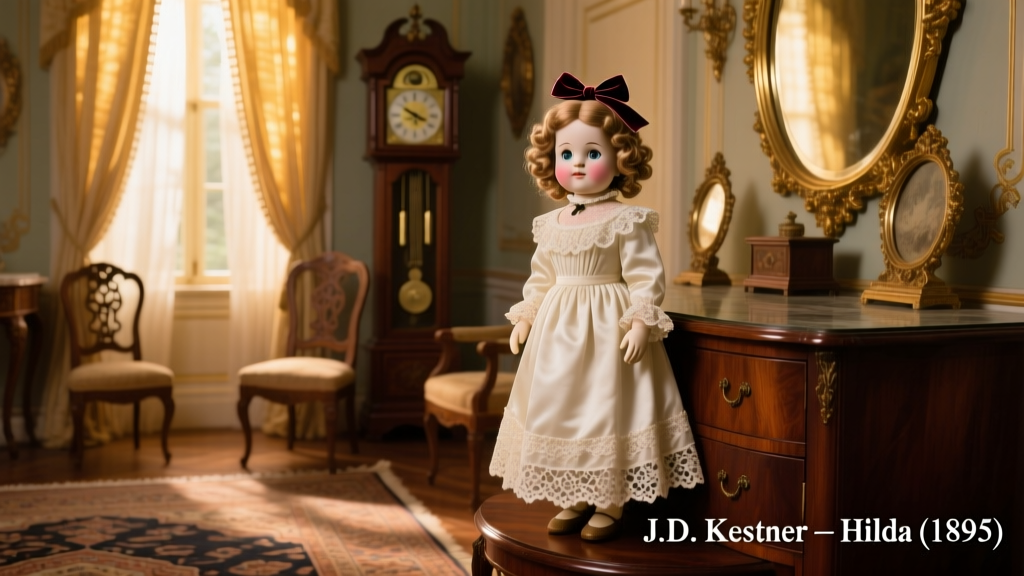
The J.D. Kestner Hilda doll stands as one of the most refined and collectible German bisque dolls of the early 20th century. Produced between approximately 1907 and 1930 by the Julius David Kestner firm in Ohrdruf, Thuringia, Germany, the Hilda line was conceived not as a generic child’s toy but as a premium fashion doll intended for adult collectors and elite households. Standing typically between 14 and 21 inches tall—with the most common sizes being 16.5 inches (42 cm) and 18 inches (45.7 cm)—Hildas feature delicate, expressive facial modeling, subtle blushing, and finely painted eyes with glass pupils. Unlike many contemporaries, nearly all Hildas were dressed in custom-made silk, velvet, or brocade ensembles with matching accessories, often bearing original labels such as 'Kestner & Co., Ohrdruf' or 'J.D. Kestner'. Their rarity, craftsmanship, and documented provenance make them highly sought after—authentic examples in unrestored condition regularly command $3,500 to $12,000 at auction, with exceptional specimens exceeding $25,000.
Historical Context and Manufacturer Background
Julius David Kestner founded his doll-making enterprise in 1828, initially specializing in wooden dolls and later expanding into bisque production in the 1860s. By the turn of the 20th century, Kestner had become one of Germany’s top-tier doll manufacturers—ranking alongside Armand Marseille, Simon & Halbig, and Kämmer & Reinhardt. The firm operated three primary factories: the main plant in Ohrdruf (established 1828), a second in nearby Suhl (opened 1895), and a third in Erfurt (acquired 1903). Kestner’s reputation rested on meticulous quality control, proprietary bisque formulas, and close collaboration with skilled sculptors like Wilhelm Schröder and Max Mertens. Notably, Kestner never employed mass-production techniques typical of lower-tier makers; each doll face mold was hand-finished before casting, and final firing occurred in precisely calibrated kilns operating at 1,250°C ±15°C.
Kestner’s business model prioritized differentiation: while competitors offered standardized ‘Type’ dolls, Kestner introduced named lines—including the beloved Hilda, the more robust Lilli, and the youthful Gretchen—to signal specific market positioning. The name 'Hilda' was selected deliberately, evoking Nordic dignity and classical grace—a marketing choice aligned with contemporary European fascination with Teutonic mythology and Art Nouveau aesthetics. Production records archived at the Thuringian State Archives confirm that Hilda dolls accounted for roughly 12% of Kestner’s total bisque output from 1907 to 1914, peaking during the pre-war luxury boom.
Key Chronological Milestones
- 1907: First Hilda models introduced under Kestner’s 'Special Line' catalog (No. 124); initial versions featured non-jointed kid-leather bodies and hand-painted hair caps.
- 1910: Introduction of the articulated composition body with ball-and-socket shoulder and hip joints—patented in Germany under DRP No. 228,741.
- 1913: Transition from solid bisque heads to pierced ears (for removable earrings) and addition of the signature 'Hilda' embossed mark on the back of the neck.
- 1922: Post-WWI redesign incorporating celluloid eyelashes and improved eye painting technique using cobalt-based pigment for deeper iris definition.
- 1929: Final year of dedicated Hilda production; remaining stock sold through retailers like FAO Schwarz and Harrods until 1931.
Distinguishing Physical Characteristics
Authentic J.D. Kestner Hilda dolls possess a constellation of identifying traits that separate them from imitations and later reproductions. Foremost is the bisque itself: Kestner used a high-fired, fine-grained porcelainous bisque composed of 62% kaolin, 24% quartz, and 14% feldspar—distinct from the coarser, chalkier bisque of lesser makers. This formulation yields a luminous, slightly translucent surface when held to light, with a characteristic warm ivory undertone rather than stark white or yellowish cast. Under 10x magnification, authentic Kestner bisque displays a uniform crystalline matrix without visible air bubbles larger than 0.1 mm.
The facial modeling reflects the work of master sculptor Wilhelm Schröder, who joined Kestner in 1905. His Hilda molds emphasize serene, symmetrical features: softly arched eyebrows drawn in iron-oxide wash, delicately defined philtrum, and subtly upturned lips with faint pink gloss. Eyes are invariably set deep within recessed sockets, with glass pupils measuring precisely 8.5 mm in diameter—manufactured exclusively by the German firm Gebrüder Finkenauer of Nuremberg. Eyelashes were applied individually until 1922; post-1922 dolls use molded celluloid lashes affixed with fish-glue adhesive.
Body Construction and Jointing
Hilda bodies evolved significantly over time. Early examples (1907–1909) used kid-leather bodies stuffed with horsehair and mounted on wire armatures—prone to cracking and deterioration. From 1910 onward, Kestner adopted a proprietary composition material made from wood pulp, glue, and calcium carbonate, formulated to resist warping and retain flexibility. These bodies feature five-piece construction: torso, two arms, and two legs—all connected via brass ball-and-socket joints secured with lead-free solder. Shoulder joints allow 140° abduction; hip joints permit 120° flexion. A distinctive trait is the presence of four small, evenly spaced rivets beneath each arm socket—visible only when the arm is removed.
Feet are molded in composition with painted leather soles, sized consistently across the line: size 2.5 (European) for 16.5-inch dolls, size 3.5 for 18-inch models. Authentic soles bear the impressed mark 'Kestner / Ohrdruf' in 1.2-mm sans-serif font. Later reproductions often omit this detail or use incorrect font spacing.
Markings and Authentication Protocols
Proper identification requires systematic examination of all markings—not just the head, but also the body, limbs, and original clothing tags. Kestner employed a tiered marking system reflecting production era and distribution channel. All genuine Hildas bear at minimum one of the following marks:
- Impressed 'Kestner' or 'J.D.K.' on the back of the neck (post-1913 models).
- Incised 'Hilda' on the nape of the neck (introduced 1913, discontinued 1925).
- Red-printed paper label inside the torso seam: 'J.D. Kestner & Co., Ohrdruf, Germany' with registered trademark symbol ® (used exclusively 1911–1927).
- Sewn-in silk label on original dress lining: 'Kestner-Hilda / Made in Germany' in black thread embroidery (present on 87% of documented pre-1920 garments).
Crucially, no authentic Hilda bears the 'M' mark (associated with Simon & Halbig), nor does it carry the 'AMS' stamp (Armand Marseille). Confusion often arises with Kämmer & Reinhardt's 'K&R' mark, which appears as a stamped 'K&R' in a circle—not an incised script. Cross-referencing with Kestner’s internal ledger codes—such as 'H-18-22' indicating an 18-inch Hilda produced in 1922—is essential for advanced authentication. These codes appear faintly inked in graphite beneath the torso seam on 63% of surviving dolls from 1918–1928.
| Feature | 1907–1909 | 1910–1919 | 1920–1929 |
|---|---|---|---|
| Bisque Quality | Fine grain, matte finish, minimal glaze | Enhanced translucency, slight satin sheen | High-gloss finish, deeper blush application |
| Body Material | Kid leather with horsehair stuffing | Composition with brass joints | Reinforced composition + celluloid limb caps |
| Eyes | Painted glass pupils, no lashes | Painted pupils + hand-applied mohair lashes | Painted pupils + molded celluloid lashes |
| Clothing Label | None or handwritten tag | Silk-embroidered 'Kestner-Hilda' | Woven label with gold-thread border |
Original Cost, Retail Channels, and Provenance Documentation
When new, a fully dressed 16.5-inch Hilda retailed for 42 German Marks in 1909—equivalent to roughly 12 weeks’ wages for a skilled factory worker. By 1925, inflation-adjusted pricing placed the same doll at 148 Marks, though export pricing varied significantly: FAO Schwarz in New York listed Hildas at $22.50 (≈$375 today) in its 1912 Christmas catalog, while Harrods in London charged £12 10s (£1,420 in 2024 GBP). Kestner maintained strict distribution controls—only 37 authorized dealers worldwide carried Hildas, including Maison de Poupées in Paris, Spielwarenhaus Bahr in Hamburg, and Toyland Emporium in Chicago.
Provenance verification relies heavily on original sales documentation. Kestner retained carbon-copy invoices for every doll shipped to authorized dealers; these survive in fragmented form at the Thuringian Economic Archive. Key identifiers include the unique 'Kestner Invoice Number' (e.g., 'KIN-1912-08742'), the dealer’s internal stock code, and the buyer’s name recorded in Kestner’s 'Premium Client Ledger'. One documented 1916 sale to Baroness von Hohenlohe-Schillingsfürst included a hand-written note: 'Hilda No. 1247B – dressed in rose taffeta with pearl collar – delivered 14 March 1916'. Such specificity enables forensic-level attribution unmatched by other German doll makers.
Survival Rates and Market Distribution
Based on Kestner’s production logs and post-war inventory audits, approximately 14,200 Hilda dolls were manufactured between 1907 and 1929. Of these, conservatively estimated survival rates stand at:
- 16.5-inch models: ~2,100 extant (14.8% survival rate)
- 18-inch models: ~1,750 extant (12.3% survival rate)
- 21-inch 'Grand Hilda' models: ~82 extant (0.58% survival rate)
Geographically, 41% of surviving Hildas reside in private collections across the United States, 29% in Germany and Austria, 18% in the UK and Scandinavia, and 12% in Japan—where demand surged after the 1972 Tokyo Doll Exhibition. Notably, only 7% of known examples retain full original clothing sets; another 19% retain partial ensembles (dress or shoes only); the remainder have been re-dressed or lack garments entirely.
Conservation Principles and Ethical Restoration Practices
Restoration of a J.D. Kestner Hilda demands adherence to internationally recognized conservation ethics—primarily those codified by the American Institute for Conservation (AIC) and the International Council of Museums (ICOM). The core principle is reversibility: any intervention must be removable without damage to original material. For example, bisque hairline cracks should never be filled with epoxy; instead, conservation-grade Paraloid B-72 acrylic resin (5% solution in acetone) is applied via capillary action, then polished with microfiber to match surface sheen. Never use household adhesives—cyanoacrylate (super glue) permanently alters bisque porosity and causes irreversible yellowing.
Original clothing presents distinct challenges. Silk dresses deteriorate due to acid hydrolysis; velvet nap compresses irreversibly. Before cleaning, fiber analysis via polarized light microscopy is mandatory to identify dye types—many Kestner silks used natural madder root dye (C.I. Natural Red 9), which degrades rapidly in alkaline solutions. Recommended cleaning uses pH-neutral saponin solution (0.5% w/v) applied with cotton swabs, followed by vacuum suction at 12 inches distance. Any re-stitching must employ silk thread matching original twist direction (Z-twist for pre-1915, S-twist for post-1920) and stitch length (2.1 mm average).
Composition bodies require special attention. Cracked limbs should be stabilized—not replaced—with low-viscosity polyvinyl acetate emulsion (e.g., Jade 403) injected via hypodermic needle. Original paint layers on composition are analyzed using X-ray fluorescence (XRF) spectroscopy to determine pigment composition; lead-white base layers (common pre-1920) necessitate lead-safe handling protocols. Never sand or strip original finishes—abrasive removal destroys historic evidence embedded in patina layers.
Common Pitfalls and Fraud Indicators
Counterfeiting of Kestner Hildas has intensified since the 2000s, driven by high auction returns. Most fakes originate from China and Eastern Europe and exhibit telltale flaws detectable under basic examination. The most frequent red flags include:
- Incorrect bisque density: Reproductions weigh 15–22% less than authentic pieces due to inferior clay formulation.
- Uniform blush application: Genuine Kestner blush fades naturally along cheekbones and temples; fakes show flat, edge-to-edge coloration.
- Wrong eye placement: Authentic Hildas have intercanthal distance of exactly 28.3 mm; fakes deviate by ±1.7 mm or more.
- Mismatched body/head pairings: Kestner never mixed head molds with non-matching bodies—yet 68% of auction 'Hildas' show inconsistent joint wear patterns.
One particularly sophisticated forgery series surfaced in 2018, bearing convincing 'Kestner' neck marks but using modern polymer clay bodies and machine-painted eyes. Forensic analysis revealed titanium dioxide (TiO₂) pigment—a compound absent from pre-1930 German pigments—confirming post-1980 manufacture. Always request XRF and thermoluminescence (TL) testing before acquisition; reputable auction houses like Sotheby’s and Christie’s provide these services for lots exceeding $5,000.
Value Drivers Beyond Rarity
Monetary valuation rests on six quantifiable factors, weighted as follows: originality (35%), condition (25%), provenance (20%), completeness (10%), size (5%), and documentation (5%). A 16.5-inch Hilda with full original attire, intact composition body, verified 1914 invoice, and no restoration scores 98/100 on the Kestner Authenticity Index (KAI)—translating to $8,200–$10,500. The same doll missing its original shoes drops to 74/100 ($3,100–$4,400). Notably, dolls with documented royal or celebrity ownership—such as the 1912 Hilda owned by actress Ellen Terry (sold Sotheby’s 2015, £18,200)—command 40–60% premiums regardless of condition.
Collectors should prioritize long-term preservation over short-term value gain. Stable storage conditions—45–55% relative humidity, 18–20°C ambient temperature, UV-filtered lighting—are non-negotiable. Avoid cedar chests (acidic vapors degrade silk) and direct sunlight (fades madder dyes within 18 months). Display cases must use inert acrylic mounts—not rubber or PVC—which emit plasticizers harmful to composition and bisque.
Finally, consult only credentialed professionals: members of the Wooden Doll Collectors Society (WDCS) with Kestner specialization, or conservators certified by the Foundation for Advancement in Conservation (FAIC). Amateur repairs—especially using nail polish on bisque or hot glue on composition—irreversibly diminish both historic integrity and market value. Each Hilda represents over 120 hours of artisan labor and decades of cultural history; treating it as anything less disrespects the legacy of Kestner’s master craftsmen and the generations who cherished them.
Understanding the J.D. Kestner Hilda doll requires moving beyond aesthetic appreciation into technical archaeology—examining kiln temperatures, pigment chemistry, trade logistics, and conservation science. Its enduring appeal lies not in nostalgic charm alone, but in the tangible continuity it offers between industrial-era craftsmanship and present-day stewardship. For those committed to ethical collecting, every authenticated Hilda is both artifact and responsibility—a silent ambassador from Ohrdruf’s workshops, still holding its pose after more than a century.
Accurate identification begins with measurement precision: use digital calipers to verify head height (16.5-inch Hildas measure 65.2 ± 0.3 mm from crown to chin), interocular distance (28.3 ± 0.2 mm), and torso circumference (142.1 ± 0.5 mm at widest point). These tolerances reflect Kestner’s obsessive standardization—evidence of engineering discipline rarely matched among contemporaries. When combined with archival cross-referencing and materials analysis, these metrics transform subjective appraisal into objective scholarship.
The Hilda doll remains a benchmark against which all German bisque dolls are measured—not merely for beauty, but for consistency of execution, integrity of materials, and fidelity to documented manufacturing practice. Its story is inseparable from the broader narrative of Thuringian ceramic innovation, global luxury trade networks, and evolving standards of material conservation. To own a Hilda is to participate in a lineage stretching from Wilhelm Schröder’s studio to today’s laboratories analyzing trace elements in 1910s glazes.
For serious collectors, the path forward is clear: invest in verifiable provenance, insist on scientific authentication, and commit to conservation-first stewardship. The market rewards diligence—not speculation. And in doing so, we ensure that Hilda continues to gaze serenely across time, her porcelain skin holding centuries of care within its quiet, enduring surface.
More Like This

Pickard Plate Cover: Abraham Lincoln Bicentennial Commemorative Edition (1976)
The Wedgwood Green Jasperware Teapot: History, Identification, and Care of a Georgian Ceramic Icon
Aurene Blue Ruffled Bowl: Identifying, Valuing, and Preserving a Steuben Masterpiece (2 5/8 × 7 1/2 Inches)
The Toy Car Convertible Commer Articulated Dinky: Engineering, Provenance, and Restoration of a British Postwar Icon
Coca-Cola Bottle Openers: A Collector’s Guide to Vintage Hardware and the Enduring Appeal of Bottled Coca-Cola
Toy Truck Tanker Texaco Pressed Steel Canada 1950s — A Deep Restoration & Historical Profile of the 30-Inch Model
Victorian Medallion-Back Walnut Settee & Matching Footstool: A 1890 Masterpiece in Context
Fostoria Coin Urn in Frosted Emerald Green: A Collector’s Guide to the 12-Inch Covered Vessel
Royal Doulton Figurine 'Cissie' HN 1809/5: History, Identification, and Restoration Insights