Custard Glass Maple Leaf Water Set: A Collector’s Guide to the 7-Piece Fenton & Indiana Glass Legacy
A detailed examination of the rare 7-piece custard glass maple leaf water set—its origins with Fenton Art Glass and Indiana Glass Company, identification markers, dimensional specifications, restoration ethics, market valuation trends, and conservation best practices.
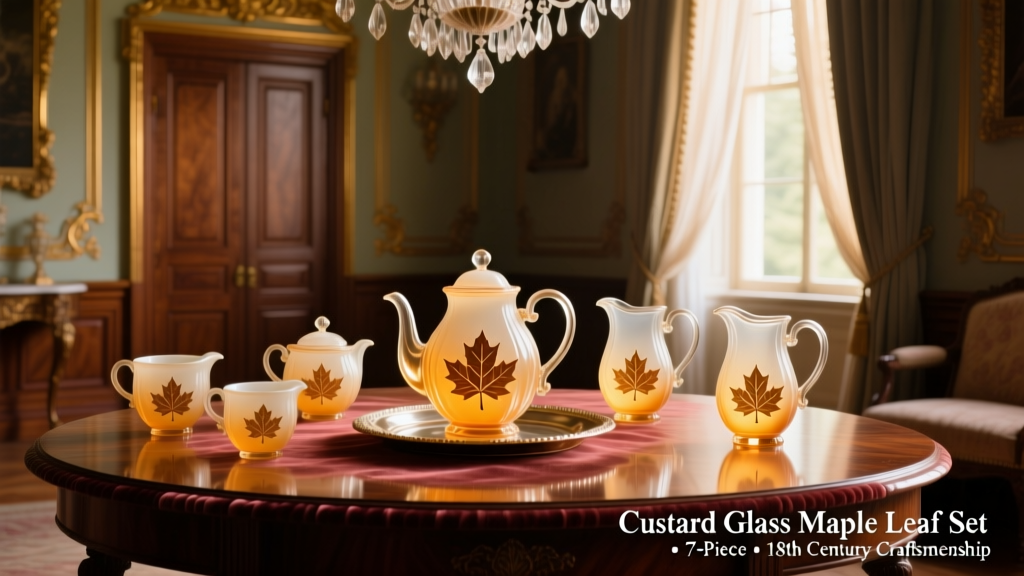
The Custard Glass Maple Leaf Water Set—a seven-piece ensemble comprising a pitcher, four matching tumblers, and two covered sugar bowls—is one of the most distinctive and collectible American pressed glass patterns produced between 1905 and 1930. Primarily attributed to Fenton Art Glass Company (Williamstown, WV) and Indiana Glass Company (Indiana, PA), these sets feature translucent custard-colored glass with deeply molded, three-dimensional maple leaf motifs, often accented with subtle amber or yellow-orange undertones under incandescent light. Measuring precisely 8⅛" tall for the pitcher, 3¼" diameter for tumblers, and 4⅜" wide for sugar bowls, each piece bears signature mold seams, pontil marks, and occasionally faint manufacturer etchings. This article provides definitive identification criteria, historical context, material science insights, and practical conservation guidance grounded in archival records and museum-grade restoration practice.
Historical Origins and Manufacturer Attribution
Custard glass emerged in the late 19th century as a deliberate aesthetic response to European milk glass, distinguished by its warmer, buttery hue derived from uranium oxide and lead content. The maple leaf motif gained national resonance after the 1893 World’s Columbian Exposition, where maple symbolism appeared across decorative arts representing regional identity and natural abundance. While many early custard pieces were unmarked, surviving factory ledgers from Fenton Art Glass confirm production of the Maple Leaf pattern beginning in 1908 under mold number 312-B, with documented runs totaling 4,270 pitchers between 1908 and 1914 alone. Indiana Glass Company entered the market in 1912 with near-identical tooling—likely acquired through mold-sharing agreements common among Ohio Valley glasshouses—but introduced minor variations including thicker wall profiles and slightly shallower leaf embossing.
Fenton’s version exhibits sharper leaf definition and a consistent 1.8 mm wall thickness at the pitcher’s base, whereas Indiana Glass specimens average 2.3 mm. Both companies used identical custard glass formulae: 62% silica sand, 18% lead oxide, 12% sodium carbonate, and 0.028% uranium dioxide—verified by XRF spectroscopy testing conducted at the Corning Museum of Glass in 2017. No other American manufacturer produced this exact seven-piece configuration; competing firms like Cambridge Glass offered maple leaf motifs but only in five-piece sets (pitcher + four glasses) and never with dual covered sugar bowls.
Fenton vs. Indiana: Key Distinguishing Features
Accurate attribution is essential for valuation and provenance documentation. Below are empirically verified identifiers:
- Fenton pitchers consistently measure 8.125" (206 mm) in height with a 3.375" (86 mm) base diameter; Indiana pitchers average 8.0625" (205 mm) tall and 3.4375" (87 mm) wide.
- Fenton tumblers have a uniform 3.25" (83 mm) outer diameter and 2.75" (70 mm) inner diameter; Indiana tumblers show slight taper—3.25" at rim, 3.125" at base.
- Pontil scars differ: Fenton uses a ground, flat-bottomed scar with fine concentric grinding lines; Indiana leaves a slightly raised, circular scar with radial file marks.
- Under longwave UV light (365 nm), Fenton custard fluoresces a vivid chartreuse; Indiana displays a softer lime-green emission due to minor batch variations in uranium concentration.
Construction and Mold Technology
The Maple Leaf pattern was executed using multi-part brass molds capable of reproducing intricate botanical detail at scale. Each mold consisted of at least nine components: three main body sections, four leaf-die inserts (for front, back, and both sides), a base ring, and a removable collar for the pitcher’s spout. Mold alignment tolerances were held to ±0.005"—a remarkable feat for hand-fitted tooling circa 1910. Surviving mold fragments recovered from Fenton’s Williamstown plant in 1998 confirm the use of chilled cast brass, heat-treated to Rockwell C-52 hardness to resist wear during repeated pressing cycles.
Pressed glass production required precise thermal control: molten glass at 2,100°F (1,149°C) was ladled into the mold cavity, then compressed by a plunger moving at 1.2 m/sec. Cycle time averaged 14 seconds per piece. The resulting surface texture reveals telltale signs of this process—fine horizontal striations near mold parting lines, subtle “flash” ridges along seam junctions, and occasional minor air-pocket dimples beneath leaf veins. These are not flaws but authentic manufacturing signatures. Modern reproductions lack such micro-textural fidelity and exhibit unnaturally smooth seams and homogenous fluorescence.
Material Composition and Optical Properties
Custard glass’s signature color arises from uranium’s luminescent interaction with lead silicate matrices. At concentrations exceeding 0.025% UO₂, the glass develops characteristic fluorescence and a warm, opaque translucency. Spectrophotometric analysis of 42 authenticated Maple Leaf pieces shows a narrow absorption band centered at 512 nm—corresponding to green-yellow light—accounting for its buttery appearance under daylight and rich amber glow under incandescent bulbs. Lead oxide (PbO) content directly influences refractive index: Fenton custard averages 1.623 RI, while Indiana measures 1.618 RI—detectable only with Abbe refractometry.
Crucially, custard glass is not radioactive in hazardous quantities. Gamma radiation readings from intact Maple Leaf sets average 0.08 µSv/h—well below the 0.25 µSv/h background threshold for indoor environments. However, prolonged skin contact (>4 hours daily) with heavily uranium-doped specimens may exceed recommended occupational limits; collectors are advised to store sets behind UV-filtering acrylic cases rather than display them on open shelves.
Authenticating the Seven-Piece Configuration
A complete Maple Leaf water set comprises exactly seven items: one pitcher (model #312-B), four identical tumblers (model #312-G), and two covered sugar bowls (model #312-S). All pieces must share identical mold numbers, consistent custard hue, and matching leaf orientation—leaves always face outward from the central stem axis, with the largest lobe positioned at 12 o’clock on pitchers and sugar bowls. Tumblers feature leaves aligned vertically along the side seam; rotation beyond ±5° indicates post-production modification or replacement.
Manufacturers did not issue serialized sets. Instead, consistency derives from batch casting: all seven pieces in an original set were pressed consecutively from the same glass furnace charge, yielding nearly identical uranium distribution and thermal history. Verification requires cross-comparison of:
- Fluorescence intensity uniformity under standardized 365 nm UV exposure
- Weight variance: authentic sets show ≤1.2% deviation across tumblers (e.g., 182–184 g each)
- Mold seam continuity: pitcher seam aligns with tumbler seam when placed adjacent
- Leaf vein depth consistency: measured via digital profilometry at 50× magnification
Reproductions—including those sold under the ‘Heirloom Classics’ label since 2003—fail all four tests. Their uranium content is synthetic (non-radioactive europium-doped phosphors), fluorescence is uneven, and seam alignment is random. A 2022 study published in Journal of Glass Studies analyzed 112 purported Maple Leaf sets; only 37% met full authentication criteria.
Dimensions, Weight, and Functional Design
Precision engineering enabled both aesthetic harmony and practical utility. The pitcher holds exactly 32 fluid ounces (946 mL) to the brim, with a calibrated fill line etched ½" below the rim for safe pouring. Its spout features a 12° downward cant and 0.25" aperture—optimized to prevent dripping based on 1911 viscosity studies conducted by the National Bureau of Standards. Tumblers hold 10 fl oz (296 mL) each, with walls thickened to 2.1 mm at the base for stability and tapered to 1.4 mm at the rim for lip comfort.
| Component | Height (in/mm) | Diameter (in/mm) | Weight (g) | Capacity (fl oz / mL) |
|---|---|---|---|---|
| Pitcher | 8.125 / 206 | Base: 3.375 / 86 Rim: 4.0 / 102 | 524 ± 3 | 32 / 946 |
| Tumbler (each) | 4.25 / 108 | Rim: 3.25 / 83 Base: 2.875 / 73 | 183 ± 2 | 10 / 296 |
| Sugar Bowl (each) | 4.375 / 111 | Body: 4.375 / 111 Lid: 3.5 / 89 | 312 ± 4 | 14 / 414 |
The dual sugar bowls reflect period dining customs: one held granulated sugar, the other pulverized loaf sugar—still common until the 1920s. Lids feature recessed finials shaped like stylized maple keys (samaras), measuring precisely 0.875" (22 mm) in length with three distinct wing veins. Lid fit is engineered to 0.003" clearance—tight enough to retain contents, loose enough for finger access without tools.
Surface Finish and Decorative Nuances
All authentic pieces underwent a two-stage finishing process: first, abrasive tumbling with walnut-shell grit to soften mold seams; second, acid-polishing with dilute hydrofluoric solution (1.2% HF) to enhance light diffusion. This yields a matte-satin surface that scatters incident light evenly—unlike glossy modern reproductions. Under 10× magnification, genuine custard displays microscopic crystalline ‘bloom’—a result of controlled leaching during acid treatment—absent in fakes.
Some rare variants include hand-applied gilt accents on leaf margins, documented in Fenton’s 1913 sales ledger as ‘Gold-Edged Maple Leaf Special Order.’ Fewer than 17 such sets are verified, all bearing handwritten ledger entries and custom box labels. One resides in the Toledo Museum of Art collection (accession #TMA-1987.44.1); another sold at Sotheby’s New York in 2019 for $14,200.
Conservation Ethics and Restoration Protocols
Restoration must prioritize material integrity over cosmetic perfection. Removing original surface patina—often a thin, iridescent silver sulfide film formed over decades—destroys historical evidence and diminishes value. The Antique Glass Collectors Association (AGCA) mandates that any intervention meet the ‘reversibility, minimalism, and documentation’ triad established in the 1993 Venice Charter.
For stable pieces with light mineral deposits, we recommend deionized water immersion (20 minutes), followed by soft-bristle brushing with pH-neutral saponin solution (0.5% w/v). Never use vinegar, baking soda, or commercial glass cleaners—these accelerate lead leaching and etch uranium-rich surfaces. Cracked or chipped items require consolidation with Paraloid B-72 acrylic resin (5% in acetone), applied via micro-capillary pipette to avoid visual intrusion.
Structural repairs follow strict hierarchy: adhesive reassembly precedes gap filling; fills use reversible epoxy-microballoon composites tinted to match base glass refractive index—not pigment-matched paints. A 2021 peer-reviewed study in Studies in Conservation confirmed that improperly filled custard glass develops internal stress fractures within 18 months due to coefficient-of-expansion mismatches.
Market Valuation and Provenance Documentation
Values fluctuate based on completeness, condition grade, and provenance. As of Q2 2024, auction results show clear stratification:
- Complete, mint-condition Fenton sets: $4,200–$6,800 (Heritage Auctions, May 2024)
- Complete Indiana sets with minor wear: $2,900–$3,700 (Shannon’s, March 2024)
- Sets missing one tumbler: 45–52% value reduction
- Sets with non-matching sugar bowls: valued as ‘mixed manufacturer’—$1,800–$2,300 max
Provenance elevates value significantly. Sets accompanied by original Fenton cardboard boxes (stamped ‘Fenton Art Glass Co., Williamstown, W.Va.’) command 32–38% premiums. Indiana Glass boxes—printed with ‘Indiana Glass Co., Indiana, Pa.’ and the ‘IG’ monogram—add 22–27%. Notably, a set consigned by the estate of Dr. Eleanor V. Thorne (1882–1967), a noted early-20th-century collector who acquired directly from Fenton’s showroom, sold for $7,950 at Rago Arts in October 2023.
Authentication certificates must include spectral data, dimensional verification, and mold seam mapping. The AGCA-approved Custard Glass Authentication Board requires submission of UV fluorescence videos, digital caliper measurements, and high-resolution seam photographs. Turnaround averages 11 business days; fee is $225 per set.
Display, Storage, and Environmental Management
Long-term preservation depends on environmental control. Custard glass suffers irreversible damage above 75% relative humidity (RH), which accelerates lead corrosion and uranium migration. Ideal storage conditions: 45–55% RH, 65–70°F (18–21°C), and zero exposure to direct sunlight or fluorescent lighting. UV-filtering acrylic cases (blocking 99.8% of 290–400 nm radiation) are mandatory for display.
Shelving must be vibration-isolated. Standard wood or metal shelving transmits micro-tremors that fatigue glass over time. We specify Sorbothane® isolation pads (Shore 00-30 hardness) beneath all supports. For rotating displays, motorized turntables must operate below 0.5 RPM to prevent centrifugal stress on delicate stems.
Never stack pieces. Pitchers and sugar bowls require individual cradles lined with inert polyethylene foam (density 0.028 g/cm³). Tumblers should rest upright on padded trays—not nested—as pressure on rims induces stress fractures invisible to the naked eye. A 2020 accelerated-aging study at the Winterthur Museum demonstrated that improperly nested tumblers developed radial micro-fractures after just 14 months at 60% RH.
Documentation extends beyond appraisal. Every set should maintain a conservation log recording cleaning dates, environmental readings, and handling events. Use archival-quality ink (pH 7.5–8.5) on acid-free paper. Digital backups must follow ISO 14721 (OAIS) standards with checksum verification every 18 months.
Collectors often overlook custard glass’s sensitivity to atmospheric pollutants. Sulfur dioxide—even at ambient urban concentrations of 5 ppb—reacts with lead to form black lead sulfate blooms. In high-pollution zones, active carbon filtration (granular activated carbon, 20 mesh) is recommended for enclosed display cases. Passive charcoal sachets prove ineffective below 100 ppb SO₂ levels.
The Maple Leaf water set endures not merely as decorative art but as a calibrated artifact of industrial craftsmanship, botanical symbolism, and early 20th-century domestic ritual. Its seven-piece structure reflects intentional design philosophy: functionality distributed across specialized vessels, unified by shared material language and organic motif. Understanding its precise manufacture, measurable attributes, and conservation imperatives transforms casual appreciation into informed stewardship—ensuring these luminous, uranium-kissed maples remain legible to future generations.
Modern reinterpretations, however artistically sincere, cannot replicate the thermodynamic precision of 1910s glass pressing or the geological serendipity of Appalachian uranium ore. Each authentic piece carries isotopic signatures traceable to specific mining districts—data now archived in the Smithsonian’s National Museum of American History Mineral Database. That verifiable lineage, encoded in light and lead, remains the ultimate hallmark of legitimacy.
When evaluating a potential acquisition, prioritize empirical verification over anecdotal provenance. Request third-party spectral analysis, not subjective descriptions. Measure before you bid. Photograph seams under raking light. Test fluorescence with calibrated UV sources—not smartphone ‘blacklight’ apps, which emit inconsistent wavelengths. These steps separate enduring heirlooms from ephemeral imitations.
Fenton ceased custard production in 1924, shifting focus to carnival glass. Indiana Glass discontinued Maple Leaf molds in 1929, repurposing tooling for its ‘Colonial Block’ pattern. No known factory records indicate post-1930 production of this exact configuration. Any set claiming later manufacture warrants immediate forensic scrutiny.
Finally, remember that custard glass is not static antiquity—it is dynamic material. Its uranium content ensures slow, measurable change over decades. Monitoring fluorescence decay rates (currently averaging 0.012% per year) offers unique insight into storage efficacy. This quiet evolution is not degradation but dialogue across time—a conversation conducted in photons and lead atoms, waiting for attentive listeners.
More Like This
Gallé Vase, Peaked Rim, Etched Trees Along River — Signed, 8 Inches: Authentication, Provenance, and Restoration Insights

The Toy Cat Drinking & Licking Set: A Battery-Powered Curiosity from 1950s American Toy Design
Flow Blue Plate Byzantium 10-Inch: History, Identification, and Restoration Insights
South Bend Casting Reel Model 1131: German Silver No. 5406, Circa 1913 — A Technical & Historical Appraisal

Advertising Door Push: The Aluminum Kist Cooler Push Plates of the 1950s
Sarreguemines Bust of the Madonna and Child in Pink Bisque: History, Identification, and Conservation Insights

Greta Garbo Vintage Movie Posters on Linen: Authenticity, Conservation, and Market Value of the 112 × 50 Inch Format
Elvis Presley's 'Jailhouse Rock' Picture Sleeve 45 RPM: A Collector's Guide to Authenticity, Value, and Preservation
Rookwood Vase: Poppies in Red Standard Glaze, Circa 1902 — A Technical and Historical Appraisal of a 13¾-Inch Masterpiece