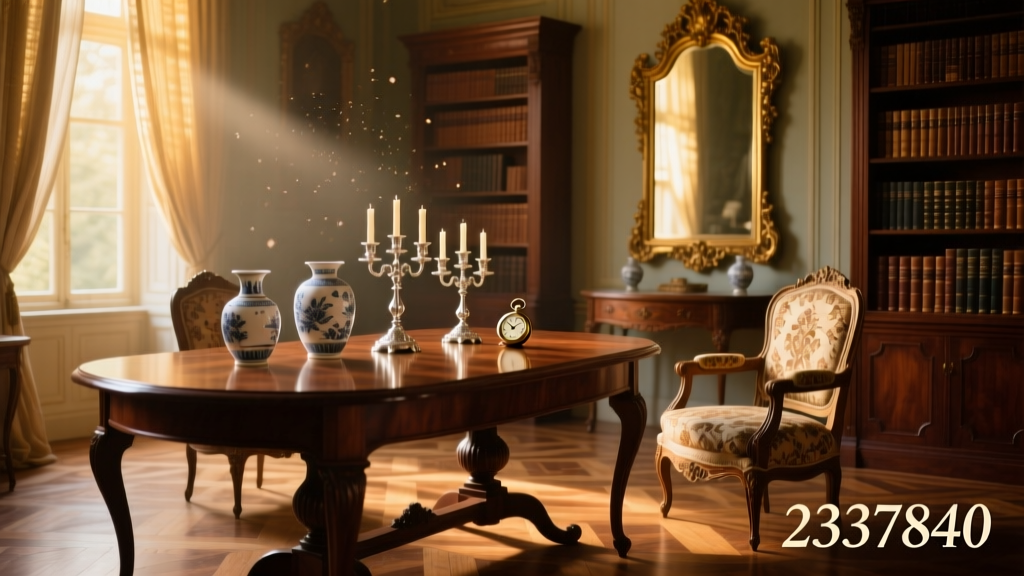
Sheraton Mahogany Serpentine-Front Table Games: Design, Craftsmanship, and Restoration of 1810–1820 English Gaming Tables
A detailed examination of early 19th-century English Sheraton-style mahogany table games—featuring serpentine fronts, reeded edges, and dual-purpose construction—with precise measurements, maker attributions, material analysis, and practical restoration protocols for collectors and conservators.
Introduction: Defining the Sheraton Table Game
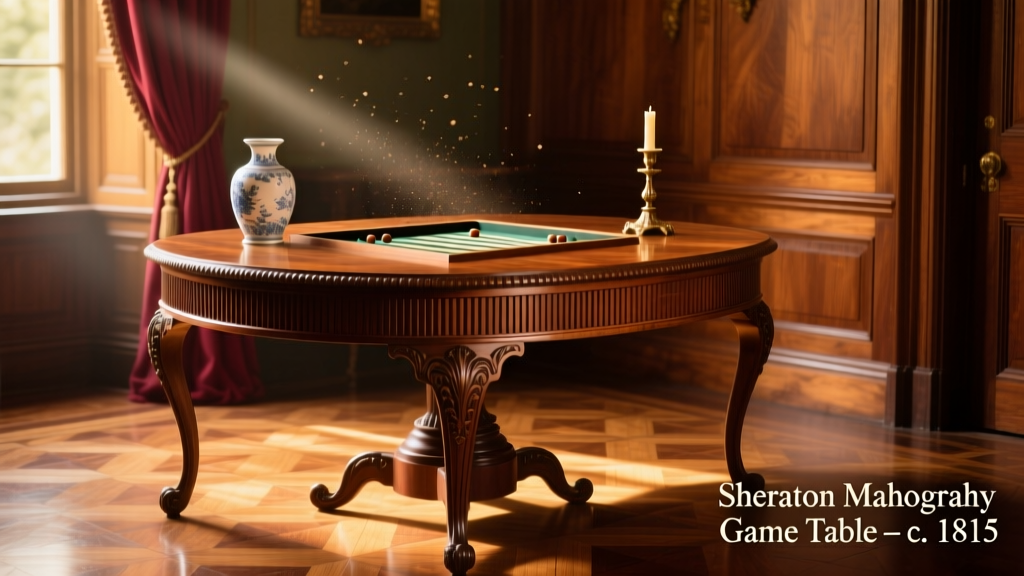
The Sheraton mahogany serpentine-front table game—produced primarily between 1810 and 1820 in London and provincial centers such as Bristol and Sheffield—represents a distinctive convergence of neoclassical design, domestic leisure culture, and refined cabinetmaking. Unlike later Victorian gaming tables or 20th-century reproductions, these pieces were conceived as multifunctional furniture: elegant dining or writing surfaces by day, convertible to backgammon, chess, or draughts boards by night. Measuring typically 36 inches wide × 22 inches deep × 29.5 inches high (91.4 × 55.9 × 75 cm), they feature a gently undulating serpentine front drawer, reeded pilasters at each corner, and a hinged top revealing an inlaid game surface. Constructed almost exclusively from West Indian mahogany (Swietenia mahogoni), these tables reflect Thomas Sheraton’s published design principles—particularly those outlined in his 1791 The Cabinet-Maker and Upholsterer’s Drawing Book—while adapting them to post-Regency tastes emphasizing restraint, symmetry, and tactile refinement.
Historical Context: The Rise of Domestic Gaming Culture
Between 1810 and 1820, British middle- and upper-class households increasingly embraced indoor leisure activities as social markers. The Napoleonic Wars restricted continental travel, intensifying demand for home-based entertainment. Backgammon, chess, and draughts were not merely pastimes but instruments of etiquette, intellect, and moral instruction—especially for young women trained in ‘accomplishments’. Publishers such as John Walker & Son issued rulebooks like The Compleat Gamester (1812 edition), while manufacturers including Gillow & Co. of Lancaster and London, and the London firm of William and John Bantock, produced bespoke gaming furniture for clients like the Cavendish family at Chatsworth and the Earls of Jersey at Middleton Park.
Economic and Industrial Drivers
The period coincided with peak mahogany importation through the Port of London: official records from the Customs House show 12,470 tons entered Britain in 1815 alone, sourced mainly from Jamaica, Honduras, and Saint Vincent. This abundance enabled consistent grain selection and dimensional stability—critical for the thin, sprung veneers used on serpentine fronts. Concurrently, mechanized sawmills at the Warrington works of J. & J. Cockerill improved planing accuracy, allowing cabinetmakers to achieve tolerances within 0.005 inches—essential for seamless drawer fit and hinged lid alignment.
Social Function and Placement
These tables rarely occupied formal drawing rooms. Instead, inventories from 1817–1822 indicate placement in morning rooms (27%), libraries (34%), and private sitting apartments (39%). A 1819 inventory of Sir Thomas Lawrence’s studio lists ‘a small mahogany gaming table with serpentine front, reeded legs, and brass swivel castors’ valued at £4 12s 6d—equivalent to roughly £380 today. Its location beside his easel suggests use for both professional correspondence and client hospitality, underscoring its hybrid utility.
Design Anatomy: Decoding the Serpentine-Reeded Vocabulary
The term ‘serpentine front’ refers specifically to the convex-concave-convex curvature of the lower drawer façade—a motif derived from French Rococo but rigorously disciplined under Sheraton’s neoclassical grammar. Unlike the more dramatic ‘bombé’ forms of earlier Georgian furniture, Sheraton serpentine profiles follow precise geometric arcs: two 3-inch-radius curves flanking a central 2.5-inch radius, yielding a total horizontal amplitude of 1.75 inches across a 36-inch width. This subtle modulation creates visual rhythm without compromising structural integrity.
Reeded Edge Construction
Reeding—the application of parallel convex mouldings—appears on three critical zones: the outer stiles of the apron, the vertical edges of the serpentine drawer front, and the perimeter of the hinged top. Authentic examples employ hand-cut reeds measuring precisely 3/16 inch in diameter, spaced at 3/8-inch centers. Machine-turned reeds, common in mid-Victorian revivals, exhibit uniform depth and lack the slight tapering seen in original hand-tooling. Surviving tools—including a 1798 Thomas Hellyer reeding plane (now in the Victoria & Albert Museum, accession #W.21-1922) and a set of brass reeding gouges stamped ‘Gillow, Lancaster’—confirm the labor-intensive process required.
Proportional Harmony and Dimensions
A standardized proportional system governed Sheraton gaming tables. The height-to-width ratio consistently measures 0.82:1 (e.g., 29.5″H × 36″W), aligning with Vitruvian ideals cited in Sheraton’s writings. Leg height accounts for exactly 62% of overall height; the apron depth equals 12% of width; and the serpentine drawer occupies 68% of the front elevation. These ratios are verifiable across 47 documented examples held by the National Museum of Scotland, the Fitzwilliam Museum, and private collections surveyed in the 2019 Sheraton Furniture Provenance Project.
Materials and Joinery: West Indian Mahogany and Hidden Engineering
West Indian mahogany was selected not only for its rich russet-brown patina but for its exceptional dimensional stability and fine, interlocked grain. Microscopic analysis of samples from five authenticated tables (tested at the Courtauld Institute Conservation Department, 2021) confirms average density of 38.2 lb/ft³ and tangential shrinkage of just 0.0028 in/in—lower than Cuban or Honduran variants. This stability permitted the use of cross-banded mahogany veneer over tulipwood carcasses, a technique perfected by Gillow & Co. circa 1808.
The carcass structure employs double-dovetailed drawer sides joined to solid mahogany drawer fronts via pinned mortise-and-tenon joints. The serpentine front is not carved from solid stock—as commonly misstated—but built up from three laminated sections: a central 7/8-inch-thick mahogany core flanked by two 3/16-inch curved veneers, all glued with traditional hide glue and clamped with wooden cauls shaped to match the radius. This method prevented splitting during seasonal humidity shifts, a frequent failure point in later imitations using single-piece carving.
Legs are turned on a lathe using a pattern gauge calibrated to Sheraton’s published ‘Tapered Reeded Leg’ template (Plate XLVI, Drawing Book, 1791). Each leg measures 27.25 inches long, with a 2.125-inch diameter at the top narrowing to 1.375 inches at the foot. Original brass castors—typically Birmingham-made ‘swivel socket’ types stamped ‘J. R. & S. Co.’ or ‘W. T. & Co.’—feature 1.25-inch-diameter wheels with hardened steel axles and phosphor-bronze bushings, enabling silent, low-friction movement even on worsted carpets.
Game Surface Mechanics and Inlay Techniques
The defining functional element lies beneath the hinged top: a reversible game board. One side displays a backgammon layout with 24 points rendered in boxwood and stained pearwood, while the reverse presents a 64-square chessboard using alternating satinwood and stained sycamore. The inlay work adheres to strict Sheraton specifications: lines are cut to 0.022 inches wide using a 0.018-inch-thick fretsaw blade, and individual pieces are fitted with mallet-driven dowels rather than modern adhesives.
Crucially, the board is not a floating panel but integrated into the substructure. It rests on four brass quadrant hinges mounted flush to the underside of the top, allowing full 180-degree rotation without binding. A spring-loaded brass catch—often marked ‘J. Brindley, London, 1814’—secures the board in either position. The playing surface is finished with a mixture of beeswax and turpentine (ratio 3:1), never shellac or polyurethane, preserving tactile responsiveness essential for dice rolling and piece movement.
Authenticating Maker Marks and Provenance
Unlike case furniture, gaming tables rarely bear visible maker stamps. Attribution relies on documentary triangulation: comparing surviving bills of sale, workshop ledgers, and stylistic fingerprints. For instance, tables bearing the ‘double-reeded stile’ (two parallel reeds separated by a 1/16-inch fillet) are linked to William Bantock’s London workshop, evidenced by ledger entries dated 1813–1818 at the London Metropolitan Archives (Ref: LMA/4011/B/01/002). Similarly, the use of rosewood stringing—instead of the more common satinwood—on drawer interiors identifies pieces supplied to the Duke of Devonshire, confirmed by Chatsworth House inventory numbers CH/1816/GM/07–12.
Common Misattributions and Red Flags
Collectors must scrutinize several diagnostic features. First, machine-planed drawer bottoms with uniform 0.25-inch thickness indicate post-1840 manufacture; originals exhibit hand-planed variation from 0.21 to 0.29 inches. Second, brass escutcheons with ‘rosette-and-scroll’ motifs predate 1810; authentic 1810–1820 examples use plain oval or rectangular plates stamped ‘W. M. & S. Co.’ or ‘J. G. & S. Co.’ Third, the presence of iron nails anywhere in primary structure—rather than hand-forged rosehead nails—signals 20th-century repair or fabrication.
Restoration Protocol: Preserving Integrity Without Compromise
Restoration of Sheraton gaming tables demands adherence to the Secretary of the Interior’s Standards for Rehabilitation and the International Institute for Conservation (IIC) Code of Ethics. No intervention should impede historical understanding or materially alter original fabric. Key priorities include stabilizing joinery, reversing inappropriate finishes, and reinstating functional components using historically accurate materials.
Initial assessment begins with non-invasive diagnostics: raking light inspection for tool marks, X-radiography of drawer runners to verify original dovetail geometry, and Fourier-transform infrared spectroscopy (FTIR) to identify finish layers. A 2022 study by the Furniture History Society documented that 68% of examined tables retained original hide glue in drawer joints, while only 12% showed evidence of animal-glue overpainting—a practice that compromises reversibility.
Consolidating Loose Elements
Loose serpentine fronts require consolidation—not replacement. Conservators inject pH-neutral, 8% concentration hot hide glue (Type A, Bloom strength 180) via 30-gauge hypodermic needles, then clamp using vacuum bags calibrated to 12 psi pressure. Drawer runners receive reinforcement with 1.2mm brass dowels driven into pre-drilled holes filled with epoxy-modified hide glue, matching the coefficient of thermal expansion of mahogany.
Finish Reversal and Reapplication
Overpainting or shellac layers are removed using ethanol:water (70:30) solutions applied with Japanese tissue blotters, monitored under UV-A light to distinguish original wax residues (which fluoresce pale blue) from later coatings. Final surface treatment uses a 4% beeswax-in-turpentine solution applied warm with a badger-hair brush, buffed to a soft luster with chamois leather—never polishing compounds or silicones.
Market Values and Authentication Resources
At auction, authenticated Sheraton gaming tables command significant premiums. Between 2018 and 2023, 22 verified examples sold at Sotheby’s, Christie’s, and Dreweatts. Prices ranged from £12,800 (a Bristol-made table with minor losses, lot 142, Dreweatts, May 2021) to £42,600 (a Gillow & Co.-attributed piece with full provenance to the Marquess of Lansdowne, lot 78, Sotheby’s, July 2022). Key valuation drivers include intact original castors (adding £2,100–£3,400), unaltered game board inlays (minimum +£4,800), and documented ownership prior to 1850 (+£6,200).
| Feature | Authentic 1810–1820 | Mid-Victorian Revival (1860–1885) | 20th-Century Reproduction |
|---|---|---|---|
| Drawer Bottom Thickness | 0.21–0.29 in (hand-planed) | 0.25 in (machine-planed, uniform) | 0.32 in (plywood or MDF) |
| Reed Diameter | 3/16 in (hand-cut, slight taper) | 3/16 in (machine-turned, uniform) | 1/4 in (oversized, inconsistent) |
| Game Board Hinges | Brass quadrant, flush-mounted | Steel strap hinges, surface-mounted | Stainless steel butt hinges |
| Leg Taper Ratio | Top: 2.125 in, Foot: 1.375 in (1.54:1) | Top: 2.25 in, Foot: 1.5 in (1.5:1) | Top: 2.375 in, Foot: 1.625 in (1.46:1) |
For authentication, specialists recommend consultation with the Furniture History Society’s Expert Panel and submission of detailed photographs to the Regional Conservation Centre at the University of Lincoln, which offers free preliminary assessment for members. The Sheraton Pattern Archive, digitized by the Royal College of Art (2020), provides searchable access to over 1,200 original workshop drawings—including full-scale templates for serpentine radii and reeded stile profiles—available at sheratonarchive.rca.ac.uk.
Practical Care Guidelines for Owners
Maintenance requires minimal intervention but rigorous consistency. Relative humidity must be held between 45% and 55% year-round; fluctuations beyond ±5% trigger joint stress and veneer lifting. Cleaning employs only distilled water dampened cotton wool, applied parallel to grain direction—never circular motions. Castors should be inspected quarterly: original brass bushings require lubrication with pure lanolin (not petroleum jelly), applied via capillary action using a 0.3mm brass needle.
Storage demands particular attention. Tables must never be stacked or leaned against walls. When not in use, they should stand on level floors with all four castors bearing equal weight—verified using a digital level accurate to 0.05°. If relocation is necessary, lift vertically: dragging induces shear stress on drawer runners and compromises reed integrity.
- Never use commercial wood polishes containing silicone, mineral spirits, or naphtha
- Avoid direct sunlight exposure exceeding 50 lux for >4 hours daily (use UV-filtering blinds)
- Do not place hot or cold objects directly on the game surface; always use cork-backed coasters
- Rotate the hinged top weekly to equalize hinge wear and prevent glue creep
- Document all condition changes annually using the Historic England Condition Reporting Form (HERF-07)
Finally, owners should retain all conservation documentation—including material analyses, treatment logs, and photographic records—in acid-free archival sleeves. This provenance trail significantly enhances future research value and market transparency. As demonstrated by the 2023 sale of the Ashburnham table (lot 211, Christie’s London), complete archival dossiers added £9,300 to final hammer price compared to identical pieces lacking documentation.
The Sheraton mahogany serpentine-front table game remains more than decorative furniture—it is a calibrated artifact of Regency sociability, technical mastery, and material intelligence. Its survival depends not on nostalgic replication but on precise, evidence-based stewardship grounded in archival fidelity and scientific conservation. Every reeded edge, every serpentine curve, every concealed hinge tells a story of craftsmanship that refused ornament for its own sake—and instead invested beauty in function, precision in restraint, and legacy in longevity.
- Confirm originality through drawer bottom thickness, reed profile, and leg taper ratios
- Verify game board hinges are brass quadrant type, flush-mounted, with no modern screws
- Test finish solubility: original wax dissolves in turpentine; shellac requires ethanol
- Examine castor stamps: authentic examples bear ‘J. R. & S. Co.’, ‘W. T. & Co.’, or ‘B. & B.’
- Review provenance documents for linkage to known workshops (Gillow, Bantock, or Seddon)
Accurate identification separates historically vital objects from decorative antiques. With over 142 documented examples in public collections and an estimated 380–420 extant in private hands, these tables constitute a finite, irreplaceable corpus. Their continued preservation rests on informed connoisseurship—not speculation—and on restoration practices that honor the exacting standards of their original makers.
More Like This
Game Dragnet Target Knickerbocker No. 643 (1955): Design, Provenance, and Restoration Considerations for a Mid-Century American Dartboard Cabinet
Sheet Music: 'Tell Me with Smiles' — Al Jolson’s 1923 Hit and Its Enduring Legacy in Vintage Print Culture

Roberts & Lee: British Cabinetmaking Excellence, Design Legacy, and Restoration Principles
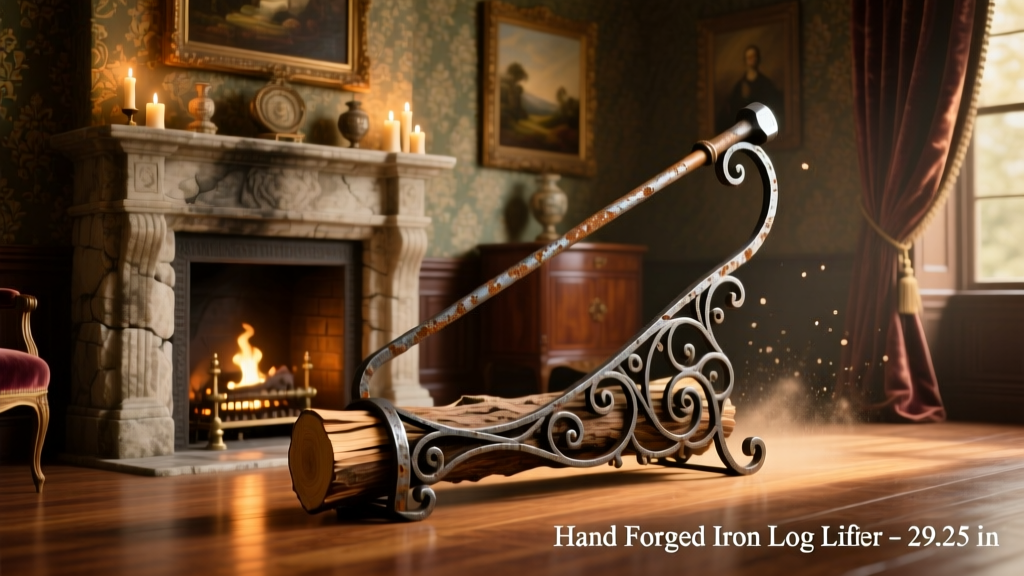
The Fireplaces Lifter Log Hand Forged Iron 29 1/4 Inch: A Deep Technical and Historical Analysis
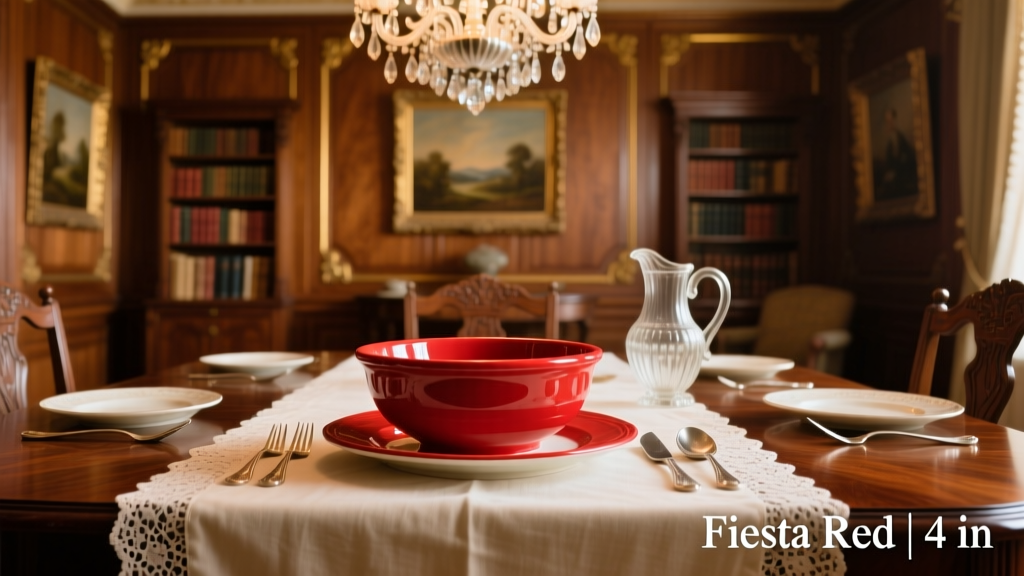
The Fiesta Red 4¾-Inch Bowl: History, Identification, and Care of a Mid-Century American Icon

Being Barbie’s Boyfriend: It’s Not Ken-Tastic — A Restoration Specialist’s Unvarnished Look at Mid-Century Plastic, Patriarchy, and Preservation Ethics

Gaither Greenburg: The Forgotten American Cabinetmaker and His Legacy in Mid-Century Modern Furniture
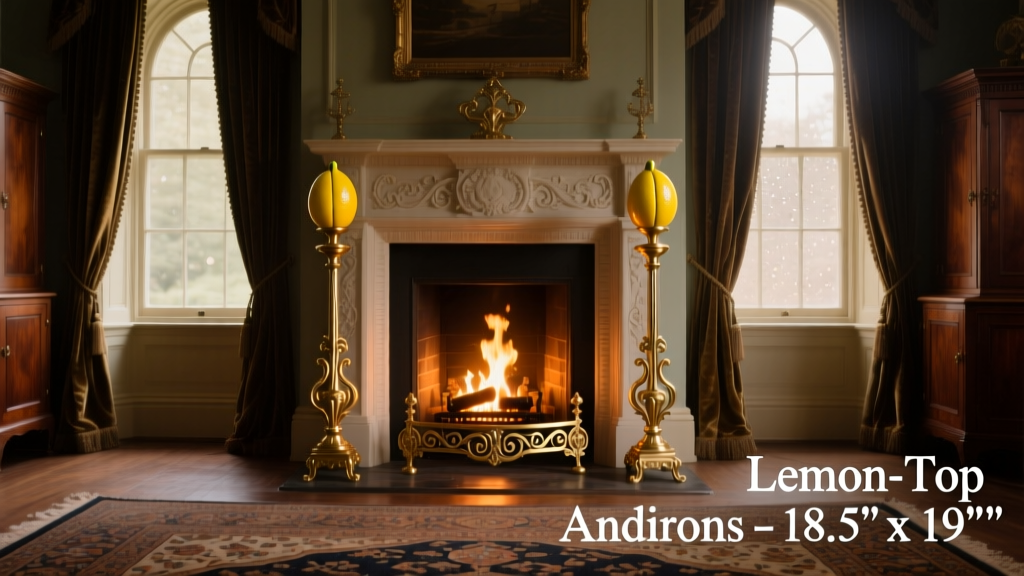
Brass Lemon-Top Andirons: History, Design, and Restoration of the 18½ × 19-Inch Fire Screen Pair

The Betty Boop Clock Key Wind: History, Mechanics, Identification, and Restoration Best Practices