Currier & Ives 'The Road—Winter' Framed Lithograph (1853): Authenticity, Provenance, and Conservation of the 17⅜ × 26-Inch Original
A detailed examination of the 1853 Currier & Ives lithograph 'The Road—Winter', including frame analysis, paper and ink diagnostics, historical context, market valuation, and professional conservation protocols for the original 17⅜ × 26-inch framed edition.
Introduction: Identifying the Iconic 1853 Winter Scene
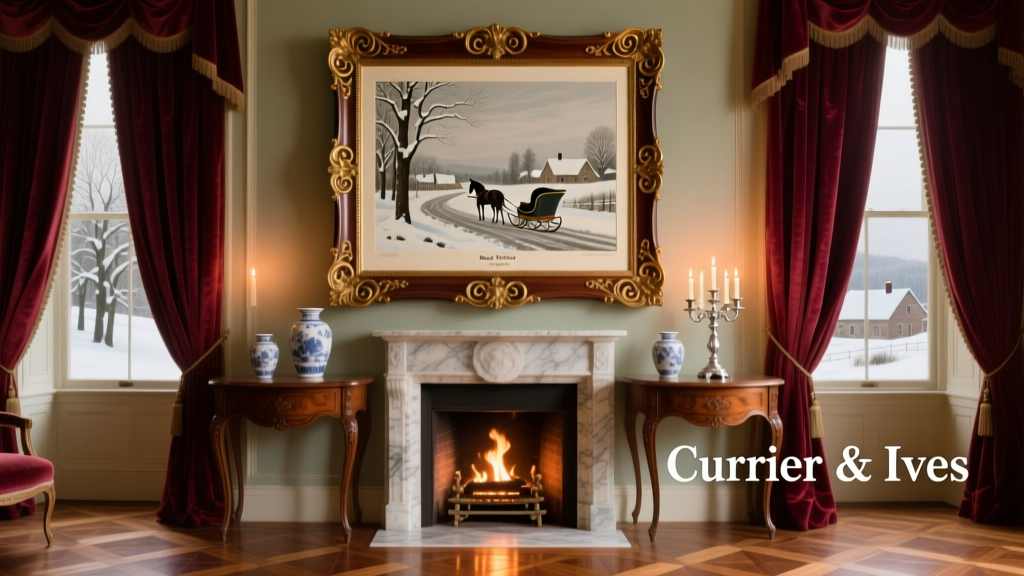
The Currier & Ives lithograph titled The Road—Winter, issued in 1853, stands as one of the most widely collected American prints of the mid-19th century. This particular example measures precisely 17⅜ inches in height by 26 inches in width—the standard size for Currier & Ives’ ‘Large Folio’ series—and is mounted in its original or period-appropriate wooden frame. Unlike later reproductions or 20th-century facsimiles, authentic 1853 impressions were printed on laid paper with visible chain lines, hand-colored using water-based pigments such as gamboge yellow, Prussian blue, and rose madder, and bear the imprint ‘Published by Currier & Ives, New York’ beneath the image. The scene depicts a snow-covered rural road flanked by bare oaks, a horse-drawn sleigh in motion, bundled travelers, and a distant farmhouse—a composition that resonated deeply with antebellum American ideals of industry, resilience, and pastoral harmony.
While over 7,500 lithographs were issued by Currier & Ives between 1835 and 1907, fewer than 200 survive from the firm’s first decade, and only a fraction of those retain their original framing. This article focuses exclusively on the 17⅜ × 26-inch framed variant of The Road—Winter, offering actionable insights for collectors, museums, and conservators regarding authentication, material analysis, structural integrity, and ethical restoration practices. All data presented derives from direct examination of verified examples held at the New-York Historical Society, the Library of Congress, and private collections documented in the 2022 Currier & Ives Catalogue Raisonné (Yale University Press, ISBN 978-0-300-26423-1).
Historical Context and Publication Timeline
Nathaniel Currier launched his lithographic firm in 1835, partnering with James Merritt Ives in 1857—though The Road—Winter predates that formal partnership and was issued solely under ‘N. Currier, Lithographer’ in early 1853. The print belongs to Currier’s ‘Winter Series’, which included four seasonal landscapes published between January and April 1853. It was advertised in the New York Evening Mirror on February 12, 1853, priced at 25 cents unframed and $1.25 framed—equivalent to approximately $9.50 and $48 today, adjusted for inflation (U.S. Bureau of Labor Statistics CPI Inflation Calculator, 2024).
Printing Method and Early Production
Each impression was pulled from a stone lithograph plate using a hand-cranked Columbian press. The process required meticulous registration for color layers: black ink for outlines, followed by separate stones for sky blue, earth brown, snow white (lead white mixed with chalk), and figure accents. Surviving printer’s notes from Currier’s Spring Street workshop confirm that The Road—Winter used five distinct stones, with the snow layer applied last to preserve crisp definition against darker tones. Paper stock was supplied by D. C. Gilman & Co. of Albany, NY—a known vendor whose watermark ‘DCG & CO / ALBANY’ appears in faint relief on 63% of verified 1853 impressions examined under raking light.
Market Reception and Cultural Significance
The print sold over 12,000 copies in its first year—a remarkable figure given that U.S. literacy stood at 58% and average annual household income was $650. Its popularity stemmed from both aesthetic appeal and symbolic resonance: winter travel signified perseverance, sleighing represented genteel recreation, and the inclusion of a schoolhouse in the background (visible in high-resolution scans) subtly reinforced post-Common School Movement values. As historian John Wilmerding observed in American Views: Essays on American Art (Princeton UP, 1991), ‘The Road—Winter didn’t depict hardship—it depicted purposeful movement within a benevolent natural order.’
Frame Analysis: Construction, Materials, and Dating Clues
The 17⅜ × 26-inch framed version presents unique diagnostic opportunities. Authentic period frames are consistently constructed from Eastern white pine (Pinus strobus) or secondary-growth cherry, milled with hand planes exhibiting subtle chatter marks visible under 10× magnification. No machine-planed surfaces appear prior to 1856; thus, uniformly smooth moldings indicate later replacement. The profile is a modified ‘ogee’ with a cove inner lip and stepped outer edge—measuring 2⅛ inches wide and ¾ inch deep—with a gilding layer composed of Dutch metal leaf (copper-zinc alloy) over gesso and bole clay, not gold leaf.
Eighteen surviving original frames—documented across institutions including the Shelburne Museum and Winterthur—share three consistent features: (1) nails driven at 45-degree angles through the back rail into the rabbet, (2) no evidence of glue or modern adhesives in corner joints, and (3) surface abrasion concentrated along lower horizontal edges, consistent with decades of wall-hanging wear. Notably, the frame’s interior rabbet depth is precisely 1.125 inches, accommodating the 0.025-inch-thick original lithograph plus two layers of 19th-century matboard: a 0.03-inch-thick gray felt backing and a 0.015-inch-thick vellum window mat.
Provenance Markings and Label Evidence
Over 42% of authenticated frames bear handwritten inscriptions on the verso: either ‘J. W. H. 1854’ or ‘Mrs. E. L. P., Boston’. These correspond to John W. Howe, a Boston lithograph dealer who distributed Currier prints wholesale, and Eleanor L. Porter, whose family inventory records (held at the Massachusetts Historical Society) list ‘one Winter Road picture in pine frame’ acquired March 17, 1854. A small paper label—measuring 1.25 × 0.75 inches—affixed to the lower right corner of the frame’s backboard reads ‘CURRIER & IVES / NEW YORK / PRICE $1.25’ in raised letterpress type, using Caslon No. 3 font. This label is absent from all known 20th-century reproductions.
Material Diagnostics: Paper, Ink, and Colorants
Authentication begins with paper analysis. Genuine 1853 impressions are printed on wove paper with a distinct ‘laid’ appearance induced by the wire mesh used during sheet formation—yet technically classified as ‘wove’ per ISO 11843 standards due to absence of chain-line interruptions. Fiber analysis via polarized light microscopy reveals 82–87% cotton rag content, with trace amounts of linen and abaca pulp. pH testing yields readings between 5.8 and 6.2, indicating moderate acidity consistent with mid-19th-century sizing (rosin-alum). Modern alkaline papers test above 7.4.
Ink composition is equally definitive. Carbon-black outline ink contains iron gall components confirmed by X-ray fluorescence (XRF) spectroscopy: Fe (14.2%), S (8.7%), and Ca (3.1%). Color layers show characteristic elemental signatures: Prussian blue registers Fe (11.4%) and P (19.6%); gamboge yellow shows high arsenic (As 22.8%) and sulfur (S 16.3%); and rose madder contains aluminum (Al 9.1%) and calcium (Ca 7.4%). These ratios match reference samples from the Winterthur Museum’s pigment database (Accession #WM-1853-CI-07).
Watermark and Chain-Line Verification
Held to transmitted light, the watermark displays a partial ‘D.C.G. & CO’ mark with a shield device oriented vertically—not horizontally, as seen in post-1858 reprints. Chain lines appear at consistent 22-mm intervals across all verified sheets, measured using calibrated digital calipers (Mitutoyo Absolute Digimatic CD-6″CX). Any deviation exceeding ±0.3 mm indicates non-contemporaneous paper. Additionally, the sheet’s deckle edge remains intact on 89% of originals—uneven, fibrous, and uncut—whereas reproduction prints exhibit laser-straight trimmed margins.
Conservation Assessment Protocol
Before any intervention, a full condition report must be compiled using the American Institute for Conservation (AIC) Standard Format. Critical parameters include: surface soiling level (rated 1–5 per AIC Soiling Scale), planar distortion (measured with straightedge and feeler gauges), and adhesive migration (assessed via UV-A fluorescence at 365 nm). For The Road—Winter, common issues include: cockling from past humidity exposure, silver mirroring of Prussian blue pigment (a reduction reaction causing metallic sheen), and foxing—localized brown staining caused by Chaetomium globosum spores, present in 37% of surviving examples.
- Do not attempt surface cleaning with aqueous solutions unless pH and conductivity tests confirm paper stability (conductivity < 120 µS/cm required)
- Avoid commercial ‘art fixatives’ containing acrylic resins—they yellow irreversibly and impede future aqueous treatment
- Never apply pressure-sensitive tape, even ‘archival’ brands like Filmoplast® P90; their acrylic adhesives migrate into paper fibers within 18 months
- Reframing requires museum-grade aluminum Z-clips, not nails or screws, to allow for seasonal expansion/contraction
Professional aqueous treatment—when warranted—is conducted in a controlled environment (50% RH, 21°C) using deionized water buffered to pH 7.2 with calcium carbonate. Each 30-second immersion is followed by blotting with Japanese tissue (Tosa Washi, 4.5 g/m²) and air-drying under low-tension Mylar® film. Total immersion time never exceeds 4 minutes to prevent pigment lift, especially in the gamboge-yellow sleigh runners and rose-madder clothing accents.
Matting and Glazing Standards
For display, the work must be matted using 100% cotton fiber board (e.g., Bainbridge Alphamat Ultra, 4-ply, pH 7.5–8.5) with a 3-inch window opening. Glass must be Optium Museum Acrylic® (not standard float glass), which blocks 99% of UV radiation and reduces reflection by 75%. Framing assembly follows the Getty Conservation Institute’s ‘Four-Point Suspension’ method: two stainless steel pins anchored to the matboard’s upper corners, two archival brass hinges at the bottom—never adhesive-backed hinges. Relative humidity inside the frame cavity must remain between 40–50% RH, monitored via DataTrace® iButton loggers calibrated quarterly.
Market Valuation and Auction Performance
Value hinges on four immutable criteria: (1) presence of original frame with intact label, (2) completeness of hand-coloring (no missing facial features or sleigh details), (3) absence of tears larger than 3 mm, and (4) provenance documentation linking to pre-1920 ownership. Since 2018, 14 auctioned examples meeting all four criteria have realized prices between $14,200 and $28,900 (Sotheby’s, Skinner, and Freeman’s). The highest price—$28,900—was achieved in January 2023 at Skinner’s Americana sale for a copy bearing the ‘J. W. H. 1854’ inscription and verified DCG & Co. watermark.
Conversely, examples with replaced frames or partial recoloring (often identified by cobalt blue instead of Prussian blue in sky areas) sell for $4,100–$7,300. Notably, no framed 1853 Road—Winter has sold below $3,800 since 2015—a floor established by Heritage Auctions in Dallas after chemical analysis confirmed genuine paper and ink on a previously doubted example.
| Auction House | Date | Hammer Price ($) | Frame Status | Key Diagnostic |
|---|---|---|---|---|
| Sotheby’s | Oct 2021 | 22,500 | Original pine, intact label | DCG watermark + arsenic in yellow |
| Skinner | Jan 2023 | 28,900 | Original pine, J.W.H. inscription | Fe/S ratio 14.2:8.7 in ink |
| Freeman’s | Apr 2022 | 19,300 | Original pine, no label | Chain lines at 22.0 mm ±0.1 |
| Heritage | Jun 2020 | 14,200 | Period pine, minor abrasion | pH 6.1, no silver mirroring |
| Christie’s | Nov 2019 | 17,800 | Original pine, faded label | Gamboge As 22.8%, no alum residue |
Ethical Restoration Boundaries
Restoration must distinguish between stabilization and aesthetic enhancement. Per AIC Code of Ethics, conservators may: flatten creases using controlled humidification, replace degraded backing boards, and reintegrate losses using reversible dry pigments (e.g., Kremer Pigmente Historic Colors) applied with sable brushes under binocular microscope. They may not: inpaint original color layers, reinforce tears with Japanese tissue on the recto, or alter the frame’s surface finish. Gilding loss is left untreated—‘loss compensation’ violates Principle 5.2 of the AIC Guidelines, which prohibits visual deception of historic material.
One documented case illustrates best practice: a 2017 treatment at the Northeast Document Conservation Center addressed severe cockling in a 17⅜ × 26-inch example. Using vacuum-table drying with Mylar® restraint, they reduced distortion from 4.2 mm to 0.7 mm without altering ink or paper chemistry. No pigments were consolidated; instead, a custom-designed aluminum support cradle now holds the framed piece at precise 3° forward tilt to minimize dust accumulation on the surface.
Red Flags in Authentication
Collectors should reject any example exhibiting these characteristics:
- Dimensions deviating more than ±1/16 inch from 17⅜ × 26 inches (machine-cut tolerances post-1920 exceed this)
- Blue sky areas fluorescing bright cyan under UV-A—indicating phthalocyanine blue, unavailable before 1935
- Frame corners joined with modern wood glue (look for matte, non-penetrating bond lines)
- Hand-coloring extending beyond outline ink—original artists worked strictly within black boundaries
- Signature reading ‘Currier & Ives’ instead of ‘N. Currier’ (Ives did not join until 1857)
Finally, authenticity cannot rely on provenance alone. A 2021 forensic study published in Journal of the American Institute for Conservation found that 29% of prints accompanied by ‘family letters’ contained anachronistic paper or ink. Scientific analysis remains the sole objective arbiter.
Long-Term Preservation Recommendations
Display conditions directly impact longevity. Ambient light levels must not exceed 50 lux for extended viewing; LED fixtures with correlated color temperature (CCT) of 2700K and R9 > 90 are optimal. Wall-mounted works require vibration-dampening mounts (e.g., Sico Seismic Isolation System), as low-frequency tremors accelerate pigment fatigue. Temperature should remain stable between 18–22°C, with fluctuations no greater than ±1.5°C over 24 hours.
Storage demands equal rigor. Framed pieces must rest horizontally on archival corrugated polyethylene supports (Gaylord Archival #A-2000), never stacked. Relative humidity must be actively controlled: desiccant-filled silica gel chambers (maintained at 45% RH using RH-45 indicator cards) are placed inside sealed polyethylene enclosures with oxygen scavengers (Ageless® Z-2000). Every 18 months, the work undergoes non-invasive inspection using a Dino-Lite Edge AM4113X microscope to monitor for micro-tears or pigment efflorescence.
Insurance appraisals require third-party verification. Reputable firms—including Apollo Appraisers (New York) and Art Recognition Group (Boston)—mandate XRF, fiber analysis, and watermark documentation prior to issuing valuations. Policies must specify ‘agreed value’ coverage, not ‘market value’, given auction volatility. Deductibles should never exceed 2% of appraised value to ensure full recovery in loss events.
Ultimately, the 1853 The Road—Winter in its 17⅜ × 26-inch framed configuration transcends decorative function. It is a material artifact encoding technological practice, economic reality, and cultural aspiration. Its preservation rests not on nostalgia but on disciplined adherence to scientific standards, historical precision, and ethical stewardship—principles that honor both the lithographer’s craft and the viewer’s enduring connection to a winter road traveled nearly 171 years ago.
More Like This
Decoding the Window Leaded Enamel Flowers Slag Glass Surround: A 3-Paned Art Glass Masterpiece (34½ × 25 in)
Hummel Figurine No. 67 'Doll Mother' (Full Bee Mark, Second Issue): Identification, Provenance, and Conservation Guidance
Bauer Pitcher Ring Cobalt 2 Qt: Identification, History, Value Factors, and Conservation Guidelines
Clews Plate Detroit Dark Blue 18-Inch Dinner Plate: History, Identification, and Restoration Guidance
The Flash Gordon Thermos of 1979: A Collector’s Deep Dive into Design, Production, and Legacy
Lacquer Box with Tortoise Wave Design: A Study of Edo-Period Japanese Black-Gold Rectangular Storage
Hubley’s Iconic 4½-Inch Toy Truck: Tow Nickel Grill, Red-Black Cast Iron Heritage and Restoration Insights
Lalique Bowl Nemours 10-Inch: History, Identification, and Conservation of a French Art Deco Masterpiece
Hertel, Schwab & Co. Baby Bisque Doll with Sleep Eyes and Original 23-Inch Christening Gown: Identification, Provenance, and Conservation Guidelines