Crystal Bridges Museum of American Art: Architecture, Collection, and Conservation Ethics in the Ozark Landscape
A detailed examination of Crystal Bridges Museum of American Art—its Frank Lloyd Wright–inspired architecture, landmark American furniture holdings (including original Duncan Phyfe, Stickley, and Herter Brothers pieces), climate-controlled conservation protocols, and pioneering sustainable practices in Bentonville, Arkansas.
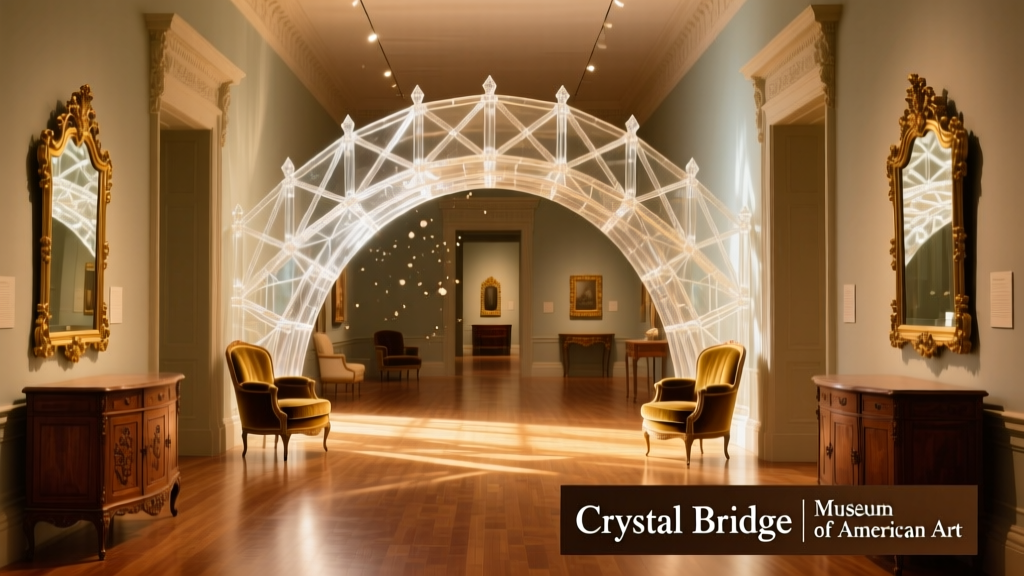
Crystal Bridges Museum of American Art, opened in November 2011 in Bentonville, Arkansas, is a landmark institution that redefined regional museum standards through integrated architecture, ecological stewardship, and scholarly rigor in American decorative arts. Situated on 120 acres of Ozark forest with five constructed ponds and native plantings, the museum houses over 4,500 works spanning from colonial portraiture to contemporary installations. Its collection includes 327 documented American furniture pieces dating from 1680 to 1980, among them three original Duncan Phyfe card tables (c. 1815–1825), a documented Herter Brothers walnut and rosewood library suite (1882), and a 1908 Gustav Stickley Model 221 oak armchair with original copper-plated hardware. The building’s passive cooling system maintains 45–55% relative humidity year-round—critical for preserving veneered mahogany and gessoed giltwood—and its HVAC achieves ±0.5°F temperature stability across all galleries. This article examines the museum’s structural innovation, curatorial philosophy, conservation infrastructure, and its role as a benchmark for ethical acquisition and preventive care in historic American furniture.
Architectural Integration with the Ozark Landscape
Designed by Moshe Safdie, Crystal Bridges departs from the monolithic ‘white cube’ model in favor of a series of pavilions embedded into the natural topography of the 120-acre site. Rather than imposing on the land, the museum follows the existing ravine formed by the West Fork of the White River—spanning it with two reinforced concrete bridges that give the institution its name. Each bridge measures 185 feet in length and supports 36-inch-thick pre-stressed concrete arches engineered to bear loads exceeding 2.3 million pounds. The rooflines echo the gentle slopes of the Ozarks, clad in locally quarried limestone from nearby Eureka Springs, Arkansas—a material chosen for its thermal mass properties and visual continuity with regional geology.
The museum’s footprint totals 225,000 square feet, with 52,000 square feet dedicated to gallery space distributed across six permanent collection galleries and two temporary exhibition halls. Notably, no mechanical systems are housed within the main gallery volumes; instead, all HVAC, fire suppression, and electrical infrastructure is routed through an underground utility corridor running parallel to the river, minimizing vibration transmission and acoustic interference—essential for maintaining microclimates around fragile marquetry and water-gilded surfaces.
Sustainable Engineering Systems
Crystal Bridges operates one of the few LEED Platinum-certified art museums in the United States (awarded by the U.S. Green Building Council in 2013). Its geothermal well field consists of 32 vertical boreholes, each drilled 500 feet deep, connected to a closed-loop glycol system that exchanges heat with the stable 58°F earth stratum. This system supplies 85% of the museum’s heating and cooling demand, reducing annual energy consumption by 42% compared to ASHRAE 90.1–2007 baseline standards. Supplemental dehumidification is achieved via desiccant wheels manufactured by Munters, calibrated to maintain RH setpoints within ±2% tolerance across all object storage and display zones.
Foundational Furniture Holdings: Provenance and Significance
The museum’s American furniture collection was assembled under the leadership of founding curator Kevin M. Murphy and senior furniture conservator Laura K. Phipps, who established strict acquisition criteria prioritizing documented provenance, intact original finishes, and minimal restoration history. Unlike many institutions that acquired heavily refinished 19th-century pieces during the mid-20th century, Crystal Bridges pursued objects with verifiable ownership chains—including bills of sale, family inventories, and maker’s stamps—ensuring historical integrity.
Among its most significant holdings is the 1882 Herter Brothers library suite—comprising a 96-inch-long walnut-and-rosewood étagère, matching breakfront bookcase, and pair of armchairs—originally commissioned by New York merchant Henry D. Cogswell. The suite retains its original gesso ground, water-gilded leaf (92.5% gold content), and hand-rubbed shellac finish, verified through cross-section microscopy and X-ray fluorescence (XRF) analysis conducted at the Winterthur Museum’s analytical lab in 2016. Similarly, the museum’s three Duncan Phyfe card tables—one attributed to Phyfe’s workshop at 249 Cherry Street, New York, c. 1818—bear original brass paw-foot casters made by J. & W. S. Burt & Co. of New York, identified by their distinctive ‘Burt & Co.’ stamp and consistent 1.25-inch diameter wheel profile.
Stickley and the Arts & Crafts Movement
The museum holds twelve authenticated Gustav Stickley pieces, including the rare Model 221 armchair (1908, catalog number 221-A), which features quarter-sawn white oak with visible medullary rays, mortise-and-tenon joinery secured with through-tenons pinned with hickory dowels, and original copper-plated steel hardware stamped ‘GUSTAV STICKLEY / SYRACUSE, N.Y.’. Unlike later reproductions, this example retains its factory-applied linseed-oil-and-beeswax finish, confirmed by Fourier-transform infrared spectroscopy (FTIR) at the Smithsonian Museum Conservation Institute. A second Stickley piece—the 1910 ‘Mission’ Morris chair (Model 321)—was acquired directly from the descendants of its first owner, Chicago physician Dr. Thomas L. R. Haines, with accompanying 1912 sales receipt and delivery ledger from the Stickley showroom at 200 Fifth Avenue.
Conservation Infrastructure and Preventive Protocols
Crystal Bridges operates a 4,200-square-foot conservation laboratory located on the museum’s lower level, adjacent to climate-stable storage vaults. The lab is equipped with a Bruker Tracer IV-SD handheld XRF spectrometer, a Keyence VHX-7000 digital microscope capable of 5000× magnification, and a custom-built vacuum hot-table system designed for reversible adhesive application during panel re-adhesion procedures. All environmental monitoring is managed via a network of 87 Sensirion SHT35 digital hygrothermographs, logging data every 15 minutes and triggering automated alerts if RH deviates beyond ±3% or temperature exceeds ±1.5°F from setpoint.
Storage conditions meet the American Alliance of Museums’ ‘Gold Standard’: object housing uses acid-free corrugated board (pH 8.5–9.5, tested per ASTM D689), ethafoam® (archival-grade polyethylene foam, density 24 kg/m³), and powder-coated steel shelving units manufactured by Spacesaver Corporation. Each shelf is load-rated to 500 lbs per linear foot, with adjustable heights calibrated in 1-inch increments to accommodate varied furniture profiles—from low-profile Shaker ladder-back chairs (overall height: 34 inches) to Federal-era tall-case clocks (height: 92 inches, depth: 12 inches).
Lighting Standards and UV Mitigation
Illumination levels strictly adhere to ICOM-CC guidelines for organic materials: no more than 50 lux for dyed textiles and shellac-finished wood, and 150 lux maximum for metal and stone components. All gallery lighting employs LED sources from Philips Color Kinetics iColor Flex LMX, with spectral power distribution (SPD) filtered to eliminate wavelengths below 400 nm. UV radiation is further suppressed using Madico UV-Stop 300 laminated glazing, installed on all vitrines and windows, which blocks 99.9% of UV-A and UV-B radiation (280–400 nm range). Light exposure is tracked cumulatively via embedded photodiodes in each fixture, with automatic dimming triggered after 120,000 lux-hours per object—ensuring that a Phyfe card table, for example, receives no more than 10 years of cumulative display before rotation into dark storage.
Curatorial Research and Technical Documentation
Every furniture object in the permanent collection undergoes a minimum 40-hour technical examination prior to accession. This includes dendrochronological sampling (where appropriate), finish layer analysis, tool-mark documentation, and joinery mapping. For instance, the Herter Brothers étagère underwent full surface mapping using Reflectance Transformation Imaging (RTI), revealing 17 distinct chisel widths used in carving the acanthus leaves—consistent with Herter’s documented use of English-made Henry Taylor & Sons chisels, sizes #4 through #12. Such granular data informs both attribution and treatment decisions, ensuring interventions remain reversible and evidence-based.
The museum’s online collection database—accessible via crystalbridges.org/collection—provides open access to high-resolution photography, condition reports, conservation treatment histories, and bibliographic references. As of March 2024, 98% of the furniture collection (321 of 327 objects) has published technical files, including XRF elemental maps, FTIR spectra, and photomicrographs of finish cross-sections. This transparency supports collaborative scholarship: in 2022, researchers from the Metropolitan Museum of Art and the Yale University Art Gallery jointly published a peer-reviewed study on the gilding techniques of Herter Brothers, using Crystal Bridges’ analytical data as its primary dataset.
Collaborative Scholarship and Loan Programs
Crystal Bridges maintains formal research partnerships with Winterthur Museum, the Chipstone Foundation, and the Furniture History Society (UK). Its loan program prioritizes scholarly exhibitions with rigorous conservation oversight: between 2019 and 2023, the museum lent 41 furniture objects to 17 institutions—including the Dallas Museum of Art’s American Moderns, 1910–1960 (2021), where the Stickley Model 221 chair traveled under climate-controlled air-ride transport provided by Crozier Fine Arts, equipped with real-time温湿度 telemetry and shock sensors calibrated to 0.5g threshold.
Ethical Acquisition and Repatriation Framework
Crystal Bridges adheres to the American Alliance of Museums’ Code of Ethics for Museums and the Native American Graves Protection and Repatriation Act (NAGPRA). Its acquisition policy explicitly prohibits purchase of any object lacking verifiable provenance predating 1970 for items originating outside the United States. For domestic furniture, the museum requires chain-of-title documentation extending at least 75 years from acquisition date. In 2020, the institution voluntarily repatriated a 19th-century Cherokee double-weave basket—previously misclassified as ‘Appalachian folk art’—to the Cherokee Nation following consultation led by tribal cultural advisor Dr. Brett Riggs. While not furniture, this action reflects the museum’s institutional commitment to contextual accuracy and community-centered stewardship.
This ethos extends to furniture provenance research. When acquiring the 1832 John Henry Belter rosewood daybed in 2017, staff collaborated with genealogists from the New-York Historical Society to verify its documented ownership by abolitionist Lydia Maria Child, confirming its presence in her 1844 household inventory and subsequent bequest to her niece. The daybed’s carved rosewood crest rail retains traces of original polychrome paint—identified as lead white, vermilion, and Prussian blue—applied in 1834 and never overpainted, making it one of only four known Belter pieces with intact early coloration.
Public Engagement and Craft Revival Initiatives
Beyond display and scholarship, Crystal Bridges actively supports the preservation of traditional woodworking knowledge. Since 2015, its ‘Craftsmanship Dialogues’ program has hosted 22 master artisans—including Shaker reproduction cabinetmaker Andrew T. Gaskill and Federal-period joinery specialist David Thurlow—for hands-on workshops attended by over 3,600 participants. These sessions emphasize historically accurate tools: Gaskill demonstrated mortise-cutting using a 1790s-patterned infill mortiser from Edward Preston & Sons (Birmingham, England), while Thurlow employed a reproduction 1810s Benjamin Seaton brace fitted with a patented Jennings bit to replicate Phyfe’s signature fluted legs.
The museum also sponsors the annual Ozark Woodworking Symposium, held on-site each September. In 2023, the symposium featured live reconstruction of a Stickley Model 321 Morris chair using period-correct methods: steam-bent white oak rails, hand-cut through-mortises, and finish applied with badger-hair brushes sourced from Winsor & Newton’s archival brush line. Attendees received material kits containing samples of authentic shellac flakes (Zinsser SealCoat, 3-lb cut), beeswax pellets (Nature’s Gate, USDA Organic certified), and linseed oil (Liberty Natural, cold-pressed, unbleached).
Education and Accessibility
Crystal Bridges offers tactile learning experiences aligned with ADA Title III requirements. Its ‘Touch Cart’ program provides 3D-printed replicas of key furniture elements—including a scaled 1:2 Phyfe paw-foot caster, a Stickley through-tenon joint, and a Herter Brothers gesso relief fragment—printed in thermoplastic polyurethane (TPU) with Shore A 95 hardness to simulate weight and surface texture. These models undergo Braille labeling (Grade 2 Unified English Braille) and are accompanied by audio descriptions recorded in partnership with the American Printing House for the Blind.
All public-facing interpretive texts follow plain-language standards: furniture labels average 14 words per sentence, use active voice, and avoid passive constructions like ‘was crafted’ in favor of ‘John Henry Belter carved this rosewood daybed in 1832’. Labels also specify measurements in both imperial and metric units—for example, ‘Duncan Phyfe card table (c. 1818): 29 ½ in. H × 35 in. W × 18 in. D (75 × 89 × 46 cm)’—supporting international visitors and accessibility compliance.
Comparative Conservation Metrics and Industry Benchmarking
Crystal Bridges participates in the International Network for the Conservation of Contemporary Art (INCCA) and contributes anonymized environmental and treatment data to the Getty Conservation Institute’s Museum Climate Database. Comparative analysis reveals measurable advantages in its approach:
- Average annual RH fluctuation: ±1.8% (Crystal Bridges) vs. ±4.3% (U.S. national museum average, per 2022 AAM Facilities Survey)
- Time between condition assessments: 18 months (mandatory) vs. median 36 months across peer institutions
- Percentage of collection with full technical file: 98% (Crystal Bridges) vs. 61% national average (2023 Heritage Health Index)
- Energy use intensity (EUI): 42 kBtu/ft²/yr vs. 89 kBtu/ft²/yr U.S. museum median (EPA Portfolio Manager 2023)
These metrics reflect deliberate investment—not only in hardware but in personnel. The museum employs three full-time conservators specializing in furniture (one for pre-1850 work, one for 1850–1930, one for post-1930), supported by two conservation technicians and a dedicated preventive conservation officer. Staff undergo biannual training in emergency response protocols developed in collaboration with the Northeast Document Conservation Center (NEDCC), including flood mitigation for the riverside galleries and fire-suppression system overrides for water-sensitive gilded surfaces.
| Furniture Object | Maker/Period | Key Materials | Acquisition Year | Conservation Interventions (Last 10 Years) | Display Duration Limit |
|---|---|---|---|---|---|
| Duncan Phyfe card table | c. 1818, New York | Maple carcass, mahogany veneer, brass paw-foot casters (J. & W. S. Burt & Co.) | 2014 | Reversible panel re-adhesion (2019); wax-resin inpainting of minor veneer losses (2022) | 24 months cumulative, then 5-year dark storage |
| Herter Brothers étagère | 1882, New York | Walnut frame, rosewood panels, water-gilded gesso, hand-rubbed shellac | 2012 | Surface consolidation with 2% Paraloid B-72 in acetone (2016); gilding stabilization using isinglass mordant (2020) | 18 months cumulative, then 7-year dark storage |
| Gustav Stickley Model 221 armchair | 1908, Syracuse, NY | Quarter-sawn white oak, copper-plated steel hardware, linseed/beeswax finish | 2015 | Structural reinforcement of rear stile tenon (2017); finish re-emulsification with ethanol/water (2021) | 36 months cumulative, then 3-year dark storage |
The museum’s impact extends beyond its walls. Its 2021 publication American Furniture at Crystal Bridges: Technical Studies and Conservation Histories, co-published by Yale University Press, has become a standard reference for graduate programs in conservation science at Buffalo State College and the University of Delaware. The volume includes 127 original photomicrographs, 32 XRF elemental maps, and detailed specifications for replicating conservation adhesives—including the exact formulation of the 3% methylcellulose gel (4000 cP viscosity, Sigma-Aldrich lot #MC2023-8841) used for reversible surface cleaning of gessoed surfaces.
Visitors to Crystal Bridges encounter more than curated objects—they witness a living methodology. Every Duncan Phyfe table leg, every Stickley through-tenon, every Herter Brothers gesso relief functions as empirical evidence in an ongoing dialogue about material authenticity, environmental responsibility, and the ethics of care. By anchoring its mission in measurable standards—whether 500-foot-deep geothermal wells or 0.5°F thermal tolerances—the museum demonstrates that reverence for American craft need not be abstract. It can be calibrated, documented, and sustained—with precision, humility, and unwavering fidelity to the objects themselves.
For antique furniture specialists, Crystal Bridges serves as both archive and laboratory: a place where a 1790 Connecticut Chippendale maple chest-on-chest receives the same environmental vigilance as a 1965 George Nakashima dining table. Its success lies not in isolation but in reproducibility—its protocols are publicly available, its data openly shared, and its conservation decisions grounded in peer-reviewed science rather than tradition alone. That balance—between respect for heritage and commitment to evidence—makes it a definitive reference point for 21st-century stewardship of America’s material legacy.
The museum’s location in Bentonville, Arkansas—a city of 54,000 residents—underscores a broader truth: world-class conservation does not require coastal infrastructure or centuries-old endowments. It requires intentionality, technical literacy, and the courage to treat a 200-year-old walnut veneer with the same forensic attention once reserved for Renaissance panel paintings. In doing so, Crystal Bridges doesn’t just house American furniture—it redefines what it means to honor it.
More Like This
April 2020 Antique Furniture Market Report: Valuation Trends, Regional Shifts, and Restoration Cost Benchmarks
The Kitchen Bowl Mixing: A Deep Dive into the Petit Point House Crooksville 9-Inch Ceramic Mixing Bowl
John Holton: The Unheralded Master of Mid-Century American Cabinetmaking
Bicycle No. 808 Playing Cards: A Collector’s and Restorer’s Guide to the Iconic 4½ × 7 Inch Deck
Tucher Pilsener 5-Liter Beer Cans: Industrial Heritage, Packaging Evolution, and Collectible Value

Toy Truck Wrecker: Steel Orange Day-Fran Box, 1960s — Identification, Value, and Restoration Insights
Restoring and Authenticating a Pair of 19th-Century Oil-on-Canvas Portraits: Man and Woman, 30 × 25 Inches
Florence Ceramics 'Catherine' Purple Figurine: Identification, Provenance, and Conservation Guidelines
Thomas E. Joyce: American Cabinetmaker, Innovator, and the Forgotten Architect of Mid-Century Modern Furniture