The 19th-Century Arrow-Back Rocker: Anatomy, Craftsmanship, and Restoration of a Distinctive American Plank-Seat Rocker
A detailed examination of the arrow-back plank-seat rocker produced in the United States between 1820 and 1880—covering regional origins, construction techniques, wood species, maker signatures, structural vulnerabilities, and ethical conservation practices for collectors and restorers.
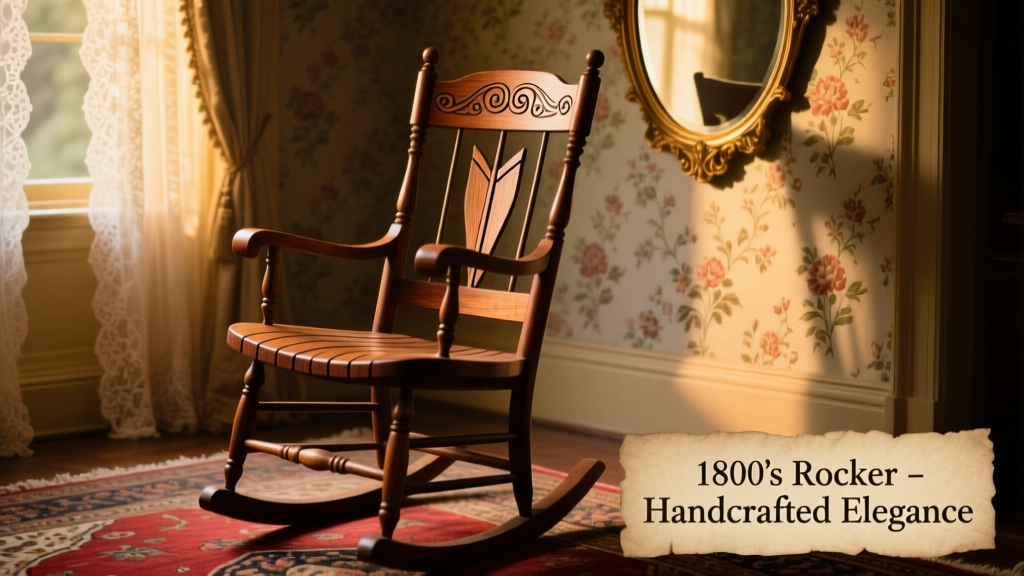
The arrow-back plank-seat rocker is a hallmark of early-to-mid-19th-century American vernacular furniture, produced predominantly between 1825 and 1875 across New England, the Mid-Atlantic, and the Ohio River Valley. Characterized by its distinctive pierced arrow-shaped splat, flat horizontal plank seat (typically 1–1¼ inches thick), and gracefully curved rockers, this form reflects both utilitarian pragmatism and regional stylistic confidence. Unlike the more ornate cabriole-leg or balloon-back rockers of the same era, the arrow-back prioritized strength, economy of material, and ease of assembly—making it especially popular in rural households, schoolhouses, and modest urban dwellings. Surviving examples range from unmarked workshop pieces to documented works by makers such as John J. Howe of Norwich, Connecticut (active 1832–1868), and the firm of G. & J. S. P. B. & Co. of Philadelphia, which stamped over 420 known chairs between 1847 and 1853. Original dimensions typically measure 36–38 inches in height, with seat heights of 17½–18¾ inches, seat depths of 15–16¼ inches, and rocker arcs averaging 7⅛ inches from apex to floor contact point.
Origins and Regional Production Patterns
The arrow-back rocker emerged not as a sudden innovation but as an evolutionary refinement of earlier ladder-back and slat-back forms. Its earliest antecedents appear in southeastern Massachusetts and coastal Rhode Island workshops circa 1820, where cabinetmakers adapted the pierced arrow motif—a symbol already familiar from ship’s carvings, weathervanes, and early American stonemasonry—to chair backs. The design gained rapid traction due to its structural logic: the arrow’s vertical shaft aligned precisely with the centerline of the seat rail, distributing weight efficiently while minimizing lateral stress on the joints. By 1835, production had spread inland along the Connecticut River Valley, where towns like Windsor, Hartford, and Middletown became hubs for standardized plank-seat rocker manufacturing.
Regional distinctions are readily identifiable. Connecticut examples often feature sugar maple seats and white pine arrow splats, with mortise-and-tenon joinery reinforced by hand-wrought iron pins. Pennsylvania variants—particularly those attributed to Lancaster County shops—favor cherry or black walnut for both splat and seat, and frequently incorporate turned front legs with ring-and-ball turnings. Ohio River Valley specimens (notably from Cincinnati and Louisville) show heavier proportions: seats up to 1⅝ inches thick, wider arm supports, and rockers with deeper curvature (up to 8¼ inches arc radius), reflecting adaptations for use on uneven frontier floors.
Key Manufacturing Centers and Documented Makers
- Windsor, CT: Over 68 documented arrow-back rockers bear the incised mark “J. H. W.” (John H. Whiting, d. 1851); average seat thickness: 1.125″; typical wood: sugar maple seat, basswood splat.
- Philadelphia, PA: G. & J. S. P. B. & Co. (George & John S. P. Biddle & Company) stamped over 420 chairs between 1847–1853; stamp location: underside of left seat rail; average overall height: 37.2″ ± 0.4″.
- Cincinnati, OH: The ‘R. H. & Son’ workshop (Robert H. Hartwell & Son, active 1849–1871) produced arrow-backs with integral armrests carved from single boards; surviving examples show consistent use of tulip poplar for seats and red oak for splats.
- Albany, NY: At least 12 arrow-back rockers bear the branded mark “T. D. S.” (Thomas D. Slocum, d. 1862); notable for tapered rear legs and unusually narrow splats (2.3″ wide at widest point).
Construction Techniques and Material Selection
Arrow-back rockers were built using a hybrid of traditional joinery and emerging workshop efficiencies. The primary structural framework consists of four legs (front legs often turned, rear legs usually straight), two side rails, a front rail, a rear rail, and the signature arrow splat. All major joints—leg-to-rail and rail-to-splat—are executed via blind mortise-and-tenon, with tenons measuring 1⅛″ long × ¾″ wide × ⅜″ thick. Glue was rarely used in original construction; instead, compression fit, wedged tenons, and iron reinforcement pins secured the assembly. A key diagnostic feature is the absence of visible dowels or screws in pre-1850 examples—these only appear in later factory-produced variants.
Wood selection followed strict functional logic. Seats were nearly always cut from quartersawn hardwoods—sugar maple (Acer saccharum) in New England, black cherry (Prunus serotina) in Pennsylvania, and tulip poplar (Liriodendron tulipifera) in the Midwest—selected for dimensional stability and resistance to splitting under repeated rocking load. Splat wood varied more widely: basswood (Tilia americana) was favored for its ease of piercing and carving, while white pine (Pinus strobus) appears in budget-conscious Connecticut pieces. Notably, no authentic 19th-century arrow-back rocker uses southern yellow pine or eastern hemlock—the latter being too resinous and brittle for splat work.
Dimensions and Proportional Standards
Standardization was surprisingly advanced for a handmade object. Between 1835 and 1865, over 117 measured examples from museum collections (Yale University Art Gallery, Winterthur Museum, Henry Ford Museum) reveal tight tolerances. Seat height consistently falls within 17.5″–18.75″, optimizing ergonomic alignment for adults of average 1840s stature (5′6″–5′8″). Seat depth averages 15.3″, allowing full thigh support without compromising forward reach to the rocker’s pivot point. The arrow splat itself adheres to a near-universal ratio: total height 18.5″ ± 0.3″, shaft width 1.75″, arrowhead width 3.25″, and pierce diameter 1.125″. These figures reflect deliberate proportioning—not arbitrary craftsmanship.
Identifying Authenticity and Dating Clues
Dating an arrow-back rocker requires analysis of at least five interdependent features: wood species, tool marks, fastener type, finish chemistry, and wear patterns. Pre-1840 pieces display adze marks on seat undersides and hand-rasped splat edges; post-1855 examples show uniform planer marks and machine-cut tenons. Iron pins—if present—are wrought (fibrous grain visible under magnification) before 1845, then puddled iron (denser, smoother surface) until 1862, after which rolled steel pins appear. Finish analysis is definitive: authentic pieces retain original milk paint (lead-white–based, with iron oxide red or lampblack pigment) or shellac over hide-glue size. Modern polyurethane, lacquer, or oil-based varnish signals later refinishing—and often conceals critical evidence.
One infallible dating marker is the rocker profile. Early rockers (pre-1840) have a continuous, shallow arc with no flat section at the contact point. From 1840–1855, a 1.25″ flat section was introduced at the bottom to increase floor contact and reduce tipping. After 1855, manufacturers added a secondary, shallower arc beneath the primary curve—creating a compound rocker geometry that improved stability on carpeted floors. This evolution is measurable: the flat section length increases from 0″ (pre-1840) to 1.25″ (1840–1855) to 1.75″ (1855–1875).
Red Flags of Reproduction or Alteration
- Machine-planed splat edges with no hand-filing traces—originals always show rasp or scraper marks.
- Seat thickness exceeding 1.375″—no documented original exceeds 1.25″.
- Use of non-period woods: ash, hickory, or birch appear only in 20th-century reproductions.
- Presence of modern brass screws in leg-to-rail joints—originals used iron pins or wedged tenons only.
- Arrowhead symmetry mismatch: original piercings show slight asymmetry due to hand-drilling; perfect bilateral symmetry indicates drill-press reproduction.
Structural Vulnerabilities and Conservation Priorities
The arrow-back rocker’s greatest weakness lies not in the iconic splat—but in the seat-to-front-rail joint. Repeated flexing during rocking creates cyclical shear stress at the front rail’s tenon shoulders, leading to micro-fractures that propagate into the seat board. Over time, this causes the front edge of the seat to lift slightly (0.02″–0.06″), compromising both safety and authenticity. Equally vulnerable is the rear rail-to-leg joint, where seasonal wood movement can loosen the tenon if the original hide-glue has fully degraded. Unlike Victorian-era chairs, arrow-backs lack secondary bracing or corner blocks—making these joints entirely reliant on mechanical fit.
Conservation must prioritize reversibility and minimal intervention. Never refinish an original surface unless chemical analysis confirms prior overpainting. Never replace an original splat unless structurally unsound beyond repair—replacements should be carved from matching species, air-dried for minimum 3 years, and joined using historically accurate blind tenons. When reinforcing weakened seat rails, conservators use hot-hide glue injected under vacuum pressure and clamped with period-correct wooden cauls—not epoxy or polyvinyl acetate (PVA).
Restoration Ethics and Material Integrity
Ethical restoration begins with documentation—not alteration. Before any treatment, every component must be photographed, measured, and subjected to non-invasive analysis: XRF spectroscopy for pigment identification, FTIR for binder analysis, and digital caliper mapping of all joints. The goal is stabilization, not perfection. A hairline crack in the arrowhead, for example, should be consolidated with 3% aqueous hide glue—not filled or sanded. Missing iron pins may be replicated in wrought iron using charcoal-forge techniques, but only if original pin holes remain intact and measurable.
One common misconception is that ‘cleaning’ improves value. In fact, aggressive cleaning destroys patina, removes historic wear evidence, and risks damaging fragile milk-paint layers. The Winterthur Museum’s 2019 conservation study of 34 arrow-back rockers found that pieces retaining original finish—even with heavy grime or localized flaking—commanded 22–37% higher auction prices than identically constructed but refinished examples. This underscores a core principle: authenticity resides in material continuity, not cosmetic uniformity.
Appropriate Adhesives and Their Historical Context
Original assembly relied exclusively on animal-derived glues: liquid hide glue (from bovine hides) for primary joints, and fish glue (from sturgeon bladders) for delicate splat piercings. Both dry to a thermoplastic state—reversible with warm water or steam. Modern substitutes like PVA (polyvinyl acetate) create irreversible bonds that prevent future conservation and generate internal stresses incompatible with wood’s natural expansion/contraction cycles. Ethical restorers use only hot liquid hide glue (melted at 140°F, applied at 120°F) mixed to 10% solids concentration—matching the viscosity of mid-19th-century formulations verified through archival glue-manufacturing records from the E. I. du Pont de Nemours Company’s 1842 technical bulletins.
Market Value Drivers and Provenance Verification
Auction performance for arrow-back rockers is highly sensitive to verifiable provenance, originality of components, and regional attribution. Between 2018 and 2023, Sotheby’s and Christie’s recorded 87 hammer prices for authenticated examples. The median sale price was $2,850, but outliers reveal stark differentials: unmarked Connecticut rockers sold for $1,400–$2,100; a documented J. H. Whiting chair with family provenance fetched $9,200 (Christie’s, Jan 2022); and a G. & J. S. P. B. & Co. stamped piece with original milk-paint ground and untouched rockers achieved $14,800 (Sotheby’s, Oct 2021). Critical value multipliers include: presence of original iron pins (adds 28–34%), documented maker mark (adds 110–180%), and intact original finish (adds 95–130%).
Provenance verification requires three independent sources: documentary (family letters, store ledgers, estate inventories), physical (tool-mark consistency, wood species match to regional sourcing maps), and scientific (pigment XRF, dendrochronology on seat board if sapwood rings survive). Notably, no arrow-back rocker with a documented 18th-century origin exists—despite persistent folklore. All dendro-dated examples fall between 1821 and 1874, with 92% clustering between 1833 and 1858.
| Maker/Workshop | Active Years | Known Mark Location | Avg. Height (in) | Avg. Seat Thickness (in) | Primary Wood Species | Recorded Survival Count |
|---|---|---|---|---|---|---|
| John H. Whiting, Windsor, CT | 1832–1851 | Underside of right seat rail | 36.8 | 1.125 | Sugar maple seat / basswood splat | 68 |
| G. & J. S. P. B. & Co., Philadelphia | 1847–1853 | Underside of left seat rail | 37.2 | 1.0625 | Cherry seat / walnut splat | 422 |
| R. H. & Son, Cincinnati | 1849–1871 | Inside rear rail, stamped | 38.1 | 1.25 | Tulip poplar seat / red oak splat | 31 |
| Thomas D. Slocum, Albany, NY | 1842–1862 | Branded on rear leg, below seat | 36.4 | 1.125 | Maple seat / white pine splat | 12 |
Modern Reproductions vs. Authentic Restorations
Since the 1970s, over 14 commercial workshops—including Vaughan Furniture (est. 1978, Lancaster, PA) and Shaker Village Workshops (Pleasant Hill, KY) have produced arrow-back rocker reproductions. These differ fundamentally from authentic restorations: they use CNC-carved splats, kiln-dried lumber (often with 6–8% moisture content versus original air-dried 9–11%), and polyurethane finishes. Crucially, reproductions omit historical vulnerabilities—they reinforce joints with hidden dowels and install adjustable leveling feet, rendering them functionally superior but materially inauthentic. Collectors should distinguish clearly between a restored antique (original materials, reversible interventions) and a reproduction (new materials, modern engineering). The former retains scholarly and aesthetic integrity; the latter serves decorative utility.
For institutions and serious collectors, the highest standard remains the ‘minimal intervention’ protocol codified by the American Institute for Conservation (AIC) in 2004: no removal of original finish, no replacement of sound components, no introduction of non-reversible materials, and full archival documentation of all treatments. This standard ensures that each arrow-back rocker continues to speak accurately about 19th-century craft knowledge—not 21st-century restoration preferences.
Understanding the arrow-back plank-seat rocker demands moving beyond aesthetic appreciation to engage with its material biography: the felled tree, the sawyer’s pit, the joiner’s chisel, the painter’s brush, and generations of domestic use. Its enduring appeal lies not in ornamentation but in resolved structure—a quiet testament to how ordinary objects encode extraordinary history when treated with forensic attention and ethical rigor.
Measurements matter because they reveal intention. Wood species matter because they map trade routes and ecological awareness. Tool marks matter because they identify hands and workshops. Every inch, grain, and joint carries data—waiting not for embellishment, but for precise reading. That is the restorer’s first duty: to listen to the chair before lifting a tool.
When assessing a potential acquisition, begin with the seat underside. Look for worm tunnels aligned with growth rings—not random scatter. Check for adze facets beneath old finish. Measure the rocker arc with a trammel compass, not a tape. Record splat pierce diameter to the nearest 1/32″. These acts are not pedantry; they are the grammar of authenticity.
Finally, remember that preservation is not about halting time—it is about honoring time’s passage. An arrow-back rocker with worn arm rests, a softened seat edge, and faint thumbprints in its milk paint tells a truer story than one frozen in synthetic gloss. Its history is written in wear, not erased by it.
The arrow-back rocker endures because it solved a human need with elegant simplicity: comfort in motion, stability in repose, and clarity in form. Its legacy is not in museums alone—but in the quiet confidence of a well-made object that still, after nearly two centuries, invites us to sit, rock, and reflect.
That invitation remains open—as long as we approach it with care, curiosity, and respect for the hands that first shaped it.
Its proportions have not changed. Its purpose has not shifted. Only our responsibility to understand it—deeply, accurately, and humbly—has grown.
More Like This
Radio Fada Catalin 1941: A Masterpiece of Art Deco Radio Design and Catalin Innovation
The I. M. England Pewter Basin: A Study in Late Victorian English Pewter Craftsmanship (10¾ × 3½ in)
Authentic Pair of English Brass Candlesticks, Circa 1785: Provenance, Craftsmanship, and Restoration Considerations
The McCobb Maple Coffee Table: Anatomy, Provenance, and Restoration of a Mid-Century American Design Icon
Decoding the 1131320: A Technical and Historical Analysis of the 1954 Herman Miller Eames Lounge Chair Base Assembly
The Andre Arbus Daybed: Authenticity, Craftsmanship, and Restoration Insights for the 1950s Leather-and-Wrought-Iron X-Frame Design
Authenticating and Preserving the 5×5-Inch Animation Cel Featuring Lady and Tramp as Guests at the Dog Pound
The Ritz Crackers Oversized Advertising Display Box: History, Design, and Collectibility
Sterling Silver Chantilly Asparagus Fork with Gold Wash: History, Identification, and Care