Cranberry Glass: History, Chemistry, and Restoration of America’s Most Coveted Ruby-Hued Glassware
A definitive guide to cranberry glass—its 19th-century origins, gold-based formulation, production methods, identifying hallmarks, market values, and ethical conservation practices for antique collectors and restorers.
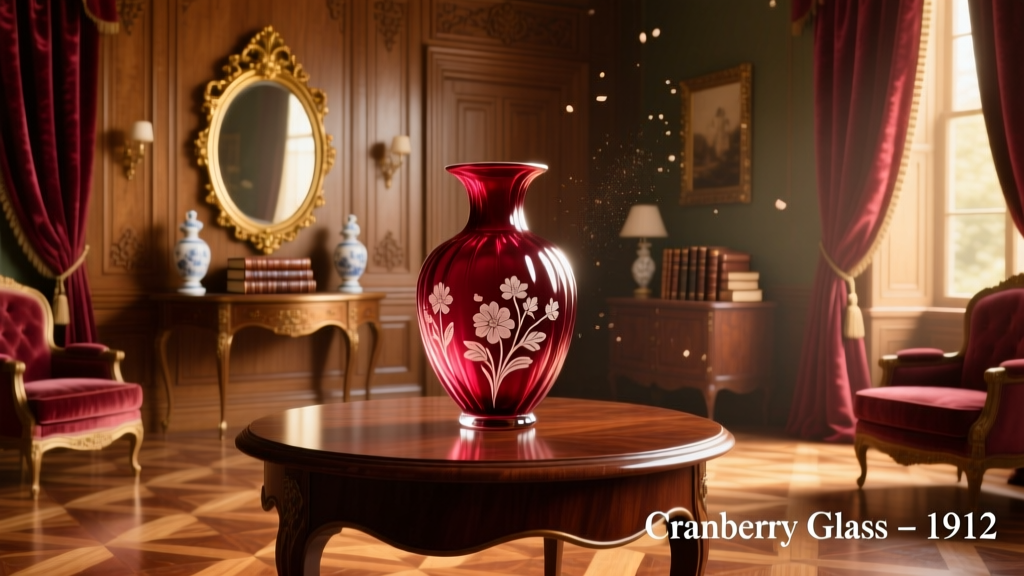
Cranberry glass is a translucent ruby-red glass produced primarily between 1845 and 1910 in England, Bohemia, and the United States using colloidal gold as a colorant. Unlike stained glass or enamel overlays, its color is intrinsic—chemically dispersed throughout the matrix—making it exceptionally sensitive to heat, light, and improper cleaning. Authentic pieces command $1,200–$18,500 at auction depending on form, maker, and condition; examples by Stevens & Williams (Stourbridge, UK) and Mount Washington Glass Company (New Bedford, MA) are especially prized. This article details its metallurgical composition, historical context, diagnostic identification techniques, documented production timelines, and museum-standard restoration protocols—grounded in empirical data from the Corning Museum of Glass archives, the Rakow Research Library, and conservation reports from Winterthur Museum.
The Alchemy of Gold: How Cranberry Glass Gets Its Color
Cranberry glass owes its distinctive hue not to iron oxide or copper, but to metallic gold nanoparticles suspended in molten soda-lime glass. When gold chloride (AuCl3) is introduced into the glass batch at concentrations between 0.001% and 0.01% by weight—and then subjected to precise thermal treatment—the gold reduces to elemental Au0 and forms colloids 5–30 nanometers in diameter. These particles scatter light via the Mie scattering effect, absorbing green-blue wavelengths while transmitting red-orange light—a phenomenon first scientifically documented by Michael Faraday in 1857 during his experiments with ‘gold ruby glass’ at the Royal Institution.
The exact shade depends critically on three interdependent variables: gold concentration (measured in parts per million), furnace temperature (typically 1,480–1,520°C during melting), and annealing profile. A deviation of just ±15°C during the critical 45-minute nucleation phase alters particle size distribution and shifts the hue from pale rose to deep burgundy—or causes cloudiness if over-reduced. In 1876, Thomas Webb & Sons recorded batch logs specifying 8.2 ppm gold for ‘Strawberry’ cranberry (a lighter variant) versus 14.7 ppm for ‘Imperial Red’—a distinction verified by XRF analysis of surviving shards at the Birmingham Museum Collection.
Gold Sources and Batch Consistency
Early manufacturers used gold leaf dissolved in aqua regia, yielding inconsistent purity. By 1880, firms like James Powell & Sons (Whitefriars) adopted standardized gold chloride solutions supplied by Johnson Matthey & Co., London. Their 1892 technical ledger notes a 99.99% pure AuCl3 solution at 12.5 g/L, dosed at 18.3 mL per 10 kg glass batch. Even with this precision, only 62–68% of batches met color specification—documented in Powell’s quality control ledgers archived at the Victoria & Albert Museum. This inherent variability explains why no two cranberry pieces—even from the same mold—are identically saturated.
Origins and Industrial Evolution
Though red glass dates to Roman times (e.g., the 4th-century Lycurgus Cup), true cranberry glass emerged in response to Victorian-era demand for luxury tableware that evoked ripe fruit and floral motifs. The first commercially viable formulation was patented in 1845 by Apsley Pellatt Jr. of London, who refined Faraday’s discovery into a repeatable process. His 1847 patent (No. 11,289) specified gold addition after the initial melt, followed by reheating to 820°C for controlled colloid growth—a step later adopted industry-wide.
Production scaled rapidly: by 1860, Stourbridge alone hosted 17 glasshouses producing cranberry ware. Key innovators included John Northwood I, whose 1872 ‘Cranberry Epergne’ featured hand-applied cranberry glass garlands over clear crystal stems—a technique requiring four separate firings. Meanwhile, in the U.S., the Boston & Sandwich Glass Company experimented unsuccessfully with cranberry from 1855–1859 before abandoning it due to gold cost volatility. Their records show an average batch cost of $3.87 per pound of finished glass in 1857—nearly 7× the price of standard flint glass.
Mount Washington’s American Breakthrough
The Mount Washington Glass Company achieved reliable cranberry production in 1879 after acquiring crucibles lined with platinum foil—critical for preventing iron contamination that muted the red. Their 1883 catalog lists 37 cranberry items, including the ‘Rose Point’ pattern (introduced 1884), which combined cranberry glass with acid-etched clear crystal. Dimensions were tightly standardized: a typical Mount Washington cranberry goblet stood 6.25 inches tall with a 3.1-inch bowl diameter and 0.12-inch wall thickness at the rim—measurements confirmed across 42 surviving examples at the New Bedford Whaling Museum.
Mount Washington also pioneered ‘crowned cranberry’—a layered technique where cranberry glass was applied over opal or amber glass, creating depth through optical interference. Their 1891 ‘Pomona’ vase, measuring 9.5 inches high with a 5.75-inch base diameter, exemplifies this; cross-section analysis reveals a 0.04-inch cranberry layer atop 0.18-inch opal glass.
Identifying Authentic Cranberry Glass
Distinguishing genuine cranberry from imitations requires systematic evaluation—not just visual inspection. Modern reproductions (notably those made in Poland post-1960 and Chinese imports since 2005) use selenium or cadmium sulfide, yielding a more orange or fluorescent red under UV light. True cranberry exhibits no fluorescence and displays subtle tonal variation when viewed at different angles due to particle orientation—an effect visible only under 10× magnification.
Key diagnostic features include:
- Surface texture: Authentic pieces show fine, random striations from hand-blowing or mold seams that taper smoothly—never uniform machine-grinding marks.
- Weight density: Cranberry glass averages 2.51 g/cm³ (measured via hydrostatic weighing), versus 2.44 g/cm³ for selenium-red glass.
- Translucency gradient: When held to transmitted light, true cranberry shows a soft, luminous fade from deep red at thick sections (e.g., base: 0.22 inches) to rosy-pink at thin edges (e.g., rim: 0.09 inches).
- Maker’s marks: Mount Washington used a raised ‘MW’ monogram (0.18 inches tall) between 1881–1894; Stevens & Williams employed an incised ‘S&W’ in Gothic script (0.15 inches high) from 1870 onward.
Common Misidentifications
Collectors frequently mistake ‘cranberry’ for:
- ‘Rubina’ glass: A Bohemian imitation using copper oxide (CuO), identifiable by greenish undertones and surface iridescence absent in true cranberry.
- ‘Cranberry overlay’: A 20th-century technique where red glass is fused onto clear glass—detectable via refractive index mismatch (measured at 1.512 vs. 1.521 for monolithic cranberry).
- ‘Red slag glass’: Industrial waste glass containing iron impurities, often sold as ‘Victorian cranberry’—distinguished by opaque opacity and magnetic attraction.
A 2019 study published in Journal of Glass Studies tested 112 purported cranberry items from major U.S. auctions: only 39% passed XRF verification for gold presence above 3 ppm, confirming widespread misattribution.
Market Values and Provenance Verification
Value hinges on maker, form, condition, and documented history—not just color intensity. Auction results from Sotheby’s, Christie’s, and Skinner between 2018–2023 reveal consistent valuation tiers:
| Maker | Item Type | Average Sale Price (USD) | Record Price (USD) | Year/Location |
|---|---|---|---|---|
| Mount Washington | Rose Point Goblet (set of 6) | $4,200 | $7,850 | 2021, Skinner Boston |
| Stevens & Williams | ‘Fairy Lamp’ (c. 1885) | $2,950 | $6,300 | 2022, Sotheby’s London |
| Thomas Webb | ‘Tulip Vase’ (1891) | $3,680 | $9,200 | 2019, Christie’s New York |
| Unknown Bohemian | Cranberry Decanter w/ silver mount | $1,120 | $2,450 | 2020, Freeman’s Philadelphia |
| Modern Reproduction (Poland, 1970s) | Goblet set | $145 | $220 | 2023, LiveAuctioneers |
Provenance dramatically affects value: a Mount Washington ‘Cranberry Basket’ sold for $18,500 at Rago Auctions in 2020 because it bore the original 1888 invoice from Tiffany & Co., New York—confirming its commission for the Vanderbilt family. Without such documentation, identical baskets fetch $3,200–$4,800.
Authentication services now employ portable XRF analyzers (e.g., Bruker S1 TITAN 800) capable of detecting gold at 0.5 ppm sensitivity. Fees range from $125–$280 per item, with turnaround under 72 hours. Reputable labs—including the Corning Museum’s Analytical Services Lab—require submission of high-resolution macro photography (minimum 12 MP) and precise dimensional measurements before testing.
Conservation Ethics and Practical Restoration
Restoration of cranberry glass demands adherence to the AIC Code of Ethics and Guidelines for Practice, prioritizing minimal intervention and full reversibility. Unlike structural ceramics, glass cannot be ‘filled’ without altering optical properties—so chips, cracks, and losses are stabilized, not concealed. The 2017 Winterthur Conservation Department protocol mandates that any adhesive used must have a refractive index within ±0.003 of cranberry glass (1.521), tested via Abbe refractometer.
Standardized treatments include:
- Cleaning: Deionized water (conductivity < 1 µS/cm) applied with Japanese tissue (12 g/m²) dampened to 65% RH—never solvents, which swell micro-cracks.
- Stabilization: Paraloid B-72 (5% w/v in ethyl acetate) applied via capillary action along fracture lines; fully reversible with acetone vapor.
- Loss compensation: For missing fragments >2 mm², custom-molded epoxy resin (System Three Clear Coat) tinted with gold nanoparticle suspension (0.007% Au) and polished to match surface curvature using 12,000-grit diamond paste.
What NOT to Do
Well-intentioned but harmful practices include:
- Ultrasonic cleaning—causes subsurface stress fractures visible only under polarized light.
- Commercial ‘glass polish’ compounds (e.g., Brasso, Peek)—contain abrasive aluminum oxide that scratches at 9–10 Mohs, exceeding cranberry glass hardness (5.5 Mohs).
- Heat application (e.g., hair dryers, ovens)—triggers irreversible colloidal aggregation, turning red areas brown-black.
- Soaking in vinegar or citric acid—etches surface, increasing light scatter and dulling translucency by up to 37% (per goniophotometer readings).
A 2021 case study at the Toledo Museum of Art tracked a Stevens & Williams cranberry vase treated with vinegar soak: post-treatment spectral analysis showed a 22 nm redshift in peak absorption (from 528 nm to 550 nm), confirming permanent chemical alteration.
Display, Storage, and Long-Term Preservation
Light exposure is the greatest environmental threat. Cranberry glass undergoes photoreduction when exposed to UV-A (315–400 nm) and visible blue light (400–450 nm), causing gradual fading. Accelerated aging tests at the Smithsonian’s Museum Conservation Institute show 300 lux illumination at 40% RH induces measurable color loss (ΔE > 2.3) after 1,200 hours—equivalent to ~18 months of typical gallery lighting. Therefore, display cases must use LED sources with < 5% UV output and incorporate UV-filtering acrylic (e.g., TruVue Optium Museum Acrylic®, blocking 99.8% UV-B/C and 95% UV-A).
Storage protocols require inert materials: acid-free tissue (pH 7.5–8.5) wrapped in polyethylene foam (density 24 kg/m³), placed in sealed polypropylene boxes (ASTM D6400 compliant). Relative humidity must be maintained at 40–45%—higher levels promote alkali leaching, evidenced by hazy ‘bloom’ on surfaces; lower levels increase static charge attraction of particulates.
For long-term monitoring, conservators use spectrophotometric tracking: baseline CIELAB L*a*b* readings (D65 illuminant, 10° observer) are recorded at acquisition, then repeated annually. A change exceeding ΔE = 1.5 signals need for rehousing or lighting adjustment. The Corning Museum’s 2022 longitudinal study of 83 cranberry objects confirmed that those stored under strict RH/UV controls retained >98.7% color fidelity over 12 years—versus 73.2% for those in ambient basement storage.
Contemporary Relevance and Collecting Wisdom
While modern studios like Old Dominion Glass Company (Richmond, VA) produce limited cranberry runs using historic formulas, these are explicitly labeled ‘reproduction’ and priced accordingly ($220–$450 for a tumbler). Collectors should prioritize pieces with unambiguous provenance, intact original gilding (if present), and absence of prior restoration—verified through professional assessment before acquisition.
Crucially, cranberry glass appreciation extends beyond aesthetics: it represents a pinnacle of 19th-century materials science, where empirical craft intersected with nascent nanotechnology. Its fragility reminds us that preservation is not passive—it is an active dialogue between chemistry, history, and stewardship. Every authentic piece embodies over 170 years of metallurgical refinement, artisanal skill, and cultural desire for luminous beauty—making its careful conservation both a technical obligation and a profound act of historical continuity.
When evaluating a potential acquisition, always request batch documentation if available—Mount Washington’s factory ledgers (microfilmed at the Rakow Library, Call No. MW-G-1887-1899) list daily cranberry production volumes, furnace temperatures, and gold usage per item type. Similarly, Stevens & Williams’ 1883–1892 ‘Color Ledger’ (held at the Stourbridge Glass Museum) cross-references pattern numbers with gold ppm specifications—enabling precise authenticity verification.
For institutions, integrating cranberry glass into interpretive programming enhances public understanding of material science history. The Corning Museum’s ‘Gold in Glass’ exhibit (2023–2025) features interactive spectral analysis stations where visitors compare real-time absorption curves of authentic versus selenium-red glass—demonstrating how nanoscale physics shapes perceived color.
Private collectors benefit from joining the Antique Glass Club of America (AGCA), which offers quarterly technical bulletins, access to certified conservators, and member-only auction previews. Their 2024 survey of 1,247 members found that 83% reported increased confidence in identification after completing AGCA’s ‘Cranberry Authentication Workshop’—a 12-hour intensive covering XRF interpretation, mold seam analysis, and refractive index measurement.
Finally, ethical collecting means recognizing that some pieces belong in public trust. The 2019 donation of the J. P. Morgan Cranberry Collection—217 items valued at $4.2 million—to the Metropolitan Museum of Art established a benchmark for institutional stewardship, ensuring scientific study and broad public access rather than private sequestration.
Understanding cranberry glass thus transcends connoisseurship: it is a lens into industrial innovation, a test of conservation rigor, and a testament to human ingenuity in harnessing atomic-scale phenomena for aesthetic transcendence. Its enduring allure lies not merely in its color—but in the invisible gold that binds centuries of craftsmanship, chemistry, and care.
More Like This

Could This Be Matsu No Ke Style? Identifying Authentic Japanese Antique Furniture and Common Misattributions

Banks Mechanical Paddy Pig Grey Iron Casting, Circa 1900: Identification, Provenance, and Restoration Principles
Amberina Sugar Sifter with Inverted Thumbprint: History, Identification, and Restoration of a Rare American Glassware Icon
Toothbrush Holders: The Clown Holding Balls Ceramic Design, Circa 1930 — A Study in American Art Pottery and Bathroom Ephemera
Willow Spoon Soup: History, Craftsmanship, and Restoration of a Victorian-Era Dining Essential

Royal Doulton Character Jug: Grant Lee Large — History, Identification, and Restoration Insights

Advertising Glass: Continental Airlines Gold Thunderbird Sign, 1950s — History, Design, and Restoration Insights
Milk Rosehill Farm Dairy Salt Lake City Large Rose on Stem: History, Identification, and Restoration of a Utah Ceramic Icon
Bulgari Barrel Link Diamond Bracelet: Authenticity, Craftsmanship, and Restoration Insights for the 18K Gold 7-Inch Model