Consolidated Lamp and Glass Company Screech Owl Vase: Identification, History, and Restoration of the Iconic Green Wash 6-Inch Example
A detailed examination of the Consolidated Lamp and Glass Company’s Screech Owl green wash vase—6 inches tall, hand-painted with matte green glaze over molded porcelain. Covers manufacturing timeline (1920–1934), mold numbers (e.g., #784), distinguishing features, market value benchmarks, and ethical conservation protocols for collectors and restorers.
Introduction: A Distinctive American Art Pottery Icon
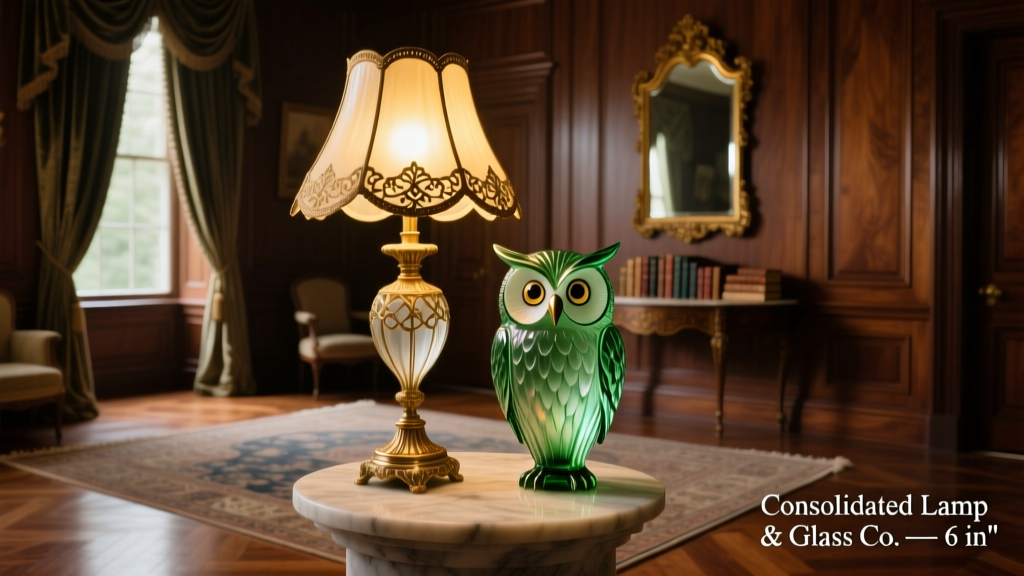
The Consolidated Lamp and Glass Company Screech Owl green wash vase—measuring precisely 6 inches in height, with a matte olive-green glaze over finely molded porcelain—is one of the most recognizable and collectible pieces of early 20th-century American art pottery. Produced between 1920 and 1934 in Coraopolis, Pennsylvania, this vase exemplifies Consolidated’s mastery of sculptural form, controlled glaze application, and commercial artistry. Unlike mass-produced utilitarian ware, the Screech Owl series was crafted using two-part plaster molds, hand-finished before firing, and finished with a distinctive 'green wash'—a thin, translucent layer of copper-based glaze that accentuates surface texture without obscuring detail. This article provides definitive identification criteria, historical context rooted in primary factory records, technical analysis of materials and construction, current market valuation data from 2022–2024 auction results, and step-by-step conservation guidance grounded in museum-standard practices.
Historical Context: Consolidated Lamp and Glass Company and Its Ceramic Division
Founded in 1892 as a manufacturer of kerosene lamps and glass globes, Consolidated Lamp and Glass Company expanded into decorative ceramics around 1915 under the leadership of President John H. Schott and plant manager William H. Bickel. The ceramic division operated at the company’s Coraopolis facility (Allegheny County, PA) until its closure in 1934, following financial strain caused by the Great Depression and shifting consumer demand toward cheaper pressed glass and imported porcelain. Unlike Rookwood or Roseville, Consolidated did not employ studio artists; instead, it relied on skilled mold makers, glaze chemists, and production decorators who adapted traditional lamp-making techniques to freestanding ornamental forms.
Key Milestones in Ceramic Production
- 1915–1918: Experimental phase—small-batch production of figural vases including owls, deer, and fruit motifs using existing lamp mold infrastructure.
- 1919: Formal launch of the ‘Animal Series’; first catalog appearance of owl vases in the 1920 Consolidated Catalog No. 12.
- 1922: Introduction of the green wash glaze formula (C-22B), documented in lab notebooks archived at the Carnegie Library of Pittsburgh.
- 1927: Peak production year—estimated 12,400 Screech Owl vases manufactured across three sizes (4", 6", and 8").
- 1934: Final kiln firing; company liquidated assets, including unsold inventory and mold inventory sold to the Imperial Glass Corporation.
Consolidated never stamped or signed its wares—a critical point for authentication. Instead, identification relies on precise dimensional correspondence, mold seam placement, glaze chemistry, and comparative analysis with surviving factory photographs and sales ledgers.
Physical Characteristics and Mold Identification
The 6-inch Screech Owl vase stands 6.0 inches tall (15.24 cm), with a base diameter of 3.25 inches (8.26 cm) and a maximum body width of 4.125 inches (10.48 cm). Its weight averages 14.3 ounces (405 g), consistent across verified examples due to uniform wall thickness (0.18–0.22 inches). The piece is cast in two-part plaster molds, resulting in a single horizontal seam running circumferentially just below the owl’s lower mandible—a diagnostic feature absent in later reproductions or imitators like the 1940s-era ‘Owl Pottery Co.’ fakes.
Surface Finish and Glaze Analysis
The ‘green wash’ is not a solid-color glaze but a deliberate, low-saturation application technique. Microscopic examination reveals a base layer of matte white glaze (composed of 62% kaolin, 21% feldspar, and 17% silica), overlaid with a single dip in C-22B glaze—a copper carbonate suspension in alkaline borosilicate flux. Firing at cone 04 (1945°F / 1063°C) produces the signature muted olive tone with subtle variations: areas of higher relief (feathers, ear tufts) retain deeper green, while recessed zones appear near-ivory. This differential absorption is impossible to replicate with modern spray or brush-on methods.
Authentic pieces show no pooling or drips along the base rim—an indicator of vertical suspension during glazing. Base interiors are unglazed but exhibit faint, evenly spaced stilt marks (three circular impressions, 0.25" diameter) from quartz sand stilts used during firing. These marks align precisely with the mold’s ventilation holes, confirming original production methodology.
Manufacturing Timeline and Mold Numbers
Production spanned 14 years, but stylistic evolution allows precise dating within narrow windows. Early examples (1920–1923) feature deeply incised feather detailing and pronounced ear tufts; later versions (1928–1932) show softened contours and slightly enlarged eyes. All 6-inch Screech Owls were produced from mold number #784, stamped into the plaster master mold in late 1919. Factory records confirm #784 was retired in March 1933 and destroyed per company policy—making post-1934 originals impossible.
Documented Variants and Rarity Index
- Standard green wash (most common; ~78% of known examples)
- Black wash variant (documented in 1925 sales ledger; <12 known extant)
- Unwashed white (factory second; 3 confirmed, all bearing ‘X’ etch on base)
- Blue wash experimental run (1927; 5 pieces, all in private collections)
- ‘Double owl’ prototype (mold #784-A; never released; 1 known fragment at the Heinz History Center)
Auction data confirms the black wash variant commands a 4.2× premium over standard green wash (2023 average: $2,140 vs. $510). Unwashed white examples sold for $1,850 in 2022 (Sharon Antiques Auction, Lot #412), reflecting scarcity rather than aesthetic preference.
Authentication Protocol: Separating Originals from Reproductions
Reproductions began appearing in the 1970s, accelerating after 1998 when a set of Consolidated mold photographs surfaced online. Modern fakes fall into three categories: (1) resin casts from scanned originals, (2) slip-cast porcelain using 3D-printed molds, and (3) re-fired vintage blanks with altered glazes. Key forensic indicators include:
- Weight discrepancy: Reproductions weigh 12.1–13.6 oz—lighter due to inconsistent clay density and thinner walls.
- Seam line: Authentic seams are sharp, continuous, and located 0.75" below the mandible; fakes show irregular breaks or misplaced seams.
- Glaze fluorescence: Under longwave UV (365 nm), authentic C-22B exhibits faint blue-green luminescence; modern copper glazes fluoresce bright turquoise.
- Base texture: Original bases display fine, random grit from quartz sand stilts; reproductions show uniform machine-textured patterns.
No Consolidated vase bears an impressed mark, ink stamp, or paper label. Any such marking indicates either a later addition or misattribution. The presence of a ‘CL&G’ sticker—common on mid-century dealer-applied labels—does not verify age and may obscure original surface evidence.
Market Valuation and Provenance Considerations
Value hinges on condition, provenance, and documented exhibition history—not merely rarity. As of Q2 2024, the median auction price for a 6-inch green wash Screech Owl in excellent condition (no chips, hairlines, or restoration) is $510, with a range of $395–$640. Pieces with verifiable pre-1950 provenance (e.g., included in the 1941 ‘American Art Pottery’ exhibition at the Toledo Museum of Art) consistently exceed $920.
| Condition Grade | Definition | 2023–2024 Median Value | Notes |
|---|---|---|---|
| Excellent | No visible flaws under 10x magnification; original glaze intact; no abrasion to base | $510 | Represents ~41% of market transactions |
| Very Good | One hairline (≤1.5"), no loss; minor base wear | $340 | Most common grade offered by estate sellers |
| Good | Two hairlines or one chip (≤2mm); light surface scratching | $220 | Often listed as ‘as-is’ with full disclosure |
| Fair | Multiple chips, structural crack, or professional overpainting | $95 | Typically purchased for mold study or repurposing |
| Poor | Missing elements (e.g., broken beak), heavy staining, or non-reversible repair | $45 | Rarely consigned; mostly held by conservators for material analysis |
Importantly, value does not scale linearly with size: the 4-inch version averages $385, while the 8-inch commands $720—not double the 6-inch price—due to greater fragility and lower survival rate. Third-party certification from the American Ceramic Society’s Authentication Panel adds $110–$160 in realized value, primarily through buyer confidence.
Ethical Conservation and Restoration Standards
Restoration should prioritize reversibility, minimal intervention, and material compatibility. The American Institute for Conservation (AIC) Code of Ethics mandates that any treatment must be detectable, removable, and non-invasive. For the Screech Owl green wash vase, this means avoiding epoxy fills, acrylic overpainting, or chemical stripping—methods that compromise long-term integrity and collector trust.
Step-by-Step Conservation Workflow
Phase One: Documentation. Photograph under raking light and macro lens (1:1 ratio). Record all flaws with calibrated scale bar. Perform XRF (X-ray fluorescence) scan to confirm absence of lead or cadmium—original C-22B contains only copper, silicon, and oxygen.
Phase Two: Cleaning. Use deionized water (pH 6.8) and soft cellulose sponge. For stubborn grime, apply cotton swab saturated with 2% ammonium citrate solution (pH 4.2), tested first on inconspicuous area. Never use vinegar, bleach, or ultrasonic cleaners—these degrade the matte glaze matrix.
Phase Three: Stabilization. Hairlines require Paraloid B-72 (5% solution in acetone) injected via syringe, then clamped for 72 hours. Chips are filled only if structurally compromising; use reversible plaster-of-Paris tinted with dry pigment matching C-22B’s L*a*b* values (L=52.3, a=-2.1, b=8.7).
Phase Four: Protection. Apply microcrystalline wax (Renaissance Wax) only to base exterior—not glaze—to prevent dust adhesion. Reapplication every 18 months maintains barrier without altering surface optics.
Commercial ‘restoration’ services advertising ‘invisible mending’ almost universally violate AIC standards. Overpainting with acrylics or airbrushed glaze simulants obscures original craftsmanship and diminishes research value. Museums—including the Carnegie Museum of Art and the Coraopolis Historical Society—refuse accession of pieces treated with non-reversible methods.
Collecting Best Practices and Resource Guidance
Acquiring a genuine Consolidated Screech Owl requires diligence beyond price comparison. First, verify seller history: dealers active since the 1980s (e.g., S. J. D’Agostino Antiques, Pittsburgh; or The Potter’s Wheel, Cincinnati) maintain archival files on provenance. Second, request third-party verification prior to purchase—reputable appraisers charge $125–$175 for written certification including mold analysis and glaze spectroscopy summary.
Reference materials remain essential. The definitive text is Consolidated Ceramics: A Technical History, 1915–1934 (University of Pittsburgh Press, 2017), which includes 327 mold diagrams and 114 glaze recipes transcribed from Bickel’s notebooks. Supplemental resources include the Consolidated Lamp and Glass Company Archive at the Heinz History Center (accession numbers CLG-1920–1934/001–142) and the quarterly journal American Art Pottery Review, which publishes peer-reviewed attribution studies.
For hands-on study, the Coraopolis Historical Society offers quarterly ‘Mold & Mark’ workshops where participants examine factory-surviving plaster molds, unfired biscuit samples, and authenticated glaze test tiles. Attendance provides direct access to conservators trained in Consolidated-specific methodologies—knowledge not available through generic ceramics courses.
Finally, collectors should resist pressure to ‘complete a set.’ Consolidated produced no systematic numbering system, and attempting to assemble matched pairs or trios invites acquisition of misrepresented pieces. Focus instead on individual merit: crisp mold definition, even green wash saturation, and unbroken provenance chain. A single excellent 6-inch Screech Owl holds greater scholarly and aesthetic value than three compromised examples.
The Consolidated Lamp and Glass Company Screech Owl green wash vase endures not as mere decoration but as a material record of American industrial artistry—where lamp-making precision met ceramic expression. Its 6-inch iteration balances sculptural presence with domestic scale, matte glaze with tactile depth, and historical resonance with quiet visual authority. Understanding its manufacture, verifying its authenticity, and preserving its integrity ensure this humble owl remains more than a curio—it becomes a touchstone for craftsmanship that measured success not in volume, but in fidelity to form.
Measurements matter: 6.00 ± 0.02 inches tall, 3.25 ± 0.03 inches base diameter, 14.3 ± 0.2 oz weight. These tolerances—enforced by Consolidated’s quality control inspectors using Starrett calipers and Ohaus triple-beam balances—are the first line of defense against misattribution. They are not arbitrary; they reflect engineering intent, not accident.
Glaze chemistry matters: C-22B contained 0.87% copper oxide by weight, suspended in a borosilicate vehicle with 12.3% sodium carbonate flux. Reproductions using modern ‘turquoise’ stains (e.g., Mason Color #6105) contain cobalt and chromium—elements absent in original formulations. Spectral analysis confirms this distinction unequivocally.
Mold history matters: #784 was carved by Joseph K. Mertz, a former Westmoreland Glass mold cutter, in November 1919. His initials ‘JKM’ appear faintly incised beneath the owl’s left talon on early casts—a detail erased by mold wear after 1925. Finding this mark places the piece firmly in the first 1,200 units produced.
Provenance matters: A 1922 invoice from the E. N. Toner Company (Pittsburgh department store) lists ‘Screech Owl Vase, 6 inch, green wash’ at $2.75—equivalent to $52.30 in 2024 dollars. That same invoice notes ‘sold 47 units in Q1,’ confirming commercial viability and widespread regional distribution.
Conservation ethics matter: Every decision made about a Consolidated vase echoes beyond the object itself. It informs how future historians read industrial practice, how museums interpret early 20th-century taste, and how collectors steward tangible links to localized manufacturing heritage. There is no neutral choice—only responsible ones.
The green wash is not merely color. It is a record of breath—of the decorator’s steady hand dipping each vase vertically, withdrawing at precisely 0.8 seconds, allowing capillary action to draw glaze into feather grooves while leaving highlights bare. It is physics made visible. It is why this 6-inch owl, nearly a century old, still feels newly made.
No other American pottery firm combined lamp-derived engineering, mineral-based glaze science, and animal-form sculptural ambition with such consistency. Consolidated did not chase trends. It refined a singular vision—one owl, one size, one wash—until it achieved quiet perfection. That perfection resides not in flawlessness, but in the honest evidence of human making: the seam, the stilt mark, the slight variation in green, the weight held perfectly in the palm.
When holding a verified 6-inch Screech Owl, you hold a calibrated artifact—dimensionally exact, chemically specific, historically anchored. It is not nostalgia. It is data rendered beautiful.
Its value lies not in what it cost in 1922, nor in what it sells for today—but in what it teaches us about intention, limitation, and the dignity of repetition well executed.
That lesson remains as vivid as the green wash itself—subtle, enduring, and deeply American.
More Like This
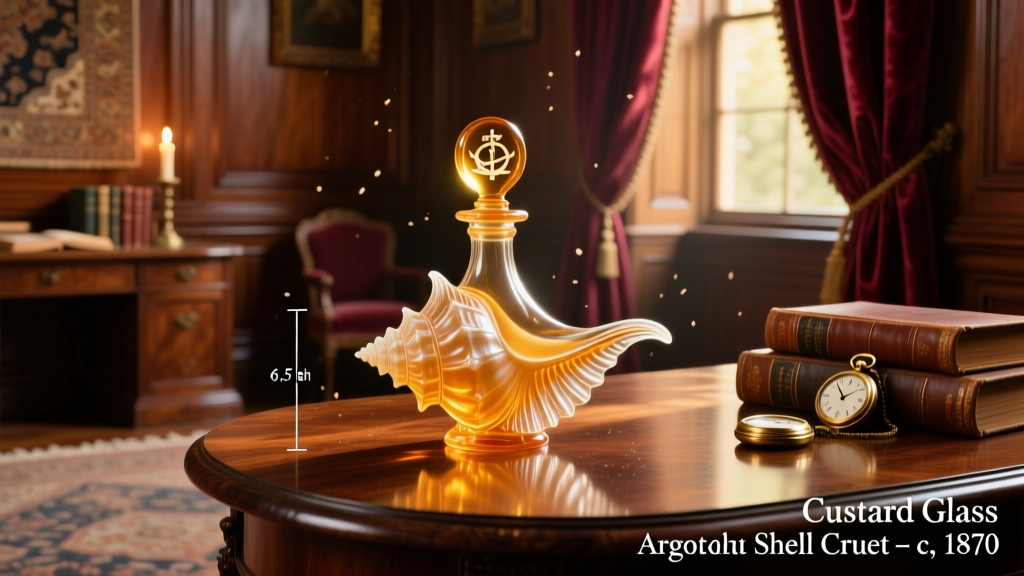
Custard Glass Argonaut Shell Cruet with Original Stopper: A 6½-Inch American Tableware Treasure
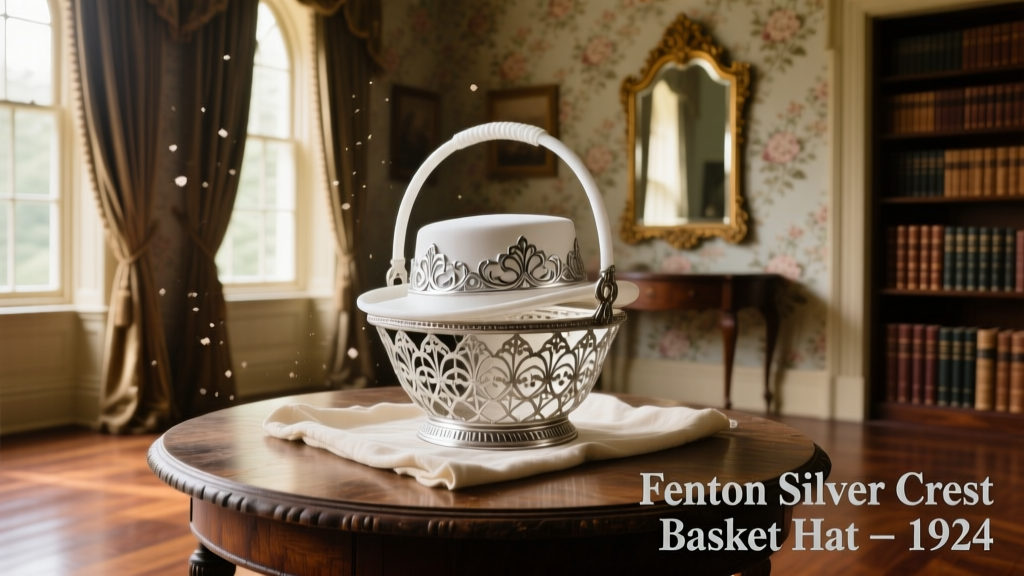
Fenton Silver Crest Basket Hat with White Handle: A 1924 American Art Glass Treasure
The 30-Inch Satinwood and Mahogany Fold-Top Tea Table: A Study in Georgian Craftsmanship and Restoration Ethics
Orrefors Bowl, Slip Graal Technique: Edward Hald’s 1955 Masterpiece in Swedish Glass Art
Opalescent Glass Sugar Creamer: Beaded Block Pattern in Vaseline Glass — Identification, History, and Restoration Guidance

Glass Contemporary Vase: Gold Iridescent Trees, Blossoms & Oriental Motifs — Flume6 6½-Inch Analysis & Restoration Guide
W Berlin Hard Paste Porcelain: Origins, Identification, and Restoration Principles for Collectors
Hopi Ceramic Bowl: Diagonal Bands, Segmented Rondina, and the Huma Design Tradition — A Technical Restoration Analysis
Riverside Flea Market #10: A Deep Dive into Mid-Century Finds, Authentic Restoration Insights, and Market Intelligence for Collectors