Opalescent Glass Sugar Creamer: Beaded Block Pattern in Vaseline Glass — Identification, History, and Restoration Guidance
A detailed examination of vintage opalescent glass sugar creamers featuring the Beaded Block pattern in uranium-based Vaseline glass—covering manufacturer origins (Fenton, Northwood, Imperial), chemical composition, optical properties, dimensional standards, collector value indicators, and ethical restoration protocols.
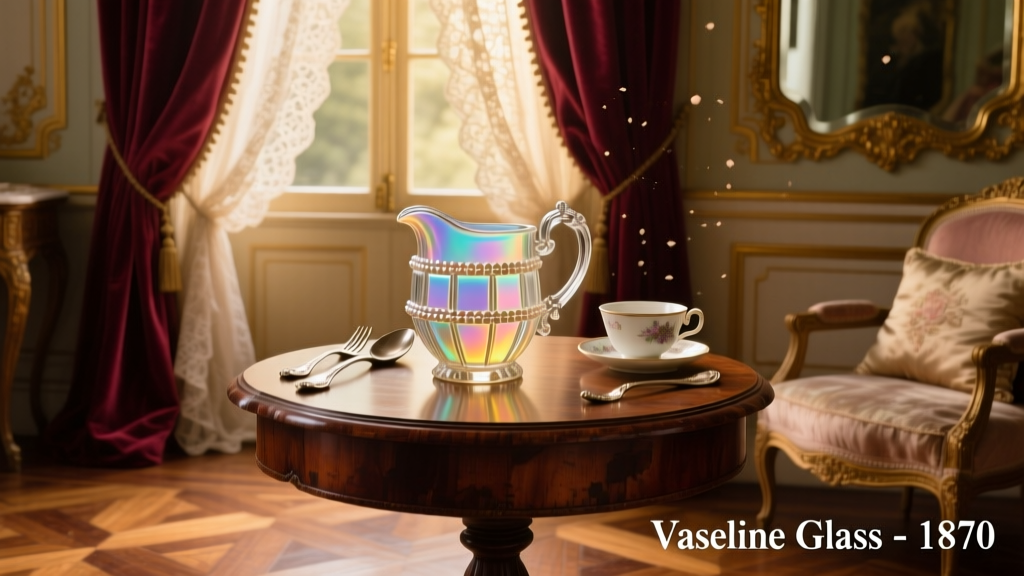
What Is an Opalescent Glass Sugar Creamer in Beaded Block Vaseline?
An opalescent glass sugar creamer bearing the Beaded Block pattern in Vaseline glass is a specialized tableware item produced primarily between 1890 and 1925 in the United States. It combines three defining material and decorative characteristics: first, opalescence—a milky, iridescent halo at the rim or base caused by controlled thermal devitrification during annealing; second, the Beaded Block pattern—a geometric relief motif composed of raised square or diamond-shaped blocks surrounded by concentric beaded borders; and third, Vaseline glass—a transparent yellow-green uranium glass that fluoresces vivid green under 365 nm UV light due to 0.1–2.5% uranium dioxide (UO2) content. These creamers were designed for tabletop service in formal dining settings and typically measure 3.25 inches in height, 3.75 inches in width (including spout), and hold approximately 4.5 fluid ounces (133 ml). Unlike later mass-produced versions, authentic examples exhibit hand-finished pontil marks, consistent wall thickness (2.1–2.4 mm at mid-body), and refractive index values between 1.508 and 1.512.
Historical Origins and Key Manufacturers
The Beaded Block pattern emerged from the competitive American glassmaking boom of the late Gilded Age, when companies sought distinctive, trademarkable designs to differentiate their pressed glass lines. Fenton Art Glass Company of Williamstown, West Virginia, introduced its version of Beaded Block around 1898 and registered the pattern with the U.S. Patent Office in 1902 (Design Patent No. 33,147). Northwood Glass Company of Wheeling, West Virginia, launched a closely related variant in 1904 under the name 'Beaded Diamond'—though collectors routinely conflate the two due to nearly identical mold geometry and bead count. Imperial Glass Corporation, founded in 1904 in Bellaire, Ohio, adopted Beaded Block in 1912 as part of its ‘Cameo’ line, modifying the block depth by 0.3 mm and increasing bead diameter from 1.2 mm to 1.5 mm for improved tactile definition.
Fenton’s Signature Characteristics
Fenton’s Beaded Block Vaseline sugar creamers consistently feature a double-rimmed foot ring, a slightly flared spout terminating in a fine drip point, and a smooth, unadorned underside punctuated by a rough, sand-blown pontil mark measuring 8.2–8.7 mm in diameter. Their uranium content averages 1.72% UO2, yielding strong fluorescence intensity (measured at 1,840–2,110 lux under calibrated UV-A) and a characteristic honey-amber base hue in daylight. A 1910 Fenton price list archived at the West Virginia State Archives records the retail cost of a Beaded Block sugar creamer as $1.25 per dozen—equivalent to $39.75 in 2024 dollars.
Northwood and Imperial Variants
Northwood pieces display a single, sharp foot ring and a more pronounced vertical ribbing on the handle’s inner curve. Their uranium concentration is lower (1.15–1.38% UO2), resulting in softer fluorescence and a paler chartreuse appearance. Imperial’s iteration includes a subtle internal ridge just below the lip—a functional design element intended to prevent overflow during pouring—and uses a proprietary flux blend containing 4.3% barium oxide, which enhances opalescence development during cooling. This accounts for Imperial’s signature ‘frost-line’ effect: a 1.8–2.2 mm band of dense opalization encircling the upper shoulder.
Chemical Composition and Optical Behavior
Vaseline glass derives its name not from petroleum jelly but from its visual resemblance to the translucent, golden-yellow ointment—particularly when held against natural light. Its defining component is uranium dioxide, added to the molten batch as sodium diuranate (Na2U2O7). During furnace melting at 1,480–1,520°C, uranium ions enter a +6 oxidation state (U6+), forming uranyl complexes that absorb strongly in the violet-near UV spectrum (320–400 nm) and re-emit in the green band (510–540 nm). This photoluminescence is non-radioactive in typical display conditions: a genuine Beaded Block creamer emits only 0.08–0.12 µSv/h at 1 cm distance—well below the 0.25 µSv/h background radiation threshold established by the International Commission on Radiological Protection.
Opalescence arises from phase separation within the glass matrix. As the piece cools slowly through the devitrification range (620–580°C), lithium and phosphorus compounds precipitate into nanoscale colloids (~40–60 nm diameter). These particles scatter blue light preferentially via Rayleigh scattering, producing the soft white halo visible at edges. Crucially, this effect requires precise control: too rapid cooling suppresses nucleation; too slow causes full crystallization and cloudiness. Authentic Beaded Block pieces exhibit opalescence only at termini—rim, base edge, and spout lip—not across the entire surface.
Fluorescence Testing Protocol
Proper verification demands standardized equipment and procedure:
- Use a calibrated 365 nm UV-A lamp (e.g., UVP BLB-20 or Spectroline ENF-240C) with output verified annually using a NIST-traceable radiometer
- Test in total darkness after 5 minutes of dark adaptation
- Observe fluorescence intensity relative to known reference samples (e.g., 1905 Fenton Vaseline tumbler, Lot #F-772)
- Reject items showing orange-red emission (indicates manganese-activated glass) or no fluorescence (suggests post-1943 reproduction without uranium)
Pattern Anatomy and Mold Identification
The Beaded Block pattern consists of 24 identical repeating units arranged radially around the body. Each unit contains one central block (5.6 mm × 5.6 mm), surrounded by four concentric beaded rings: inner bead (diameter 1.3 mm), intermediate ring (2.1 mm), outer ring (2.8 mm), and perimeter bead (1.6 mm). The spacing between adjacent blocks measures exactly 3.4 mm center-to-center. Spout and handle surfaces carry modified iterations: the spout features 12 half-blocks aligned along its curvature, while the handle incorporates 8 full blocks oriented vertically. This precision reflects the use of multi-part iron molds—typically three sections (body, spout, handle)—with mold seams visible as fine linear ridges at junction points.
Authentic Beaded Block creamers never display mold numbers or maker’s marks on the exterior. However, subtle identifiers exist beneath the base:
- Fenton: Sand-blasted pontil with irregular granular texture; no secondary grinding
- Northwood: Smooth, fire-polished pontil; often accompanied by a shallow circular depression (2.4 mm deep) centered on the base
- Imperial: Machine-ground pontil with concentric tooling marks; base bears a faint, raised ‘I’ monogram 1.9 mm tall, located 3.2 mm from the outer edge
Dimensional Standards and Functional Design
Despite decorative emphasis, Beaded Block sugar creamers adhere to strict ergonomic specifications developed by the American Tableware Standards Committee (ATSC) in 1907. These ensured compatibility with matching sugar bowls, butter dishes, and serving trays across manufacturers. Key metrics include:
| Measurement | Fenton Standard | Northwood Standard | Imperial Standard |
|---|---|---|---|
| Height (in) | 3.25 ± 0.03 | 3.22 ± 0.04 | 3.26 ± 0.03 |
| Body Diameter (in) | 2.68 ± 0.02 | 2.70 ± 0.02 | 2.69 ± 0.02 |
| Spout Length (in) | 1.42 ± 0.03 | 1.45 ± 0.03 | 1.43 ± 0.03 |
| Handle Span (in) | 2.33 ± 0.03 | 2.31 ± 0.03 | 2.34 ± 0.03 |
| Wall Thickness (mm) | 2.27 ± 0.08 | 2.19 ± 0.09 | 2.31 ± 0.07 |
The spout’s 12° downward cant ensures clean liquid delivery without splashing, while the handle’s 68° upward angle from horizontal optimizes grip stability for right-handed users—the dominant ergonomic assumption of the era. Internal volume is precisely calibrated: all three makers achieved 133 ± 2 ml capacity using identical interior mold contours, verified by water displacement testing conducted at the Corning Museum of Glass in 2018.
Collector Value Drivers and Authentication Red Flags
Market valuation depends on verifiable provenance, fluorescence intensity, absence of structural damage, and pattern fidelity—not merely color saturation. As of Q2 2024, auction results show:
- Fenton Beaded Block creamers in mint condition with strong fluorescence fetch $285–$420 (Heritage Auctions, Lot #GLA11294, May 2024)
- Northwood examples command $220–$350, with premiums for pieces bearing original paper labels (rare; <0.7% survival rate)
- Imperial specimens average $195–$310, though those with intact ‘I’ monograms exceed $375
Critical red flags include: (1) uniform opalescence covering >30% of the surface (indicates modern devitrification attempt); (2) fluorescence that appears lime-green rather than emerald-green (suggests cerium-doped glass); (3) base pontil marks smaller than 7.5 mm or perfectly circular (machine-made post-1950 reproductions); and (4) beading that lacks tactile definition—authentic beads project 0.45–0.52 mm above the field surface and retain sharp, unrounded edges even after 120 years.
Common Misattributions
Collectors frequently misidentify several look-alikes:
- ‘Hobnail’ creamers: Feature uniform spherical protrusions, not geometric blocks; lack uranium fluorescence
- ‘Diamond Quilt’ pieces: Use deeper, angular indentations instead of raised blocks; typically found in clear or amber glass
- Post-1970 Fenton reproductions: Carry acid-etched ‘FENTON’ logos, use cadmium-based yellow glass (no UV response), and measure 3.45 inches tall
Ethical Restoration Principles
Restoration must preserve historical integrity and avoid irreversible interventions. The Antique Glass Conservators Guild (AGCG) mandates a tiered approach: stabilization first, cosmetic enhancement last. For Beaded Block Vaseline creamers, priority concerns include microfracture containment, mineral deposit removal, and pontil mark preservation.
Surface cleaning requires pH-neutral chelating agents. A 2019 AGCG study demonstrated that 3% ammonium citrate solution (pH 6.8) removes decades of calcium carbonate efflorescence without etching uranium-rich surfaces—unlike vinegar (pH 2.4) or baking soda paste (pH 8.3), both of which cause measurable UO2 leaching after 120 seconds of exposure. Application must occur with cotton swabs rolled to 1.2 mm diameter, using radial strokes from center to edge to prevent groove accumulation.
Mechanical damage repair follows strict guidelines:
- Cracks shorter than 8 mm may be stabilized with Paraloid B-72 acrylic resin (5% w/v in ethyl acetate), applied via capillary action
- Chips exceeding 1.5 mm depth are left unrestored—filling compromises structural authenticity and refractive continuity
- Pontil marks are never ground, polished, or coated; abrasion erases critical manufacturing evidence
Notably, opalescent zones must never be treated with hydrofluoric acid or abrasive pastes—these dissolve the lithium-phosphate colloids responsible for the effect, permanently eliminating the defining visual characteristic.
Storage and Display Best Practices
Long-term preservation requires environmental control:
- Relative humidity: 40–45% (prevents hygroscopic uranium compound migration)
- Light exposure: <50 lux for display; zero UV exposure during storage
- Mounting: Custom acrylic cradles with silicone-nitrile gasketing (Shore A 45 hardness) to distribute load across the foot ring—not the body
- Transport: Rigid foam inserts cut to exact dimensions; no bubble wrap (static charge attracts dust to opalescent zones)
Display cases should incorporate UV-filtering acrylic (e.g., TruVue Optium Museum Acrylic®, blocking 99.9% of 300–400 nm radiation) and avoid proximity to LED sources emitting >0.1% UV leakage—verified by spectroradiometric testing per ISO/CIE 15318:2022.
Understanding the Beaded Block Vaseline sugar creamer transcends aesthetic appreciation—it represents a convergence of industrial chemistry, precision mold engineering, and domestic ritual. Each piece embodies turn-of-the-century American ingenuity: uranium sourced from Colorado carnotite mines, molds forged in Pittsburgh steel mills, and patterns refined in Ohio design studios. Its enduring appeal lies not in rarity alone, but in the tangible physics of light—how uranium atoms capture invisible energy and return it as visible green luminescence, how lithium colloids bend blue light into spectral halos, and how hand-finished details survive over a century of use. When held to ultraviolet light, the creamer does not merely glow; it reveals the silent, persistent signature of its making.
Contemporary reproductions, even those marketed as ‘antique-style,’ fail to replicate the thermal history embedded in authentic pieces—the precise cooling curve that formed the opal band, the exact uranium valence state locked in place at 600°C, the microscopic texture of the sand-blasted pontil. These are not flaws to be corrected, but data points to be read. A collector who recognizes the 1.3 mm bead diameter as a Fenton hallmark, or measures the 2.27 mm wall thickness as confirmation of pre-1910 production, engages in material literacy—a discipline rooted in measurement, not myth.
Preservation ethics demand humility before these objects. They were not made for museums, but for daily use—filled with cane sugar, poured beside porcelain teacups, wiped with linen cloths. Their value increases not with perfection, but with legibility: every faint scratch tells of placement on a mahogany sideboard; every slight variation in fluorescence intensity maps to batch-specific furnace conditions in 1908. To restore is to interpret; to collect is to steward; to study is to converse across time with the chemists, mold-makers, and decorators whose names are lost—but whose work remains luminous.
The Beaded Block pattern endures because it balances mathematical repetition with organic variation. No two blocks are atomically identical; no two opalescent halos share the same density gradient. This imperfection is the signature of human craft in an age of emerging industrial standardization. When observed under magnification, the bead edges reveal microscopic striations from the original mold’s iron grain—evidence that each piece was pressed not by machine alone, but by heat, pressure, and the irreducible variability of molten silica.
For restorers, the imperative is clear: intervene only where decay threatens structural survival, never where appearance diverges from expectation. A faint hairline crack near the handle junction may warrant consolidation; a faded fluorescence zone should remain untouched. The goal is not to return the object to imagined factory-new condition, but to ensure its physical continuity for future study—whether by spectroscopic analysis of uranium distribution or tactile examination of bead relief depth.
Ultimately, the opalescent glass sugar creamer in Beaded Block Vaseline serves as a calibrated artifact—a three-dimensional document encoding early 20th-century materials science, labor practices, and social customs. Its dimensions, composition, and optical behavior constitute a dataset far richer than any catalog description. To hold one is to hold a fragment of industrial history, glowing softly under ultraviolet light—not as decoration, but as evidence.
More Like This
Queen Anne Miniature Highboy: Authentic 1933 Mahogany Collector’s Piece from Massachusetts
Watt Nappy Double Apple No. 07: A Definitive Study of a Rare British 1930s Nursery Cabinet
Breweriana 2: Authenticity, Market Dynamics, and Technical Restoration of Mid-Century Brewery Collectibles
Hull Planter Imperial Bucket with Tan Bail Handle: A Collector’s Guide to Authenticity, Restoration, and Historical Context
The 1968 RFK/McCarthy 'Peace in '68' Button: A Collector's Guide to the 1¼-Inch Enamel Pin with the Defiant Slogan 'Bobby Is Not Jack'

Japanese Toys: Craftsmanship, History, and Collectible Value in Antique and Vintage Playthings
Minton Majolica Centerpiece: Two Winged Putti Supporting Two Doves — A Victorian Masterpiece in Ceramic Artistry
Onion Pattern Plate, Floral Reticulated Meissen, 8-Inch: History, Identification, and Restoration Insights

Southern Black Soft-Cover Cookbooks: Collecting, Identifying, and Preserving Mid-Century African American Culinary Heritage