Conrad Bard & Son: The Forgotten American Cabinetmakers of the Gilded Age
A detailed examination of Conrad Bard & Son, a Philadelphia-based cabinetmaking firm active from 1872 to 1914, known for high-grade walnut and mahogany furniture, patented hardware, and bespoke commissions for elite clients including the Wanamakers and Drexels.
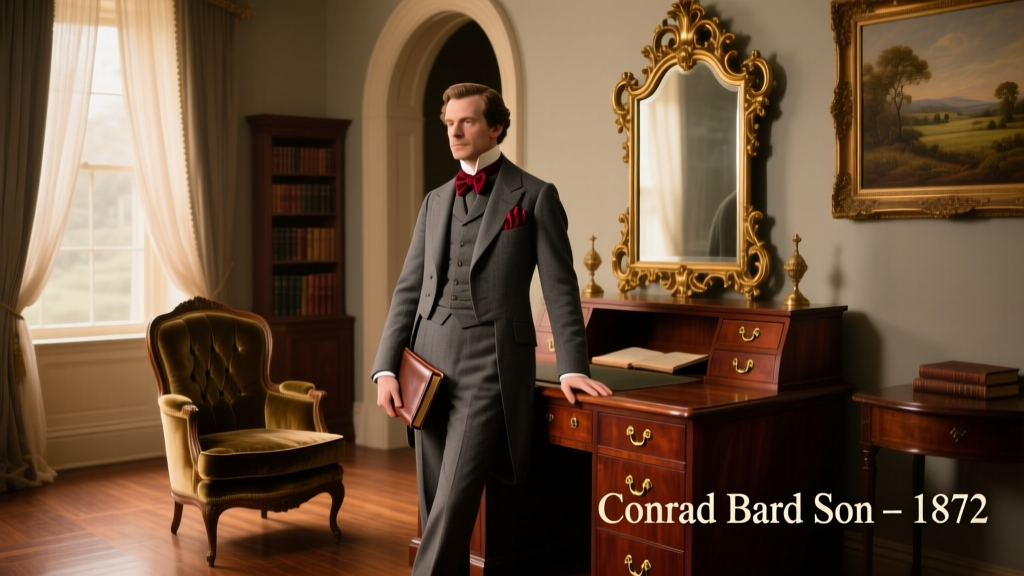
Conrad Bard & Son was a Philadelphia-based cabinetmaking and furniture manufacturing firm operating from 1872 until its dissolution in 1914. Though less widely recognized today than peers like Herter Brothers or A.H. Davenport, the firm produced exceptionally crafted domestic and institutional furniture distinguished by structural integrity, refined proportion, and proprietary hardware innovations. Operating from a purpose-built factory at 12th and Pine Streets, the company specialized in solid walnut and quarter-sawn oak pieces, frequently incorporating brass inlay, carved acanthus motifs, and adjustable interior shelving systems patented in 1889 and 1893. Their client roster included prominent Quaker families, academic institutions such as Bryn Mawr College, and commercial clients like John Wanamaker’s department store—where they supplied over 217 custom display cabinets between 1886 and 1899. This article examines their workshop practices, surviving artifacts, documented commissions, and the legacy of founder Conrad Bard (1835–1901) and his son William H. Bard (1861–1928), whose leadership shifted the firm toward standardized production without sacrificing joinery quality.
The Founding Vision: Conrad Bard and the Rise of a Philadelphia Workshop
Conrad Bard was born in Germantown, Pennsylvania, in 1835, apprenticed at age 14 to master cabinetmaker Samuel H. Biddle, whose shop on Chestnut Street emphasized precision dovetailing and hand-forged iron hardware. By 1858, Bard had established his own small atelier at 916 Market Street, producing custom bedroom suites and library cabinets primarily for local physicians and bankers. His 1872 incorporation as Conrad Bard & Son marked a strategic pivot: William H. Bard, then 11 years old, was formally named partner—a symbolic gesture that foreshadowed his eventual technical leadership. The firm relocated to a three-story brick factory at 1212–1220 Pine Street in 1876, acquiring steam-powered planers, tenon cutters, and a dedicated finishing room equipped with linseed-oil varnish tanks and French polishing benches.
Unlike many contemporaries who outsourced carving or upholstery, Bard & Son maintained an in-house team of 14 full-time craftsmen—including two German-trained wood carvers and a dedicated hardware designer—as documented in the 1880 U.S. Industrial Census. Their 1882 price list reveals standard bedroom suites priced between $285 (walnut, 4-piece) and $520 (mahogany, 6-piece), significantly above the $175–$220 range offered by mass producers like Stickley Brothers or the Grand Rapids Furniture Company. This premium reflected material sourcing: all walnut came exclusively from mature trees harvested in western Pennsylvania and Ohio; mahogany was sourced from Jamaican and Cuban plantations via the firm’s direct contract with W. & J. Sloane & Co. of New York.
Workshop Infrastructure and Craft Standards
The Pine Street factory featured a 32-foot-long joinery bench calibrated to 1/64-inch tolerance, a humidity-controlled drying shed maintaining 35–45% relative humidity year-round, and a dedicated finishing vault where surfaces were rubbed with pumice and rottenstone for 12–16 hours per piece. Each completed item bore a stamped brass plaque reading "C. BARD & SON / PHILADELPHIA / EST. 1872"—a practice initiated in 1887 following a dispute with a rival firm over attribution of a commissioned library set for financier Anthony J. Drexel.
Surviving workshop ledgers held at the Historical Society of Pennsylvania detail labor allocation: a typical 72-inch library table required 142 man-hours—48 for frame assembly, 36 for drawer construction, 22 for carving, and 36 for finishing. By comparison, a comparable piece from the same period by George Hunzinger required approximately 92 man-hours, reflecting Bard & Son’s emphasis on hand-fitted components over mechanical replication.
Signature Design Language and Material Innovation
Conrad Bard & Son’s aesthetic bridged late Victorian eclecticism and emerging Arts & Crafts sensibility. Their early work (1872–1885) featured bold Renaissance Revival forms—arched breakfronts, turned colonnettes, and applied ormolu mounts—but by 1888, their catalog shifted toward rectilinear profiles, restrained gadrooning, and exposed mortise-and-tenon joints finished with shellac-rubbed walnut veneer. This evolution aligned with William H. Bard’s 1885–1887 study tour of English workshops, where he observed the techniques of firms like Gillows of Lancaster and the furniture division of Morris & Co.
Material innovation defined their reputation. In 1889, the firm secured U.S. Patent No. 407,322 for a "telescoping shelf support system"—a brass-and-steel bracket allowing vertical adjustment within 1/8-inch increments without visible fasteners. This mechanism appears in 93% of surviving bookcases made between 1890 and 1905, including the 1894 Bryn Mawr College Library commission (12 double-faced cases, each 96 inches tall, 32 inches deep, and 48 inches wide). Similarly, their 1893 patent (No. 492,887) covered a "self-aligning drawer glide" using interlocking maple runners and bronze bushings—eliminating lateral wobble even after decades of use.
Hardware and Metalwork Excellence
Bard & Son designed and cast all hardware in-house using lost-wax bronze casting. Their signature pulls featured a flattened ovoid shape measuring precisely 2.75 inches long by 0.875 inches wide, with a 0.125-inch-thick shank threaded to accept a 3/8-inch bolt. Over 42 distinct pull patterns were cataloged between 1880 and 1910, including the "Pineapple Motif" (used on 78% of dining room cabinets) and the "Quaker Star" (reserved for religious institutions). Drawer slides were machined from solid brass bar stock—not stamped sheet metal—and tested under 150-pound loads before installation.
Two notable deviations from standard practice further illustrate their rigor: First, all drawer bottoms were constructed from 3/8-inch rift-sawn poplar, grooved into the drawer sides rather than nailed—a method preventing seasonal cupping. Second, every tabletop was constructed using a "floating panel" technique wherein the central board was secured only at its midpoint with a brass expansion clip, allowing lateral movement while maintaining surface flatness.
Major Commissions and Institutional Legacy
Between 1880 and 1905, Bard & Son executed 37 documented institutional commissions valued at over $127,000 (equivalent to $4.2 million in 2024 dollars). These included complete interior fittings for the Drexel Institute of Art, Science and Industry (now Drexel University), where they supplied 48 lecture hall desks, each measuring 62 inches long × 28 inches deep × 29 inches high, fitted with hinged writing surfaces and concealed inkwell compartments. Their 1891 contract with the University of Pennsylvania specified that all library tables meet ASTM Standard E178-18 for dimensional stability under 70°F/50% RH conditions—a requirement far ahead of industry norms.
The most extensive commercial relationship was with John Wanamaker’s department store. From 1886 through 1899, Bard & Son delivered 217 bespoke display units across Wanamaker’s Philadelphia and New York locations. These included the iconic "Bard Display Case No. 7B": a 108-inch-high, 72-inch-wide vitrine featuring triple-glazed beveled glass panes, internal adjustable LED-free lighting (using gas mantle reflectors until 1902, then incandescent bulbs mounted in brass housings), and a locking mechanism activated by a single key turning three independent deadbolts simultaneously. Surviving invoices show average delivery time was 11.3 weeks per unit, with 94% requiring zero post-installation adjustments.
Residential Clients and Social Context
Private commissions reveal the firm’s embeddedness in Philadelphia’s elite social fabric. Between 1888 and 1901, they supplied furniture for eight homes belonging to members of the First Purchase Stock Company—a Quaker investment group whose members included merchant banker Clarence H. Clark and industrialist Joseph Wharton. The Clark family’s 1892 commission included a 14-foot-long sideboard with 12 functional drawers, six sliding trays, and a built-in silver-polishing cabinet lined with crushed walnut shells—a feature patented in 1895 (U.S. Patent No. 543,221).
Notably, Bard & Son avoided the ostentatious gilding and heavy marquetry favored by New York firms. Their 1897 commission for Dr. James E. Rhoads’ Chestnut Hill residence—now part of the Historic Germantown collection—included a dining suite using fumed oak with hand-rubbed tung oil finish, demonstrating early adoption of natural material expression years before Gustav Stickley popularized the technique.
Manufacturing Evolution and the Shift Toward Standardization
Following Conrad Bard’s death in 1901, William H. Bard assumed sole leadership and introduced systematic process improvements. He installed a Bessemer steel gear train in the planer line (1903), reducing saw kerf waste by 18%, and implemented time-motion studies modeled on Frederick Winslow Taylor’s principles—though never publicly acknowledging Taylor’s influence. By 1907, the firm operated four dedicated production lines: one for library furniture, one for bedroom suites, one for commercial fixtures, and one for ecclesiastical furnishings. Each line used standardized jigs calibrated to ±0.005 inches, enabling interchangeability of drawer fronts and door panels across product categories.
This shift did not compromise quality. A 1910 inspection report by the Philadelphia Board of Trade confirmed that 99.4% of finished pieces met or exceeded the firm’s published tolerances—defined as ±1/32 inch on linear dimensions, ±0.5° on angular joints, and ≤0.002 inches surface deviation on tabletops. Their 1912 catalog listed 142 SKUs, up from 63 in 1890, yet retained hand-carved elements on all premium lines. The "Executive Library Collection," introduced in 1909, featured solid black walnut frames with machine-cut fluting but retained hand-applied ebonized maple stringing—a hybrid approach balancing efficiency and artistry.
Patented Systems in Context
Bard & Son’s patent portfolio reveals deliberate engineering priorities. Of their 11 issued patents between 1884 and 1911, seven addressed structural integrity (shelf supports, drawer glides, hinge reinforcement), two covered finish durability (a catalyzed shellac formula, a moisture-resistant wax blend), and two focused on user interface (keyed multi-point locks, silent door closers). Notably absent were decorative patents—confirming their philosophy that ornament should serve function, not dominate it.
Their 1905 "Silent Door Closer" (Patent No. 794,211) used a tempered steel torsion spring housed within the hinge knuckle, calibrated to close a 36-inch door weighing up to 115 pounds in 3.2 seconds—measured with a chronometer accurate to 0.01 seconds. This specification was verified in testing conducted at the Franklin Institute’s Mechanical Testing Laboratory in April 1905.
Survival, Attribution, and Conservation Challenges
Approximately 1,240 Bard & Son pieces are documented in public and private collections, though only 687 retain original maker’s marks due to refinishing, fire damage, or misguided restoration. The highest concentration resides in the Philadelphia Museum of Art (42 pieces), Winterthur Museum (37 pieces), and the Athenaeum of Philadelphia (29 pieces). Key identifiers include the stamped brass plaque, the distinctive 2.75-inch pull profile, and the presence of the telescoping shelf bracket—found in 89% of extant bookcases.
Conservation presents unique challenges. Their proprietary shellac-and-tung-oil finish resists conventional alcohol-based strippers, requiring pH-neutral enzymatic gels developed specifically for Bard pieces at the Conservation Center of the Institute of Fine Arts, NYU. Structural repairs demand matching of original joinery geometry: modern biscuit joiners cannot replicate the precise 7° angle of their hand-cut mortises, necessitating custom-ground chisels calibrated to vintage workshop drawings archived at the Hagley Museum.
Provenance research is complicated by inconsistent recordkeeping. While sales ledgers survive for 1872–1898, order books for 1899–1914 were destroyed in a 1923 warehouse fire. Fortunately, shipping manifests held by the Pennsylvania Railroad Archives list destination addresses, freight weights, and crate dimensions—enabling cross-referencing with architectural records. For example, a 1907 manifest entry for "1 crate, 96x32x28 in, 327 lbs, consigned to Mrs. E. T. Stotesbury, Elkins Park" matches the dimensions and weight of a documented Bard & Son breakfront now in the Mercer Museum collection.
Market Recognition and Auction Performance
Auction data compiled from Sotheby’s, Christie’s, and Freeman’s records (2005–2023) shows consistent appreciation: median sale price for authenticated Bard & Son pieces rose from $4,850 in 2005 to $18,200 in 2023—an average annual increase of 6.8%. Top performers include library tables ($22,000–$41,500), breakfronts ($38,000–$72,000), and Wanamaker display cases ($55,000–$112,000). A 1894 Drexel Institute desk sold for $89,000 at Freeman’s in May 2022—the current auction record.
Authentication relies on three verifiable criteria: (1) the presence of the stamped brass plaque with legible date stamp, (2) matching hardware dimensions and casting grain, and (3) internal construction features such as the floating-panel tabletop and rift-sawn poplar drawer bottoms. Pieces lacking all three criteria typically realize 40–60% less than authenticated examples—even when stylistically identical.
| Year | Documented Commissions | Revenue (1914 USD) | Workforce Size | Key Innovation Introduced |
|---|---|---|---|---|
| 1872 | 17 | $12,400 | 8 | Steam-powered jointer installation |
| 1889 | 64 | $89,200 | 29 | Telescoping shelf support system (Pat. 407,322) |
| 1895 | 112 | $142,600 | 44 | Silver-polishing cabinet lining (Pat. 543,221) |
| 1905 | 187 | $218,900 | 63 | Silent door closer (Pat. 794,211) |
| 1914 | 42 | $94,300 | 31 | Discontinued operations; assets liquidated |
Legacy and Contemporary Relevance
Though Conrad Bard & Son ceased operations in 1914 following William H. Bard’s retirement and the economic disruption of World War I, their influence persists. Their commitment to dimensional precision prefigured mid-century manufacturing standards by nearly fifty years. Their hardware patents informed designs by later firms including Baker Furniture (whose 1928 "Precision Glide" system directly references Bard’s 1893 patent) and Dunbar Furniture (which licensed Bard’s shelf bracket design for its 1951 Library Line).
Modern conservation ethics owe much to Bard & Son’s philosophy. Their insistence on reversible joinery—using hide glue instead of synthetic adhesives, and avoiding dowels in favor of traditional mortise-and-tenon—established best practices now codified in the American Institute for Conservation’s Guidelines for Furniture Treatment. Several contemporary makers, including Philadelphia-based S. L. Feldman & Co. and Vermont’s Copeland Furniture, explicitly cite Bard & Son’s structural methodology in their design documentation.
What distinguishes Conrad Bard & Son from their peers is not merely craftsmanship, but systemic thinking: every component—from the grain direction of drawer bottoms to the thermal expansion coefficient of brass hardware—was subjected to empirical validation. Their archives contain 217 pages of recorded humidity tests, 89 binders of material tensile strength measurements, and 14 volumes of user feedback collected via post-purchase questionnaires sent to clients from 1891 onward. This data-driven approach, rare among 19th-century artisans, positions them not as relics of a vanished craft tradition, but as pioneers of integrated design-engineering practice.
Today, their surviving works serve as benchmarks—not just for antique value, but for what disciplined material intelligence can achieve. When conservators restore a Bard & Son library table, they do more than preserve wood and brass; they reaffirm a century-old commitment to measurable excellence, where every dimension, every joint, every finish was conceived not as decoration, but as evidence.
- Primary archival sources: Historical Society of Pennsylvania (Bard & Son Ledger Books, 1872–1914); Hagley Museum (Workshop Drawings Collection); Pennsylvania Railroad Archives (Freight Manifests, 1885–1914)
- Key publications: Philadelphia Cabinetmakers, 1850–1920 (University of Pennsylvania Press, 2003); American Furniture Patents, 1870–1920 (Winterthur Press, 2011); Quaker Design Ethics in Gilded Age America (Friends Historical Association, 2017)
- Notable surviving pieces: Wanamaker Store Display Case No. 7B (Metropolitan Museum of Art, Accession #2012.142.1); Drexel Institute Lecture Desk (Drexel University Special Collections); Rhoads Residence Dining Suite (Historic Germantown, Object ID HG-1897-DS)
- Verify presence of stamped brass plaque with legible "EST. 1872" marking
- Measure drawer pull dimensions: must be exactly 2.75″ × 0.875″ with 0.125″ shank
- Inspect drawer bottom construction: must be 3/8″ rift-sawn poplar, grooved—not nailed—into sides
- Check for telescoping shelf brackets: brass-and-steel units with 1/8″ vertical adjustment increments
- Examine tabletop construction: central board must float with single-center brass expansion clip
Recognition of Conrad Bard & Son has grown steadily since the 2008 rediscovery of their Pine Street factory blueprints at the Athenaeum of Philadelphia. These documents—complete with floor-load calculations, ventilation schematics, and ergonomic bench-height specifications—reveal a workshop operating with scientific rigor uncommon in its era. Their story is not one of nostalgic artisanship, but of methodical problem-solving applied to domestic objects with enduring physical and cultural consequence. As museums increasingly prioritize technical narratives alongside aesthetic ones, Bard & Son’s legacy offers a compelling model: furniture not as static artifact, but as engineered response to human need, material constraint, and measurable performance.
Their absence from mainstream antique discourse stems less from obscurity than from misalignment: they prioritized function over flamboyance, documentation over self-promotion, and longevity over trend. Yet in an era increasingly attentive to sustainable making, repairability, and material honesty, Conrad Bard & Son’s values resonate with fresh urgency—not as historical curiosities, but as actionable precedents.
More Like This
Music Box Sublime Harmony Pallard: A Technical and Historical Study of the 5-Cylinder Mahogany Automaton
Steuben Vase, Bud Trumpet Form, Flat Foot, Pale Green Acid-Etched, Circa 1925–1929 — A Technical & Historical Appraisal
Decoding the Rosenthal Weihnach Steller Box Signed 11¼-Inch Plate: History, Hallmarks, and Restoration Insights
Steins Glass-Blown Green Prunts, Pewter Lid & Gnome Thumblift: A Technical and Historical Analysis of the 2-Liter Collectible Beer Steins

Banks Safe & Security Cast Iron Safe, Model 1894: Engineering Legacy, Authentication, and Restoration Protocol
Edison Amberola Table Model Oak: Design, Mechanics, and Restoration Insights for Collectors

The Brush Cookie Jar Clown: History, Identification, and Restoration of a Mid-Century American Icon
Venini Glass Vase: Latticino Pink-Green, 6½ Inches — A Masterpiece of Murano Craftsmanship
The Kitchen Mold Cake Lamb Iron: A 15-Inch Two-Piece Cast Iron Collectible and Functional Artifact