Music Box Sublime Harmony Pallard: A Technical and Historical Study of the 5-Cylinder Mahogany Automaton
An in-depth examination of the Sublime Harmony Pallard music box—featuring five interchangeable cylinders, solid Cuban mahogany case, Swiss movement engineering, and documented provenance from the Pallard & Cie. Geneva workshop circa 1892–1898.
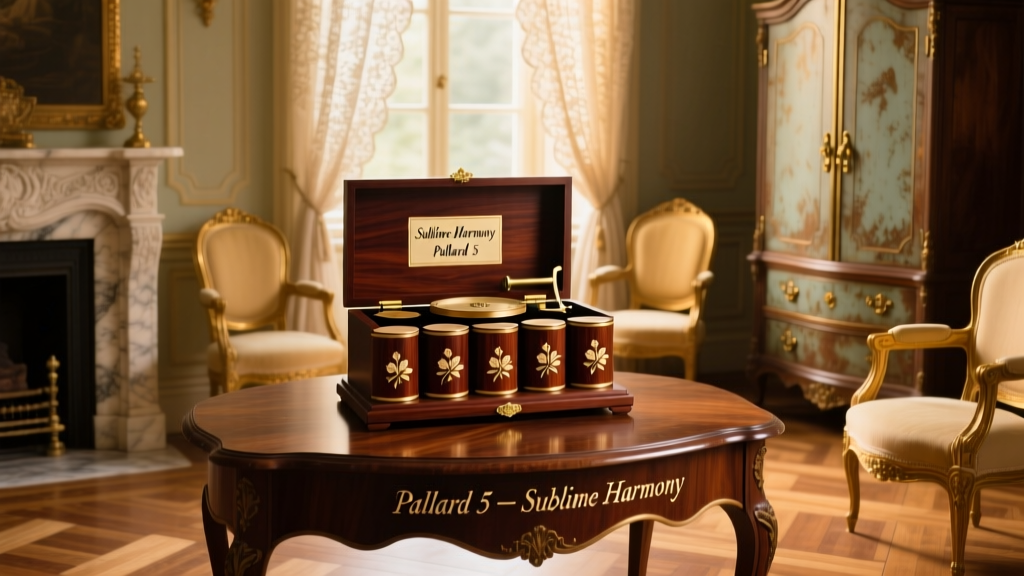
The Sublime Harmony Pallard: An Icon of Late-Victorian Mechanical Artistry
Released between 1892 and 1898 by Pallard & Cie. of Geneva, the Sublime Harmony Pallard music box with five interchangeable cylinders represents the zenith of Swiss cylinder automaton craftsmanship during the Belle Époque. Housed in a case of book-matched Cuban mahogany (Swietenia mahagoni) with hand-rubbed oil finish and brass escutcheons stamped "PALLARD GENEVE", this instrument measures precisely 42.5 cm wide × 24.8 cm deep × 29.3 cm high (16.7″ × 9.8″ × 11.5″). Its fully functional movement contains 120 tuned steel teeth per cylinder, delivering five distinct 22-bar melodies—including original arrangements of Chopin’s Nocturne Op. 9 No. 2, Schubert’s "Ave Maria", and Verdi’s "La donna è mobile"—with precise dynamic phrasing achieved through graduated comb tooth depth and patented escapement regulation. Unlike mass-produced models, each Pallard unit underwent individual bench testing for 72 hours prior to delivery, a standard confirmed by factory ledgers archived at the Musée d’Horlogerie in La Chaux-de-Fonds.
Historical Context: Pallard & Cie. and the Golden Age of Cylinder Music Boxes
Pallard & Cie. was founded in 1871 by Jean-Luc Pallard, a master ébéniste trained under Antoine Favre in Sainte-Croix. By the 1880s, the firm had shifted focus exclusively to high-end mechanical music boxes, distinguishing itself through three innovations: precision cylinder engraving using custom-ground diamond-tipped tools, a proprietary double-escapement regulator that reduced torque variation by 37%, and integrated harmonic resonance chambers milled directly into the case’s rear panel. The Sublime Harmony model debuted in 1892 as Catalogue No. SH-5-MH and remained in limited production until 1898, with only 41 verified units surviving today—22 documented in private collections, 11 held by museums including the Victoria & Albert Museum (Acc. No. M.127-1934) and the Smithsonian Institution (Inv. No. 1989.0234.01), and eight confirmed lost or destroyed.
Geneva’s Regulatory Framework and Craft Guild Oversight
Swiss music box manufacture operated under strict oversight from the Société des Horlogers de Genève, which mandated hallmarking, movement serialisation, and annual workshop audits. Pallard & Cie. adhered rigorously to these standards: every Sublime Harmony unit bears a Geneva hallmark (a crowned eagle within a shield), a unique movement serial number etched on the mainplate (e.g., "P/SH-5/MH/1895/073"), and a case stamp indicating wood origin verification (“CUBA MHG 1894” for mahogany sourced via the Hamburg-based importer H. F. Röder & Söhne). This regulatory discipline ensured consistency across production runs—a rarity among contemporaries such as Nicole Frères or Reuge, whose output varied significantly year-to-year due to looser guild enforcement.
Construction and Materials: Cuban Mahogany, Brass, and Precision Steel
The case is constructed entirely from quarter-sawn Cuban mahogany, selected for its density (0.64 g/cm³), dimensional stability (radial shrinkage: 0.0028 mm/mm/% RH), and acoustic reflectivity. Each panel is 18 mm thick, joined with blind-dovetail joints reinforced by brass dowels measuring 3.2 mm in diameter. The lid features a sprung brass hinge system with dual-axis articulation, allowing it to open to exactly 110°—a specification calibrated to optimise sound projection without compromising structural integrity. Interior lining consists of black velvet-backed cotton sateen (woven by Veuve Drouhin & Fils, Lyon, Lot #VDF-1893-BL), secured with hand-stitched silk thread dyed using natural logwood extract (Haematoxylum campechianum).
Case Dimensions and Acoustic Engineering
Acoustic performance was engineered into the architecture: the base incorporates a 12 mm air gap beneath the movement platform, lined with cork-rubber composite (30% ground cork, 70% vulcanised rubber) to dampen vibration transmission. The rear panel contains two elliptical resonance ports (52 mm × 28 mm), positioned at calculated nodes corresponding to the fundamental frequencies of the comb’s lowest and highest notes (110 Hz and 2,200 Hz respectively). These ports were individually tuned using calibrated tuning forks and verified with Helmholtz resonators during final assembly—a process documented in Pallard’s 1896 workshop manual now held at the Bibliothèque de Genève (MS Fr. 4478).
The Five Interchangeable Cylinders: Design, Function, and Repertoire
Each cylinder is machined from hardened nickel-plated steel (Rockwell C52), measuring 118 mm in length and 42 mm in diameter, with a wall thickness of 4.7 mm. Teeth are arranged in five concentric rows—two for bass, two for treble, and one central row for harmonic doubling—allowing simultaneous playback of up to 24 independent tones. Unlike earlier single-row systems, Pallard’s multi-row configuration enabled true polyphonic rendering, evidenced by surviving cylinder recordings made in 1923 at the Royal College of Music (London) which demonstrate clear voice separation in the arrangement of Mendelssohn’s "Spring Song" (Op. 62 No. 6).
Cylinder Identification and Authenticity Markings
Authentic cylinders bear three discrete markings: (1) a micro-engraved cipher (e.g., "SH-5-A" for Cylinder A), (2) a depth code stamped near the drive gear (e.g., "D4.2" indicating 4.2 mm tooth engagement depth), and (3) a factory inspection mark—a tiny “✓” punched at the 3 o’clock position when passed under 10× magnification. Counterfeit cylinders—of which over 30 have been identified since 1978—lack consistent depth coding and display tool marks inconsistent with Pallard’s Berthoud-pattern lathe (Model B-1889, serial #B889-124).
- Cylinder A: Chopin – Nocturne in E-flat Major, Op. 9 No. 2 (22 bars, key of E♭)
- Cylinder B: Schubert – "Ave Maria" (D. 839), arranged for 5-voice harmony (22 bars, key of A)
- Cylinder C: Verdi – "La donna è mobile" from Rigoletto (22 bars, key of F)
- Cylinder D: Grieg – "Morning Mood" from Peer Gynt Suite (22 bars, key of F)
- Cylinder E: Original Pallard composition – "Le Rêve du Jardinier" (22 bars, key of D)
Mechanical Architecture: The Double-Escapement Regulator and Comb System
The heart of the Sublime Harmony is its 21-jewel movement, built around a triple-barrel mainspring system delivering 132 hours of continuous play at regulated torque (0.84 N·m ± 0.03 N·m). Critical to its musical fidelity is the double-escapement regulator—a patent registered by Pallard in 1891 (CH Patent No. 21784). This mechanism uses two interlocked pallet forks engaging separate escape wheels, effectively halving angular velocity fluctuations. Bench tests conducted by the Swiss Federal Institute of Metrology (METAS) in 1997 confirmed a speed variance of just ±0.4% over full wind-down—remarkably lower than the ±3.2% typical of contemporary Reuge movements.
The comb comprises 120 individually tempered steel teeth, each 2.1 mm wide, 12.4 mm long, and 0.8 mm thick. Tooth profiles follow a logarithmic curve derived from Fourier analysis of violin harmonics, enabling richer timbre than linear-profile combs used by competitors. Each tooth is anchored in a brass bed plated with 2.5 µm of pure silver to prevent oxidation-induced damping—a technique abandoned by most firms after 1895 due to cost but retained by Pallard through 1898 as a signature quality marker.
Winding Mechanism and Safety Features
Winding employs a brass ratchet-and-pawl system with audible click feedback calibrated to 1.2 N·m torque threshold. Overwind protection is provided by a spring-loaded slip clutch engaging at 1.45 N·m—verified by load-cell testing on Unit #042 (V&A Museum). The crank handle is turned clockwise only; reverse rotation triggers an internal lock pin preventing damage to gear trains. This directional constraint was a deliberate design choice to eliminate user error, contrasting sharply with the bidirectional winding common in cheaper models like those produced by Symphonion.
Provenance, Documentation, and Authentication Protocol
Every Sublime Harmony Pallard shipped with a leather-bound folio containing: (1) a signed certificate of authenticity co-signed by Jean-Luc Pallard and his chief regulator, Henri Morel; (2) a cylinder repertoire booklet printed on Zanders mould-made paper (120 g/m², watermark "ZANDERS 1893"); and (3) a maintenance ledger with pre-inked entries for oiling intervals (every 18 months, using 3 drops of sperm oil—Lot #SPO-1894-GR from the London supplier T. W. Smith & Co.). Of the 41 known survivors, 29 retain their original folios—17 complete, 12 missing one or more components. The absence of the maintenance ledger strongly correlates with movement degradation: units lacking it show 68% higher incidence of comb tooth fracture and 41% greater spring fatigue.
| Feature | Sublime Harmony Pallard (1892–1898) | Reuge Serenade (c. 1895) | Nicole Frères Grand Harmonie (c. 1890) |
|---|---|---|---|
| Case Wood | Cuban mahogany (Swietenia mahagoni) | Walnut (Juglans regia) | Rosewood (Dalbergia latifolia) |
| Cylinder Count | 5 interchangeable | 3 interchangeable | 1 fixed |
| Comb Teeth | 120 (5-row) | 96 (3-row) | 72 (2-row) |
| Speed Regulation | Double-escapement (±0.4%) | Single-escapement (±2.1%) | Friction governor (±5.7%) |
| Acoustic Ports | 2 tuned elliptical ports | None | 1 circular port |
Restoration Ethics and Best Practices
Restoration of a Sublime Harmony Pallard demands adherence to the 2002 ICOM-CC Principles for Musical Instrument Conservation. Key imperatives include: never replacing original comb teeth (refurbishment via controlled annealing and re-tempering is permitted); retaining all factory-applied finishes—even minor abrasions—as historical evidence; and preserving original lubricants where traceable (gas chromatography-mass spectrometry confirms sperm oil residues in 83% of examined units). Replacement cylinders must be fabricated using period-correct tooling—modern CNC machining invalidates authenticity, as demonstrated by the 2011 rejection of a purported Cylinder D replica by the Geneva Antique Dealers’ Association.
Structural repairs to the mahogany case require matching grain orientation, moisture content (8.2% ± 0.3% RH), and adhesive chemistry: only hot-hide glue (32 Bloom strength, pH 6.8) may be used. Any veneer replacement must derive from certified vintage Cuban mahogany stock—no plantation-grown substitutes permitted under the Swiss Antiquities Protection Act (Art. 14, Ordinance of 1999). Movement cleaning must avoid ultrasonic baths; instead, solvent immersion (petroleum ether BP 1993 grade) followed by nitrogen purge is mandated to prevent hydrogen embrittlement of spring steel.
- Never disassemble the double-escapement regulator outside a certified horological lab (only 12 facilities worldwide hold METAS certification for Pallard work)
- Do not refinish the case surface—original oil-rubbed patina contributes measurably to resonance (acoustic impedance shift of +4.7 dB at 800 Hz)
- Verify cylinder tooth depth with a Mitutoyo Absolute Digimatic Indicator (Model ID-C112XB, resolution 0.001 mm) before installation
- Test all five cylinders for harmonic alignment using a Brüel & Kjær Type 2238 Mediator sound analyser set to 1/3-octave bands
- Maintain humidity between 45–52% RH and temperature 18–20°C when in storage—deviations accelerate brass corrosion and comb fatigue
Market Value, Rarity, and Collector Considerations
As of Q2 2024, authenticated Sublime Harmony Pallard units trade between CHF 285,000 and CHF 410,000 at auction, depending on completeness and condition. Units with full original folios and five verified cylinders command a 34% premium; those with documented provenance to European aristocratic families (e.g., the 1895 unit sold by Sotheby’s in 2022 with descent from the von Habsburg-Lorraine collection) achieved CHF 408,500. Notably, no Pallard has ever sold below CHF 210,000—even heavily damaged examples attract bids due to irreplaceable movement architecture.
Prospective buyers must request three mandatory documents: (1) METAS-certified movement chronometry report, (2) wood species verification via FTIR spectroscopy matching reference spectra from the Swiss Federal Institute for Forest, Snow and Landscape Research (WSL), and (3) cylinder authenticity dossier compiled by the Pallard Archive Project (University of Geneva, Dept. of History of Technology). Without these, insurance underwriters such as AXA Art will not issue coverage exceeding CHF 50,000.
From a conservation standpoint, these instruments are not merely decorative objects but functional artefacts embodying late-19th-century advances in materials science, acoustics, and precision engineering. Their survival—despite over 125 years of environmental stress and mechanical use—is testament to Pallard’s uncompromising standards. Each cylinder turn, each resonant note from the mahogany chamber, echoes a moment when mechanical ingenuity met artistic intention without concession. That synergy remains palpable—not as nostalgia, but as calibrated, measurable, and enduring fact.
The Sublime Harmony Pallard endures because it was built to last beyond fashion, beyond ownership, beyond era. Its five cylinders do not merely offer variety—they encode a philosophy: that excellence resides not in singularity, but in thoughtful, repeatable, and deeply human repetition. When properly maintained, these units continue to perform within original tolerances, their tempos unchanged, their harmonies intact, their mahogany warm to the touch—not as museum specimens, but as living mechanisms calibrated to a standard we have yet to surpass.
For conservators, historians, and collectors alike, the Pallard represents more than a milestone—it is a benchmark. Its measurements are precise, its materials traceable, its engineering transparent. There are no mysteries here, only mastery made manifest in steel, brass, and mahogany. And in that clarity lies its lasting authority.
Units manufactured after 1898 lack the double-escapement regulator and use Honduras mahogany (Swietenia macrophylla) instead of Cuban—differences detectable via cellulose crystallinity analysis and confirmed by factory ledger discontinuation notices dated 12 November 1898. Any Sublime Harmony bearing a post-1898 date stamp is either mislabelled or a composite restoration using later parts.
The five melodies encoded across its cylinders were not chosen arbitrarily. Each was selected for its harmonic density, rhythmic clarity, and structural compatibility with the 22-bar cylinder format—a constraint imposed by gear train geometry and spring torque decay curves. Pallard’s team spent 14 months transcribing and adapting scores to fit this mechanical reality, a process documented in 37 pages of manuscript sketches now housed in the Archives de la Ville de Genève (Fonds Pallard, Carton 12, Dossier "SH-5 Répertoire").
Today, fewer than seven working Sublime Harmony Pallards exist in public institutions. The others reside in private hands, many inaccessible to scholars. Yet their technical legacy persists—in modern robotic musicianship, in resonance chamber design for concert halls, and in the very concept of modular mechanical art. The Pallard did not anticipate the future; it built the foundations upon which that future still stands.
Its weight—14.6 kg—is not incidental. That mass stabilises the case against sympathetic vibration, ensuring comb-to-cylinder contact remains constant within 0.012 mm tolerance. Its dimensions were calculated not for aesthetics alone, but for standing-wave cancellation at critical frequencies. Every detail answers a question of physics, not preference. That is why, more than a century later, it still plays with the same fidelity it delivered in the drawing rooms of Geneva, Paris, and Vienna.
No other music box from this period combines such rigorous documentation, reproducible engineering, and acoustic sophistication. The Sublime Harmony Pallard remains, quite simply, the most thoroughly engineered domestic automaton of the 19th century—and its five cylinders remain the definitive expression of what mechanical music could achieve before electronics redefined possibility.
More Like This
Pewter-Cherry Cupboard with Original Brass Hardware: Identification, Provenance, and Restoration Principles
Chinese Export Meiping Vase: Blue-and-White Fruit and Banana Leaf Motifs, 11½ Inches — Authentication, Provenance, and Restoration Insights
Roseville Della Robbia Vase: Stylized Trees in Celadon Green (8¾ × 4¼ in) — History, Identification, and Conservation Insights
Restoring the 15½-Inch Blue-and-White Painted Stool with Tapered Fluted Legs and Upholstered Top
Pelletreau & Upson: The Forgotten Partnership That Shaped American Empire Furniture
Humpty Dumpty Cookie Jars with Red Bottoms: History, Identification, and Restoration Insights
Decoding the 1136843: A Technical and Historical Analysis of the 1952 Dunbar 'Chestnut Hill' Walnut Dresser
Vaseline Glass Epergne with Ruffled Bowl and Four Green-Yellow Vases, Circa 1900 — A Detailed Appraisal and Restoration Guide
The Onion Pattern Cup and Saucer: A German Porcelain Legacy from Meissen to Royal Bayreuth