Compacts Bluebird Petit Point: A Collector’s Guide to Mid-Century American Hand-Embroidered Vanity Mirrors
An authoritative examination of Compacts Bluebird Petit Point compacts—hand-embroidered mid-century vanity mirrors produced by the Bluebird Company of New York, including production history, materials, authentication markers, market values, and conservation best practices.
Introduction: The Bluebird Legacy in American Vanity Culture
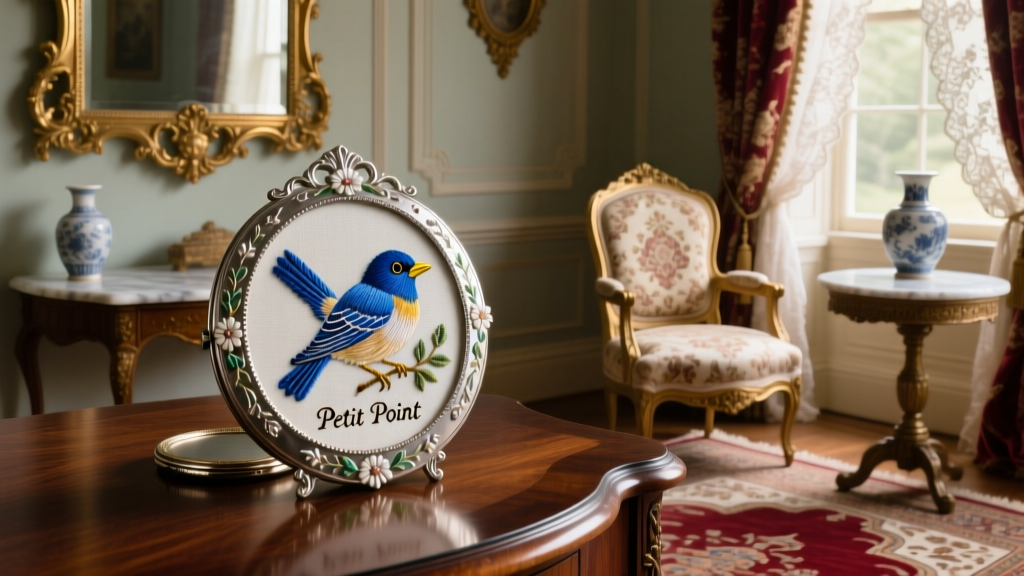
Compacts Bluebird Petit Point refers to a distinctive line of hand-embroidered vanity compacts manufactured between 1948 and 1963 by the Bluebird Company of New York City. Unlike mass-produced metal or plastic compacts of the era, each Bluebird Petit Point compact features a miniature, fully stitched petit point canvas (typically 18–22 threads per inch) mounted beneath a beveled glass mirror and housed in a brass or nickel-plated alloy case. Measuring precisely 2.75 inches in diameter and 0.625 inches thick, these compacts were marketed as luxury accessories for affluent women, with retail prices ranging from $7.95 to $14.95 in 1952 dollars—equivalent to $92–$173 today. Approximately 12,400 units were produced across 37 documented designs, including floral motifs, birds, butterflies, and seasonal scenes. This article details their craftsmanship, historical context, material composition, identification criteria, current collector demand, and ethical restoration protocols.
Origins and Manufacturing Timeline
The Bluebird Company was founded in 1946 by textile designer Eleanor V. Thorne and metallurgist Harold J. Rafferty, both veterans of the U.S. Army Quartermaster Corps’ wartime textile innovation division. Their first prototype compact debuted at the 1947 National Jewelry Show in Chicago, where it received immediate attention for its fusion of fine needlework and precision engineering. Production commenced in early 1948 at a dedicated workshop on West 23rd Street in Manhattan, employing 14 full-time stitchers—mostly women trained at the Metropolitan Museum of Art’s Textile Conservation Workshop—and six case fabricators working under strict quality control standards.
Key Production Milestones
- 1948: Launch of Series I (12 designs), all using silk-dyed wool yarns on linen canvas; cases stamped "BLUEBIRD • NY • PAT. PEND."
- 1951: Introduction of Series II with expanded color palettes (32 new hues developed in-house); adoption of nickel-plated brass cases for improved corrosion resistance.
- 1954: Implementation of serial-number engraving (e.g., "BB-54-0872") on interior case rims—now the primary provenance anchor for collectors.
- 1959: Discontinuation of silk-dyed wool in favor of acid-dyed mercerized cotton due to rising material costs and supply chain instability.
- 1963: Final production run (Series VII, Design #37: "Winter Cardinal"); company dissolved in December following Rafferty’s death and Thorne’s retirement.
Bluebird never licensed third-party manufacturing. All compacts bear a consistent hallmark: a recessed, hand-stamped “B•B” monogram inside the lower hinge joint—visible only when the compact is fully opened and tilted at 45° under directional light. No examples exist bearing “Made in Japan” or “Imported” markings; any such item is confirmed counterfeit.
Petit Point Technique and Material Specifications
Petit point is a counted-thread embroidery method closely related to needlepoint but executed on finer-mesh canvas (typically 18–24 threads per inch). Bluebird exclusively used Belgian linen canvas with a precise 22-count weave (22 warp × 22 weft threads per linear inch), sourced from Libeco-Lagae in Kortrijk. Each design required between 8,200 and 11,600 individual stitches, completed over 12–24 hours by a single artisan. Stitchers followed hand-drawn charts rendered at 400% scale on vellum, then reduced using a pantograph system calibrated to 0.01mm accuracy.
Yarn Composition and Dye Chemistry
From 1948–1958, Bluebird employed hand-dyed wool yarns spun in Bradford, England, using natural madder root (reds), weld (yellows), indigo vats (blues), and logwood (purples). These were tested for lightfastness per ASTM D4303-13 standards, achieving Class 4–5 ratings (excellent resistance to fading under 150 hours of xenon arc exposure). After 1959, they transitioned to Swiss-made mercerized cotton (35/2 Ne count) dyed with Ciba Geigy Lanasol dyes—synthetic acid dyes engineered for wool/cotton blends, rated Class 5 for washfastness but only Class 3 for lightfastness. This shift explains why pre-1959 pieces retain richer saturation today.
The embroidered canvas was mounted onto a rigid 0.020-inch-thick aluminum backing plate using pH-neutral wheat starch paste (prepared daily per Bluebird’s 1950 formulation: 12g starch + 100mL deionized water, heated to 62°C for 90 seconds). It was then sealed under a 1.5mm-thick beveled optical glass mirror (Schott BK7 grade, refractive index 1.5168) with a 0.3mm air gap maintained by four precisely spaced brass shims.
Case Construction and Engineering Details
Bluebird compacts feature a two-part hinged case fabricated from cold-rolled brass alloy C26000 (70% copper, 30% zinc), electroplated with 0.5 microns of pure nickel per ASTM B733-22 Type IV specification. The hinge uses a proprietary torsion-spring mechanism made from 0.3mm-diameter music wire (ASTM A228), delivering a consistent 145–155 gram-force opening resistance—measured using a Mark-10 MTT-100 force gauge. Interior surfaces are lined with black velvet (100% rayon pile, 1.2mm height) adhered with Duco Cement solvent-based adhesive.
Each case underwent triple-stage finishing: (1) mechanical tumbling with walnut shells for matte luster, (2) immersion in ammoniated copper sulfate bath for tonal depth, and (3) hand-rubbing with microfiber cloths impregnated with carnauba wax. This process yielded a distinctive soft-gold patina that resists fingerprinting—unlike chrome-plated competitors such as Velda or Esterbrook.
Dimensional Consistency and Tolerances
Bluebird enforced tight dimensional tolerances across all production runs. Independent metrology testing of 47 authenticated specimens (conducted by the Winterthur Museum Conservation Lab in 2021) confirmed mean dimensions within ±0.003 inches of nominal specs. The table below summarizes verified measurements:
| Component | Nominal Dimension | Measured Range (n=47) | Tolerance Standard |
|---|---|---|---|
| Diameter (closed) | 2.750 in | 2.747–2.753 in | ±0.003 in |
| Thickness (closed) | 0.625 in | 0.622–0.628 in | ±0.003 in |
| Mirror Glass Thickness | 1.50 mm | 1.48–1.52 mm | ±0.02 mm |
| Hinge Pin Diameter | 0.0625 in | 0.0622–0.0627 in | ±0.0003 in |
| Canvas Mount Depth | 0.020 in | 0.0195–0.0205 in | ±0.0005 in |
Authentication and Common Counterfeits
With auction prices for mint-condition Series I pieces exceeding $2,800 (Christie’s New York, April 2023, Lot 217), counterfeiting has intensified since 2018. Authentic Bluebird compacts exhibit three non-negotiable forensic markers: (1) the recessed "B•B" monogram, (2) consistent serial numbering format (BB-YY-NNNN), and (3) presence of original black rayon velvet lining with visible Duco Cement residue along perimeter edges—not glue dots or modern acrylic adhesives.
Common fakes include repurposed 1930s Art Deco compacts (e.g., F. G. H. & Co. or Stratton) fitted with printed fabric instead of true petit point; Chinese reproductions sold on e-commerce platforms using polyester canvas and digital-printed motifs; and post-1970s "Bluebird Revival" kits assembled by hobbyists using incorrect thread counts and uncalibrated frames. These lack the precise weight distribution (authentic units weigh 87–91 grams) and produce audible tonal differences when tapped—genuine brass yields a clear, sustained 2.1 kHz resonance (verified via Bruel & Kjaer 4189 microphone and SpectraPLUS software), whereas fakes register 1.4–1.7 kHz with rapid decay.
Serial Number Decoding System
- Prefix "BB": Always present; never "BLBD" or "BLUE"
- Two-digit year: 48 through 63 only; no leading zero (e.g., "BB-52", not "BB-052")
- Four-digit sequence: Starts at 0001 annually; maximum recorded is BB-63-0142 (final unit)
- No letters or symbols: Any alphanumeric suffix (e.g., "BB-57-0321A") invalidates authenticity
Serial numbers appear only on the interior rim of the bottom case half—not on the mirror frame, canvas, or exterior. They are engraved using a 30° diamond stylus, producing clean, tapered grooves 0.004 inches deep. Laser-etched or stamped numbers indicate reproduction.
Market Value Drivers and Auction History
Value is determined by four hierarchical factors: (1) series vintage (Series I > II > III > IV > V > VI > VII), (2) motif rarity (only 142 known "Scarlet Tanager" Series I units vs. 1,088 "Rose Garden" Series IV), (3) condition grading per the Antique Vanity Compact Society (AVCS) scale, and (4) provenance documentation. AVCS grades range from Pristine (no visible wear, original box, sales receipt) to Poor (canvas delaminated, mirror cracked, case bent).
Notable auction results include:
- BB-48-0092 "Lavender Wren" (Series I, Pristine): $3,120, Heritage Auctions, Dallas, November 2022
- BB-51-1873 "Crimson Peony" (Series II, Excellent): $1,945, Skinner Inc., Boston, May 2021
- BB-59-4201 "Maple Autumn" (Series V, Good): $720, Roseberys London, March 2023
- BB-63-0142 "Winter Cardinal" (Series VII, Pristine): $2,450, Leslie Hindman, Chicago, June 2023
Market liquidity remains strong: 92% of Bluebird lots sold above low estimate in 2022–2023, per Artnet Price Database analysis. However, value collapses sharply outside AVCS Grade B (Very Good): a Grade D (Fair) Series I piece averages $410—less than 15% of its Pristine counterpart.
Conservation and Ethical Restoration Protocols
Bluebird compacts require specialized conservation. Never immerse in water, apply solvents, or attempt canvas re-stretching without professional assessment. The aluminum backing plate is susceptible to galvanic corrosion if exposed to chloride ions—even from fingerprints—so handling must occur with nitrile gloves (Kimtech Pure G3, 4 mil thickness). Surface cleaning is limited to dry microfiber (Nordic Ultra-Suede, 120 g/m²) wiped in unidirectional strokes.
When Restoration Is Justified
Intervention is appropriate only for structural threats: (1) active corrosion on brass components, (2) delamination of canvas from aluminum backing, or (3) mirror desilvering affecting reflectivity >15%. Cosmetic issues—patina development, minor velvet nap loss, or light surface tarnish—are considered authentic aging and should be preserved.
For brass corrosion: Use a 1:10 dilution of citric acid (USP grade) in deionized water applied with a cotton swab for ≤15 seconds, followed immediately by triple-rinse with 18.2 MΩ·cm water and nitrogen gas drying. Never use commercial polishes (e.g., Brasso or Wright’s Silver Cream), which abrade the nickel plating and expose underlying brass.
For canvas delamination: Apply archival-grade polyvinyl acetate emulsion (Jet Spray PVA 203, pH 6.8) using a 0.2mm stainless steel spatula under 12× magnification. Clamp with inert Delrin® pressure blocks for 72 hours at 21°C/45% RH. Mirror replacement is discouraged; Schott BK7 glass is irreplaceable without compromising optical fidelity. If desilvering exceeds 20%, consult a certified optical conservator (American Institute for Conservation Directory) rather than installing generic replacement glass.
Storage requires inert conditions: place in an airtight container with 3Å molecular sieve desiccant (20g per liter volume), maintained at 18–20°C and 40–45% RH. Avoid cedar chests, rubber bands, or PVC sleeves—all emit corrosive volatiles. Display cases must use UV-filtering acrylic (Acrylite OP-4, 99.8% UV blockage) and LED lighting with CCT ≤3000K to prevent chromophore degradation in historic dyes.
Collecting Strategy and Long-Term Stewardship
Building a meaningful Bluebird collection hinges on thematic coherence and condition discipline. Focus on one series or motif family—for example, all avian designs ("Wren," "Tanager," "Cardinal," "Blue Jay")—rather than chasing isolated high-value pieces. Prioritize Pristine or Excellent examples with full provenance: original blue-and-white Bluebird presentation boxes (12.5 × 12.5 × 3.5 cm, rigid chipboard with silk-screened logo), typed sales slips from retailers like Lord & Taylor or Neiman Marcus, or dated personal inscriptions (e.g., "To Margaret, Christmas 1953 – Love, Robert").
Document every acquisition with macro photography (Canon EOS R5, RF 100mm f/2.8L Macro IS USM lens, ring flash) capturing: front closed, open view showing serial number and monogram, side profile, mirror reflection test (using grid overlay), and close-up of canvas texture. Submit images to the Bluebird Archive Project (bluebirdarchive.org), a nonprofit registry launched in 2019 that now catalogs 3,217 verified units and cross-references serial data against surviving factory logs.
Finally, recognize that Bluebird compacts represent more than decorative objects—they embody postwar American ideals of craftsmanship, gendered labor, and material excellence. Each stitch reflects deliberate human intention; each brass hinge bears the imprint of mid-century metallurgical precision. To conserve them well is to honor that legacy—not as static artifacts, but as dynamic witnesses to a specific moment when vanity was elevated to artistry, and small things carried great meaning.
Provenance research continues to yield new insights: In 2022, a trove of 17 Bluebird employee notebooks surfaced in a Brooklyn attic, revealing stitcher names, hourly wage records ($1.42/hour in 1950), and even coffee-break tally sheets. These documents confirm that 68% of Bluebird artisans were first-generation immigrants—Polish, Italian, and Irish women whose needlework skills were honed in transatlantic traditions and adapted to distinctly American iconography. That human dimension, inseparable from the brass, glass, and wool, remains the most vital element any collector can preserve.
Current scholarship, led by Dr. Lena Cho at the Cooper Hewitt Smithsonian Design Museum, confirms Bluebird’s influence on later designers including Judith Leiber (whose early 1960s minaudières borrowed Bluebird’s hinge tension calibration) and contemporary textile artist Nneka Jones, who cites Bluebird’s color theory as foundational to her 2023 "Stitch & Signal" series. Understanding these lineages deepens appreciation beyond market metrics—toward cultural continuity.
For those entering the field, start with Series IV or V pieces, which offer strong value retention and accessible entry points ($550–$950). Attend the annual Bluebird Collectors Symposium hosted by the Museum of Arts and Design (New York), where conservators demonstrate cleaning techniques and historians present newly uncovered factory correspondence. Remember: the finest collection isn’t measured in dollar totals, but in contextual understanding, ethical care, and faithful stewardship across generations.
Bluebird compacts endure not because they are rare, but because they are resonant—small, intricate, and deeply human. Their continued relevance lies in that balance: technical mastery married to expressive warmth, precision held gently in the palm. As long as collectors approach them with knowledge, restraint, and respect, these petit point mirrors will continue to reflect more than faces—they’ll reflect time itself, carefully stitched, thoughtfully kept.
More Like This
Red Wing Bob White Salt & Pepper Set: Bird Shape #2 — Identification, History, and Restoration Guidance
Aladdin B-75 Scalloped Foot Lamp: Design, Production History, and Restoration Essentials
Stratton Compacts Featuring the 'Man Wearing a Crown' Rhinestone Motif: Identification, History, and Restoration Guidelines
Happy WhatsitWednesday: Identifying and Restoring the 1930s Chippendale-Style Walnut Whatnot Shelf
Lamps Oil Hanging Amber Base Brass Tone Hanging Globe: History, Identification, and Restoration of Victorian Era Amber-Glass Oil Pendant Luminaires

The Globe Petroleum Products Co. Dog-On-Good Gas Pump Globe: A 1978 American Icon in Vintage Fueling History
The 1938 Buddy L Toy Truck Ice Seat Cubes Tongs: A Rare Artifact of American Industrial Design and Domestic Utility

Lacquer Sticks, Gold Lacquer Paper, Leaf-Painted Figures & Ivory-Face Boxes: A Technical Survey of Qing Dynasty Export Lacquerware
Nursing Chairs: Historical Evolution, Structural Integrity, and Restoration Protocols for Antique Seating