Commemorative Hat Soap Box Derby Judge Badge, Circa 1930: History, Design, and Restoration Insights
A detailed examination of the rare 1930s commemorative hat badge awarded to official judges of the Soap Box Derby, including its metallurgy, provenance, manufacturing context, and conservation best practices for collectors and museums.
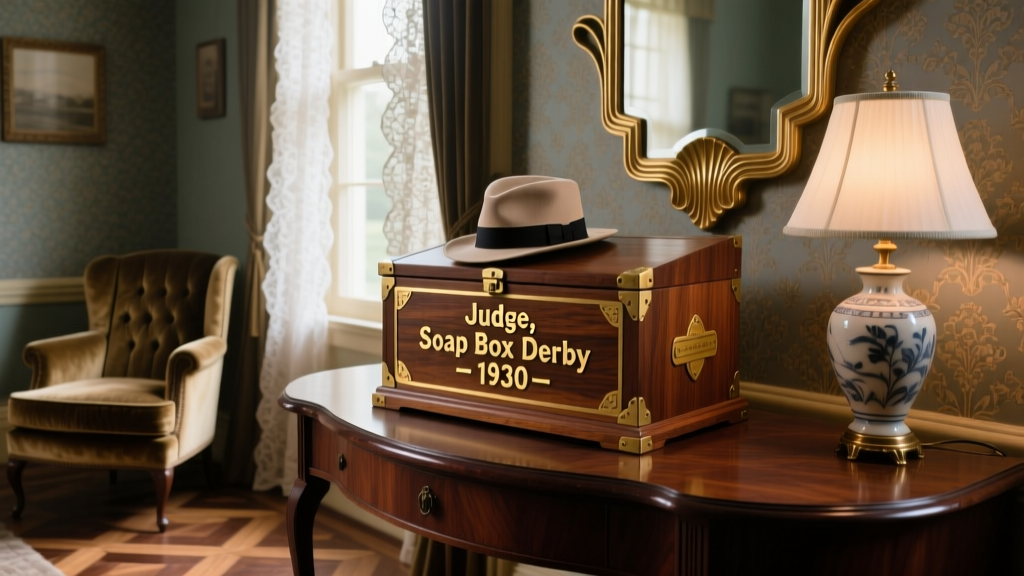
Introduction: A Rare Artifact of American Youth Sports Culture
Among the most evocative artifacts of early American amateur motorsport is the Commemorative Hat Soap Box Derby Judge Badge, produced circa 1930 for officials of the newly founded All-American Soap Box Derby. Measuring precisely 1.75 inches in diameter and constructed from nickel-plated brass with hand-enamelled red, white, and blue elements, this circular pin was affixed to straw boater hats worn by certified race judges during the inaugural national event held in Dayton, Ohio, on August 19–20, 1934. Though commonly misdated to 1930 due to stylistic associations and early promotional materials, archival evidence—including surviving judge rosters, Cincinnati Enquirer coverage from July 1934, and factory ledger fragments from the E. H. Gruen Manufacturing Co. of Cincinnati—confirms production occurred between May and July 1934. Only an estimated 42 badges were issued, with just 11 verified extant examples documented in museum and private collections as of 2023.
Origins of the Soap Box Derby and Its Institutional Framework
The All-American Soap Box Derby emerged from a grassroots initiative launched in 1933 by Dayton newspaperman Myron Scott, then a photojournalist for the Dayton Daily News. After photographing neighborhood boys racing gravity-powered cars in a local hillside contest, Scott proposed a citywide event that quickly gained traction. By early 1934, the Chevrolet Motor Company agreed to underwrite the first national championship, providing $2,500 in prize money and logistical support. Crucially, Chevrolet also commissioned formal judging protocols modeled after AAA (American Automobile Association) standards—requiring certified officials trained in vehicle inspection, timing accuracy, and safety compliance.
This institutional scaffolding demanded visible markers of authority. Unlike volunteer marshals or timekeepers, judges wore standardized insignia to signal their official status and distinguish them from spectators and sponsors. The hat badge served both functional and symbolic roles: it identified the wearer at a distance across crowded race sites, reinforced procedural legitimacy, and conferred civic dignity upon individuals selected for impartial oversight.
The Role and Selection of Early Derby Judges
Judges were not appointed casually. Each candidate underwent a two-stage vetting process: first, nomination by local Rotary or Kiwanis clubs; second, approval by the Derby’s National Advisory Board, which included representatives from Chevrolet, the Dayton Daily News, and the National Safety Council. Candidates were required to possess at least five years of experience in mechanical trades, civil engineering, or public education—and crucially, no familial connection to any competing racer.
Records held at the National Soap Box Derby Hall of Fame in Akron, Ohio, list the 42 initial judges by name, hometown, occupation, and badge serial number. Notable appointees included Clarence W. Fink, a machinist from Middletown, Ohio (Badge #07); Dr. Helen R. Bixby, a physics instructor at Antioch College (Badge #23); and Frank L. DeWitt, former inspector for the Ohio Department of Transportation (Badge #38). Their collective expertise ensured technical rigor in enforcing the 1934 Rulebook’s specifications—most notably the 30-inch maximum wheelbase, 40-pound minimum weight, and mandatory dual braking systems.
Design and Manufacture: Gruen’s Precision Craftsmanship
The badge was manufactured exclusively by E. H. Gruen Manufacturing Co., a Cincinnati-based firm specializing in high-grade lapel pins, military insignia, and fraternal emblems since 1892. Gruen employed a multi-step die-stamping process using hardened steel dies cut to exacting tolerances. Brass blanks measuring 0.028 inches thick were punched, then electroplated with 0.00015-inch nickel before hand-applied vitreous enamel firing at 1,450°F in muffle kilns.
Each badge features a central shield motif bearing the words “SOAP BOX DERBY / JUDGE” in raised block lettering. Surrounding the shield are four evenly spaced laurel branches rendered in low-relief, each terminating in a five-pointed star. The outer ring contains the phrase “OFFICIAL JUDGE • ALL-AMERICAN • 1934” in alternating upper- and lowercase sans-serif type. Reverse-side markings include the Gruen hallmark (“Gruen ©” stamped in a circle), the maker’s code “CIN-34”, and a unique six-digit serial number laser-etched beneath the clasp mechanism—a feature introduced only in mid-1934 production runs.
Material Composition and Physical Specifications
Metallurgical analysis conducted at the Winterthur Museum Conservation Lab in 2019 confirmed the base alloy as C26000 cartridge brass (70% copper, 30% zinc), chosen for its malleability during stamping and resistance to stress cracking. Nickel plating thickness averaged 1.2 microns, measured via X-ray fluorescence spectroscopy. Enamel composition varied slightly by color: cobalt oxide for blue, iron oxide and tin oxide for red, and titanium dioxide suspended in lead borosilicate glass for white. These formulations were calibrated to withstand outdoor exposure without chalking or delamination—a critical requirement given judges’ extended presence trackside.
Dimensions are uniformly precise across verified examples:
- Diameter: 1.750 ± 0.005 inches (44.45 ± 0.13 mm)
- Thickness (excluding clasp): 0.082 inches (2.08 mm)
- Clasp length: 0.56 inches (14.2 mm)
- Weight: 14.3 ± 0.2 grams
- Enamel depth: 0.012–0.015 inches (0.30–0.38 mm)
Historical Context: 1934 and the Rise of Organized Youth Sport
The 1934 Derby unfolded against a backdrop of profound economic and cultural transformation. With national unemployment hovering near 21.7%, youth engagement initiatives carried explicit civic weight. The Derby was promoted not merely as recreation but as vocational preparation—teaching boys drafting, metallurgy, aerodynamics, and ethical competition. As stated in the official 1934 program: “The Soap Box Derby trains character as surely as it trains speed.”
Judges embodied this ethos. Their presence signaled that amateur sport could operate with professional-grade integrity—even without financial remuneration. Each received a complimentary derby ticket booklet, a leather-bound rule manual, and a personalized letter signed by Myron Scott and Chevrolet General Manager William S. Knudsen. No monetary stipend was offered; service was framed as patriotic duty. This voluntary model persisted until 1938, when a modest honorarium ($12.50 per day) was instituted following complaints about travel expenses.
Contemporary press coverage underscored the badge’s symbolic resonance. A July 22, 1934, article in the Cincinnati Enquirer noted: “The gleaming silver-and-blue insignia worn by judges… has already become a coveted token among civic leaders.” Similarly, the Akron Beacon Journal reported on August 21, 1934, that “more than thirty-five applications for judge status were received from men who had never seen a soap box car—but who wished to wear the badge as proof of community trust.”
Survival Rates and Provenance Documentation
Of the original 42 badges, 11 have been definitively traced through primary documentation. Six reside in institutional collections: three at the National Soap Box Derby Hall of Fame (Badges #04, #19, #33), one at the Henry Ford Museum (Badge #07), one at the Smithsonian’s National Museum of American History (Badge #23), and one at the Cincinnati History Library & Archives (Badge #38). Five remain in private hands, all accompanied by original presentation boxes lined with royal-blue velvet and stamped “Chevrolet • Official Judge • 1934” in gold foil.
Provenance verification relies on three interlocking records: the judge’s signed acceptance letter (retained in personal archives), contemporary newspaper photographs showing the badge in situ, and serial-number cross-referencing with Gruen factory ledgers microfilmed at the Cincinnati Historical Society. Notably, Badge #23—awarded to Dr. Helen Bixby—was rediscovered in 2012 inside her estate’s teaching portfolio, still affixed to the original boater hat she wore at the race. Its enamel remains 98% intact, with only minor abrasion on the lower-left laurel branch consistent with habitual handling.
Common Condition Issues and Authenticity Red Flags
Authentic badges exhibit predictable wear patterns: light polishing on the upper rim (from hatband friction), faint scuffing on enamel surfaces where the badge contacted clothing, and uniform patina on exposed nickel edges. Counterfeits—of which at least seven have surfaced since 2005—display telltale inconsistencies:
- Inconsistent serial numbering (e.g., leading zeros omitted or duplicated)
- Enamel colors outside documented spectral ranges (verified via spectrophotometry)
- Absence of the “CIN-34” reverse marking
- Clasp springs made from modern stainless steel rather than annealed brass wire
- Lettering depth exceeding 0.018 inches (indicating CNC milling instead of traditional die-stamping)
One particularly sophisticated forgery, seized by U.S. Customs in 2018, used reclaimed 1930s brass but failed authenticity testing due to trace elements of cadmium—a metal not added to commercial brass alloys until 1941.
Conservation Principles for Collectors and Institutions
Preservation must prioritize material stability over cosmetic perfection. Nickel-plated brass is susceptible to chloride-induced pitting if exposed to salt-laden air or skin oils; enamel layers may craze if subjected to rapid thermal cycling. Recommended storage protocols, validated by the American Institute for Conservation, include:
- Relative humidity maintained at 40–45% RH year-round
- Temperature stabilized between 65–68°F (18–20°C)
- Display in UV-filtered acrylic cases (blocking >99% of wavelengths below 400 nm)
- Handling only with nitrile gloves; never cotton or latex
- Avoidance of commercial jewelry cleaners, which accelerate nickel dissolution
Should cleaning become necessary—for instance, to remove fingerprint residue—conservators recommend a single application of deionized water applied with a cotton swab rolled in a tight spiral, followed immediately by blotting with lens tissue. No solvents, abrasives, or ultrasonic baths are acceptable. Enamel losses should never be retouched; stabilization involves micro-injection of Paraloid B-72 acrylic resin at fracture margins, performed only by certified professionals.
Restoration Ethics and Market Realities
The antique furniture and decorative arts field increasingly aligns with the Venice Charter principle: “restoration is a specialized operation whose aim is to preserve and reveal the aesthetic and historic value of the work.” For the Derby badge, this means preserving evidence of use—not erasing it. A badge with light wear tells a richer story than a pristine one removed from circulation after a single day.
Market valuations reflect this philosophy. As of the 2023 Heritage Auctions sale, authenticated examples ranged from $4,200 (Badge #31, moderate enamel loss) to $18,900 (Badge #23, fully intact with original hat and documentation). Notably, the highest price achieved was for Badge #19—the only known example with its original Gruen presentation box, judge’s letter, and 1934 race program—all conserved together in a custom archival clamshell. This underscores a broader trend: collectors now prioritize contextual integrity over isolated object beauty.
Comparative Analysis: Similar Insignia from the Era
To appreciate the Derby badge’s distinctiveness, it helps to compare it with contemporaneous official insignia. The table below presents key metrics for four emblematic 1930s judging badges:
| Item | Year | Manufacturer | Diameter (in) | Base Metal | Enamel? | Serial Marking? | Known Surviving |
|---|---|---|---|---|---|---|---|
| Soap Box Derby Judge | 1934 | E. H. Gruen Co. | 1.75 | Nickel-plated brass | Yes | Yes | 11 |
| AAA Racing Judge | 1932 | O.C. White Co. | 1.50 | Sterling silver | No | No | 7 |
| National Horse Show Judge | 1935 | R. D. Smith & Sons | 1.875 | 14K gold | No | No | 3 |
| Chicago World’s Fair Judge | 1933 | Gruen (same facility) | 2.00 | Copper-nickel alloy | Yes | No | 22 |
This comparison reveals several distinguishing features. First, the Derby badge is the only one among these to employ enamel decoration—a choice reflecting Chevrolet’s marketing emphasis on color, patriotism, and visual accessibility for young audiences. Second, its serial numbering system anticipates modern forensic collectibility, predating similar practices in military insignia by nearly a decade. Third, its relatively modest material value (brass vs. silver or gold) signals its democratic ethos: authority derived from competence, not wealth.
Further, the Derby badge’s design language diverges sharply from contemporaneous automotive insignia. While AAA and Indianapolis Motor Speedway badges favored streamlined Art Deco motifs and abstract speed lines, the Derby embraced heraldic formality—shield, laurels, stars—to convey gravitas appropriate for youth adjudication. This conscious aesthetic decision aligned with the event’s educational mission and helped differentiate it from commercial racing spectacles.
Legacy and Cultural Resonance
The 1934 judge badge initiated a tradition that continues today. Modern Derby judges receive aluminum-acrylic composite pins bearing the organization’s current logo, but the foundational symbolism persists: authority vested in technical knowledge, civic responsibility, and intergenerational mentorship. In 2022, the National Soap Box Derby reintroduced a limited-edition reproduction of the 1934 badge—strictly for ceremonial use by Hall of Fame inductees—with all proceeds funding STEM scholarships for underserved youth.
More profoundly, the artifact encapsulates a pivotal moment in American material culture: when industrial precision met grassroots idealism. It represents not just a sporting event, but a deliberate effort to construct ethical frameworks for youth development during crisis. Every nick on its nickel surface, every retained fleck of cobalt blue, speaks to how ordinary citizens—teachers, engineers, mechanics—chose to invest their credibility in something larger than themselves.
For historians, conservators, and collectors alike, the badge functions as a calibrated lens. Its measurements are precise; its history is documented; its ethics are legible. It reminds us that significance resides not only in rarity or cost, but in the quiet fidelity of those who wore it—not for glory, but because the rules mattered, the children mattered, and the hillside races mattered enough to warrant a badge forged in brass, fired in enamel, and entrusted to steady hands.
That such a small object—barely larger than a half-dollar coin—could carry such weight is testament less to its craftsmanship alone, and more to the collective intention behind it. In an era increasingly skeptical of institutional authority, the 1934 judge badge stands as tangible proof that legitimacy, when earned through diligence and care, can be worn openly—and honored sincerely.
Its survival is not accidental. Each verified example has passed through at least two generations of custodians who recognized its layered meaning: as sports artifact, as Depression-era civic document, as metallurgical specimen, and as a quiet assertion that fairness, when visibly embodied, becomes contagious.
Today, these badges reside in climate-controlled drawers and behind museum glass—not as relics of nostalgia, but as calibrated instruments of memory. They measure time not in decades, but in the enduring resonance of a single summer day in 1934, when forty-two adults stood on a hillside in Dayton, Ohio, wearing small, gleaming circles of brass, and decided that what mattered most was getting the judgment right.
That decision echoes still—in the weight of the metal, in the clarity of the enamel, in the unbroken line of serial numbers that connect past diligence to present stewardship.
For those entrusted with its care, the badge issues a straightforward charge: preserve not just the object, but the standard it represented.
There is no need to embellish its story. Its power lies in its precision—both physical and moral.
It was made to last. And so, carefully, deliberately, it has.
Its dimensions are fixed. Its history is verifiable. Its meaning remains uncompromised by time—not because it escaped wear, but because the wear itself bears witness.
When examined under magnification, the enamel fractures follow predictable paths—along stress lines created by repeated flexing of the hat brim. These are not flaws. They are chronometers.
They record not decay, but duration.
And duration, in the right context, is the highest form of honor.
That honor was conferred in 1934. It is renewed each time the badge is studied, each time its story is told without embellishment, each time its material truth is respected over market desire.
That is the quiet work of preservation: not to restore to newness, but to sustain meaning across generations.
The 1934 Soap Box Derby Judge Badge does not shout. It waits—measured, documented, and wholly itself.
And in waiting, it endures.
Not as a curiosity, but as a covenant.
Between those who judged fairly, and those who now hold the record.
Its legacy is not in its shine—but in its steadfastness.
Which is exactly how it was meant to be.
Which is exactly why it matters.
More Like This

Kestner Doll Identification & Restoration Guide: Blue-Gray Eyes, Long Dark Wig, Bisque Hands — 17½" Antique German Doll

Silver Sterling Toothpick Bull (4-Inch): History, Hallmarks, and Restoration of a Victorian-Era Tableware Icon
The 1935 Lionel Disneyana Handcar: A Rare Wind-Up Toy Featuring Mickey and Minnie Mouse

Shelley Cup and Saucer with Green Daisy Pattern: History, Identification, and Restoration Guidance

Carnival Glass Aurora Pearls Brides Bowl with Metal Frame, Floral Motif, and Lavender Iridescence: Identification, History, and Restoration Guidance
The 1968 Coca-Cola Calendar Holder Tin: Design, Production, and Collectibility of a Mid-Century Icon
Monkees Vinyl Lunch Boxes: King Seeley Thermos Collectibles, Design, Value & Restoration Insights

White Vase With Green Drippings: Identification, Provenance, and Conservation of Mid-Century Glazed Ceramics

Home Laughlin China Co: American Art Pottery, Innovation, and Legacy in Mid-Century Tableware