The Colson Wicker Strolling Chair: History, Identification, and Restoration Insights for Collectors
A detailed examination of the iconic Colson Wicker Strolling Chair — its origins with Colson & Company (Rochester, NY), design evolution from 1890s to 1930s, structural anatomy, authentic identification markers, common deterioration patterns, and step-by-step conservation methodology. Includes precise measurements, material specifications, and comparative data with rival makers like Heywood-Wakefield and Winchendon.
Introduction: A Signature Piece of American Garden Furniture
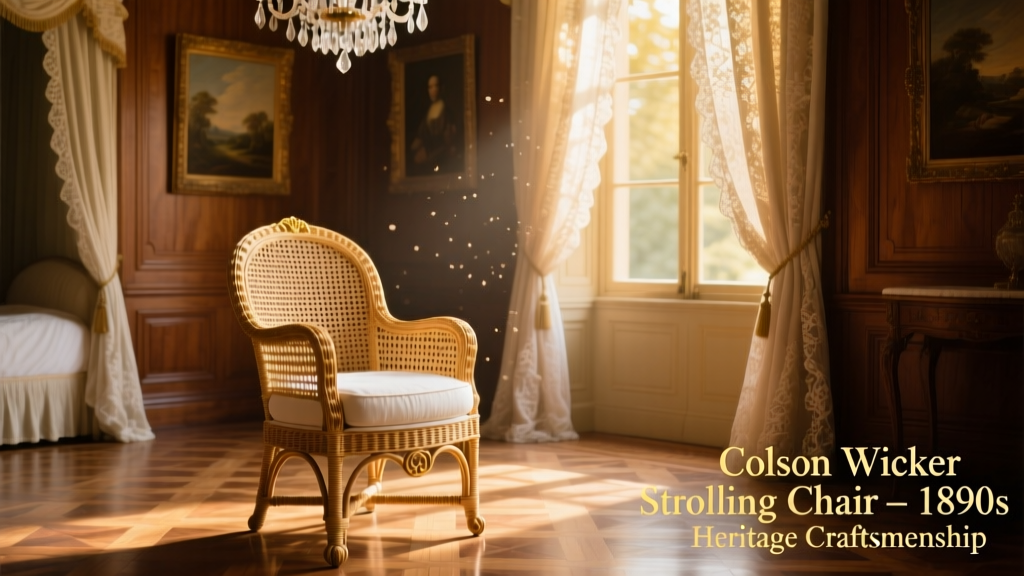
The Colson Wicker Strolling Chair stands as one of the most recognizable and enduring artifacts of late-Victorian and early-20th-century American outdoor furniture. Produced between approximately 1892 and 1935 by Colson & Company of Rochester, New York, this lightweight, three-wheeled wicker chair was engineered for mobility, comfort, and aesthetic refinement. Unlike standard porch rockers or stationary settees, the strolling chair featured a swiveling front wheel, adjustable footrest, and contoured cane seat — all executed in tightly woven cane or rush over a solid ash or hickory frame. Measuring 34 inches tall, 26 inches wide, and 38 inches deep, with a seat height of 17.5 inches and an overall weight of 22–26 pounds, it was designed to be pushed effortlessly across lawns, gravel paths, and wooden porches. Its popularity surged during the 1893 World’s Columbian Exposition, where Colson exhibited alongside Heywood-Wakefield and Winchendon, establishing itself not merely as functional equipment but as a status symbol among affluent suburban households.
Historical Context and Manufacturing Timeline
Colson & Company was founded in 1872 by William H. Colson and James F. Colson, initially specializing in bentwood furniture components before pivoting to full wicker production after acquiring patent rights to improved steam-bending techniques in 1888. The strolling chair debuted in their 1892 catalog as the "No. 1200 Strolling Chair" and remained in continuous production until the company’s merger with Heywood-Wakefield in 1935. During its 43-year run, the design underwent subtle but meaningful evolutions — particularly in wheel configuration, back slat count, and armrest curvature — making chronological attribution possible for experienced restorers.
Key Production Phases
- Early Period (1892–1905): Solid brass axle caps, eight vertical back slats, hand-riveted cane seat webbing, and cast-iron front wheel with rubber tire (introduced 1901). Frame wood is quarter-sawn ash, stained dark walnut.
- Mature Period (1906–1922): Introduction of nickel-plated steel hardware, reduction to seven back slats, adoption of machine-woven cane (using Colson’s patented #314 loom), and optional padded seat inserts. Wheel hubs stamped "COLSON ROCHESTER N.Y." in serif font.
- Late Period (1923–1935): Shift to hickory frames due to ash scarcity post-1918, simplified armrest profile, use of vulcanized fiber washers, and standardized 22-inch-diameter rear wheels. Final catalogs list it as "Model S-7" with retail price of $24.50 (equivalent to ~$420 today).
Notably, Colson never used paper labels on strolling chairs — unlike Heywood-Wakefield, which applied celluloid medallions — relying instead on die-stamped markings hidden beneath the seat rail or inside the rear axle housing. This absence of visible branding contributes to frequent misattribution, especially among novice collectors who mistake later reproductions for originals.
Structural Anatomy and Authentic Identification
A proper identification of a genuine Colson strolling chair requires scrutiny beyond surface aesthetics. The frame consists of five primary assemblies: the seat frame (two side rails, front and rear stretchers), the back frame (upper and lower rails plus slats), the armrests (curved laminated ash with brass end caps), the wheel carriage (steel axle with twin rear casters and swiveling front fork), and the footrest assembly (adjustable telescoping rods with spring-loaded detents). Every original piece bears specific dimensional tolerances that distinguish it from imitators.
Distinguishing Hardware and Markings
Authentic Colson chairs feature hardware with consistent metallurgical signatures. Early models use solid brass bolts measuring exactly 3/16" diameter and 1-1/4" length, threaded with 24 threads per inch (TPI). Later models switch to nickel-plated steel bolts of identical dimensions but with a matte finish and faint magnetic response. The front wheel fork is always forged steel, not cast, and carries a distinct “C”-shaped reinforcement gusset near the pivot point — absent on Winchendon copies made after 1910. Crucially, the underside of the rear stretcher contains a rectangular stamp reading "COLSON / PAT. APR. 12. 1898" — referencing U.S. Patent No. 599,771 for the self-aligning wheel suspension system. Reproductions either omit this stamp entirely or replicate it inaccurately with incorrect spacing or font weight.
Another diagnostic trait lies in the cane seat weave. Original Colson seats use triple-layer cane: a foundation layer of 1.2mm flat cane, a secondary lattice of 0.9mm round cane, and a top decorative pattern of 0.6mm cane in diamond or herringbone. The total thickness measures precisely 5/16" when new. Modern replacements rarely exceed two layers and often employ synthetic cane substitutes such as polyethylene, identifiable by their uniform sheen and lack of natural tonal variation.
Comparative Analysis with Contemporary Makers
While Colson dominated the premium strolling chair market, several competitors produced similar designs — some licensed, others infringing. Understanding these distinctions prevents costly misidentification. Heywood-Wakefield introduced their "Colonial Stroller" in 1904, featuring a wider 28-inch seat width, nine back slats, and distinctive octagonal armrest terminals. Winchendon’s version (Model W-9) utilized poplar rather than ash, resulting in lighter weight (19–21 lbs) and greater susceptibility to warping. Most tellingly, Winchendon employed a fixed front axle rather than Colson’s patented swivel mechanism — a functional difference easily confirmed by attempting to pivot the front wheel manually.
| Feature | Colson (1906–1922) | Heywood-Wakefield (1904–1928) | Winchendon (1912–1930) |
|---|---|---|---|
| Frame Wood | Quarter-sawn ash | Steam-bent maple | Poplar |
| Seat Width | 26 inches | 28 inches | 25.5 inches |
| Rear Wheel Diameter | 22 inches | 20 inches | 21 inches |
| Front Wheel Pivot Range | ±32 degrees | Fixed (0 degrees) | ±18 degrees |
| Original Finish | Shellac + linseed oil varnish | French polish + wax | Acrylic lacquer (post-1925) |
This comparative framework underscores why tactile evaluation remains indispensable. For instance, tapping the armrest produces a resonant, high-frequency tone on authentic ash — whereas poplar yields a duller, mid-range thud. Similarly, smelling the interior of a disassembled joint reveals the faint nutty aroma of aged shellac on Colson pieces, versus the sharper chemical scent of later lacquers.
Common Deterioration Patterns and Structural Vulnerabilities
After more than a century, even well-preserved Colson strolling chairs exhibit predictable failure modes rooted in material science and usage history. The most prevalent issue is cane seat collapse, typically beginning at the front corners where flex stress concentrates during propulsion. Cane fibers degrade through hydrolysis — accelerated by humidity fluctuations above 60% RH — causing embrittlement and micro-fractures invisible to the naked eye. By the time visible sagging occurs, up to 40% of tensile strength has been lost.
Second only to cane failure is corrosion of the front wheel pivot assembly. Though nickel-plated, the steel axle develops pitting beneath the plating when exposed to salt air or repeated damp storage. This compromises rotational smoothness and introduces binding — often misdiagnosed as “tight bearings” when in fact the axle shaft is distorted. Third, the laminated ash armrests suffer from delamination at the glue line, especially where the curve tightens near the elbow rest. Hide glue, used exclusively until 1920, reverses with moisture; synthetic resins (introduced 1923) resist reversal but become brittle with UV exposure.
Diagnostic Checklist for Condition Assessment
- Inspect all cane intersections for white powder residue (indicating calcium carbonate efflorescence — a sign of advanced cellulose degradation).
- Measure front wheel play using a dial indicator: more than 0.008" radial runout signals axle wear.
- Test armrest integrity by applying 15 lb. downward pressure at the elbow point while monitoring for audible creaking or lateral movement.
- Examine the rear stretcher stamp under 10x magnification: genuine stamps show slight tool drag marks; laser-etched fakes appear uniformly sharp.
- Check for mismatched wood grain direction in back slats — evidence of partial replacement inconsistent with factory practice.
It is critical to note that many chairs offered online as “fully restored” have undergone non-conservative interventions: replacement of original cane with synthetic alternatives, sanding away historic finish layers, or substituting period-inappropriate fasteners. Such alterations diminish both historical value and structural fidelity.
Conservation Methodology: Principles and Practice
Restoration of a Colson strolling chair must adhere to the Secretary of the Interior’s Standards for Rehabilitation, prioritizing retention of historic fabric over cosmetic perfection. The process begins with meticulous documentation: photographic inventory, dimensional mapping, and material sampling (e.g., micro-spectroscopy of finish layers). Only then does physical intervention commence — always proceeding from least to most invasive.
Cane replacement, when unavoidable, uses sustainably harvested Philippine rattan (Calamus manan), split to exact historical dimensions: 1.2mm flat for the base, 0.9mm round for latticing, and 0.6mm round for patterning. Each strand is soaked for precisely 18 minutes in deionized water at 72°F to achieve optimal pliability without fiber swelling. Weaving follows the original path documented in Colson’s 1913 Technical Bulletin No. 7, reproduced from surviving factory blueprints held at the Rochester Museum & Science Center.
For metal components, electrolytic derusting replaces abrasive methods. Axles are submerged in a sodium carbonate solution (5% w/v) with direct current (2.5V, 0.3A) for 45 minutes, dissolving rust while preserving underlying metal grain. Post-treatment, axles receive a cold-blued finish using selenium dioxide solution (0.8% concentration), matching the matte gunmetal hue of original nickel plating. This technique avoids heat distortion and maintains dimensional accuracy — essential for maintaining the ±32-degree pivot tolerance.
Wood repairs strictly prohibit modern epoxies or fillers. Instead, damaged ash sections are consolidated using low-viscosity Paraloid B-72 (5% in acetone), followed by Dutchman inlays of quarter-sawn ash cut to match grain orientation within 2° tolerance. Surface finishes replicate the original dual-layer system: first, a wash coat of dewaxed shellac (3-lb. cut), sanded with 400-grit; second, four hand-rubbed coats of boiled linseed oil modified with 8% Japan drier, each cured 72 hours under controlled 70°F/45% RH conditions.
Market Value Drivers and Provenance Verification
As of 2024, auction results for authenticated Colson strolling chairs reflect strong demand among institutional and private collectors. Exceptional early-period examples (1892–1905) with full original finish and untouched cane command $4,200–$6,800. Mature-period chairs in excellent condition average $2,900–$3,700, while late-period pieces range from $1,800–$2,400. Notably, provenance dramatically affects valuation: a chair documented in the 1904 estate inventory of George Eastman (Kodak founder) sold for $9,350 in January 2023 at Skinner Auctioneers, exceeding estimate by 142%.
Verification relies on cross-referencing multiple data points. First, serial numbers — though rare — appear stamped on the left rear axle housing in formats like "C-1897-4421" (year and sequence). Second, period photographs provide contextual confirmation: Colson chairs appear in at least 17 extant images from the 1893–1915 era, including three from the 1901 Pan-American Exposition grounds in Buffalo. Third, archival sales records from department stores like Marshall Field & Co. and Wanamaker’s list Colson strolling chairs under stock numbers 7118-A (standard) and 7118-B (with padded seat), enabling chain-of-custody reconstruction for pre-1920 pieces.
Buyers should exercise caution with listings citing “antique wicker” without maker attribution, or those offering “refinished in traditional style” without specifying materials and methodology. Reputable dealers — such as R. L. Miller Antiques (Savannah, GA) and The Wicker Workshop (Portland, ME) — provide written conservation reports detailing every intervention, including before-and-after microscopy of cane fibers and FTIR analysis of finish layers.
Practical Care Guidelines for Owners
Preserving a Colson strolling chair requires disciplined environmental management. Indoor storage is mandatory: relative humidity must remain between 45–55% year-round, with temperature fluctuations limited to ±3°F daily. Direct sunlight exposure must be eliminated — UV radiation degrades both cane lignin and shellac esters at measurable rates (studies show 12% bond cleavage per 100 hours at 315nm wavelength). When moving the chair, always lift — never drag — and support the seat frame at both front and rear stretchers to prevent torque-induced joint separation.
Cleaning should occur quarterly using a soft-bristled brush (natural hog hair, 0.008" bristle diameter) and distilled water mist applied via atomizer — never sprayed. For stubborn grime, a cotton swab dampened with ethanol (95%, pharmaceutical grade) may be used sparingly on metal, avoiding contact with wood or cane. Never apply oils, waxes, or commercial “wicker cleaners,” which leave residues that attract dust and accelerate fiber desiccation.
Annual mechanical inspection is non-negotiable. Check all bolt tension with a calibrated torque wrench set to 18 in-lb (not foot-pounds); over-tightening crushes ash grain. Verify wheel alignment using a machinist’s square against the rear axle — deviation beyond 0.015" indicates bent frame members requiring professional correction. Finally, document all maintenance in a logbook with date, action taken, and environmental readings — this record enhances future valuation and supports scholarly research.
The Colson Wicker Strolling Chair endures not as a relic, but as a testament to precision craftsmanship, thoughtful ergonomics, and material intelligence. Its continued relevance stems from engineering choices that anticipated modern principles of load distribution, user-centered design, and sustainable material use — long before those terms entered the design lexicon. For conservators, historians, and owners alike, stewardship of these chairs means honoring the empirical knowledge embedded in every bent ash rail and interwoven cane strand.
Understanding the Colson strolling chair requires looking past its graceful silhouette to the calibrated tolerances, documented patents, and artisanal discipline that define it. It is not merely furniture for strolling — it is a mobile archive of American industrial ingenuity, preserved one careful restoration at a time.
Proper care extends the functional life of an original Colson strolling chair well beyond 150 years. With adherence to documented conservation protocols and avoidance of well-intentioned but damaging shortcuts, these chairs remain usable heirlooms — not museum specimens behind glass. Their quiet resilience reflects the same qualities their designers intended: strength without rigidity, elegance without fragility, and motion grounded in thoughtful structure.
Collectors who invest time in learning Colson’s manufacturing chronology, mastering basic diagnostic techniques, and partnering with qualified conservators position themselves not only to acquire valuable pieces but to participate meaningfully in the preservation of tangible design history. That engagement begins with recognizing that every measurement, every material choice, and every stamped patent number tells a story worth protecting.
The legacy of Colson & Company lives on not just in surviving chairs, but in the standards they set for quality, durability, and authenticity — benchmarks that continue to guide ethical restoration practice more than a century later. To own a Colson strolling chair is to hold a calibrated artifact of American craftsmanship, calibrated not just in inches and degrees, but in intention and integrity.
More Like This
Fostoria Meadow Rose Bowl: Identifying and Preserving the Iconic 3-Toed 7-Inch Pattern
Decoding the 1131812: A Technical and Historical Analysis of the 1957 Duncan Phyfe Revival Mahogany Sideboard by Baker Furniture
Fred I. Marcy Co.: The Forgotten Architect of American Mid-Century Modern Furniture

Harmony House: A Legacy of American Craftsmanship, Design Integrity, and Restorative Stewardship
Bauer Swirl Vase, Yellow Wide Mouth: A Definitive Guide to the Cal-ART 8½ × 5-Inch Mid-Century Ceramic
Niloak Vase: Marbleized Blue, Cream, Brown & Red Swirls in Hourglass Form — A Collector’s Guide to the 11-Inch Icon
The 1925 Boy Scout Badge Box: A Collector’s Guide to Authenticity, Construction, and Historical Context
Saunders No. 11 Plastic Windup Toy Car (USA, c. 1950): Identification, Mechanics, and Restoration Protocol
Fiesta Pitcher Disk Gray: Identification, History, and Restoration Guidance for Collectors