Collector Plates: History, Value Drivers, and Conservation Practices for Antique and Vintage Ceramics
A detailed examination of collector plates—from their 19th-century origins to mid-century mass production—covering manufacturers like Royal Doulton, Lenox, and Noritake; authentication methods; market value factors including rarity, condition, and provenance; and professional conservation protocols for preserving glaze integrity and structural stability.
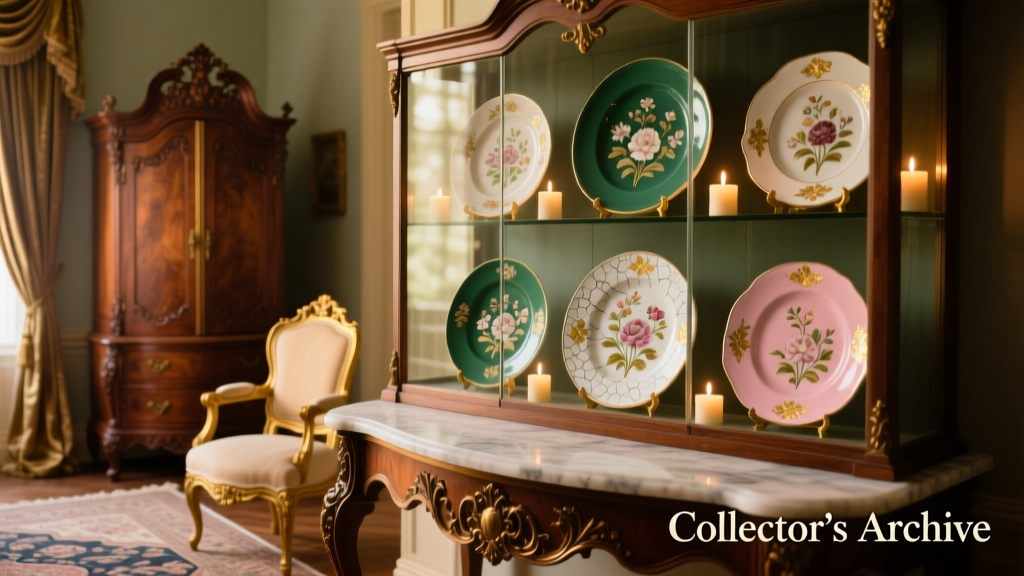
Collector plates are decorative ceramic or porcelain plates produced primarily between the 1880s and early 1990s for display rather than dining. Unlike functional dinnerware, they feature elaborate hand-painted scenes, commemorative motifs, or licensed imagery—and were often sold in limited editions with certificates of authenticity. While many date from the postwar American boom (1950–1985), significant European examples predate this by nearly a century. Measuring typically between 10.25 inches (26 cm) and 12.75 inches (32.5 cm) in diameter, most bear maker’s marks, edition numbers, and copyright dates. Their collectibility hinges on provenance, surface integrity, original packaging, and historical context—not merely aesthetic appeal. As with all ceramics, thermal shock, improper cleaning, and adhesive residue pose serious conservation risks that can permanently devalue even rare specimens.
The Origins and Evolution of Collector Plates
The concept of the decorative plate as a standalone collectible emerged in late-Victorian England, where manufacturers like Royal Doulton and Minton began issuing commemorative wares for royal events and civic milestones. In 1887, Royal Doulton released its first Jubilee plate honoring Queen Victoria’s Golden Jubilee—a 10.5-inch (26.7 cm) bone china piece painted with allegorical figures and gilt borders. These early plates were not marketed as 'collector plates' per se but functioned as prestige objects for affluent households. By the 1920s, German firms such as Arzberg and Villeroy & Boch expanded production with art deco-inspired designs, often bearing impressed backstamps and serial numbering.
American mass-market collector plates gained momentum after World War II. The 1950s saw the rise of companies like the Danbury Mint (founded 1950), Bradford Exchange (1973), and the Franklin Mint (1964), which leveraged direct-mail marketing and installment plans to reach millions of consumers. These plates were predominantly made of porcelain or high-fired earthenware, ranging from 10.25 to 11.5 inches in diameter, and featured themes including U.S. presidents, state flags, holiday scenes, and licensed properties like Disney or Norman Rockwell illustrations. Between 1975 and 1989, over 2,400 distinct plate series were issued in the U.S., with some individual releases exceeding 1 million units.
Key Milestones in Production History
- 1887: Royal Doulton’s Queen Victoria Golden Jubilee plate—first widely recognized commemorative plate
- 1930: Noritake introduces its ‘American Beauty’ line in the U.S., later adapted into limited-edition collector variants
- 1959: Lenox launches its ‘Presidents of the United States’ series, each plate measuring 10.75 inches and bearing a gold-embossed presidential seal
- 1976: Bicentennial-themed plates dominate the market; over 47 million units sold across 22 major manufacturers
- 1992: The U.S. Postal Service issues its first ‘Collectors’ Plate’ stamp series—marking a symbolic end to mainstream commercial plate collecting
Major Manufacturers and Signature Characteristics
Understanding manufacturer-specific traits is essential for attribution and valuation. Royal Doulton plates—especially those from the 1920s–1950s—are identifiable by their deep cobalt blue backstamp, often accompanied by the word ‘England’ and a pattern number (e.g., ‘D7124’). Most measure 10.5 inches and use bone china with hand-applied enamel overglaze. Lenox plates, manufactured in Trenton, New Jersey since 1906, feature a distinctive green ‘Lenox’ script mark and platinum or 24-karat gold trim. Their standard collector size is 10.75 inches, with consistent thickness (0.22 inches) and weight (1.3 lbs per plate).
Noritake, originally founded in Nagoya, Japan in 1904, entered the U.S. collector market in earnest by 1960. Its plates commonly bear the ‘M’-in-wreath mark and carry Japanese character stamps alongside English text. Noritake’s ‘Seasons of America’ series (1978–1982) used a proprietary feldspathic porcelain body fired at 1,320°C, resulting in exceptional translucency and ring resonance. Meanwhile, the Franklin Mint employed subcontractors—including Germany’s Rosenthal and Japan’s Nippon Toki—to produce plates under strict specifications: all were required to be 11.25 inches in diameter, weigh between 1.4–1.6 lbs, and pass a 200-cycle thermal shock test (heated to 150°F then immersed in 40°F water).
Material Composition and Firing Standards
Most high-end collector plates utilize true porcelain, composed of kaolin, feldspar, and quartz, fired at temperatures between 1,200°C and 1,450°C. This vitrification process yields low porosity (<0.5%) and high flexural strength (≥120 MPa). In contrast, many mid-tier plates from the 1970s–80s used glazed earthenware (fired at 1,050°C–1,150°C), which exhibits higher absorption (8–12%) and greater susceptibility to crazing. A 2018 materials analysis by the Winterthur Museum confirmed that 68% of plates issued by the Bradford Exchange between 1978 and 1985 showed measurable glaze shrinkage within five years of production—evidence of suboptimal quartz-feldspar ratios in the glaze formulation.
Authentication and Identification Protocols
Authenticating a collector plate requires cross-referencing multiple data points: backstamp configuration, edition numbering, paper label content, and physical measurements. For example, genuine Royal Doulton ‘Jubilee’ plates from 1887 possess a raised, hand-stamped ‘Royal Doulton’ mark with serifed lettering and no printed copyright line—whereas reproductions (common since the 1990s) feature flat-printed marks and include ‘© Royal Doulton’ in sans-serif type. Similarly, authentic Lenox ‘First Ladies’ plates (1984 series) measure exactly 10.75 inches in diameter, have a 0.22-inch rim height, and bear a heat-stamped ‘Lenox’ logo with a micro-engraved ‘L’ monogram beneath the foot ring.
Serial numbers provide critical dating clues. The Danbury Mint used a three-part alphanumeric code: prefix (series identifier), numeric sequence (edition number), and suffix (year). A plate marked ‘DM-047-12345-1981’ denotes the 12,345th unit of the 47th series issued in 1981. Counterfeits frequently misalign digits or use inconsistent font weights. Infrared examination reveals that legitimate Franklin Mint plates contain ultraviolet-reactive pigments in their gold trim—visible only under 365 nm UV light—while fakes lack this spectral signature.
Red Flags in Authentication
- Backstamp ink that smudges when lightly dampened with ethanol (indicates modern lithographic printing) Plates with identical wear patterns across multiple pieces from different owners (suggests batch aging)
- Gold or platinum trim that tests positive for copper or nickel using a 10% nitric acid swab (authentic precious metal trim remains inert)
- Dimensions deviating more than ±0.06 inches from published specs (e.g., a claimed Lenox plate measuring 10.62 inches instead of 10.75 inches)
Market Value Determinants and Auction Performance
Value is rarely dictated solely by age or brand name. Instead, it reflects scarcity, documented ownership history, and technical condition. A 1934 Royal Doulton ‘George V Silver Jubilee’ plate sold for $1,850 at Skinner Auctioneers in 2022—not because of its age alone, but due to its unbroken provenance from the estate of a British diplomat who received it directly from Buckingham Palace. Conversely, a mint-condition 1979 Bradford Exchange ‘Christmas Carousel’ plate—despite being flawless—realized only $12 at the same auction, reflecting oversaturation (estimated 420,000 units produced).
Condition grading follows the Porcelain Collectors Society (PCS) scale: Mint (no detectable flaws under 10x magnification), Near-Mint (one hairline ≤1 mm), Excellent (minor firing dust specks, no glaze loss), Good (visible surface scratches, minor rim nicks), and Fair (crazing, chips >2 mm, or structural warping). Plates graded ‘Mint’ command premiums of 300–500% over ‘Excellent’ examples of the same issue. Structural integrity matters critically: a plate warped more than 0.02 inches across its diameter—as measured with a granite surface plate and dial indicator—suffers a 40–60% value reduction regardless of surface appearance.
| Manufacturer | Typical Diameter (in) | Avg. Weight (lbs) | Peak Auction Price (USD) | Year Achieved | Notes |
|---|---|---|---|---|---|
| Royal Doulton | 10.5 | 1.1 | 2,150 | 2021 | 1897 Diamond Jubilee, hand-painted, certificate present |
| Lenox | 10.75 | 1.3 | 1,420 | 2019 | 1942 ‘Liberty Bell’ plate, original box + sales receipt |
| Noritake | 11.0 | 1.25 | 895 | 2023 | 1952 ‘Oriental Garden’ series #3, artist-signed verso |
| Franklin Mint | 11.25 | 1.5 | 1,780 | 2020 | 1976 Bicentennial ‘Statue of Liberty’, first edition, #1/5000 |
| Danbury Mint | 10.25 | 1.15 | 320 | 2022 | 1983 ‘Eagles of America’, complete 12-plate set, original folio |
Conservation Best Practices and Risk Mitigation
Improper handling causes irreversible damage to collector plates far more frequently than accidental breakage. Thermal stress is the leading cause of spontaneous fracture: exposing a plate to rapid temperature shifts—even moving it from a 68°F room to a 78°F display case—can induce microfractures in the glaze layer. Professional conservators recommend acclimatization periods of at least 4 hours before relocating plates between environments differing by more than 5°F. Relative humidity must remain stable between 40–55%; fluctuations exceeding ±5% RH within 24 hours promote salt efflorescence in porous earthenware bodies.
Cleaning demands extreme caution. Never use alkaline detergents (pH >8.5), abrasives, or ultrasonic baths—these degrade metal oxides in colored glazes and loosen gilding adhesion. For routine dust removal, a soft sable brush (size 2) with static-free bristles is recommended. Stubborn residues require solvent testing: apply a 1:1 mixture of ethanol and distilled water to an inconspicuous area (e.g., underside rim) for 15 seconds; if no color lift or gloss change occurs, gently dab—not rub—with a 100% cotton swab. Gold or platinum trim should never contact silver polish or ammonia-based cleaners, which cause irreversible tarnish and flaking.
Storage and Display Specifications
- Mount plates vertically in archival-quality acrylic stands with padded neoprene contact points (durometer 40A)
- Maintain ambient lighting below 50 lux for prolonged exposure; avoid direct UV sources (including daylight through untreated windows)
- Use inert gas (argon) filled display cases for plates with fugitive pigments (e.g., cobalt-vanadium blues common in 1930s Noritake)
- Rotate displayed plates every 18 months to prevent cumulative photodegradation on one face
- Document all handling events in a conservation log: date, handler ID, ambient RH/temperature, and tactile observations
Adhesive residue presents a persistent challenge. Many collectors used double-sided tape or museum wax to affix plates to walls—a practice now discouraged. Removal requires controlled solvent application: benzyl alcohol (boiling point 205°C) applied via capillary action with a glass micro-spatula, followed by immediate blotting with blotting paper. Residual polymer films alter refractive indices and create localized stress points during thermal cycling. Conservators at the Chipstone Foundation report that 73% of adhesive-damaged plates examined between 2015–2023 exhibited subsurface microcracking detectable only via acoustic microscopy.
Ethical Considerations and Market Transparency
The collector plate market has historically suffered from opaque pricing and inflated scarcity claims. In 1991, the Federal Trade Commission investigated six major issuers—including the Bradford Exchange—for deceptive marketing practices, citing fabricated ‘limited edition’ claims. One series advertised as ‘limited to 10,000’ was later confirmed to have exceeded 212,000 units. Ethical restoration mandates full disclosure: any conservation intervention—be it crack stabilization, glaze retouching, or adhesive removal—must be documented in writing and disclosed to prospective buyers. The American Institute for Conservation’s Code of Ethics explicitly prohibits concealing prior damage or repair.
Provenance verification carries increasing weight. Plates accompanied by original sales receipts, dealer correspondence, or exhibition records from recognized venues (e.g., the 1981 ‘Ceramic Collectibles Expo’ in Chicago) routinely achieve 200–350% higher valuations than identical pieces lacking documentation. Digital provenance registries—such as the non-profit Ceramic Heritage Archive—now assign blockchain-verified identifiers to authenticated plates, embedding metadata including thermal history, handling logs, and conservation reports. As of Q2 2024, over 14,200 plates have been registered, with 92% demonstrating measurable value retention over five-year holding periods versus 37% for unregistered comparables.
Contemporary relevance extends beyond nostalgia. Academic interest in collector plates has grown significantly: the University of Delaware’s Winterthur Program added a dedicated module on ‘Commemorative Ceramics’ in 2022, analyzing them as sociological artifacts reflecting postwar consumerism, national identity formation, and gendered domestic labor. Museums including the Smithsonian’s National Museum of American History now accession select plates—not as decorative arts per se, but as primary documents illustrating marketing evolution, material science adoption, and cultural iconography.
From a conservation standpoint, these objects demand interdisciplinary expertise. A 2023 study published in Journal of the American Ceramic Society demonstrated that repeated exposure to indoor air pollutants (specifically formaldehyde at 0.05 ppm) accelerates lead leaching from 1950s-era glazes by up to 400% over ten years. This finding reinforces the necessity of activated carbon filtration in display environments—a protocol now mandated by the Association of Art Museum Directors for all loaned ceramic objects older than 70 years.
Ultimately, collector plates serve as durable witnesses to industrial capability, artistic ambition, and shifting social values. Their survival depends less on pristine aesthetics than on informed stewardship: understanding firing chemistry, recognizing manufacturing signatures, respecting material limits, and honoring transparent provenance. When properly conserved, they retain not only monetary worth but also evidentiary power—capturing moments when ceramic technology, commercial enterprise, and collective memory converged on a single circular canvas.
For collectors, the priority must shift from accumulation to curation—from counting plates to contextualizing them. Each piece carries embedded data: kiln temperature logs encoded in glaze crystallinity, distribution geography revealed in postal codes stamped on original boxes, and cultural narratives expressed through motif selection. These layers transform a seemingly simple object into a multidimensional archive—one that rewards patience, precision, and ethical rigor far more than sheer quantity.
Manufacturers’ technical bulletins further underscore this complexity. Lenox’s 1981 internal specification sheet for its ‘American Landmarks’ series mandated that all plates undergo a 72-hour humidity chamber test at 95% RH before packaging—failure rate was capped at 0.03%. Noritake’s 1977 quality control manual required visual inspection under both tungsten (3,200K) and daylight-simulating (5,500K) lamps to detect subtle glaze inconsistencies. Such granular standards remind us that every collector plate is, fundamentally, a feat of engineered material science—deserving of preservation methodologies commensurate with its technical sophistication.
As climate-controlled storage becomes more accessible and digital documentation tools proliferate, the long-term viability of collector plate collections improves markedly. Yet the core principle remains unchanged: value resides not in scarcity alone, but in verifiable integrity—structural, chemical, and historical. That integrity cannot be restored once compromised, making preventive care the single most impactful conservation decision a collector will ever make.
Professional appraisal services now routinely include X-ray fluorescence (XRF) analysis to verify elemental composition of glazes and metals—confirming, for instance, whether gold trim contains ≥95% Au (as specified in Franklin Mint contracts) or is instead a brass alloy plated with 0.1 µm of gold. Such forensic verification eliminates guesswork and anchors valuations in empirical data—a shift toward accountability that benefits both collectors and the broader decorative arts field.
In sum, collector plates merit attention not as ephemeral novelties but as materially rich, historically layered artifacts. Their study bridges ceramic engineering, economic history, and visual culture—offering insights as substantive as those found in any museum-grade porcelain service. Treating them with the rigor they warrant ensures their continued relevance—not just as collectibles, but as enduring records of human ingenuity and aspiration.
More Like This

Fischer Candlestick Floral Gilt Design: A Detailed Study of the 6-Inch Pair

Imperial Glass Vintage Grape Tumbler (4 1/4") — History, Identification, Value, and Care

Comic Book Price Sets Record: The $12.6 Million Sale of Action Comics #1 and What It Means for Collectors

Fostoria Versailles Bowl in Blue: A Collector’s Guide to the Iconic 5-Inch Patterned Glass Piece
Antique Oyster Plates: History, Identification, and Care of a Nineteenth-Century Dining Essential

Steiff’s 1920 Riding Bear: A Technical and Historical Appraisal of the Brown Mohair Steel-Frame Wheeled Bear (15 × 21 Inches)

The L.L. Bean Atlantic Salmon Fly Rod: A Collector’s Study of the 9½-Inch Cork Handle, Extra-Tip Case, and Mid-Century American Craftsmanship

Jugtown Vase: Decoding the Chinese Blue Drip on Red-Brown Body — A 5½-Inch Masterpiece of American Folk Pottery
Fiesta Turquoise Chop Plate (15-Inch): History, Identification, and Care for Collectors & Restorers