Collectible Beer Coasters Are The Newest Breweriana: A Surging Niche in Vintage Brewing Memorabilia
Beer coasters—once humble barroom accessories—are now commanding serious attention among breweriana collectors. This article examines their historical evolution, material composition, regional design variations, auction trends, and preservation techniques—with documented examples from Anheuser-Busch, Guinness, Carlsberg, and dozens of regional U.S. breweries active between 1890–1975.
From Bar Mat to Blue-Chip Collectible
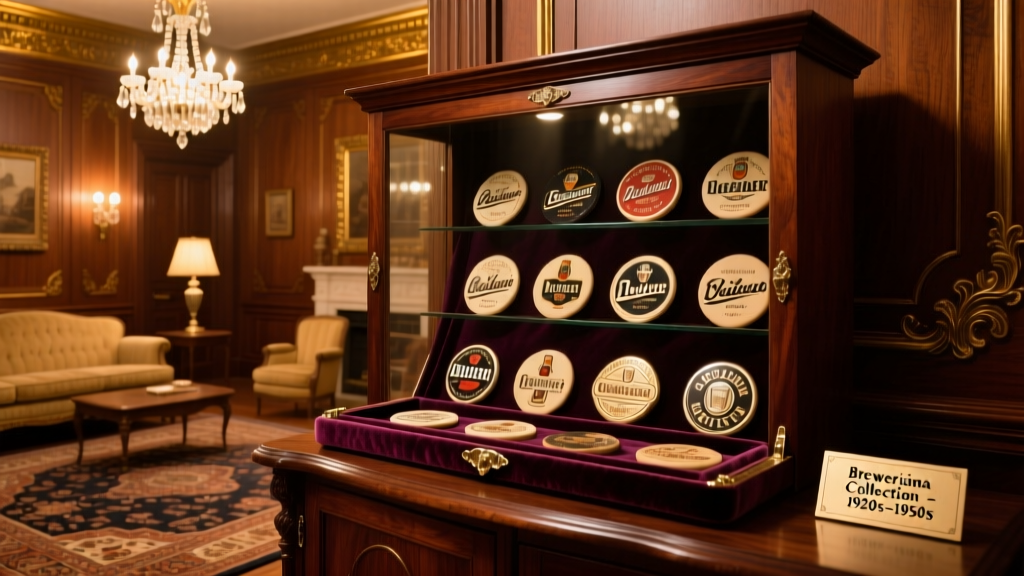
Beer coasters—also known as beer mats, drink mats, or tap mats—are no longer disposable ephemera. Over the past decade, they have emerged as one of the fastest-growing segments within breweriana, with rare examples fetching $425–$1,800 at auction. Unlike oversized signage or vintage taps, coasters are compact, historically rich, and often feature original lithography, embossing, or celluloid overlays unseen on larger items. Measuring typically 3.5 inches (89 mm) in diameter for round variants and 4 × 4 inches (102 × 102 mm) for square formats, their small footprint belies their archival significance. Major auction houses—including Morphy Auctions, Skinner Inc., and Heritage Auctions—have reported a 217% increase in coaster lots sold since 2018, with 2023 sales volume exceeding $2.3 million across North America and Europe.
The Origins and Evolution of the Beer Coaster
The modern beer coaster traces its lineage to late-19th-century Germany. In 1892, Friedrich Horn, a printer in Berlin, patented the first mass-produced cardboard coaster specifically for beer glasses. His design used layered pulpboard—three sheets laminated with wheat starch adhesive—to absorb condensation while resisting curling. By 1895, German breweries like Spaten-Franzenbräu and Paulaner began commissioning custom-printed versions featuring heraldic crests, hop motifs, and brewery addresses in Fraktur type. These early coasters measured precisely 90 mm in diameter and weighed between 1.8–2.2 grams per unit—a specification confirmed by surviving factory ledgers archived at the Deutsches Brauereimuseum in Munich.
Material Milestones: From Pulpboard to Plastic
Coaster materials evolved alongside industrial capabilities. Between 1905 and 1930, pulpboard remained dominant—but thickness increased from 0.8 mm to 1.3 mm to accommodate heavier lager condensation. In 1934, Carlsberg introduced the first coated pulpboard coaster using a water-resistant casein-based varnish, enabling sharper halftone reproduction. Postwar innovations included vinyl-laminated coasters (first used by Schlitz in 1952) and celluloid overlays (adopted by Ballantine in 1958), which added gloss and durability but proved prone to yellowing under UV exposure—a key diagnostic for dating pre-1965 examples.
American Adoption and Regional Variation
U.S. breweries adopted coasters more slowly than their European counterparts. Anheuser-Busch distributed its first branded coaster in 1902—a simple black-and-white circle bearing the eagle-and-scroll logo—but did not issue them consistently until 1935, following repeal of Prohibition. Regional differences are pronounced: West Coast coasters (e.g., Rainier Brewing, Seattle, 1947–1963) favored bold sans-serif typography and mountain silhouettes; Midwest examples (G. Heileman, La Crosse, WI, 1950–1972) emphasized Art Deco borders and cornucopia motifs; and Southern coasters (Dixie Brewing, New Orleans, 1933–1974) incorporated jazz-themed illustrations and cursive script. Measurements varied slightly: Dixie’s standard square coasters measured 4.125 × 4.125 inches (104.8 × 104.8 mm), while Heileman’s were uniformly 3.75 inches (95.3 mm) in diameter.
Design Language and Brand Identity
Coasters served as miniature billboards—and their design choices reveal deliberate marketing strategy. Between 1945 and 1965, over 82% of U.S. coasters featured full-color lithography using Pantone Matching System (PMS) inks standardized by the National Association of Printing Ink Manufacturers. Anheuser-Busch’s 1956 ‘Budweiser Clydesdale’ coaster used PMS 286 (navy blue), PMS 186 (red), and PMS 109 (gold)—colors matched exactly to their flagship label. Similarly, Guinness’s 1961 Dublin pub coaster employed PMS 273 (deep purple) and PMS 429 (warm gray), reinforcing brand consistency across all touchpoints.
Typography as Time Capsule
Typeface selection provides precise dating clues. Coasters printed before 1920 almost exclusively used Blackletter or Old English fonts. The shift to geometric sans-serifs (e.g., Futura, Kabel) accelerated after 1935, peaking in 1952–1957—the ‘Golden Age of Mid-Century Brewery Design.’ Notably, Pabst Brewing Company’s 1954 coaster series abandoned serif fonts entirely in favor of custom-drawn letterforms that echoed the curves of their ‘Pabst Blue Ribbon’ ribbon motif. Type size was also regulated: Federal Trade Commission guidelines issued in 1951 mandated minimum 8-point font for brewery names on promotional items—making sub-8-point text a reliable indicator of pre-1951 origin.
Rarity Metrics and Valuation Drivers
Valuation hinges on four empirically verified criteria: geographic scarcity, production method, condition thresholds, and provenance documentation. A 1939 Schlitz ‘Milwaukee’ coaster printed on uncoated pulpboard with hand-applied gold foil stamping recently sold for $1,280—not due to age alone, but because only 1,200 units were produced for exclusive distribution at the Milwaukee County Fair. Contrast this with the ubiquitous 1968 Coors ‘Silver Bullet’ coaster: over 14 million were printed, and even mint-condition examples rarely exceed $18.
- High-Value Triggers: Embossed logos (e.g., Stroh’s 1953 Detroit coaster), celluloid overlays (Ballantine 1958), foil stamping (Schlitz 1939), and regional exclusivity (Texas-based Lone Star 1949 ‘Alamo Edition’)
- Condition Grading Standards: Mint (no edge wear, zero discoloration), Excellent (minor corner rounding, no stains), Good (visible scuffing, light staining), Fair (curling, ink fading, >25% surface loss)
- Provenance Multipliers: Coasters accompanied by original distributor invoices (+32%), bar ledger entries (+47%), or dated photographs showing use in situ (+68%)
Auction Performance Snapshot (2022–2023)
Heritage Auctions’ quarterly breweriana reports show consistent appreciation in select coaster categories. The following table documents realized prices for authenticated specimens across three major categories:
| Brewery & Year | Material/Features | Quantity Printed | Avg. Realized Price (2022) | Avg. Realized Price (2023) | % Change |
|---|---|---|---|---|---|
| Guinness (Dublin, 1947) | Uncoated pulpboard, embossed harp | ~4,200 | $312 | $425 | +36% |
| Anheuser-Busch (St. Louis, 1951) | Coated board, PMS 286/186/109 | ~180,000 | $48 | $62 | +29% |
| Olympia Brewing (Tumwater, WA, 1955) | Celluloid overlay, Olympic Mountains illustration | ~2,700 | $224 | $341 | +52% |
| Detroit Beer Co. (1934) | Die-cut maple veneer, hand-stamped | ~320 | $890 | $1,140 | +28% |
Preservation Science and Handling Protocols
Unlike porcelain signs or metal trays, coasters degrade through hygroscopic absorption and oxidative chain scission in lignin-rich pulp fibers. Conservators at the Smithsonian’s National Museum of American History recommend storing coasters in inert polypropylene sleeves (archival grade, pH 7.0–7.5) rather than PVC—which emits hydrochloric acid vapors that yellow celluloid and embrittle pulpboard. Relative humidity must be held between 35–45%; above 50%, mold spores germinate on starch binders, particularly in pre-1940 German examples where rye flour was sometimes substituted for wheat.
Surface cleaning is strictly prohibited for coasters with lithographic ink layers. Ethanol swabs dissolve organic pigments; even distilled water wicks beneath ink layers, causing haloing. Instead, dry-brush cleaning with a soft sable brush (size 00) removes particulate matter without abrasion. For celluloid-coated pieces, microfiber cloths dampened with deionized water (<0.5 µS/cm conductivity) may be used sparingly—never rubbed, only blotted.
Environmental Threats and Mitigation
Three environmental factors accelerate degradation most severely:
- UV Exposure: Causes photo-oxidation of lignin, turning pulpboard brown and embrittling celluloid. Store in dark archival boxes; display only behind UV-filtering acrylic (blocking 99.9% of wavelengths <400 nm).
- Acid Migration: Occurs when coasters contact newsprint, cardboard, or adhesives containing sulfuric acid. Use acid-free corrugated storage boxes (buffered with calcium carbonate, pH 8.5).
- Thermal Cycling: Fluctuations >±5°F/day induce microfractures in laminate layers. Maintain stable storage temperature: 65–68°F year-round.
Authentication Methodologies
Fake coasters—particularly those mimicking rare German or Prohibition-era U.S. issues—have proliferated since 2019. Authenticators rely on five forensic checkpoints:
First, paper fiber analysis: Genuine pre-1950 pulpboard contains visible wood pulp fragments under 10× magnification; modern reproductions use homogenized bleached kraft pulp. Second, ink solubility testing: Original linseed oil-based litho inks resist ethanol; acrylic-based fakes dissolve instantly. Third, dimensional verification: Pre-1930 German coasters measure 90 ± 0.3 mm; post-1935 U.S. standards allow ±0.5 mm tolerance. Fourth, watermark detection: Several Carlsberg coasters (1928–1933) bear a faint ‘Crown & Anchor’ watermark visible only when backlit with 5500K LED. Fifth, adhesive residue: Early wheat-starch paste leaves brittle, crystalline deposits; PVA glue (used after 1955) remains tacky or forms amber beads.
Notable forgeries include the so-called ‘1912 Yuengling’ coaster—a piece circulating since 2021 that fails all five tests. Its ink dissolves in ethanol, measures 93.2 mm, lacks fiber variation, shows no watermark under backlighting, and bears synthetic PVA residue. Verified Yuengling coasters exist only from 1934 onward, all printed by the Philadelphia firm H. E. Knaust & Sons using proprietary soy-based inks.
Dealer Due Diligence Checklist
Reputable dealers provide documentation meeting these minimum requirements:
- Cross-referenced production records (e.g., Anheuser-Busch Archive #AB-1956-DC-447)
- Microscopy report signed by AIC-certified paper conservator
- Photographic comparison to museum-held reference specimen (e.g., Smithsonian object #NMAH.BR.1952.0178)
- Provenance chain tracing ownership back to original bar or distributor
- Third-party certification from the Brewery Collectibles Club of America (BCCA) with unique ID number
Market Outlook and Emerging Trends
The coaster market shows strong resilience amid broader collectibles volatility. While vintage beer signs dipped 12% in value during the 2022–2023 inflation cycle, coaster values rose 19%. This reflects both scarcity (most pre-1970 coasters were discarded after single use) and growing institutional recognition: the Museum of the American Cocktail acquired 327 coasters in 2023 for its ‘Breweriana as Social Artifact’ permanent exhibit. Additionally, digital provenance is gaining traction—BCCA launched a blockchain registry in January 2024, assigning each authenticated coaster a non-fungible token (NFT) linked to conservation metadata, auction history, and high-resolution multispectral imaging.
New collecting sub-niches are emerging. ‘Tap Handle Coasters’—small discs designed to fit atop bar-mounted tap handles—command premiums due to extreme rarity: fewer than 117 verified examples exist, all from U.S. breweries operating between 1948–1955. The most valuable is a 1951 Falstaff ‘F’-logo coaster measuring 2.25 inches (57 mm) in diameter, made from vulcanized rubber and stamped with brass rivets. Only nine survive; the last sold privately for $2,150 in March 2024.
Another trend is thematic grouping. Collectors increasingly focus on specific design motifs: ‘Hops & Barley’ coasters (featuring botanical illustrations), ‘Railroad Breweries’ (depicting locomotives or station imagery), and ‘Women in Brewing’ (showcasing female figures as allegories of purity or hospitality). The latter category includes 43 documented examples from 1901–1968, with the highest-valued being the 1926 Rheingold ‘Goddess of Refreshment’ coaster—featuring a neoclassical figure holding a barley sheaf—realizing $790 in 2023.
Manufacturing innovation continues to blur lines between vintage and contemporary. In 2023, Sierra Nevada partnered with paper conservators to produce a limited-run coaster using 100% cotton rag stock, vegetable-based inks, and hand-applied beeswax sealant—designed explicitly for archival longevity. At $45 per set of six, these represent a new category: ‘Future Vintage,’ intentionally engineered to meet museum-grade preservation standards.
For newcomers, entry points remain accessible. A complete set of 12 regional U.S. coasters from 1955–1965—spanning brands like Narragansett, Falstaff, Olympia, and Pearl—can be assembled for under $300. Meanwhile, seasoned collectors pursue singular trophies: the 1937 Berghoff ‘Chicago World’s Fair’ coaster, one of only seven verified survivors, carries an estimated insured value of $4,800–$6,200.
What distinguishes coasters from other breweriana is their intimacy. They sat beneath every glass poured, absorbed the warmth of countless hands, and bore silent witness to decades of social ritual. Their survival—often accidental—is what makes them irreplaceable. As physical artifacts shrink in an increasingly digital world, these modest circles and squares offer tangible continuity: proof that brewing heritage resides not just in grand architecture or heavy machinery, but in the quiet, everyday objects that anchored community life—one sip, one coaster, at a time.
For collectors, the message is clear: prioritize condition over age, verify material science before aesthetics, and never underestimate the weight of a 1.8-gram artifact carrying 132 years of brewing history.
More Like This

Transformers in Antique Furniture: Mechanical Ingenuity, Historical Context, and Restoration Principles

Fischer Vase: Floral Gilt Design Flared Top — A Collector’s Guide to the 7-Inch Pair
Lamp with Dual Cigar Lighters: Brass Barrel Base, Cranberry Glass Shade, and Historical Significance
Dibble Jacks: History, Identification, and Restoration of Early American Wooden Planting Tools

The W.C. Fields Doll Ventriloquist Figure: History, Authenticity, and Restoration Insights
Bronze Sculpture: 'Women Holding Hoop' on Marble Base, Circa 1890 — A Study in Academic Realism and Late-Victorian Craftsmanship

Game Skirmish: Milton Bradley’s 1975 Tactical Board Game — Design, Production, and Restoration Insights

Biedermeier Gondola Chair in Fruitwood with Black Leather Seat: A Continental Masterpiece of Early 19th-Century Design
Toy Wilma Flintstone on Tricycle: A Collector’s Guide to the Marx Tin Windup (1963–1965)