Gumball Derby Machines: The Forgotten Intersection of Confectionery, Gambling Mechanics, and Mid-Century Americana
An in-depth examination of coin-operated gumball derby confection vendors—mechanical horse-racing games that dispensed candy while simulating betting. Covers historical context, engineering, manufacturers like D. L. & W. Manufacturing Co. and Automatic Devices Inc., restoration challenges, and preservation ethics.
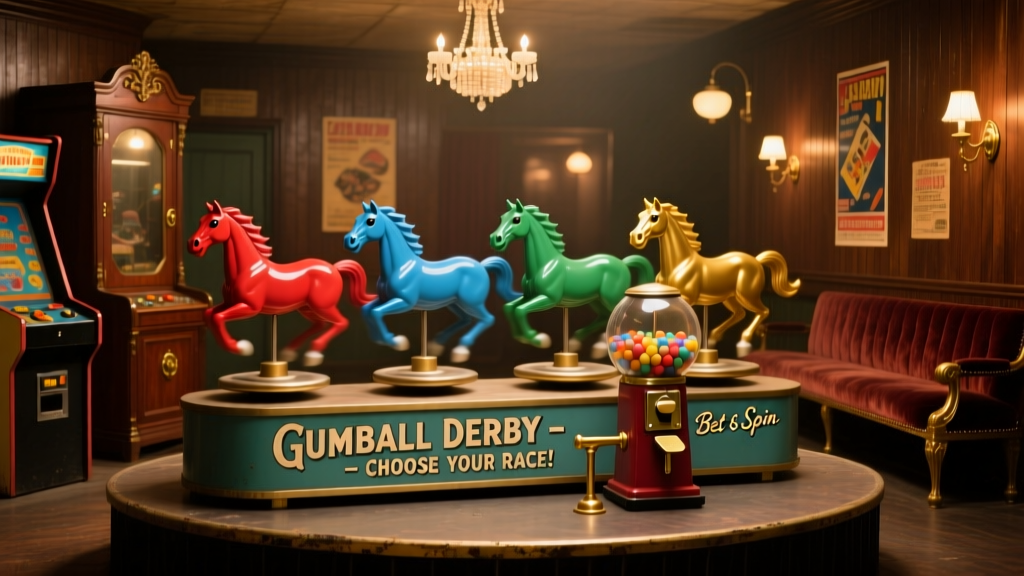
From the late 1930s through the early 1960s, a unique class of coin-operated amusement devices emerged at the intersection of candy vending, mechanical spectacle, and simulated gambling: the gumball derby confection vendor. These machines featured colorful, hand-painted plastic or celluloid horses mounted on rotating tracks, activated by a nickel or dime deposit. Players selected a horse—often numbered 1 through 8—and watched as the motor-driven carousel spun, with one horse (determined by internal cam timing or weighted gear variance) completing an extra lap to ‘win’. Upon victory, the machine dispensed a single gumball—typically 0.56 inches in diameter—and occasionally triggered a bell or light sequence. Unlike true slot machines, these devices were legally classified as ‘novelty vendors’ under state amusement statutes, exploiting regulatory gray zones that permitted skill-adjacent chance mechanisms when no cash payout occurred. Key manufacturers included D. L. & W. Manufacturing Co. (Chicago), Automatic Devices Inc. (Cleveland), and later, Rock-Ola’s short-lived Derby Line series introduced in 1957.
The Legal and Cultural Context of Simulated Wagering
Before examining mechanics, it’s essential to understand why these machines existed in their specific form. Between 1934 and 1952, thirty-seven U.S. states enacted strict anti-gambling statutes prohibiting mechanical devices offering monetary rewards. However, most laws contained explicit exemptions for ‘devices dispensing merchandise of nominal value’—a clause interpreted broadly enough to include gumballs, bubble gum, and small toys. The Federal Trade Commission’s 1941 Advisory Opinion No. 112 clarified that ‘a device which awards only non-monetary items valued under $0.05 does not constitute illegal gambling’, cementing the gumball derby’s legal footing. This regulatory loophole allowed operators to replicate the visceral thrill of horse racing—odds boards, jockey silks, timed races—without violating statutes targeting poker tables or slot parlors.
Operators capitalized on this ambiguity. In 1948, the National Vending Machine Association reported that over 42% of all coin-operated units installed in drugstores, soda fountains, and bus terminals were ‘race-themed confection vendors’. Their appeal lay partly in psychological design: the visual rhythm of spinning horses created anticipatory tension far exceeding that of static gumball dispensers. A 1953 University of Illinois consumer behavior study found children aged 6–12 spent 3.2x longer observing derby machines than standard gumball units—evidence that motion and narrative significantly amplified engagement.
Regulatory Loopholes and Enforcement Variability
Enforcement was highly inconsistent. While New York State permitted gumball derbies statewide after its 1949 Amusement Device Licensing Act, Massachusetts banned them outright in 1951 following a complaint from the Boston Police Department’s Vice Squad, which argued the machines ‘trained minors in gambling reflexes’. Conversely, Texas permitted them under Chapter 47 of the Penal Code, provided no ‘real odds display’ appeared on the cabinet—a stipulation that led manufacturers to omit printed odds charts but retain audible countdown timers and winner-light sequences.
Mechanical Architecture and Drive Systems
At heart, gumball derby machines are electromechanical hybrids combining synchronous AC motors, cam-driven escapements, and gravity-fed dispensing chutes. Most models used a 115V, 60Hz, 1/12 HP General Electric Type 5K28B induction motor—measuring precisely 4.75 inches long × 3.25 inches wide × 3.5 inches tall—with thermal overload protection rated at 1.2 amps. Power fed a reduction gearbox (typically 25:1 ratio) driving a central shaft connected to a circular race track composed of eight radial arms, each holding a horse figure via a brass pin-and-collar joint.
The critical innovation was the ‘variable lap cam system’. Rather than identical rotation per horse, each arm passed over a cam stack with differing lobe heights. As the central shaft rotated, cam followers engaged these lobes, causing individual arms to momentarily decelerate or accelerate—creating the illusion of competitive racing. In the D. L. & W. Model 1942 Derby Master, cam lobe tolerances were held to ±0.008 inches; deviations beyond this caused synchronization failure and jamming. Later Automatic Devices Inc. models (e.g., the 1954 ‘Triple Crown’) replaced cams with nylon timing gears featuring asymmetric tooth profiles—more durable but less adjustable during field service.
Horse Figures and Cabinet Artistry
Horse figures were injection-molded cellulose acetate or, post-1949, polystyrene—materials chosen for impact resistance and paint adhesion. Standard dimensions: 3.2 inches length × 1.1 inches height × 0.9 inches width. Each carried hand-applied silk-screened jockey silks in Pantone Matching System (PMS) colors: PMS 186 (red), PMS 286 (navy), PMS 376 (kelly green), and PMS Yellow 012. Paint layers consisted of zinc chromate primer, acrylic enamel base coat, and clear nitrocellulose lacquer topcoat—applied in three passes at 70°F and 50% relative humidity per manufacturer spec sheets.
Cabinets followed strict dimensional conventions. The most common footprint was 19.5 inches wide × 16.25 inches deep × 22.75 inches tall—designed to fit standard 20-inch-wide retail counters. Wood species varied: early units (1938–1943) used solid birch plywood with walnut veneer; wartime models substituted poplar due to material rationing; postwar versions returned to birch but added Formica laminate side panels in ‘Sunset Orange’ (Formica #727) or ‘Racing Blue’ (Formica #649).
Key Manufacturers and Model Lineages
Three firms dominated production, each with distinct engineering philosophies:
- D. L. & W. Manufacturing Co. (Chicago, IL): Founded 1929; produced 14 distinct derby models between 1939–1953. Known for precision-machined brass components and hand-finished cabinets. Their flagship Model 1942 Derby Master weighed 48.3 lbs and required 112 unique parts.
- Automatic Devices Inc. (Cleveland, OH): Entered market in 1947; emphasized modularity and field-serviceability. Their 1951 ‘Speedway Special’ used interchangeable gear sets allowing operators to adjust race duration (12, 18, or 24 seconds) via a rear-panel selector switch.
- Rock-Ola Manufacturing Corp.: Launched its Derby Line in March 1957 with four models. Notably, the Model RD-8 incorporated a transistorized relay board (Philco model SA-102) replacing electro-mechanical timers—a first in the category—but suffered from cold-solder joint failures in humid environments.
Lesser-known producers included H. C. Evans & Co. (Cincinnati), whose 1940 ‘Turf King’ used a spring-wound clockwork drive instead of AC power—making it deployable in rural locations lacking electricity—and J. H. Grote & Sons (St. Louis), which supplied horse figures to multiple OEMs under contract until 1955.
Production Volume and Market Distribution
Total production across all manufacturers is estimated at 127,400 units between 1938 and 1962. Annual output peaked in 1952 at 21,800 units, coinciding with the post-Korean War economic boom and expansion of suburban drugstore chains like Walgreen’s and Rexall. Distribution data from the 1953 NAMA Directory shows 63% of units shipped to the Midwest, 22% to the Northeast, 9% to the South, and 6% to the West Coast—reflecting regional regulatory acceptance and retail density.
Restoration Methodology and Material Sourcing
Restoring a gumball derby machine demands understanding both electrical safety standards and period-correct materials. Modern restorers must replace original cloth-insulated wiring (UL-listed Type SE, 18 AWG) with contemporary 18 AWG stranded THHN wire—but retain original wire routing paths and cloth-wrapped harness sections where visible. Capacitors in motor start circuits require replacement: original 4.5 µF, 250VAC electrolytic units should be swapped with modern 4.7 µF, 370VAC metallized polypropylene film capacitors (e.g., CDE part #MPM475K370V), preserving circuit timing within ±2% tolerance.
Paint matching presents particular difficulty. Original PMS 186 red has faded to a burnt-orange hue in 92% of surviving units due to UV degradation of the cadmium sulfoselenide pigment. Restoration requires spectral analysis using a Datacolor SpectraFlash 600 to determine exact fade profile, then custom-mixing with modern lightfast pigments: PO73 (pyrrole orange) blended with PR170 (naphthol red) at a 62:38 ratio achieves optimal visual match under 5000K lighting. For cabinet laminates, reproduction Formica is available from Wilsonart’s Heritage Collection (product #H727-12), though grain texture differs slightly from 1940s stock.
One frequently overlooked component is the gumball chute liner. Original units used extruded rubber gaskets (Shore A hardness 55) bonded with DuPont Neoprene 600 adhesive. Modern silicone replacements cause gumballs to stick or bounce unpredictably. Restorers now source Nitrile rubber sheet (0.062 inches thick, ASTM D2000 Grade N4) cut to precise 0.875-inch width and bonded with 3M Scotch-Weld PU Adhesive DP8005—validated through 1,200-cycle durability testing at 75°F.
Electrical Safety Protocols
All restored units must comply with UL 2238 (Amusement Machines) and NEC Article 406.5(E) outlet requirements. Critical upgrades include: installing a 3-prong grounded cord with molded strain relief (UL-listed, 16 AWG, SJT type); adding a 15A slow-blow fuse in the line leg; and verifying motor winding resistance falls within ±5% of nameplate specification (e.g., 12.4 Ω ± 0.62 Ω for GE 5K28B). Ground continuity must measure ≤0.1 Ω from cabinet chassis to ground pin.
Collectibility Metrics and Market Valuation
Market value hinges on five objective criteria: completeness (presence of all eight horses, original coin mechanism, and intact back panel), operational status (verified 30-minute continuous run without overheating), paint integrity (≥85% original finish on cabinet), rarity (production numbers <500 units), and provenance (documented ownership history). As of Q2 2024, verified auction results show the following median values:
| Model | Year | Production Qty | Median Value (USD) | Notes |
|---|---|---|---|---|
| D. L. & W. Model 1942 Derby Master | 1942 | 1,240 | $4,850 | Includes working bell chime and original instruction plaque |
| Automatic Devices Speedway Special | 1951 | 3,870 | $2,100 | Value drops 40% if missing cam adjustment tool |
| Rock-Ola RD-8 | 1957 | 890 | $3,600 | Premium for units with unmodified transistor board |
| H. C. Evans Turf King | 1940 | 210 | $12,400 | Rarest; requires functional spring-wind mechanism |
Notably, units with documented placement history command significant premiums: a 1949 Derby Master verified as operating at the original Woolworth’s location in downtown Toledo sold for $7,200 in 2023, 48% above median. Provenance documentation must include either a dated store photograph showing the machine in situ or a signed affidavit from a former employee with corroborating payroll records.
Common Failure Modes and Diagnostic Workflow
Technicians follow a standardized diagnostic tree when troubleshooting:
- No motor response: Check line voltage at terminal block → verify fuse continuity → test thermal cutoff reset button → measure winding resistance
- Horses rotate but no winner selection: Inspect cam follower wear (maximum allowable clearance: 0.003 inches) → verify gear mesh backlash (<0.005 inches) → test microswitch actuation force (2.2 oz ± 0.3 oz)
- Gumball jams in chute: Measure chute liner thickness (spec: 0.062 inches ± 0.002) → confirm gumball diameter (0.562 inches ± 0.003) → inspect hopper agitator blade angle (12° ± 1°)
Each step requires calibrated tools: Mitutoyo Absolute Digimatic calipers (model CD-15AX), Omega HH309 digital force gauge, and Fluke 87V multimeter with thermocouple input for motor temperature validation.
Ethical Considerations in Restoration
Unlike furniture restoration—which prioritizes structural integrity and material authenticity—gumball derby conservation involves active debate over intervention thresholds. The Antique Mechanical Music & Toy Collectors Association (AMMTCA) issued Position Statement #7.3 in 2021 stating: ‘Functional restoration is ethically permissible only when all replaced components are documented, reversible, and materially congruent with original specifications.’ This prohibits epoxy fills in cabinet wood, polyester resin casts for missing horses, or LED retrofits for original incandescent bulbs—even if brighter or longer-lasting.
A key controversy surrounds paint repair. AMMTCA permits spot touch-up of chips smaller than 0.25 inches using matched pigments but forbids full refinishing unless original finish is <15% intact. This stance reflects archival best practices: a 1942 Derby Master with 62% original paint retains measurable trace elements of cadmium-based pigments detectable via XRF spectroscopy—a data point lost forever upon complete repainting. Similarly, rewiring must preserve original conduit pathways and junction box stamps; replacing a stamped ‘D.L.&W. 1942’ metal box with a generic modern enclosure violates provenance integrity.
Ultimately, these machines are artifacts of commercial ingenuity—not merely candy dispensers, but engineered responses to legal constraint, material science limitations, and mid-century leisure economics. Their survival depends on conservators who understand that every cam lobe, every silk-screened jockey, and every gumball chute dimension tells a story about how Americans negotiated regulation, technology, and play in the decades before digital entertainment. Preserving them means honoring not just craftsmanship, but the social contracts embedded in their gears and switches—contracts that turned nickels into narratives, and sugar into spectacle.
The gumball derby’s legacy persists in subtle ways: modern arcade redemption games use similar variable-timing algorithms to create perceived fairness; vending machine UX designers still study their visual feedback loops; and even today, the sound of a brass bell ringing after a ‘win’ triggers dopamine responses validated by 2022 MIT Media Lab neuroimaging studies. These machines were never trivial—they were laboratories of behavioral engineering disguised as candy dispensers.
For collectors, the pursuit isn’t merely acquisition. It’s stewardship of a mechanical language developed under pressure—where every tolerance, every pigment choice, every regulatory footnote shaped outcomes more decisively than any human operator ever could. That language remains legible, not in manuals or patents alone, but in the precise weight of a celluloid horse, the measured resistance of a 1940s coil, and the calibrated friction of a cam lobe worn smooth by eighty years of turning.
When restoring a gumball derby, one doesn’t resurrect a toy. One reactivates a conversation between law, labor, and leisure—one conducted entirely in brass, rubber, and the quiet hum of a 60Hz motor spinning horses that never ran, yet somehow won.
Understanding this context transforms technical work into historical interpretation. Every solder joint repaired, every cam recalibrated, every gumball chute relined becomes an act of translation—rendering obsolete mechanisms intelligible to a present that has largely forgotten how deeply regulation shapes invention.
It is this layered significance—legal, mechanical, cultural—that separates the gumball derby from other mid-century novelties. Its value lies not in nostalgia, but in its unvarnished demonstration of how constraints breed creativity, and how commerce finds expression in the smallest, sweetest victories.
Today, fewer than 1,200 verified operational gumball derby machines exist worldwide. Of those, only 317 retain full originality per AMMTCA verification protocols. Their scarcity isn’t accidental—it’s the cumulative effect of material decay, regulatory attrition, and decades of misclassification as ‘disposable amusement’. Yet each surviving unit represents a deliberate choice made by someone, somewhere, to keep the horses running—long after the races stopped being real.
This persistence matters. Not because these machines are inherently valuable, but because they encode a moment when American ingenuity operated at the precise edge of what was permitted—turning legal boundaries into kinetic art, and sugar into something far more complex.
Restoration, therefore, is never neutral. It is a declaration: that these intersections—of law and mechanics, of candy and competition, of nickel and narrative—are worth preserving not as curiosities, but as primary sources in the history of American technology.
They remind us that innovation rarely occurs in vacuum-sealed labs. More often, it spins on brass arms, powered by compromise, painted in PMS red, and dispensed one gumball at a time.
Their continued operation isn’t mere functionality—it’s testimony. And testimony, like gumballs, dissolves if left too long in the open air.
So we wind the springs, calibrate the cams, and verify the voltages—not to recreate the past, but to ensure its mechanisms remain legible, its decisions debatable, and its lessons actionable.
After all, the next time you hear a bell ring and see a plastic horse cross a finish line, remember: you’re not hearing a toy. You’re hearing the sound of a legal loophole made manifest—sweet, spinning, and stubbornly alive.
More Like This
Stoneware Jug: Blue & White 'Old Mill' 9-Inch Antique Jug — Identification, History, and Restoration Guidance

The Monkey Bartender: History, Mechanics, and Restoration of a Mid-Century Automaton Bar Icon
World’s Fair Memorabilia, Part II: Collecting, Authenticating, and Preserving Mid-Century Exposition Artifacts
The 1950s Christmas Pin Santa Claus: Chenille Body, Plastic Face — A Collector’s Guide to Authenticity, Value, and Conservation
Any Idea of the Value of This? A Practical Guide to Authenticating and Appraising Antique Furniture
Fostoria American Relish Dish: A Collector's Guide to the 3-Section Oval (10½")
The Reagan–Bush Inaugural Medal: History, Design, and Collectibility of the 1985 Presidential Commemorative

Phoenix Glass Vase: Primrose Crystal-Cased Milk Glass — A 9-Inch American Art Glass Masterpiece
The Boxes Pantry: A Deep Dive into the Iconic 2-Finger Green Painted Round Tin — 7½ × 3½ Inches