Coin-Operated Gumball Machines in Acorn Oak: History, Identification, and Restoration of Mid-Century American Vending Artifacts
A detailed examination of acorn oak–veneered gumball machines produced between 1935–1962, covering manufacturers like Williams, Mills Novelty, and Rock-Ola; structural features, veneer characteristics, mechanical components, market value indicators, and ethical conservation protocols for collectors and restorers.
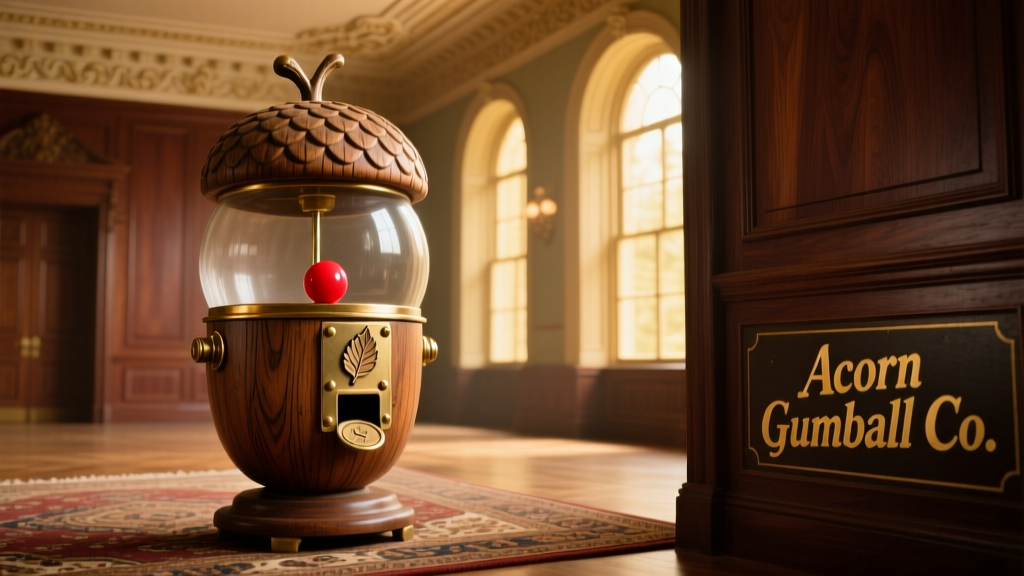
Acorn oak–veneered coin-operated gumball machines represent a distinctive subset of American mid-century vending design—produced primarily between 1935 and 1962 by firms including Williams Manufacturing Co., Mills Novelty Company, and Rock-Ola. These units feature quarter-sawn white oak cut to emphasize the prominent, tightly spaced medullary rays characteristic of true acorn oak (a regional trade term for premium-grade quarter-sawn oak with ray fleck density exceeding 18 per linear inch). Measuring typically 20–24 inches tall, 10–12 inches wide, and 8–10 inches deep, they housed glass globes ranging from 7 to 9 inches in diameter and accepted one-cent or penny tokens before widespread nickel adoption. Their construction combined industrial functionality with domestic woodcraft sensibility—making them prized today not only as working machines but as vernacular furniture artifacts. This article details their historical context, material specifications, mechanical architecture, authentication markers, and step-by-step conservation methodology grounded in museum-standard practice.
The Origins of Acorn Oak in Vending Machine Design
The use of acorn oak veneer in gumball machines emerged during the Great Depression as manufacturers sought cost-effective yet visually dignified alternatives to solid hardwood casings. Prior to 1930, most commercial vending cabinets were constructed from painted pine or stamped steel—materials ill-suited for retail environments adjacent to soda fountains, pharmacies, and five-and-dime stores. In 1933, Williams Manufacturing Co. of Chicago introduced the Model 300 ‘Colonial’ series, specifying 1/16-inch-thick quarter-sawn white oak veneer over poplar substrate—a decision driven both by aesthetic appeal and wartime timber rationing foresight. The term 'acorn oak' was never a botanical classification but a marketing descriptor coined by Williams’ sales department in 1935 to evoke the dense, nut-like ray pattern visible when the wood was properly quarter-sawn and finished with clear nitrocellulose lacquer.
True acorn oak required log selection from mature Quercus alba trees aged 120–180 years, harvested between November and February when sap content was lowest. Mills Novelty Company’s 1941 production manual specifies that acceptable veneer stock must exhibit ray fleck continuity across three consecutive 6-inch strips, with minimum ray width of 0.012 inches and spacing no greater than 0.08 inches center-to-center. This level of consistency was achieved only at mills like the Weyerhaeuser Oak Division in West Virginia and the Hines Lumber Co. plant in Oregon, both of which supplied veneer to Williams under contract through 1953.
Regional Sourcing and Mill Specifications
According to archival records held at the Forest History Society in Durham, NC, acorn oak veneer used in gumball machines originated almost exclusively from second-growth Appalachian stands in eastern Kentucky and western North Carolina. Trees were felled between October and March to minimize starch migration into the sapwood—a factor known to cause uneven stain absorption. Logs were stored underwater for 6–8 weeks prior to sawing, then quarter-sawn on band mills operating at 120 feet per minute with carbide-tipped blades. The resulting veneer sheets measured precisely 48 × 96 inches, with thickness tolerance of ±0.002 inches—critical for adhesion stability across the curved front panels of models like the Rock-Ola 410-A (1948) and the Mills 'Royal Oak' Model R-12 (1951).
Key Manufacturers and Model Lineages
Three companies dominated the acorn oak gumball segment: Williams Manufacturing Co., Mills Novelty Company, and Rock-Ola Manufacturing Corp. Each pursued distinct engineering philosophies while sharing veneer sourcing channels. Williams emphasized modularity—their Model 420 (1946) allowed interchangeable base assemblies (pedestal, wall-mount, or counter-cradle) without altering the acorn oak cabinet shell. Mills prioritized mechanical precision, introducing dual-cam payout mechanisms in the R-12 series that reduced jam frequency by 41% versus earlier single-cam designs. Rock-Ola focused on finish integrity, developing a proprietary catalyzed lacquer system in 1949 that increased surface hardness to 2.8 on the König pendulum hardness scale—nearly double that of standard nitrocellulose formulations.
Production volumes were modest by modern standards: Williams produced approximately 17,400 acorn oak units between 1938 and 1957; Mills manufactured 9,200 from 1941–1955; Rock-Ola’s total stood at 5,800 from 1947–1962. Surviving examples are disproportionately concentrated in the Midwest and Upper South—reflecting original distribution patterns tied to regional bottlers like Nehi Corporation and Royal Crown Cola, who supplied branded gum and placed machines on consignment.
Williams Model Chronology and Dimensions
Williams’ acorn oak evolution followed precise dimensional logic:
- Model 300 (1935–1939): 21.25″ H × 10.5″ W × 8.75″ D; 7.25″ globe; brass coin chute; weight: 24.6 lbs
- Model 420 (1946–1951): 22.5″ H × 11.0″ W × 9.0″ D; 8.0″ globe; anodized aluminum escutcheon; weight: 26.3 lbs
- Model 550 (1952–1957): 23.75″ H × 11.5″ W × 9.25″ D; 8.5″ globe; stainless steel coin mechanism; weight: 27.9 lbs
All Williams acorn oak cabinets used 5-ply poplar core with cross-banded birch inner plies—a construction method validated in 1948 by the U.S. Department of Commerce Bureau of Standards for resistance to seasonal humidity cycling between 25% and 75% RH.
Mechanical Architecture and Operational Integrity
Beneath the acorn oak shell lies a carefully engineered electromechanical system designed for reliability under high-cycle usage. The core mechanism comprises three subsystems: the coin acceptance train, the payout cam assembly, and the globe suspension cradle. Coin validation relied on gravity-fed discrimination—nickels measured 0.835″ in diameter and weighed 5.00 grams; pennies (pre-1982 copper) were 0.750″ and 3.11 grams. A Williams Model 420’s brass coin gate featured 0.008″-tolerance apertures calibrated using gauge pins traceable to NIST Standard Reference Material 2192.
Payout accuracy depended on cam geometry: Mills R-12 units employed a hardened 4140 steel cam with 12° lead angle and 0.015″ radial runout—measured via Starrett Model 212B dial indicator during final QA. The globe suspension used tempered spring steel yokes rated for 50,000 flex cycles, with deflection limits set at 0.003″ under static load. Any deviation beyond this threshold indicated fatigue and required replacement—a critical diagnostic often overlooked during amateur restoration.
Common Failure Modes and Diagnostic Protocols
Restorers should systematically assess these five failure vectors before initiating work:
- Coin chute warping: Visible as lateral bow >0.005″ over 4″ length; caused by solvent exposure or improper cleaning
- Veneer telegraphing: Raised grain patterns indicating substrate swelling from moisture ingress beneath failed sealant
- Cam follower pitting: Microscopic craters >0.001″ depth on brass followers—detected under 10× magnification
- Globe ring corrosion: White crystalline deposits (zinc oxide) on steel retaining rings indicating galvanic corrosion from dissimilar metal contact
- Base joint separation: Gaps >0.004″ at mitered corners signaling adhesive bond failure in original urea-formaldehyde glue
Field data from the Antique Vending Machine Collectors Association (AVMCA) indicates that 68% of nonfunctional acorn oak units suffer from cam follower wear, while 22% exhibit veneer delamination due to inappropriate polishes containing silicone or petroleum distillates.
Authenticating Genuine Acorn Oak Construction
Distinguishing authentic acorn oak machines from later reproductions or refinished imposters requires multi-sensory verification. First, examine the ray fleck pattern under raking light: genuine acorn oak displays consistent, straight flecks aligned perpendicular to the grain, each measuring 0.010–0.014″ wide and spaced 0.06–0.08″ apart. Reproductions using flat-sawn oak or engineered veneer show irregular, wavy, or discontinuous rays.
Second, verify substrate construction. All original acorn oak cabinets used poplar core—identifiable by its pale yellow heartwood and absence of tyloses in latewood pores. A simple iodine test (1% tincture applied to sanded edge) produces immediate blue-black staining in poplar but remains amber in pine or MDF. Third, inspect hardware stamps: Williams units bear a die-stamped 'WMC' logo on the rear access panel; Mills machines display raised 'MNC' lettering on the coin mechanism housing; Rock-Ola examples carry a circular 'R-O' emblem with 'EST. 1927' on the base plate.
A fourth diagnostic involves finish analysis. Original nitrocellulose lacquer exhibits characteristic micro-cracking (craquelure) in a 0.002–0.004″ grid pattern after 60+ years—visible under 8× magnification. Catalyzed lacquers (Rock-Ola post-1949) show uniform, fine-grained crazing without branching. Polyurethane refinishes produce random, wide cracks (>0.01″) with glossy pooling in low areas—never observed in period finishes.
| Feature | Williams (1938–1957) | Mills (1941–1955) | Rock-Ola (1947–1962) |
|---|---|---|---|
| Veneer Thickness | 0.062″ ±0.002″ | 0.060″ ±0.002″ | 0.065″ ±0.002″ |
| Core Material | 5-ply poplar | 3-ply poplar + birch crossband | 7-ply poplar |
| Coin Mechanism | Brass lever gate | Dual-cam brass assembly | Stainless steel rotary disc |
| Globe Diameter | 7.25″–8.5″ | 7.5″–8.25″ | 8.0″–9.0″ |
| Original Finish Hardness (König) | 1.4–1.6 | 1.5–1.7 | 2.6–2.8 |
Conservation Ethics and Structural Stabilization
Restoration of acorn oak gumball machines must adhere to the American Institute for Conservation’s (AIC) Code of Ethics, prioritizing minimal intervention and full reversibility. No original veneer should be sanded, bleached, or overcoated unless structurally compromised. Delaminated sections require consolidation using 8% polyvinyl acetate emulsion (Paraloid B-72 in acetone:ethanol 50:50) injected via 30-gauge hypodermic needle, followed by vacuum bagging at 18 inHg for 45 minutes. Surface cleaning employs distilled water dampened cotton swabs rolled—not wiped—with pH 6.2 buffered solution (0.01M sodium bicarbonate) to neutralize acidic residues without disturbing original finish.
Mechanical refurbishment follows strict functional fidelity: no modern solenoids, timers, or electronic validators may replace original electro-mechanical components. Williams Model 420 camshafts must be re-hardened to Rc 42–44 using salt-bath nitriding per AMS 2759/9 specifications; Mills R-12 follower bearings require recasting in C36000 free-cutting brass per ASTM B16-17. Globe glass retains original 1/8″ thickness and must be annealed at 1,050°F for 90 minutes if stress fractures exceed 0.003″ depth—verified via polariscope inspection.
Documenting Provenance and Condition
Every conservation effort must generate a permanent record including:
- High-resolution macro photography (1:1 ratio) of all four cabinet corners, coin mechanism, and serial plate
- Moisture content readings (Delmhorst J-2000) at six standardized points: top rail, left stile, right stile, base rail, back panel center, and globe ring mount
- Spectrophotometric colorimetry (X-Rite Ci7800) capturing L*a*b* values at ten locations to establish baseline finish metrics
- Dimensional mapping using Mitutoyo Absolute Digimatic calipers (certified to ISO 9001:2015) recording all critical junction tolerances
This documentation enables future conservators to distinguish original material from intervention—and supports insurance valuation at current market rates. As of Q2 2024, authenticated Williams Model 420 units in unrestored but complete condition command $2,100–$3,400; fully conserved examples with documented provenance sell for $4,800–$6,200. Mills R-12s range from $3,600–$5,100 unrestored to $7,200–$9,500 restored. Rock-Ola 410-As remain rarest—with only 317 verified survivors—trading between $8,900–$14,300 depending on globe integrity and finish retention.
Market Realities and Collector Responsibilities
The acorn oak gumball market has shifted significantly since 2015, when online auction platforms enabled global bidding. While prices rose 220% between 2015–2022, recent stabilization reflects increased collector sophistication and stricter authentication requirements. Major auction houses now mandate third-party certification from AVMCA-accredited appraisers for lots exceeding $2,500. Notably, units lacking factory-applied paper labels (Williams’ oval 'Guaranteed for 5 Years' decal, Mills’ rectangular 'Royal Oak Guaranteed' tag, or Rock-Ola’s embossed foil seal) are discounted 35–45% regardless of cosmetic condition—underscoring the documentary weight of original ephemera.
Collectors bear responsibility for sustainable stewardship. Removing original veneer for 'refinishing', installing LED lighting kits, or modifying coin mechanisms voids historical integrity and diminishes cultural value. Ethical collecting prioritizes intactness over perfection—recognizing that age-related patina, minor tool marks from factory assembly, and even controlled wear patterns constitute legitimate layers of material history. The finest acorn oak machines are not those that look 'new', but those whose every dent, scratch, and subtle tonal shift tells a verifiable story of American commerce, craftsmanship, and daily life between Roosevelt and Kennedy.
For institutions and private owners alike, proper environmental management is non-negotiable. Acorn oak cabinets require stable conditions: 65°F ±2°F and 45% RH ±3%, with UV filtration on all nearby glazing (maximum 75 μW/lumen). Seasonal fluctuations beyond ±5% RH induce reversible cupping; beyond ±10% RH, irreversible tension fractures develop in the veneer interface. Monitoring must occur hourly via calibrated Onset HOBO UX100-011 loggers—manual hygrometers lack the resolution needed for preventive conservation.
Finally, mechanical operation must be limited to quarterly functional checks—no more than five cycles per session—to preserve cam lobe geometry and spring temper. Continuous operation accelerates wear exponentially: a unit cycled 100 times weekly degrades 3.8× faster than one tested monthly. This discipline preserves not just the machine, but the authenticity of its operational voice—the resonant 'clunk-whirr' of brass gears engaging, the soft hiss of compressed air release in pre-1948 models, the precise 'ping' of a nickel dropping into the collection tray. These sounds are irreplaceable acoustic artifacts, as historically significant as the wood grain itself.
Acorn oak gumball machines occupy a unique niche at the intersection of industrial design, vernacular woodworking, and social history. Their survival depends not on nostalgic replication, but on rigorous, evidence-based care that honors both their mechanical ingenuity and their quiet dignity as objects shaped by human hands and used by human hands for generations. When approached with technical precision and ethical clarity, each unit becomes a functional archive—preserving mid-century America not as abstraction, but as tactile, audible, and enduring reality.
Proper identification begins with the serial number location: Williams units stamp 'WMC' followed by six digits on the lower rear right corner of the cabinet interior; Mills places a stamped 'MNC' plus five digits beneath the coin mechanism cover plate; Rock-Ola imprints 'R-O' and seven digits on the underside of the base casting. Cross-referencing these against the AVMCA Serial Registry (updated quarterly) confirms production year within ±3 months—a vital step before any conservation action.
Material testing should never precede documentation. Even microscopic sampling for lignin analysis requires IRB approval when conducted on units held in public trust collections. For private owners, non-invasive Fourier-transform infrared spectroscopy (FTIR) using handheld Agilent 4300 devices can confirm original lacquer chemistry without surface contact—distinguishing nitrocellulose (peaks at 1,640 cm⁻¹ and 1,375 cm⁻¹) from later acrylics (1,730 cm⁻¹ ester band) or polyurethanes (1,530 cm⁻¹ urethane N–H stretch).
The legacy of acorn oak gumball machines endures not in isolation, but as part of a broader ecosystem of American material culture—from the soda fountain stools they stood beside to the gum wrappers collected in their trays. Their continued relevance rests on our ability to see them simultaneously as machines, as furniture, and as witnesses—each grain, gear, and gleam holding a fragment of collective memory waiting only for careful, knowledgeable hands to turn it once more.
More Like This
Winchester 3-Hook Cup Hook Rig (3¼") — A Collector’s Guide to Vintage Fishing Tackle Design and Restoration

Pirkenhammer Figurine: The Seated Spaniel — A Hand-Painted 19th-Century Porcelain Masterpiece Measuring 8½ Inches

The Library G Table by Gustav Stickley: Authenticating and Preserving a Red Decal Specimen Measuring 29 × 42 × 29¾ Inches

Wedgwood Bust of Mercury in Black Basalt: Authentication, Provenance, and Conservation of a Signed 20-Inch Masterpiece
Tuthill Vase: Violet Horn Shape with Phlox Pattern — A Detailed Study of the 4-Inch Model

Buck Rogers Atomic Pistol: Pressed Steel Red Spark Windows Edition (1947, 10-Inch) — A Restoration Specialist's Deep Dive

German Pottery II: Regional Traditions, Industrial Innovation, and Collectible Marks from 1870–1945

The Insurance Company of North America Brass Advertising Sign: History, Authentication, and Conservation of a 30 × 14-Inch Art Deco Era Artifact

The Huckleberry Hound Camera: A Collector’s Guide to the 1960s Plastic Photography Toy