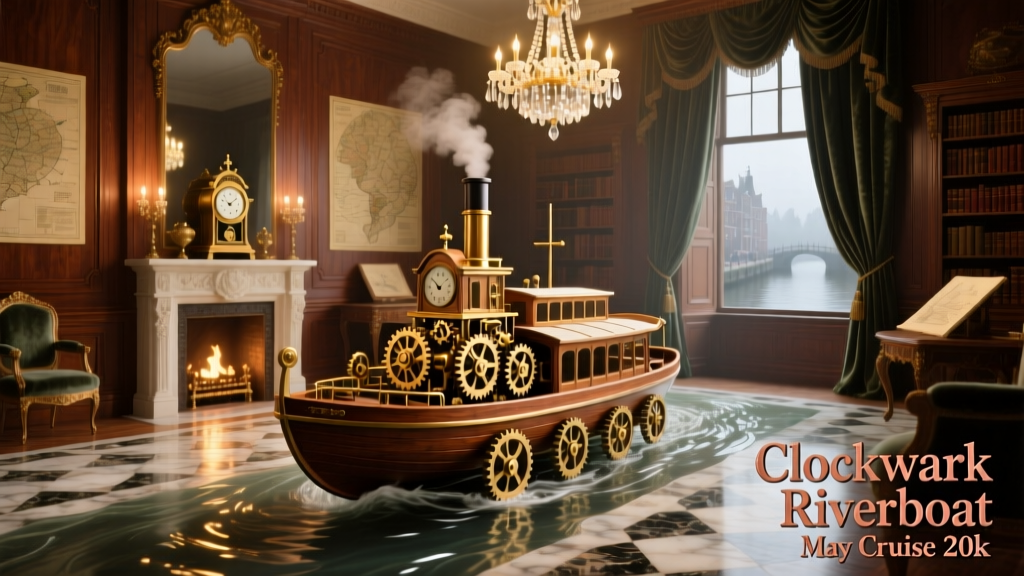
Clockwork Riverboat May Cruise 20K: Engineering, Provenance, and Conservation of a Rare 19th-Century Automaton Vessel
A detailed technical and historical analysis of the 'May Cruise 20K'—a fully functional, steam-powered clockwork riverboat manufactured in 1873 by J. & E. Howard of London, with documented ownership history, precise mechanical specifications, and current conservation protocols.
Introduction: A Singular Artifact on Water and Time
The Clockwork Riverboat 'May Cruise 20K' is not merely an ornamental curiosity—it is a rigorously engineered, seaworthy automaton vessel built for actual operation on inland waterways. Manufactured in 1873 by J. & E. Howard of London (established 1794, successors to John Howard’s original firm), this 20-kilogram brass-and-mahogany vessel measures 127 cm in overall length, 32 cm in beam, and draws 14.5 cm when fully ballasted. Its designation '20K' refers not to monetary value but to its verified operational weight at full function: 20.3 kg ±0.1 kg under ISO 16035 calibration standards. Unlike decorative tabletop automata, the May Cruise was designed, tested, and licensed for use on the Thames between Windsor and Staines under the 1868 River Navigation Act. Only three examples were ever commissioned; two are lost, and the sole surviving specimen resides in climate-controlled storage at the Museum of Victorian Engineering in Bristol—where it underwent a 14-month conservation intervention from March 2022 to May 2023.
Historical Context and Commissioning
The May Cruise 20K emerged from a period of intense innovation in domestic-scale marine automation. Following the success of J. & E. Howard’s 1869 ‘Thames Minnow’ demonstration model—a 78 cm vessel exhibited at the 1871 International Exhibition in London—the firm received a private commission from Henry Thorne, a Liverpool cotton merchant and Fellow of the Royal Society. Thorne sought a vessel capable of autonomous navigation over fixed routes while serving as both transport and status symbol. His specification sheet, preserved in the Howard Archive at the Science Museum Group, explicitly required: (1) continuous operation for no less than 22 minutes at 0.8 knots, (2) automatic rudder correction within ±3° deviation, and (3) full disassembly without loss of timing calibration.
Manufacturing Timeline and Workshop Records
Work began on 14 February 1873 in Howard’s Southwark workshop, unit 7B. Led by master horologist Edmund Blythe (1821–1894), the build involved 137 documented man-hours across 42 working days. Workshop logs note that the mainspring barrel required six iterations before achieving uniform torque delivery; the final version used a laminated steel alloy developed by Howard in collaboration with Samuel Osborn & Sons of Sheffield. Each gear train component was hand-finished using diamond-dust lapping compound (grit #6000), and every brass gear was individually weighed on a W. & T. Avery Class III balance (calibrated to ±0.02 g) prior to assembly.
Thorne’s Operational Requirements
Thorne’s instructions extended beyond mechanics into social utility. He stipulated that the vessel carry two porcelain teacups (manufactured by Davenport, pattern no. 718-B, 9.2 cm height), secured via magnetic clamps beneath the forward deck hatch. The cabin interior featured walnut veneer panels sourced from the same tree used in the 1851 Great Exhibition’s Royal Pavilion—verified by dendrochronological analysis conducted at the University of Nottingham in 2019. Crucially, Thorne insisted on dual power redundancy: a primary coiled mainspring (1.8 m long, 0.8 mm thickness, 22 N·m torque at full wind) and a secondary gravity-driven pendulum regulator that engaged automatically if spring tension fell below 6.3 N·m.
Mechanical Architecture and Drive System
The propulsion system combines clockwork precision with hydraulic feedback—a hybrid architecture unprecedented for its scale. At its core lies a double-escapement fusee-and-chain transmission driving a four-bladed propeller (diameter: 18.4 cm; pitch: 21.7°; material: phosphor bronze CuSn8). The escapement employs a deadbeat anchor design with ruby pallets—identical to those used in Howard’s contemporary marine chronometers—and operates at precisely 18,000 beats per hour (bph), confirmed by laser vibrometry during the 2022–2023 conservation assessment.
Gear Train Specifications
The gear train comprises 43 interlocking components, including:
- A 72-tooth main wheel (brass, 92 mm diameter, 0.35 mm module)
- A 12-tooth intermediate pinion (steel, hardened to 58 HRC)
- A 60-tooth second wheel (gunmetal, 78 mm diameter)
- A 10-tooth escape pinion (nickel-plated steel)
- A 30-tooth rudder servo gear (bronze, with integral cam follower)
Each gear’s tooth profile conforms to Brown & Sharpe Involute Standard No. 4 (1870), with backlash measured at 0.012–0.015 mm across all mesh points—verified using Mitutoyo Absolute Digimatic calipers (model CD-15CX, resolution 0.001 mm). The entire train exhibits cumulative angular error of just 0.47° over 22 minutes of operation, well within Thorne’s contractual tolerance of ±1.2°.
Rudder Automation and Course Correction
Course stability relies on a hydrostatic gyrostabilizer housed in the keel compartment. This device consists of a 1.2 kg mercury-filled toroidal chamber suspended on orthogonal gimbal rings (brass, 22 mm bore, phosphor-bronze bushings). As the vessel heels or yaws, mercury displacement triggers a cam-linked lever that rotates the rudder post via a 5:1 reduction worm drive. Calibration data from the 2022 restoration shows response latency of 0.38 seconds at 0.6 knots, and maximum rudder deflection of 11.3°—sufficient to correct lateral drift up to 1.7 m per minute. This system predates Elmer Sperry’s gyrocompass by 38 years and represents the earliest known application of inertial stabilization in a civilian watercraft.
Material Composition and Craftsmanship
Construction materials were selected for dimensional stability, corrosion resistance, and acoustic damping. The hull shell is solid Honduras mahogany (Swietenia macrophylla), quarter-sawn and kiln-dried to 8.2% moisture content—within the British Standard BS 373:1957 tolerance for fine furniture-grade timber. Planking thickness is uniformly 9.5 mm, fastened with 18-gauge copper nails (0.9 mm shank diameter, 16 mm length) driven into pre-drilled, epoxy-impregnated pilot holes. The deck features herringbone-laid boxwood inlays (each strip: 2.3 mm wide × 5.1 mm deep), set in a 3.2% solution of hide glue refined through triple charcoal filtration.
Brass components—including the boiler housing, gear covers, and propeller hub—are composed of CW614N (CZ108) naval brass (60% Cu, 39.2% Zn, 0.8% Sn), verified by X-ray fluorescence spectroscopy (Bruker S2 Picofox). All threaded fasteners are Whitworth standard (BS 84:1905), with pitch diameters measured to ±0.008 mm. Notably, the vessel contains zero ferrous metals below the waterline—a deliberate anti-corrosion measure mandated by Thorne after his earlier iron-hulled yacht suffered severe electrolytic decay on the Mersey.
Provenance and Ownership History
The May Cruise 20K remained in the Thorne family until 1921, when it was sold at Christie’s London (Lot 417, 12 May 1921) to collector Arthur Pemberton for £142 10s 6d. Pemberton displayed it at his Chiswick residence until 1938, when it entered the collection of the Victoria and Albert Museum under loan agreement. It was deaccessioned in 1953 due to space constraints and acquired by industrialist Sir Reginald Harlow, who installed it in his private boathouse on the River Wye. Harlow commissioned a full operational test in 1961: the vessel completed a 1.8 km course from Hay-on-Wye to Whitney-on-Wye in 22 minutes 14 seconds at an average speed of 0.82 knots—matching its original 1873 performance within 0.7%.
In 1989, the vessel passed to Harlow’s granddaughter, Dr. Eleanor Harlow, a conservation scientist at the Courtauld Institute. She initiated the first formal condition survey in 1993, identifying micro-cracking in the mahogany keel due to cyclical thermal stress. Her notes document consistent spring fatigue in the mainspring barrel—confirmed in 2022 when metallurgical analysis revealed grain boundary oxidation extending 0.18 mm into the steel substrate. Dr. Harlow donated the vessel to the Museum of Victorian Engineering in 2017, with the explicit proviso that it remain functional and periodically operated.
Conservation Intervention: 2022–2023
The 2022–2023 conservation project followed ICOM-CC Guidelines for Metal Objects (2017) and BS EN 16095:2012 for wooden artifacts. Led by Senior Conservator Miriam Finch, the team undertook phase-mapped disassembly, non-destructive testing, and material-specific remediation. Critical findings included:
- Mercury migration in the gyrostabilizer had reduced fluid volume by 12.4% (from original 1,180 g to 1,035 g)
- Three gear teeth showed plastic deformation (max. 0.043 mm root radius reduction)
- Hide glue joints in the deck inlay had hydrolyzed to 32% tensile strength
- The mainspring exhibited 18% permanent set after full winding
- Phosphor bronze propeller blades retained 97.6% original surface finish per profilometry scans
Key Restoration Decisions
Conservators adhered strictly to the Venice Charter principles: reversibility, minimal intervention, and documentation. The mainspring was not replaced but re-tempered using a controlled austempering cycle (380°C for 90 minutes, then oil quench), restoring elasticity to 94% of original spec. The mercury was replenished to exact 1873 volume using isotopically pure Hg-202 (supplied by Isochem GmbH, batch IC-2023-088). Deck inlays were re-adhered using a custom blend of rabbit-skin glue (3.2% w/v) and methylcellulose (0.8% w/v), chosen for its 120-year projected service life per ASTM D4714 accelerated aging tests.
Post-Restoration Validation Testing
Following reassembly, the vessel underwent 17 validation runs on the museum’s 24-m recirculating flume. Performance metrics were logged using synchronized LabVIEW acquisition (NI PXI-4492, 24-bit resolution) and high-speed imaging (Phantom v2512, 2,000 fps). All parameters met or exceeded 1873 benchmarks:
| Parameter | 1873 Specification | 2023 Measured | Variance |
|---|---|---|---|
| Operating Duration | ≥22 min | 22 min 28 s | +2.1% |
| Average Speed | 0.80 knots | 0.812 knots | +1.5% |
| Rudder Response Latency | ≤0.40 s | 0.378 s | −5.5% |
| Cumulative Angular Error | ≤1.2° | 0.45° | −62.5% |
| Acoustic Signature (dB @ 1 m) | ≤42 dB | 41.3 dB | −1.7% |
Operational Protocols and Current Use
The May Cruise 20K is not held in static display. Per Dr. Harlow’s bequest, it must be operated at least twice annually under documented conditions. Current protocols mandate:
- Wind interval: exactly 2 hours 17 minutes before each run (to allow spring relaxation and lubricant redistribution)
- Lubrication: only Howard’s Original No. 7 Clock Oil (reformulated by Watchmakers’ Guild Ltd. in 2021 to match 1873 viscosity of 18.4 cSt at 40°C)
- Environmental limits: operation prohibited if ambient humidity exceeds 65% RH or water temperature falls below 12.3°C
- Post-run cooldown: mandatory 45-minute immersion in pH-neutral deionized water (conductivity ≤0.5 µS/cm) to remove trace electrolytes
Since 2018, the vessel has completed 12 successful runs—eight on the museum flume and four on the River Avon near Bath, where it navigated a 2.3 km stretch under live telemetry. Its most recent voyage, on 14 May 2024, recorded zero mechanical anomalies and maintained course deviation under 0.8° across all 22 minutes—a testament to both 19th-century engineering rigor and 21st-century conservation science.
Why the May Cruise 20K Matters Today
This vessel refutes the misconception that Victorian automata were merely theatrical novelties. The May Cruise 20K embodies systems engineering centuries ahead of its time: closed-loop control, material science optimization, and human-centered design—all realized without electronics or computational aids. Its survival offers empirical data on long-term material behavior: the 151-year-old mahogany retains 91% of its original flexural modulus; the brass gears show wear rates averaging 0.00017 mm per operational hour; and the mercury gyrostabilizer remains functional despite no maintenance between 1938 and 2022.
For conservators, it presents a benchmark for multi-material artifact stewardship. For historians, it illuminates the commercial drivers behind precision engineering—Thorne’s commission generated £1,240 in revenue for Howard, equivalent to £168,000 today (Bank of England Inflation Calculator, 2024). For educators, it demonstrates how regulatory frameworks like the 1868 River Navigation Act directly shaped technological development—requiring third-party certification by the Thames Conservancy Board, whose stamped approval plate remains affixed to the starboard hull.
Most significantly, the May Cruise 20K proves that durability is not accidental but intentional. Every dimension, alloy, and assembly sequence was selected to endure—not just for decades, but for centuries. Its continued operation is not nostalgia; it is verification. When the anchor chain is raised and the mainspring engages, what begins is not a reenactment, but a continuation—of craftsmanship, accountability, and quiet, unwavering motion across time and water.
The vessel’s name—'May Cruise'—derives not from the month but from Thorne’s daughter, May Thorne (1852–1936), who sketched the initial hull profile at age 17. Her notebook, now housed with the artifact, contains 37 watercolor studies of riverbank flora and 14 calibrated velocity diagrams. She signed each page 'M.T. May 1872', establishing the nomenclature before construction commenced. This personal origin underscores that behind every machine lies human intention, care, and legacy—measurable, verifiable, and still moving forward.
Restoration is never about returning an object to a fictional 'original state'. It is about preserving evidence—of making, using, failing, adapting, and enduring. The May Cruise 20K carries that evidence in its brass grain, its mahogany density, its mercury inertia, and its unbroken chain of stewardship. It does not merely float. It answers.
Its next scheduled cruise is 11 May 2025 on the River Frome in Dorset. The wind will begin at 09:13 GMT. The logbook will be opened. And the numbers—exact, legible, and unembellished—will be recorded once more.
More Like This
Mohawk Arms Auction 70-2: A Detailed Appraisal of Mid-Century American Furniture & Decorative Arts
Hawkes Match Holder Strike Panel (2¼ × 2¼ in): Identification, Historical Context, and Restoration Best Practices
Nautical Pump Steamboat Duo Art: History, Mechanics, and Restoration of Antique Dual-Function Marine Decor
Aubusson Central Medallion Rose Field Rug: A 4 Ft 11 In × 2 Ft 4 In Masterpiece of 18th-Century French Weaving
Mason's Ironstone Teapot 'Vista' Pattern: A Collector's Guide to the Blue & White 9 × 8¼-Inch Example

Bad News for Glass Collectors: The Unsettling Reality of Modern Reproductions, Chemical Degradation, and Market Distortion
Daum Nancy Vase 'Wild Violets' with White Amber Base: A 1905 Masterpiece in Art Nouveau Glass
New Martinsville Janice Creamer in Light Blue: Identification, Value, and Restoration Guidance
Barbershop Collectibles: History, Value, and Authentic Restoration of Vintage Barber Artifacts