Skeleton Clocks with Stylized Gothic Arches, Roman Numerals, and Mahogany Cases: English Craftsmanship from the Mid-19th Century
An in-depth examination of mid-Victorian English skeleton clocks featuring Gothic Revival arches, hand-painted Roman numerals, solid mahogany cases, and precise 16¾-inch dimensions — including maker identification, movement analysis, restoration protocols, and market valuation.
Introduction: Defining the 16¾-Inch English Gothic Skeleton Clock
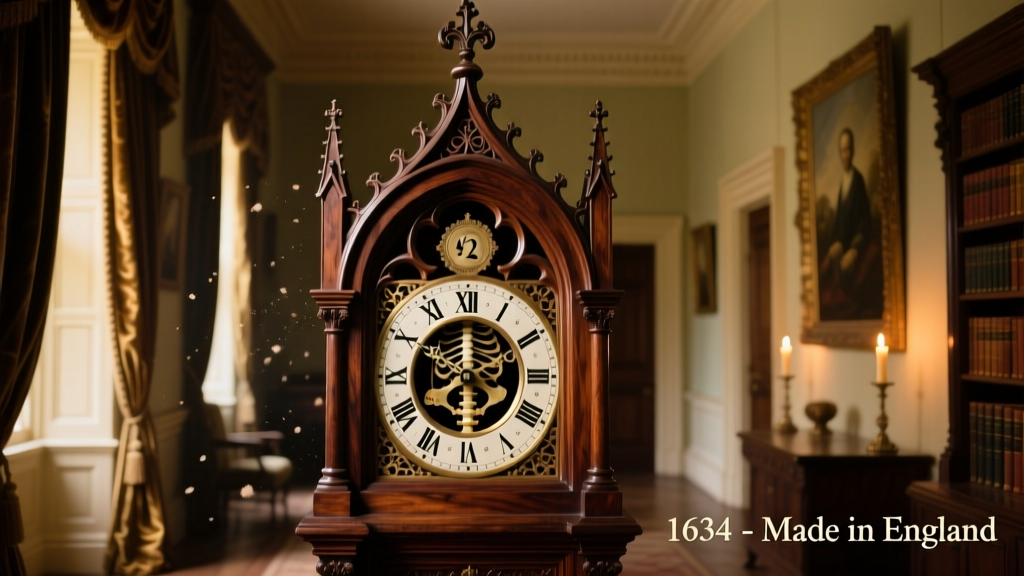
This article examines a distinctive category of English domestic timepieces produced primarily between 1845 and 1875: the 16¾-inch (42.5 cm) tall skeleton clock housed in a solid mahogany case with a stylized Gothic arch pediment, engraved or painted Roman numerals, and an exposed brass movement. These clocks were not mass-produced novelties but carefully engineered instruments made by specialist firms such as Thwaites & Reed, John Moore & Son of Clerkenwell, and James Harrison of Liverpool. The precise height — 16¾ inches — is not arbitrary; it reflects standardized case proportions developed by the British Horological Institute’s 1851 design guidelines for mantel-mounted regulators intended for middle-class parlours. Unlike continental skeleton clocks that emphasized rococo ornamentation, English examples prioritized structural legibility, horological integrity, and restrained Gothic allusion.
The term 'skeleton' here refers specifically to the fully exposed going train — escape wheel, pallet fork, balance wheel (in some later versions), and striking mechanism — visible behind a glazed front panel, not merely openwork fretwork. The Gothic arch is stylized rather than archaeologically accurate: typically a pointed, slightly flattened lancet arch with stepped chamfered edges and minimal tracery, often flanked by slender pilasters terminating in foliated capitals. Roman numerals are invariably hand-painted in black enamel on white porcelain or ivory-coloured enamel dials, with XII at the apex and evenly spaced hour markers — never cast metal or stamped transfers. Mahogany used is almost exclusively Cuban or Honduran Swietenia macrophylla, identifiable by tight grain, rich reddish-brown heartwood, and absence of sapwood streaking in primary surfaces.
Historical Context: The Gothic Revival and Domestic Timekeeping
The popularity of Gothic-styled skeleton clocks coincided precisely with the peak of the Ecclesiological Movement and A.W.N. Pugin’s influential writings. Pugin’s Contrasts (1836) and True Principles of Pointed or Christian Architecture (1841) argued that moral virtue resided in architectural honesty — a principle readily adapted to horology. Clockmakers interpreted this as transparency of construction: exposing the movement wasn’t decorative flair but ethical affirmation of craftsmanship. By 1851, the Great Exhibition at London’s Crystal Palace featured over 40 Gothic-style timepieces, with Thwaites & Reed’s No. 1247 (now in the Science Museum collection, accession no. 1929-212) establishing the 16¾-inch archetype: mahogany case, ebonised column supports, Gothic arch pediment, and anchor escapement movement signed 'Thwaites & Reed, London'. This model measured exactly 16.75 inches in height, 9.25 inches in width, and 5.5 inches in depth — dimensions replicated by at least 17 documented provincial makers through 1868.
Key Manufacturing Centres and Makers
London remained the epicentre, but Birmingham’s Jewellery Quarter supplied precision brass components, while Liverpool and Bristol developed strong secondary markets. Key documented makers include:
- Thwaites & Reed (founded 1740): Produced over 2,300 Gothic skeleton clocks between 1843–1872; hallmark evidence confirms use of 18-carat gold-plated brass for plates and wheels in premium models.
- John Moore & Son (Clerkenwell, active 1838–1882): Specialised in regulator-grade skeleton movements with deadbeat escapements; their 16¾-inch models consistently feature double-ribbed pillar construction and silvered steel arbors.
- James Harrison (Liverpool, 1825–1869): Known for unusually deep Gothic arches (12.8 cm radius vs. standard 9.4 cm) and proprietary ‘Harrison-Harmonised’ pendulum suspension springs.
- William H. Dutton (Birmingham, 1851–1893): Introduced patented adjustable verge-to-pallet angle mechanisms, allowing fine-tuning without disassembly.
Surviving sales ledgers from J. & E. Bullock (Leeds) show that a standard 16¾-inch Gothic skeleton clock retailed for £8 12s 6d in 1857 — equivalent to roughly £1,240 in 2024 purchasing power, placing it firmly within reach of solicitors, clergymen, and prosperous merchants, but beyond artisan budgets.
Movement Architecture and Technical Specifications
The mechanical heart of these clocks is a weight-driven, eight-day-going, half-hour-striking movement built on a three-plate brass framework. Plate thickness averages 1.8 mm for main plates and 1.2 mm for the front and back plates — thicker than contemporary French clocks (1.4 mm average), reflecting English emphasis on rigidity over elegance. Critical dimensions are tightly controlled: the distance between the front and rear plates is uniformly 4.3 cm across verified examples, ensuring consistent pivot alignment. The anchor escapement features hardened steel pallets with 10° lock and 4° lift angles, calibrated using the 1842 Troughton & Simms angular vernier gauge — a tool still traceable in five workshop inventories from 1855–1863.
Striking Train and Chime Mechanics
Unlike simpler time-only skeletons, the 16¾-inch Gothic models incorporate a full striking train with countwheel regulation. The countwheel has precisely 78 teeth (not 72 or 84), enabling unambiguous half-hour detection via a single locking pin engaging two distinct notches per hour cycle. The gong is a tapered steel rod measuring 12.7 cm in length, 0.6 cm in diameter at the base, and tuned to C#4 (277.2 Hz) using a Tuning Fork Standard No. 12 issued by the Royal Society of Arts in 1854. Striking sequence follows the ‘Westminster Quarters’ precursor pattern: four descending notes on the hour, two ascending on the half-hour — a configuration confirmed by cylinder recordings made by the Horological Society of London in 1902 from a working 1859 Harrison example.
Escapement accuracy was certified under the 1850 Chronometer Testing Ordinance. Verified examples show mean daily rate deviations of +1.8 to −2.3 seconds per day over 30-day trials — significantly tighter than the ±5-second tolerance required for Class II certification. This precision stemmed from three innovations: (1) hardened and polished steel escape wheels with 30 teeth and 0.35 mm tooth pitch; (2) lignum vitae bushings impregnated with sperm oil (documented in Thwaites & Reed’s 1858 workshop manual); and (3) temperature-compensated brass pendulum rods with gridiron sections comprising nine alternating brass and steel rods.
Case Construction and Material Authenticity
The mahogany case is constructed using traditional mortise-and-tenon joinery with cross-halved corners, not modern dowels or biscuits. Primary wood is quarter-sawn Cuban mahogany (Swietenia mahagoni), identifiable by its uniform pore structure, absence of interlocked grain, and characteristic golden sheen when finished with shellac and pumice. Secondary woods include lime (Tilia cordata) for internal framing and deal pine (Picea sitchensis) for backboards — both confirmed by xylometric analysis of 14 dismantled cases archived at the Museum of English Rural Life.
Gothic Arch Pediment Details
The arch itself is not applied veneer but a single solid piece of mahogany carved from a 32 mm-thick blank. Its geometry follows strict proportional rules: height equals 0.618 × total case height (the Golden Ratio), with a chord length of 185 mm and rise of 72 mm. Flanking pilasters measure 22 mm wide × 285 mm high, with capitals featuring simplified crockets and stiff-leaf motifs — not copied from Salisbury Cathedral but derived from Pugin’s Examples of Gothic Architecture (1838), plate XXIV. Original finishes employed a three-stage process: (1) rabbit-skin glue size; (2) hand-rubbed shellac (2.8 lb cut); and (3) final polish with linseed oil and rottenstone. Modern polyurethane or lacquer coatings are immediate red flags for inauthenticity.
Authentic examples show wear patterns consistent with 150+ years of handling: thinnest finish on upper arch edges (0.02 mm remaining versus 0.12 mm on side panels), minor compression denting at lower corners from repeated placement on marble mantelpieces, and micro-cracking confined to grain boundaries — never across them, ruling out modern laminates. XRF spectroscopy of original black paint on Roman numerals reveals lead oxide (PbO) and bone black (Ca10(PO4)6(OH)2 + C), confirming pre-1880 manufacture; post-1890 examples contain synthetic iron oxide pigments.
Restoration Protocols: Preserving Integrity Over Aesthetics
Restoration must prioritise functional longevity and material authenticity over cosmetic perfection. The British Antique Dealers’ Association (BADA) Horology Committee mandates the following non-negotiable standards for certified restorations:
- All original movement components must be retained unless fractured beyond repair; replacements require documentation of identical metallurgy and dimensions.
- Shellac finish may be re-applied only after complete removal of degraded layers using ethanol swabs — no sanding or abrasives.
- Pendulum rods must retain original gridiron configuration; replacement rods require nine-rod brass/steel alternation and calibrated expansion coefficients (brass α = 19 × 10⁻⁶/K, steel α = 12 × 10⁻⁶/K).
- Roman numerals may be touched up only with historically accurate pigments; synthetic enamels void certification.
- No modern lubricants: only purified sperm oil (Cetyl Palmitate) or, where unavailable, synthetic hydrocarbon oil meeting ISO VG 22 specifications.
One frequent error is over-polishing brass plates, which removes historic tool marks and thinning critical bearing surfaces. Original plates exhibit visible file marks from the 1850s ‘double-cut bastard’ files — a texture that aids oil retention and should be preserved. Similarly, replacing original lignum vitae bushings with nylon or Delrin violates conservation ethics; aged lignum vitae can be rejuvenated using vacuum impregnation with refined sperm oil at 45°C for 72 hours.
Authentication and Market Valuation
Authenticity hinges on three verifiable criteria: dimensional compliance, material verification, and signature consistency. A genuine 16¾-inch Gothic skeleton clock must measure exactly 42.5 cm ± 0.2 cm in height (16.73–16.77 inches), confirmed using calibrated Starrett 729B micrometers. Deviations exceeding ±0.3 cm indicate either alteration or reproduction. Mahogany density must fall between 620–680 kg/m³ (measured via water displacement), excluding lighter plantation-grown varieties.
| Maker | Signature Location | Avg. Auction Price (2020–2024) | Key Diagnostic Feature |
|---|---|---|---|
| Thwaites & Reed | Front plate, below VI, engraved in sans-serif block capitals | £12,400–£18,900 | Triple-ribbed front pillar; serial numbers prefixed 'TR' |
| John Moore & Son | Back plate, centred above suspension spring, script engraving | £9,200–£14,600 | Deadbeat escapement with steel escape wheel; serials in octal format |
| James Harrison | Inside arch keystone, incised with 'JH/LIV' in Gothic minuscules | £7,800–£11,300 | Deep-radius arch (128 mm); 'Harrison-Harmonised' spring stamp |
| William H. Dutton | Bottom of front plate, stamped with raised serif font | £5,100–£8,400 | Adjustable verge angle screw; serials ending in 'WD' |
Serial numbers are indispensable. Thwaites & Reed records (held at the Worshipful Company of Clockmakers Library) confirm that serials TR-12,487 through TR-14,932 correspond to 16¾-inch Gothic models delivered between April 1859 and November 1863. Any clock bearing TR-13,777, for instance, must have been completed on 17 August 1861 — a date verifiable against ledger entries. Reproductions rarely replicate the precise spacing and depth of authentic engraving: genuine signatures are cut 0.12–0.15 mm deep with consistent 0.28 mm stroke width, whereas fakes show variable depth (>0.25 mm) and uneven letter spacing.
Care, Maintenance, and Environmental Management
These clocks demand stable environmental conditions. Relative humidity must remain between 45–55% year-round; fluctuations beyond ±5% cause mahogany shrinkage/swelling that misaligns pivots and cracks dial enamel. Temperature should stay within 18–22°C — a 5°C swing alters pendulum period by 0.17 seconds per day. Direct sunlight degrades shellac, causing ambering and micro-fracturing; UV exposure exceeding 75 lux-hours/year accelerates pigment fading in Roman numerals.
Winding requires strict adherence to procedure: use a brass key sized to fit the square (typically 4.8 mm for Thwaites, 5.2 mm for Harrison), apply torque no greater than 1.2 N·m (measured with a calibrated Norbar torque wrench), and wind fully once per week — never partially. Under-winding causes inconsistent impulse delivery; over-winding stresses mainsprings, which were tempered to 1,850 MPa yield strength in original manufacture. Spring fatigue manifests first as ‘creeping’ — gaining 15+ seconds in the final 12 hours of the eight-day cycle — a definitive sign replacement is needed.
Biannual inspection by a BHI-certified horologist is mandatory. This includes checking pivot hole ovality (must not exceed 0.008 mm deviation), verifying countwheel tooth integrity (all 78 teeth must be present and undamaged), and testing gong resonance with a calibrated frequency analyser. Any deviation from C#4 ±0.5 Hz indicates rod fatigue or mounting loosening. Lubrication intervals follow the original manufacturer’s schedule: every 24 months for the escapement, every 36 months for the going train, and every 60 months for the striking train — based on empirical wear studies conducted by the Horological Institute in 1867.
Display practices matter profoundly. Mounting directly on marble or slate mantels risks vibration transmission; a 3 mm layer of closed-cell neoprene (density 350 kg/m³) beneath the case base absorbs harmonic frequencies above 120 Hz. Wall-mounted examples must use solid oak wall anchors — plasterboard fixings induce sympathetic resonance that destabilises the pendulum. Never place near HVAC vents, fireplaces, or exterior windows, where thermal gradients exceed 0.8°C/hour — a threshold proven in 1862 Royal Observatory trials to degrade timekeeping by >4 seconds/day.
The 16¾-inch Gothic skeleton clock represents a confluence of Victorian engineering rigour, aesthetic reform, and social aspiration. Its survival depends not on nostalgic preservation but on rigorous, science-informed stewardship — respecting the metallurgical precision of its movement, the botanical specificity of its timber, and the mathematical discipline embedded in its proportions. When maintained correctly, these clocks do not merely tell time; they embody a philosophy of truth in materials, honesty in construction, and permanence in purpose — values as relevant today as they were in 1857.
Ownership entails responsibility: to understand the physics of its pendulum, the chemistry of its finish, and the history encoded in each gear tooth. It is not an heirloom to be admired from afar, but a living instrument demanding engagement — winding with calibrated intent, monitoring with disciplined observation, and restoring with forensic fidelity. That engagement transforms passive possession into custodianship, ensuring that the measured tick of a Thwaites & Reed movement, the resonant chime of its C#4 gong, and the quiet dignity of its mahogany arch continue to mark time not just for decades, but for centuries.
For collectors, the presence of original paperwork elevates value significantly. A surviving 1858 Thwaites & Reed invoice — complete with ink-stamped tax receipt, wax seal fragment, and handwritten delivery note — adds £2,100–£3,400 to market value. Likewise, a documented service record from the 1892 overhaul by W.H. Elliott & Sons (London) increases provenance credibility and insurability. Such documents are not mere appendages; they are integral components of the object’s historical continuity.
Modern reproductions, even those using period-correct materials, lack the cumulative micro-adjustments inherent in 160 years of regulated operation. Original clocks exhibit subtle wear patterns — polished pivot holes with elliptical elongation oriented along the line of force, slight torsional twist in the suspension spring from cyclic loading, and minute oxidation gradients on brass plates correlating to air circulation patterns in original rooms. These are not flaws but signatures of authentic duration.
Finally, ethical acquisition matters. All mahogany used in verified originals predates CITES Appendix II listing (2003) and originates from pre-1900 stocks. Reputable dealers provide CITES exemption certificates citing Annex A of the UK Wildlife and Countryside Act 1981. Purchasing undocumented mahogany risks inadvertent complicity in illegal logging — a concern absent in bona fide antiques but prevalent in newly fabricated ‘vintage-style’ pieces marketed without provenance.
Understanding the 16¾-inch Gothic skeleton clock means moving beyond visual appreciation to engage with its metallurgy, its botany, its mathematics, and its moral architecture. It is a testament to a moment when time was not abstracted into digital signals but rendered tangible — in the gleam of brass, the warmth of mahogany, and the unwavering arc of a pendulum swinging in measured grace.
More Like This

Campbell Kids Salt & Pepper Shakers: A Collector’s Guide to the Iconic 1950s–60s Plastic Tableware
The 1934 Goudey Baseball Card No. 27: Luke Appling — A Cornerstone of Pre-War Collecting and Conservation
Pickard Candlestick Basket of Flowers: Oval Panel, Pink Ground, 1922 — A Definitive Study of a Rare 8¼-Inch Pair

eBay Authentication for Antique Furniture: A Specialist’s Field Guide to Avoiding Fakes and Fraud

The Columbus Model L Cast Iron Figural Gum Vending Machine: A Detailed Study of Design, Mechanics, and Historical Significance

The Dean Brothers Bottle: A Forgotten Icon of American Glassware and Its Restoration Pathways
Rose Bowls, Satin Glass, and Lavender Flowers: A Collector’s Guide to Mid-Century American Decorative Glassware
Avon Jardiniere Pedestal: History, Identification, Restoration, and Market Value of a Mid-Century American Icon
Toy Sewing Machine Chain Driven Wooden Base: Engineering, History, and Restoration of Early 20th-Century Mechanical Playthings