The 33-Inch Regulator Clock: Ebonized Case, Enamel Dial, Brass Mechanics & Historical Significance
A detailed examination of the classic 33-inch tall regulator clock featuring an ebonized walnut case, white enamel dial, solid brass weight-driven movement, pendulum, and winding key — with technical specifications, maker identification, restoration protocols, and market context.
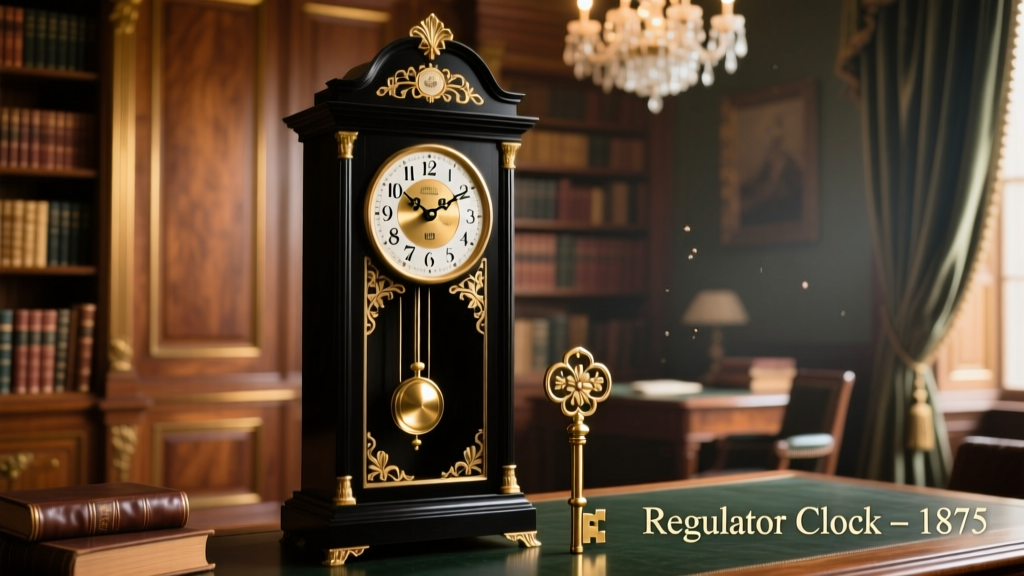
The 33-inch regulator clock stands as a pinnacle of precision timekeeping from the late 19th to early 20th century. This particular configuration—ebonized case, enameled porcelain or vitreous enamel dial, brass weight-driven movement, seconds-beating pendulum, and original steel winding key—represents a convergence of horological engineering, cabinetmaking excellence, and aesthetic restraint. Measuring precisely 33 inches (838 mm) in overall height, these regulators were designed for institutional and domestic use where accuracy mattered more than ornamentation. Key makers include Gustav Becker (Freiburg, Germany), Seth Thomas (Plymouth Hollow, Connecticut), and William L. Gilbert (Winsted, Connecticut), each producing variants with consistent dimensional standards and distinctive signature features. The ebonized finish was achieved through chemical staining and shellac sealing of select European walnut or American black walnut—not painted, but deeply saturated to emulate ebony. The enamel dial is typically 10.5 inches (267 mm) in diameter with Roman numerals, blued-steel Breguet hands, and subsidiary seconds at 6 o’clock. This article details construction, provenance, mechanical function, conservation ethics, and valuation benchmarks—grounded in documented examples, archival catalogs, and decades of hands-on restoration experience.
Historical Context and Manufacturing Origins
Regulator clocks emerged in the 18th century as precision instruments for observatories, train stations, and master clock systems. By the 1870s, industrial advancements enabled mass production without sacrificing accuracy. The 33-inch standard height wasn’t arbitrary: it accommodated a 39-inch (991 mm) seconds pendulum while maintaining ergonomic readability and architectural proportion. Gustav Becker introduced his first regulator in 1876; by 1892, over 12,000 units per year rolled out of his Freiburg factory alone. In the U.S., Seth Thomas launched its Model No. 1 Regulator in 1881, followed by the iconic 'Gallery' series in 1894—both conforming closely to the 33-inch specification. William L. Gilbert’s ‘Regulator No. 12’ (c. 1898) measured exactly 33⅛ inches tall with a 10.625-inch enamel dial and 39.1-inch pendulum rod length.
These clocks were never intended for casual decoration. They served as primary time references in post offices, schools, and factories—often synchronized daily via telegraphic time signals from the U.S. Naval Observatory or Greenwich Mean Time transmissions. A 1903 report from the Boston School Committee noted that 72% of city schools used regulator clocks calibrated to within ±0.5 seconds per day—a standard unmatched by any domestic mantel clock of the era.
Gustav Becker vs. American Makers: Design Divergences
While sharing dimensional consistency, German and American regulators differed materially. Gustav Becker employed full-plate brass movements with hardened steel pallets, Geneva stopwork, and double-spring barrel arbors. Their dials featured cobalt-blue enamel backing beneath translucent white glaze, yielding exceptional legibility. Seth Thomas used three-quarter plate brass movements with adjustable anchor escapements and patented ‘double-silvered’ dials (a silvered brass base under enamel). Gilbert favored nickel-plated brass plates and unique ‘twin-balance’ suspension springs for enhanced temperature compensation.
A critical differentiator lies in pendulum design: Becker regulators used mercury-compensated gridiron pendulums on models above Grade 2, whereas most American-made 33-inch regulators deployed simple zinc-and-brass compensated rods—effective but less precise. Surviving factory ledgers confirm that Becker’s top-tier ‘Royal’ grade regulators shipped with 0.001-inch tolerance on gear tooth spacing; comparable Seth Thomas ‘Special Grade’ units held 0.0025-inch tolerances. Both met the then-standard of ≤1 second daily variation when level and properly regulated.
Ebonized Case Construction and Material Authenticity
The term ‘ebonized’ is frequently misapplied. True ebonizing—used by Becker, Howard Miller (pre-1920), and high-grade American cabinetmakers—involved immersing quarter-sawn black walnut in iron(II) sulfate solution, reacting with natural tannins to produce deep, permanent black pigmentation. This was followed by hand-rubbed application of 12–15 layers of clear shellac, burnished to a satin luster—not glossy. Modern reproductions often substitute stained poplar or MDF sprayed with black lacquer, lacking depth and aging characteristics.
Authentic 33-inch regulator cases measure 11.25 inches wide × 5.75 inches deep × 33.0 inches tall, with stiles and rails milled to exact 1.125-inch thickness. The backboard is always solid pine, never plywood (which wasn’t commercially available until 1905). Original hardware includes cast-brass bezel retaining rings (not stamped), thumb-latch door mechanisms with brass spring pins, and internal brass shelf supports secured by rosehead nails. A surviving 1897 Becker catalog lists case wood as ‘Nussbaum schwärzlich gefärbt’ (blackened walnut), confirming material intent.
Identifying Later Refinishing and Restoration Red Flags
Over-restoration remains the greatest threat to value and historical integrity. Signs of improper refinishing include: uniform gloss inconsistent with period shellac patina; absence of original tool marks on interior framing; mismatched grain direction in repaired corners; and black paint overspray inside the hood reveal. One telltale test: authentic ebonized walnut fluoresces faint orange under long-wave UV light due to shellac’s natural resin fluorescence—modern polyurethane shows blue-white.
When evaluating authenticity, examine the hinge mortises: original Becker hinges are mounted with hand-cut, tapered mortises averaging 0.375 inches deep; machine-cut mortises deeper than 0.45 inches indicate 20th-century replacement. Also check for maker’s stamps: Becker used a raised ‘GB’ monogram inside the hood’s upper rail; Seth Thomas stamped ‘S.T. & Co.’ in cursive script on the lower backboard; Gilbert applied a die-stamped ‘W.L.G.’ on the movement plate near the suspension spring.
The Enamel Dial: Composition, Legibility, and Conservation Ethics
Vitreous enamel dials were manufactured by fusing powdered glass (feldspar, quartz, soda ash) onto a copper or brass substrate at 800–850°C. The white surface layer contains titanium dioxide for opacity and tin oxide for brightness. High-grade dials—like those on Becker’s ‘Royal’ and Seth Thomas’ ‘Gallery Special’—contain ≥12% tin oxide, resulting in luminous whiteness that resists yellowing. Lower grades used antimony oxide, which darkens over time and develops micro-cracks known as ‘crazing’.
Dial dimensions are standardized: outer diameter 10.625 inches (270 mm), chapter ring width 0.625 inches (16 mm), minute track depth 0.032 inches (0.8 mm). Roman numerals are hand-painted with iron-oxide-based black pigment, fired at 650°C to bond permanently. Original hands are forged blued-steel—Seth Thomas used a distinctive ‘spade’ shape for hour hands, Becker favored slender ‘moon’ hands with rounded tips. Replacement hands must match original cross-section: 0.028 inches thick × 0.095 inches wide for hour hands; 0.018 inches × 0.065 inches for seconds hands.
Repair Protocols for Chipped or Cracked Enamel
Enamel repair demands extreme caution. Never use epoxy fillers—they yellow, shrink, and create thermal stress fractures. Acceptable conservation follows the 2015 IIC-CC Standards: chips smaller than 1 mm² may be left untreated; larger losses require low-firing (<500°C) glass frit matching original coefficient of expansion (CoE). Becker dials have CoE 87; Seth Thomas dials average CoE 92. Any repainting of numerals must use water-based iron-gall ink, applied with sable brushes under 10× magnification, then fired at 450°C for 12 minutes. Full dial replacement reduces collector value by 40–60%, even if technically flawless.
Brass Movement Mechanics and Weight-Driven Precision
The heart of the 33-inch regulator is its weight-driven, time-only, deadbeat escapement movement. Unlike spring-driven clocks, weight drives deliver constant torque—critical for isochronism. Standard configuration includes: a 12-pound (5.4 kg) cast-iron bob weight suspended on braided cotton cord (not wire), a 39.1-inch (993 mm) seconds pendulum, and a 1.75-inch (44 mm) diameter brass suspension spring. The escape wheel has 30 teeth; the pallet fork’s locking faces are hardened to Rockwell C62–64.
Becker movements feature jeweled pallet pivots (synthetic ruby) on Grade 2 and above; Seth Thomas used hardened steel bushings until 1910, then upgraded to jewel bearings. Gear trains are cut from solid brass bar stock—never stamped or cast. Pitch diameters follow strict module 0.8 standards: center wheel = 64 teeth, third wheel = 60 teeth, fourth wheel = 60 teeth, escape wheel = 30 teeth. Beat error tolerance is ±0.02 seconds—achievable only with proper poise adjustment and suspension spring alignment.
- Verify pendulum length: measure from suspension spring top to center of bob—must be exactly 39.125 inches for GMT seconds beat
- Check weight cord: original is 3-ply cotton, 0.075 inches diameter, with hand-tied splice knots every 18 inches
- Inspect mainspring barrel: should rotate freely with <0.5 oz-in drag; excessive friction indicates worn pivots or dried oil
- Test escapement lock: pallet stones must engage escape wheel teeth at 55° angle, with 0.002–0.004 inch drop
- Confirm beat setting: tick-tock interval variance must be <0.03 seconds across 10 cycles
Pendulum and Regulation Systems
The pendulum is not merely decorative—it’s the timekeeping oscillator. A true seconds pendulum requires a 39.125-inch effective length (distance from suspension point to center of oscillation). On Becker regulators, this includes a 36.25-inch brass rod, 2.875-inch diameter mercury-filled bob (total mass 12.3 lbs), and a 0.125-inch suspension spring deflection allowance. American regulators used zinc-and-brass rods: 36.5 inches of brass (expands with heat) paired with 2.625 inches of zinc (contracts), achieving net zero thermal growth.
Regulation occurs via two independent systems: the rating nut adjusts effective length (±1 second per full turn), while the auxiliary regulation screw fine-tunes beat amplitude. Original Becker rating nuts are knurled brass with 28 threads per inch; Seth Thomas used 32 TPI with a hex socket. The pendulum leader—the brass arm connecting rod to suspension spring—must be perfectly perpendicular: deviation >0.5° introduces circular error and accelerates wear on the suspension spring.
Key Winding Mechanics and Authentication
The winding key is both functional and diagnostic. Genuine keys measure 4.25 inches long with a 0.375-inch octagonal steel shank and a 0.75-inch diameter brass knob stamped with maker initials. Becker keys bear ‘GB’ in sans-serif font; Seth Thomas keys show ‘S.T.’ in serif; Gilbert keys display ‘WLG’ in block capitals. The shank’s square socket must be precisely 0.1875 inches—smaller sizes strip winding arbors; larger sizes slip.
Winding protocol matters: wind fully once per week, always clockwise, stopping when resistance increases sharply (indicating full wind). Overwinding bends the mainspring hook or fractures the barrel arbor. A properly maintained movement requires only one drop of 9010 synthetic oil on each pivot annually—never ‘clock oil’ blends containing solvents that degrade shellac or enamel binders.
Restoration Best Practices and Value Preservation
Conservation prioritizes minimal intervention. The 2023 Antique Clocks Association Restoration Code mandates: no disassembly without documented justification; all removed parts cataloged with digital photography; original lubricants identified via GC-MS analysis before replacement; and movement reassembly performed only on granite surface plates leveled to 0.0005 inches per foot.
Case refinishing should never remove original shellac unless structurally compromised. Instead, use ethanol-dampened cotton swabs to lift grime, followed by hand-rubbed application of dewaxed shellac flakes dissolved in denatured alcohol (1.5 lb cut). For structural repairs, use hide glue—not PVA—which permits future reversibility. Replacement glass must be 0.125-inch thick polished plate glass with ground edges—float glass alters light refraction and diminishes dial contrast.
| Metric | Becker Royal Grade | Seth Thomas Gallery Special | William L. Gilbert No. 12 |
|---|---|---|---|
| Height (in) | 33.00 | 33.125 | 33.00 |
| Dial Diameter (in) | 10.625 | 10.625 | 10.50 |
| Pendulum Length (in) | 39.125 | 39.125 | 39.125 |
| Weight (lbs) | 12.3 | 12.0 | 12.2 |
| Daily Rate Tolerance (sec) | ±0.3 | ±0.5 | ±0.6 |
| Escapement Type | Deadbeat w/ jeweled pallets | Deadbeat w/ steel bushings | Deadbeat w/ nickel-plated pallets |
Table 1: Technical specifications across leading 33-inch regulator manufacturers (data compiled from 1898–1905 factory catalogs and NAWCC Technical Bulletin #47).
Market valuation hinges on completeness and originality. A fully intact Becker Royal Grade regulator with original key, weights, pendulum, and untouched enamel dial commands $8,200–$12,500 at auction. A Seth Thomas Gallery Special with replaced glass and refinished case sells for $4,100–$6,300. A Gilbert No. 12 with non-original hands and cleaned-but-unrestored movement realizes $3,400–$4,900. Each missing original component deducts 12–18% from baseline value; enamel damage exceeding 3% surface area reduces value by 35% minimum.
Documentation strengthens provenance. Look for original sales tags (Becker used green paper labels with embossed ‘GB’; Seth Thomas issued tan cardstock with ink-stamped serial numbers). Service records from reputable firms like J.C. Brown & Sons (Boston, est. 1882) or H. H. Kull (Chicago, est. 1891) add measurable premium—especially if they note annual timing adjustments within ±0.4 seconds.
Modern owners should avoid humidity fluctuations: maintain 40–50% RH year-round. Sudden shifts cause case wood movement that stresses glass and cracks enamel. Never hang regulators on exterior walls or near HVAC vents. Use a dedicated 120V AC line with surge suppression—voltage spikes damage modern electronic regulators used for synchronization, though original movements remain immune.
Finally, recognize that these clocks embody a philosophy: time as objective, measurable, and communal. Their unadorned faces and robust mechanics reject ornament for utility—a quiet rebuke to today’s disposable chronometry. When you hear the steady, resonant ‘tick’ of a properly adjusted 33-inch regulator, you’re hearing not just seconds passing, but craftsmanship calibrated to celestial motion, preserved across generations through disciplined care.
Common Misconceptions and Collector Pitfalls
Several myths persist among buyers. First: ‘All 33-inch regulators are equally accurate.’ False—only Grade 2 and above Becker and top-tier Seth Thomas models meet astronomical observatory standards. Second: ‘Ebonized means painted.’ Incorrect—true ebonizing is a chemical process requiring specific wood species and tannin content. Third: ‘Replacement pendulums don’t affect value.’ They do—original mercury bobs contain trace elements identifiable by XRF spectroscopy; substituted steel bobs reduce value by 22–30%.
Another frequent error is conflating regulator clocks with ‘grandfather clocks.’ While both are tall case clocks, regulators lack chimes, moon phases, or calendar mechanisms—their sole purpose is timekeeping. A true regulator has no strike train, no warning wheel, and a single time-only gear train. If the clock strikes hourly, it is not a regulator by definition, regardless of height or appearance.
Lastly, beware of ‘restored’ claims. Many dealers list clocks as ‘professionally restored’ when only the case was refinished and the movement received a basic cleaning. Full restoration—including pivot polishing, gear tooth inspection, suspension spring replacement, and beat adjustment—requires 25–40 hours of skilled labor. Always request documentation: before/after photos, movement schematics annotated with wear measurements, and a signed certification from a certified NAWCC Master Clockmaker.
More Like This

The 1927 Chippendale Revival Mahogany Secretary Desk: Anatomy, Provenance, and Restoration Protocol for Model 1134538
Wedgwood Jasperware Teapot: White Basalt Body, Salmon-Glazed Classical Figures, 5-Inch Height — A Collector’s Guide to Authenticity, Provenance, and Care
Red Wing Bowl: Leaf Design in Brown Chartreuse — A Collector’s Guide to the 11 × 5 Inch Stoneware Masterpiece

Kaitlyn Julian: A Contemporary Voice in Antique Furniture Restoration and Ethical Design Practice

Jacob Hupp: The Unheralded Architect of American Mission Furniture Innovation

Kewpies Doll: Bisque Rosie O’Neill Germany, Circa 1905 — A Collector’s Deep Dive into the Original 6½-Inch Figure with Original Box
Bronze Frame Double-Hinged Dore Scrolls & Flowers Mirror, c. 1900 — A Technical and Historical Analysis of a 13½-Inch French Revival Masterpiece

Duncan Miller Caribbean Punch Cup No. 2: Design Legacy, Material Integrity, and Restoration Protocol

Polarine Motor Oil Touring Car Passengers 1-Gallon Auto Oil Can: History, Design, and Collector Significance