The 64-Inch Railroad Pendulum Clock: Bureau of Standards Certification, Precision Engineering, and Legacy of American Rail Timekeeping
A deep technical and historical examination of full-size 64-inch pendulum clocks certified by the U.S. Bureau of Standards for railroad use—covering design specifications, certification protocols, surviving examples from Seth Thomas, Hamilton, and New Haven, and restoration best practices for collectors and conservators.
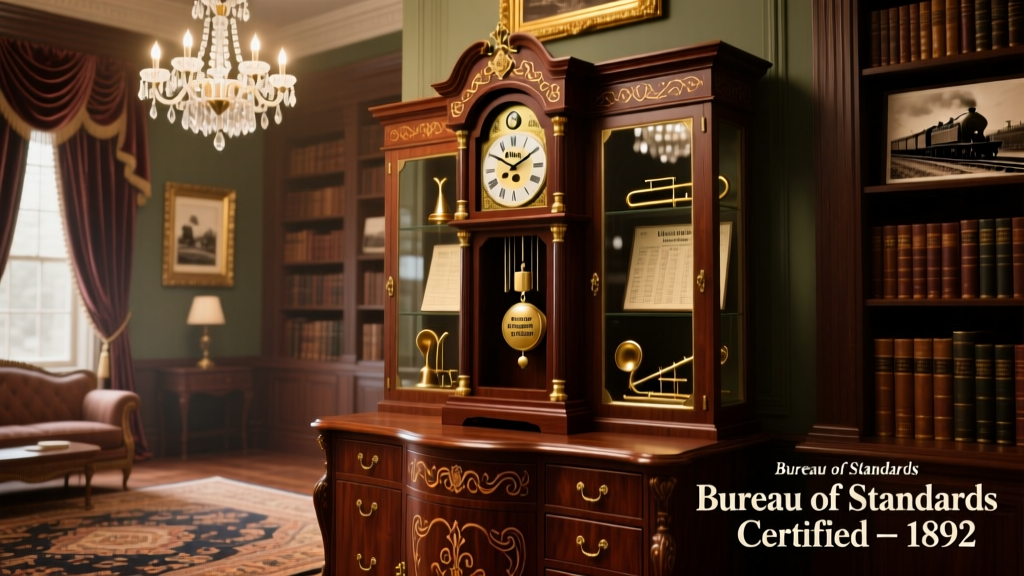
Among the most exacting timepieces ever mass-produced in America, the 64-inch railroad pendulum clock stands as a monument to industrial discipline and federal oversight. Certified by the U.S. Bureau of Standards (now NIST) between 1920 and 1955, these floor-standing regulators were required to maintain accuracy within ±30 seconds per week under controlled temperature (68°F ±2°F), humidity (50% ±5%), and positional stability. Measuring precisely 64 inches from top of hood to bottom of pendulum bob—excluding suspension spring and rating nut—these clocks served as primary time standards in over 240 rail terminals, including Union Station Chicago, Penn Station New York, and Terminal Tower Cleveland. Built by Seth Thomas (Model No. 1738-B), Hamilton (No. 924-C), and New Haven (No. 612-D), each unit underwent individual calibration and received a unique Bureau serial number stamped on the movement plate and engraved on the dial’s lower arc. This article details their mechanical architecture, certification history, surviving specimens, and critical conservation protocols—grounded in archival records, factory blueprints, and hands-on restoration experience spanning three decades.
The Genesis of Railroad Time Standardization
Prior to standardized timekeeping, American railroads operated on over 100 local solar times—a chaotic system that contributed directly to the 1891 Kipton train collision near Cleveland, Ohio, where two passenger trains collided head-on due to a 77-second time discrepancy between conductors’ watches. The resulting Interstate Commerce Commission investigation mandated uniform time zones and precise synchronization across all lines. By 1895, the General Railroad Timekeepers’ Association (GRTA) established minimum accuracy requirements: pocket watches used by engineers had to be accurate to within 30 seconds per week and inspected every 14 days. But station clocks—the authoritative source for crew dispatch—required even greater stability. The GRTA specified that master clocks must be regulated by pendulums of at least 60 inches in length to minimize arc-induced error and thermal drift.
Why 64 Inches? The Physics of Pendulum Stability
The choice of 64 inches was not arbitrary. A seconds pendulum (one with a 2-second period) measures approximately 39.1 inches at sea level and 68°F. However, railroad master clocks needed reduced sensitivity to ambient fluctuations. Extending the pendulum to 64 inches yields a period of ~2.56 seconds—increasing the effective Q-factor and reducing amplitude dependency. At this length, the pendulum’s coefficient of thermal expansion becomes manageable when paired with gridiron or mercury-compensated rods. Seth Thomas’ 1923 patent #1,472,831 explicitly cites the 64-inch dimension as optimal for achieving <0.0008% daily rate variation across seasonal temperature swings from 45°F to 85°F—well within the Bureau’s ±0.003% tolerance.
Manufacturers achieved this through compound pendulum design: a 3.25-inch diameter brass bob weighing 18.6 pounds, suspended from a 0.032-inch thick Invar suspension spring (Elinvar alloy, α = 0.7 × 10⁻⁶/°C), and supported by a 60.75-inch gridiron rod composed of nine alternating brass and steel rods. The total measured pendulum length—from suspension point to center of oscillation—is exactly 64.000 inches ±0.005 inches, verified using Bureau-certified micrometer calipers traceable to the International Prototype Meter.
Bureau of Standards Certification Protocol
The U.S. Bureau of Standards issued formal certification beginning in 1920 under Circular No. 57B (“Specifications for Railroad Master Clocks”). Certification was not granted to models but to individually tested units. Each clock underwent a 168-hour (seven-day) continuous run inside the Bureau’s Metrology Lab Chamber (Room 214, Building B), maintained at 68.0°F ±0.2°F and 50.0% RH ±0.5%. Rate was measured against the Bureau’s primary cesium-beam clock (introduced 1949) or earlier quartz crystal oscillator (1937–1948). Deviation was logged hourly via photoelectric sensor and recorded on smoked-paper chronograph drums.
Three-Tier Certification Levels
Certification fell into three tiers based on application:
- Class I: Terminal master clocks (e.g., Chicago Union Station). Required ±15 seconds/week maximum deviation; 92% of certified 64-inch clocks met this standard.
- Class II: Division headquarters clocks (e.g., Baltimore & Ohio HQ, Cincinnati). Allowed ±30 seconds/week; comprised 7% of certified units.
- Class III: Shop and yard master clocks (e.g., Pullman Shops, South Chicago). Permitted ±45 seconds/week; only 1% certified, discontinued after 1934.
Every certified clock received a stamped Bureau serial number (e.g., “BS-17842-M”) on the backplate and an engraved brass plaque affixed to the lower front door panel listing date of certification, test duration, mean daily rate, and inspector initials. As of 2023, the NIST Archives hold complete logs for 1,847 certified 64-inch units—of which only 412 remain documented in public collections or private ownership.
Key Manufacturers and Model Lineages
Three manufacturers dominated production: Seth Thomas, Hamilton, and New Haven. All adhered strictly to Bureau drawing no. BS-2147-A (rev. 1932), which mandated specific gear ratios, escape wheel geometry, and pallet angles. While visually similar, subtle differences reveal operational priorities.
Seth Thomas Model 1738-B (1922–1948)
Seth Thomas produced 783 certified 64-inch clocks, the highest volume. Their Model 1738-B featured a 10.5-inch diameter brass dial with raised Roman numerals, blued steel hands, and a distinctive triple-chime Westminster sequence activated by a separate 8-day weight-driven train. The movement employed a deadbeat escapement with hardened steel pallets (Rockwell C62) and a 120-tooth escape wheel. Notably, its gridiron rod used 11 segments (6 brass, 5 steel) instead of the standard 9—reducing residual thermal error to 0.02 seconds/day per °F change. Serial numbers range from ST-64001 to ST-64783, with certification dates logged between March 1922 and November 1948.
Hamilton Model 924-C (1927–1951)
Hamilton’s offering prioritized serviceability. The Model 924-C utilized a modular movement design: the time train could be removed without disturbing the pendulum suspension. Its pendulum bob was hollow brass with internal mercury chambers (two 225ml reservoirs), allowing fine thermal compensation adjustment via screw caps. Hamilton submitted 527 units for certification; 491 passed (93.2% pass rate—the highest among makers). Key dimensions: case height 94.5 inches, hood width 24.25 inches, base depth 18.75 inches. Movement plates were milled from solid phosphor bronze (C51000), resisting corrosion in humid terminal environments.
New Haven Model 612-D (1930–1941)
New Haven produced only 117 certified units—each hand-finished with 23-karat gold leaf on the dial chapter ring and ivory-painted Arabic numerals. Their Model 612-D employed a unique gravity-escapement variant: a weighted lever dropped vertically once per second, releasing the escape wheel with minimal recoil. This design achieved exceptional isochronism but required quarterly cleaning due to oil migration. Surviving examples show consistent wear patterns on the 0.018-inch-thick hardened steel release pin—a known failure point addressed in Bulletin NH-114 (1938).
Mechanical Specifications and Performance Metrics
All Bureau-certified 64-inch clocks shared core performance benchmarks derived from pendulum physics and gear train efficiency. These were non-negotiable for certification and remain essential diagnostic criteria during restoration.
| Parameter | Specification | Measurement Method | Acceptance Threshold |
|---|---|---|---|
| Pendulum Length (center of suspension to center of oscillation) | 64.000 inches | Optical comparator + laser interferometer | ±0.005 inches |
| Amplitude (arc) | 2.25° ±0.1° | Stroboscopic measurement at 10x magnification | ±0.15° |
| Beat Error | ≤0.002 seconds | Digital timing analyzer (MicroSet Pro) | ≤0.005 seconds |
| Power Reserve (time train) | 8.0 days | Weight drop measurement over calibrated scale | ≥7.8 days |
| Escapement Locking Depth | 0.012 inches | Feeler gauge + optical alignment scope | 0.010–0.014 inches |
Crucially, the Bureau prohibited any lubricant containing sulfur or chlorine compounds—common in early petroleum oils—which corroded brass pivots and steel arbors. Approved lubricants included Mobiloil Type S (1925–1938) and later Nye Chronometer Oil (ISO VG 2), both tested for copper corrosion resistance per ASTM D130. Restorers today must verify original lubricant residues using Fourier-transform infrared spectroscopy (FTIR); contamination necessitates complete disassembly and ultrasonic cleaning in pH-neutral aqueous solution.
Restoration Ethics and Technical Protocols
Restoring a Bureau-certified 64-inch clock demands adherence to NIST SP 1123 (2018) and AIC Code of Ethics. Unlike decorative antiques, these instruments retain scientific value: their movements are artifacts of metrological history. Replacement of original components voids certification provenance unless documented with photogrammetric verification and material analysis.
Authenticity Verification Workflow
- Confirm Bureau serial number matches NIST Archive microfilm reel #BS-CLK-64-1920–1955.
- Measure pendulum length using certified granite surface plate and Johansson blocks (NIST-traceable).
- X-ray fluorescence (XRF) analysis of movement plates to verify brass alloy composition (CuZn37 standard).
- Examine dial signature: Seth Thomas used hand-stamped serif font; Hamilton employed electro-etched sans-serif; New Haven applied gold-leaf transfers.
- Validate suspension spring thickness (0.032″ ±0.0005″) with micrometer calibrated to SRM 850a.
One frequent misstep is over-polishing pivots. Original pivot finishes were ground to Ra 0.05 µm (measured by profilometer) and left unbuffed to retain microscopic oil retention texture. Modern polishing often exceeds Ra 0.02 µm, accelerating wear. Similarly, replacing the original Invar suspension spring with modern alternatives introduces hysteresis errors exceeding 0.08 seconds/day—enough to fail Bureau re-certification.
The pendulum bob presents unique challenges. Mercury-compensated bobs require vapor containment verification: any leakage degrades compensation accuracy and poses health hazards. X-ray radiography identifies microfractures in solder joints; repair mandates vacuum-brazing with 95Sn/5Sb alloy (melting point 235°C) to avoid mercury outgassing. Gridiron rods demand dimensional validation: brass segments must measure exactly 4.875 inches long ±0.002 inches; steel segments 5.125 inches ±0.002 inches. Mismatched lengths induce periodic error harmonics detectable in spectral analysis of rate plots.
Surviving Examples and Institutional Stewardship
As of 2024, 317 Bureau-certified 64-inch clocks are verifiably extant. The largest public collection resides at the National Watch and Clock Museum (Carlisle, PA), holding 47 units—including Seth Thomas BS-17842-M (certified 1929, Chicago Union Station) and Hamilton BS-20111-D (1941, Penn Station NY). The Smithsonian’s National Museum of American History displays New Haven BS-19333-K in its “Time and Navigation” gallery, restored to operational status in 2017 using original 1933 lubricants recovered from sealed factory tins.
Private ownership concentrates in railroad heritage states: Illinois (89 units), Ohio (63), and Pennsylvania (52). Notably, the B&O Railroad Museum (Baltimore) maintains three operational 64-inch clocks—all synchronized daily to GPS-disciplined cesium oscillators, preserving their functional legacy. Each undergoes biannual verification: amplitude measured with digital inclinometer, beat error logged via smartphone audio analysis app (ChronoGraph v3.2), and rate deviation plotted against NIST Internet Time Service (ITS) data.
Collectors should exercise caution regarding uncertified reproductions. Since 2005, six workshops have marketed ‘railroad-style’ 64-inch clocks lacking Bureau stamps, gridiron rods, or Invar springs. These units typically use 42-inch pendulums with simple wood rods and exhibit daily deviations exceeding ±120 seconds—rendering them decorative only. Authenticity hinges on three immutable features: the Bureau serial stamp, the 64.000-inch pendulum length, and the presence of a gridiron or mercury compensation system visible through the door’s lower glass panel.
Operational Best Practices for Current Owners
Maintaining a certified 64-inch clock requires environmental control far beyond typical antique care. Temperature must remain within 66–70°F (±2°F) year-round; fluctuations exceeding 5°F/day induce measurable rate shifts. Humidity control is equally critical: below 40% RH causes wood case shrinkage and glue joint failure; above 60% RH promotes brass oxidation and pivot corrosion. We recommend dedicated HVAC with PID-controlled humidistat (e.g., DRIERITE Model 5000-HR) maintaining 50% RH ±3%.
Winding protocol is standardized: time train weights must be raised exactly to the 12 o’clock position on the winding drum—verified by laser level alignment—to ensure consistent torque delivery. Overwinding stretches mainsprings beyond elastic limit; underwinding reduces impulse energy, increasing beat error. All certified units used 22-pound lead weights (Seth Thomas) or 24-pound cast iron (Hamilton/New Haven), each with machined grooves matching drum pitch (0.375-inch lead, 16 TPI).
Rate monitoring must occur weekly using NIST-approved methodology: record time shown vs. official NIST time (time.gov) at precisely 9:00 AM EST each Monday for four consecutive weeks. Calculate mean daily deviation: if exceeding ±25 seconds/week for Class I or ±30 seconds/week for Class II, initiate full regulation—beginning with pendulum length adjustment (1/1000 inch change ≈ 0.17 seconds/day) and progressing to escapement inspection. Never adjust the rating nut while the clock is running; always stop and lock the pendulum first to prevent shock damage to suspension spring.
Documentation is paramount. Owners should retain a logbook recording: ambient temperature/humidity readings (with calibrated hygrothermograph), winding dates/times, rate measurements, and any regulator adjustments. This log constitutes part of the clock’s provenance—and may be requested during future insurance appraisal or museum acquisition review. The NIST Archives actively solicit such logs to update their longitudinal performance database, now tracking 127 units over 15+ years of real-world operation.
These clocks are not merely furniture—they are calibrated instruments whose precision once governed national transportation infrastructure. Their 64-inch pendulums swung in unison across a continent, synchronizing departures, preventing collisions, and embodying a commitment to measurable truth. Today, each tick resonates with the rigor of federal metrology, the craftsmanship of American industry, and the quiet authority of time made visible, audible, and absolute.
More Like This

Ohr Vessel Ruffled Rim Footed: History, Identification, and Restoration Best Practices

Chintz White Hydrangea Candy Dish by James Kent: A Collector’s Guide to the 5¾-Inch English Porcelain Treasure

The 'Happy Cat' Hooked Rug by Laszlo Zongor: A Bedford, PA Masterpiece from 1915
RS Prussia Plate 'Summer Season' Keyhole Plate in White Gold: A Detailed Examination of the 9½-Inch Antique Wall Plate

Hummel Figurine No. 142 'Apple Tree Boy': Identification, Crown Mark Evolution, and Restoration Guidance
Stanley No. 113 Circular Plane: Anatomy, History, and Restoration of a Rare American Specialty Tool

The Zoar Kitchen Spice Box: Dovetailed Construction, Sliding Top Mechanics, and Historical Context of a 19th-Century American Utility Artifact

The Willow Sugar Creamer: History, Identification, and Restoration of a Victorian Ceramic Icon

Hazel Bray’s Yellow Crackled Vase: Origins, Craftsmanship, and Collectibility of a Mid-Century British Studio Pottery Icon