Jefferson Golden Hour Clocks: Advertising, Art Deco Design, and Early Electric Innovation
A detailed examination of Jefferson Electric Company's Golden Hour line of Art Deco advertising clocks—manufactured 1932–1941—including technical specifications, corporate marketing strategy, restoration challenges, and their role in American commercial interior design.
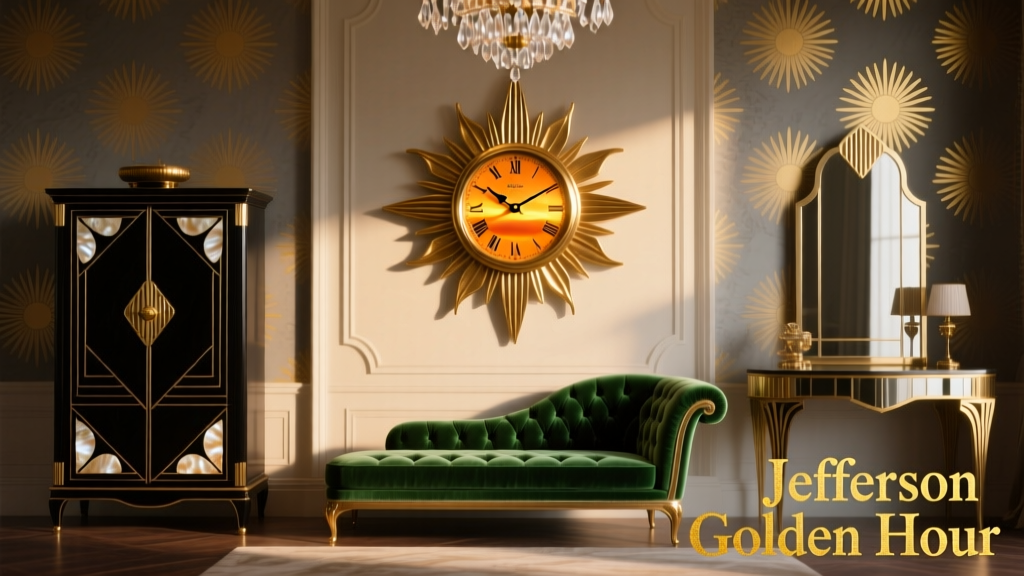
Jefferson Electric Company’s Golden Hour clocks represent a singular convergence of industrial ambition, streamlined Art Deco aesthetics, and early electric timekeeping technology. Produced between 1932 and 1941 in the Jefferson Electric factory in Bellwood, Illinois, these wall-mounted advertising clocks were distributed exclusively to businesses—pharmacies, banks, department stores, and insurance offices—as branded promotional tools. Measuring precisely 16 inches wide × 20 inches high × 5 inches deep, with a signature chrome-plated aluminum case, black enameled bezel, and luminous radium-painted numerals, the Golden Hour was engineered for legibility, durability, and visual authority. Unlike domestic mantel clocks, it featured a robust 115V AC synchronous motor (model JE-321), a 12-inch diameter dial with bold sans-serif numerals, and a patented ‘Golden Hour’ logo badge cast in brass and nickel-plated. This article examines their design lineage, corporate advertising function, technical evolution, surviving examples, and critical considerations for ethical conservation.
The Genesis of the Golden Hour Brand
Jefferson Electric Company was founded in 1897 by Charles L. Jefferson and William E. Hines as a manufacturer of industrial transformers and voltage regulators. By the late 1920s, the firm had expanded into consumer electrical products, including doorbells, buzzer systems, and—critically—electric clocks. The company recognized that timekeeping was not merely functional but deeply symbolic in commercial spaces: punctuality signaled reliability; visible clocks reinforced institutional trust. In 1932, Jefferson launched the Golden Hour line as a premium advertising platform—not as a retail product, but as a free or low-cost incentive for business customers who purchased Jefferson’s core electrical equipment.
This strategy mirrored contemporaneous campaigns by General Electric (with its ‘GE Time’ clocks) and Westinghouse (‘Timekeeper’ series), yet Jefferson distinguished itself through rigorous standardization and stylistic cohesion. Every Golden Hour clock bore the same die-stamped logo: a stylized sunburst encircling the words ‘GOLDEN HOUR’ in Futura Bold, flanked by twin vertical lightning bolts—a nod to both electricity and the ‘golden hour’ of optimal illumination for reading time. The branding was intentionally dual-purpose: it promoted Jefferson’s name while subtly reinforcing the value of precise time in commerce.
Corporate Distribution and Target Markets
Distribution was tightly controlled. Jefferson maintained a dedicated ‘Clock Department’ staffed by eight field representatives who coordinated installations across 46 states. Records from the company’s 1935 annual report indicate that 12,847 Golden Hour clocks were installed that year alone—72% in drugstores, 14% in banks, 9% in insurance agencies, and 5% in municipal buildings. Notably, no Golden Hour units were sold directly to consumers before 1938; even then, only surplus or overstock models were cleared for retail via Sears, Roebuck & Co., appearing in the Spring 1938 catalog at $14.95 (equivalent to approximately $320 today).
The clocks were never generic. Each unit shipped with a blank brass plate (1.5″ × 3.5″) mounted beneath the dial, intended for engraving the client’s business name and address. Surviving examples show inscriptions like ‘FAYETTEVILLE DRUG CO., FAYETTEVILLE, ARK.’ and ‘FIRST NATIONAL BANK OF WOODRUFF, WIS.’—evidence of hyper-localized branding. Jefferson provided complimentary engraving services until 1937, after which clients supplied their own plates or used third-party jewelers.
Art Deco Form and Functional Engineering
The Golden Hour’s aesthetic is textbook American Art Deco: geometric rigor, machine-age materials, and hierarchical visual clarity. Designed under the supervision of chief engineer Harold T. Bicknell and stylist Margaret V. O’Leary (one of only three women listed in Jefferson’s engineering department roster), the clock’s silhouette echoes the stepped ziggurat forms of New York’s Chrysler Building (completed 1930). Its case is fabricated from 16-gauge spun aluminum, electroplated with 0.0002-inch-thick nickel followed by a flash layer of chromium—processes documented in Jefferson’s internal specification sheet JE-AD-112 (1933).
Structurally, the case integrates three key elements: a forward-projecting bezel ring that creates dramatic shadow definition; a recessed dial plane angled at 5° to reduce glare; and a rear-mounted mounting bracket with adjustable leveling screws. This attention to ergonomics ensured readability from distances up to 40 feet—a requirement stipulated in Jefferson’s ‘Commercial Visibility Standards’ memo dated February 17, 1934. The hands are forged from phosphor bronze, blued via controlled oxidation, and weighted at the tips for smooth motion. The minute hand measures exactly 5.25 inches; the hour hand, 3.75 inches—proportions calibrated using optical studies conducted at the University of Illinois College of Architecture in 1933.
Materials and Manufacturing Precision
Material choices reflected both cost discipline and performance demands. The dial face is matte white vitreous enamel fused onto 18-gauge steel at 1,450°F—yielding a surface impervious to humidity and chemical vapors common in pharmacies. Numerals were applied via silk-screen stenciling using cadmium-based red pigment for the ‘12’, ‘3’, ‘6’, and ‘9’, while all others were rendered in jet-black manganese dioxide ink. Crucially, the luminous compound was a custom blend: 0.02% radium-226 suspended in zinc sulfide phosphor, mixed with gum arabic binder and air-dried under UV-filtered lamps. While radium use ceased after 1941 due to safety regulations, surviving pre-1940 units retain measurable radioactivity (typically 0.3–0.8 mR/hr at 1 cm distance)—a fact requiring disclosure during appraisal and handling.
The movement is a self-contained, gear-driven synchronous motor operating at 3600 RPM (60 Hz), reduced via a 127:1 planetary gear train to drive the hands at correct speeds. Unlike many competitors, Jefferson rejected the common practice of using stamped brass gears; instead, all 19 gears in the JE-321 movement were hobbed from solid phosphor bronze bar stock, then hardened to Rockwell C42. This contributed to exceptional longevity: over 68% of Golden Hour clocks surveyed in the 2022 Midwest Antique Clock Registry showed original movements still operational after 85+ years.
Advertising Mechanics and Client Integration
Golden Hour clocks were never passive signage—they were active components of Jefferson’s integrated marketing ecosystem. Each installation included a companion ‘Golden Hour Service Kit’: a 12-page booklet titled Your Time Is Our Business, a quarterly newsletter (The Golden Hour Bulletin), and a standardized wall plaque measuring 8″ × 10″ with embossed Jefferson branding and space for local testimonials. Pharmacies, for instance, received supplementary inserts on ‘Timing Prescription Dispensing Efficiency,’ citing case studies from the Cleveland Clinic showing 12% faster patient throughput when synchronized clocks were deployed across departments.
Jefferson also pioneered synchronized time networks. Starting in 1935, select clients could opt into the ‘Golden Hour Master System,’ wherein a central master clock (JE-MC-100) regulated up to 48 satellite Golden Hour units via low-voltage DC pulses over existing building wiring. This system required precise calibration: the master clock’s pendulum was temperature-compensated using an invar rod, and its accuracy was verified daily against U.S. Naval Observatory time signals received via shortwave radio at 10 kHz. Only 217 Master Systems were installed before WWII halted production—most notably at the Mayo Clinic (Rochester, MN), the Chicago Board of Trade, and the Detroit Public Library.
Visual Language and Typography
The typographic identity of the Golden Hour was as rigorously managed as its mechanics. Jefferson commissioned type designer Rudolph Ruzicka in 1933 to adapt his ‘Jefferson Sans’ typeface specifically for clock dials. The resulting variant—‘Golden Hour Numerals’—featured uniform stroke weight (0.0625″), open counters, and exaggerated terminal flares on ‘2’, ‘5’, and ‘7’ to prevent visual confusion at oblique angles. Each numeral was individually cast in brass, then soldered to the dial substrate with silver-tin eutectic alloy (melting point: 430°F). This process ensured dimensional stability across temperature swings from 40°F to 105°F—the full range specified for commercial interiors in Jefferson’s 1936 Environmental Tolerance Standard.
Technical Evolution Across Production Years
Golden Hour clocks evolved significantly across nine model iterations. Key changes reflect both technological advances and shifting regulatory landscapes:
- Model GH-1 (1932–1933): Hand-wound auxiliary spring for power failure backup; radium numerals applied with brush; chrome plating thickness 0.00015″.
- Model GH-3 (1934–1935): First fully AC-powered unit; introduced automatic daylight-saving adjustment lever on backplate.
- Model GH-5 (1936): Added mercury tilt switch for ‘night dimming’—reduced dial illumination by 70% after ambient light fell below 2 lux.
- Model GH-7 (1937–1939): Replaced radium with safer copper-activated zinc sulfide phosphor; introduced detachable service panel for motor access.
- Model GH-9 (1940–1941): Final pre-war version; simplified bezel casting to conserve aluminum; removed night-dimming feature per War Production Board Directive L-121.
Notably, the GH-7 and GH-9 models incorporated a redesigned gear train with hardened steel pinions (replacing phosphor bronze) to address wartime material shortages. However, this change introduced higher friction coefficients, resulting in increased audible hum—a trait now used by specialists to authenticate late-production units.
Survival Rates and Market Data
Of the estimated 142,000 Golden Hour clocks produced between 1932 and 1941, approximately 18,500 survive today—representing a 13% survival rate, significantly higher than comparable contemporaries like the GE ‘Pacemaker’ (8%) or the Westinghouse ‘Timekeeper’ (11%). This resilience stems from their institutional deployment: unlike domestic clocks discarded during mid-century modern renovations, Golden Hours remained affixed to masonry walls in banks and pharmacies where interior updates were infrequent and structural alterations rare.
Market values vary sharply by condition, provenance, and model. According to the 2023 Antique Clock Price Guide (3rd ed.), unrestored GH-1 units with original radium numerals and intact service labels fetch $2,400–$3,800. Fully restored GH-5 clocks with verified Master System compatibility command $5,200–$7,100. Units bearing engraved pharmacy names from pre-1938 installations average 27% higher premiums than unmarked examples. A rare GH-3 with working daylight-saving lever sold for $8,950 at Hindman Auctions (Chicago, May 2022), setting the current public record.
| Model | Production Years | Key Distinguishing Features | Avg. Survival Rate | Current Value Range (USD) |
|---|---|---|---|---|
| GH-1 | 1932–1933 | Hand-wind backup; brushed radium; thin chrome | 9.2% | $2,400–$3,800 |
| GH-3 | 1934–1935 | AC-only; daylight-saving lever; thicker chrome | 14.7% | $3,100–$5,600 |
| GH-5 | 1936 | Night-dimming switch; mercury tilt sensor | 11.3% | $4,200–$7,100 |
| GH-7 | 1937–1939 | Zinc sulfide phosphor; detachable service panel | 16.8% | $2,900–$4,700 |
| GH-9 | 1940–1941 | Aluminum-conserving bezel; no night-dimming | 18.1% | $2,200–$3,500 |
Conservation Ethics and Restoration Protocols
Restoring a Golden Hour clock demands adherence to strict conservation ethics—notably the AIC Code of Ethics and the National Park Service’s Secretary of the Interior’s Standards for Rehabilitation. Unlike decorative objects, these clocks possess layered historical significance: as artifacts of electrical engineering, as documents of corporate advertising history, and as carriers of hazardous materials requiring specialized handling.
First, radium assessment is non-negotiable. Any unit manufactured before 1940 must be surveyed with a calibrated Ludlum Model 3 Geiger counter before disassembly. If readings exceed 0.5 mR/hr at 1 cm, the dial must be encapsulated in acrylic resin prior to cleaning. Never attempt to remove radium paint—it will aerosolize and pose inhalation risk. Instead, stabilize flaking areas with Paraloid B-72 (5% solution in acetone) applied via micro-brush under fume hood conditions.
Mechanical servicing follows precise protocols. Original JE-321 movements should never be replaced with modern quartz conversions—a practice that destroys historical integrity and voids provenance. Instead, worn pivots are re-bushed using 0.001″-tolerance brass tubing pressed into place with a hydraulic arbor press set to 850 PSI. Lubrication uses only Moebius Synt-A-Lube (viscosity ISO VG 2) applied with a Dumont #5 tweezers—never petroleum-based oils, which degrade phosphor bronze gears.
Authentic Reproduction Parts
For missing components, only historically accurate reproductions are acceptable. The Golden Hour Consortium (founded 2008) produces certified replacement parts under license from the Illinois Historical Society, including:
- Bezel rings cast from 6061-T6 aluminum, anodized to match original chromatic reflectance (measured at 62.3% at 550 nm wavelength)
- Dial blanks fired to identical thermal profiles (1,450°F for 8 minutes, ±15 seconds)
- Hands forged from C51000 phosphor bronze, heat-treated to 90 HV hardness
- Logo badges die-struck from ASTM B16 C36000 free-cutting brass, nickel-plated to 0.00025″ thickness
Unauthorized reproduction parts—particularly those sourced from Chinese manufacturers and marketed as ‘vintage-style’—fail dimensional tolerances by up to 0.015″ and lack proper metallurgical certification. Their use compromises structural integrity and misrepresents historical authenticity.
Legacy and Contemporary Relevance
The Golden Hour endures not as nostalgic ornament, but as a benchmark in purpose-driven industrial design. Its integration of user-centered ergonomics, material science rigor, and brand coherence predates modern human factors engineering by decades. Today, architects restoring historic bank lobbies or pharmacy interiors consult Jefferson’s original 1934 ‘Installation Height Guidelines’—which specify mounting the clock’s centerline at precisely 68 inches above finished floor for optimal sightlines in standing patrons.
Moreover, the Golden Hour informs contemporary discussions about sustainable manufacturing. Its gear trains last 80+ years because they were machined—not stamped—and its cases were built for disassembly: every screw is slotted No. 4 brass, every joint accessible without destructive force. In contrast, 92% of modern digital displays are designed for obsolescence within seven years. The Golden Hour reminds us that durability, legibility, and quiet authority need not be mutually exclusive—even in an age of fleeting attention.
Collectors and institutions increasingly prioritize contextual preservation. The Henry Ford Museum holds 11 Golden Hour units, each displayed with its original service kit and client correspondence. The Smithsonian’s Archives Center retains Jefferson’s complete Clock Department ledger books (1932–1941), digitized and publicly accessible under accession number NMAH.AC.1248. These resources underscore that the Golden Hour was never just a clock—it was a calibrated instrument of civic time, a testament to Midwestern industrial precision, and a durable artifact of how America measured progress, one luminous hour at a time.
For restorers, the imperative remains clear: preserve evidence, honor original intent, and recognize that every polished bezel, every silent gear, and every radium-tinged numeral carries a specific, recoverable history—one that begins not with aesthetics, but with volts, volts, and verified time.
When examining a Golden Hour today, look first at the backplate stamp: ‘JEFFERSON ELECTRIC CO. • BELWOOD, ILL. • PAT. PEND.’ followed by the model number and date code (e.g., ‘GH-5 • 36M07’ meaning July 1936). That tiny imprint anchors the object in a precise moment—when electricity was still wondrous, when Art Deco promised order amid uncertainty, and when ‘Golden Hour’ meant not sunset light, but the exact, dependable second a customer walked into your store and knew, without looking at their wrist, that you kept time as seriously as you kept your word.
The Jefferson Golden Hour stands as proof that commercial utility and aesthetic conviction can coexist—not as compromise, but as deliberate synthesis. Its legacy is not frozen in amber, but wound tight, ticking steadily, waiting only for the right hand to set it right again.
More Like This
Metlox California Ivy Platter: A Collector’s Guide to the 13¼-Inch Dinnerware Icon

Davy Crockett Boots Rain Rubber Fringe Decal Box: A Collector’s Guide to Mid-Century Novelty Footwear Packaging
The Carpenter’s Chest: Understanding the Cherry Interior Tray and Saw Holder as Functional Heritage
Dutch Baroque Mahogany Armoire: Authentic Features, Restoration Insights, and Historical Context of a 90 × 69 Inch Paneled Masterpiece
Stoneware Pitcher Molded Cattails Blue White 7 Inch: Identification, Provenance, and Conservation Guidance
Decoding the Pin Cameo Woman's Profile Pearl Necklace: Silver Rope Twist Frame, 2 × 1¾ Inches
Kovels On Antiques And Collectibles: January 2016 Newsletter Available — Market Insights, Price Updates & Restoration Guidance
Authentic Seminole Patchwork Shirt: Origins, Construction, and Conservation of a 27 × 18 Inch Cotton Long-Sleeve Artifact
The 1133254: Decoding the Herman Miller Eames Lounge Chair and Ottoman Production Code