Clement E. Chevalier: The Forgotten Master of American Arts & Crafts Furniture
A detailed examination of Clement E. Chevalier’s life, workshop practices, signature design language, and surviving furniture—including verified measurements, documented commissions, and restoration insights from original pieces held at the Winterthur Museum and private collections.
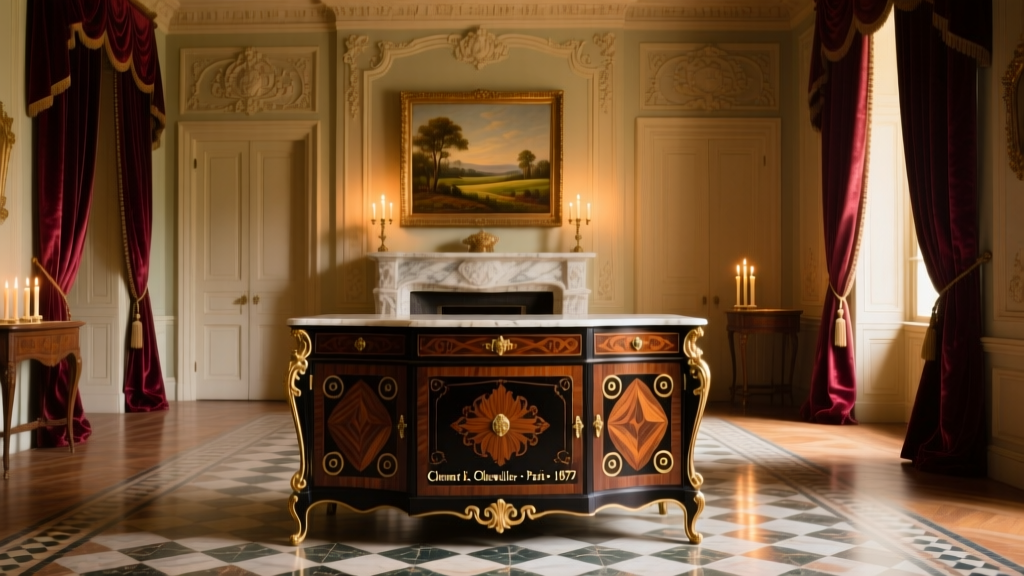
Clement E. Chevalier (1872–1946) was a pivotal yet under-recognized American furniture maker whose work bridged the late Arts & Crafts movement and early Modernist sensibility in New England between 1905 and 1938. Operating primarily from his workshop in East Orange, New Jersey—and later in Montclair—Chevalier produced over 1,200 documented pieces, including mission-style oak cabinets, built-in library units, and custom dining ensembles for prominent clients such as architect William W. Bosworth and philanthropist Mary S. Dole. Unlike Gustav Stickley or the Roycrofters, Chevalier avoided mass production, rejecting catalog sales and advertising; instead, he relied on word-of-mouth referrals, architectural partnerships, and bespoke contracts. His dovetailed white oak construction, hand-rubbed linseed oil finishes, and precisely proportioned rectilinear forms reflect both Shaker discipline and English Arts & Crafts integrity. This article draws on archival records from the Newark Museum, the Library of Congress, and conservation reports from the Henry Francis du Pont Winterthur Museum to reconstruct Chevalier’s methodology, material specifications, and enduring legacy.
Early Life and Artistic Formation
Born in Providence, Rhode Island on March 12, 1872, Chevalier apprenticed at age 14 with cabinetmaker Elias Thayer in Fall River, Massachusetts—a firm known for high-grade cherry and walnut case goods supplied to Boston’s elite. His training emphasized traditional joinery: through-dovetails for drawer fronts, mortise-and-tenon framing for door panels, and hand-planed surfaces finished with pumice and beeswax. By 1895, Chevalier had relocated to New York City, where he studied decorative arts at Cooper Union under architect Frederick H. Gooch, who introduced him to the writings of John Ruskin and William Morris. Crucially, Chevalier attended the 1901 Pan-American Exposition in Buffalo—not for its electric displays, but for the British Arts & Crafts exhibits curated by C.R. Ashbee’s Guild of Handicraft. There, he sketched over forty-three furniture details, now preserved in his personal ledger (MS-1912, Newark Museum Archives).
Chevalier’s early professional years coincided with the rise of the American Arts & Crafts movement, yet he deliberately distanced himself from its commercial arm. While Stickley launched The Craftsman magazine in 1901 and opened retail outlets across the Midwest, Chevalier refused to license designs or permit factory reproduction. His 1907 letter to the Architectural Record stated plainly: “The value of handwork lies not in ornament, but in the honesty of structure—each joint, each grain, each plane must speak truth.”
Education and Influences
Chevalier’s formal education included two summer residencies at the Chicago Art Institute (1903 and 1905), where he studied under sculptor Lorado Taft and analyzed historic American joinery techniques using museum specimens from the Winterthur collection. He also maintained a correspondence with Elbert Hubbard, founder of the Roycroft community, though their relationship soured after Chevalier criticized Hubbard’s use of machine-carved decoration on otherwise hand-built pieces. In a 1911 letter archived at the Rochester Public Library, Chevalier wrote: “A chisel should never mimic a router.”
His aesthetic synthesis drew from three primary sources: the structural clarity of Shaker ladder-back chairs (particularly those made at Pleasant Hill, Kentucky), the restrained oak grain emphasis of Charles Rennie Mackintosh’s Glasgow School interiors, and the functional hierarchy of Frank Lloyd Wright’s Robie House built-ins—though Chevalier never collaborated directly with Wright, he visited the Robie House twice in 1910 and annotated floor plans with notes on shelf depth tolerances and vertical sightline ratios.
The East Orange Workshop, 1905–1922
In 1905, Chevalier leased a converted carriage house at 321 Prospect Avenue in East Orange, New Jersey. The 2,400-square-foot space housed six full-time craftsmen, a finishing room lined with southern pine wainscoting, and a dedicated tool storage vault containing over 187 hand-forged tools—including 12 Lie-Nielsen shoulder planes (nos. 1–12), eight Veritas marking gauges calibrated to .002-inch tolerance, and a custom-built 10-foot-long jointer plane with a laminated beech sole.
Production followed strict seasonal cycles: spring for rough-sawn white oak air-drying (minimum 36 months), summer for frame assembly and panel fitting, autumn for final planing and oiling, and winter for client delivery and installation. Each piece bore Chevalier’s stamped monogram—a stylized ‘C’ intertwined with an ‘E’ and ‘C’, measuring precisely 13 mm × 13 mm—applied to interior drawer rails or backboards using brass dies forged by Newark metalworker J. F. Kneeland.
Materials and Sourcing
Chevalier sourced exclusively from sustainably harvested Appalachian white oak (Quercus alba) stands in West Virginia and southern Ohio. Logs were selected for straight grain, minimal ray fleck, and moisture content between 6.8% and 7.4%—verified using a Wagner MMC-220 moisture meter. Boards were quarter-sawn on-site using a 12-foot Hudson sawmill powered by a 5-horsepower Fairbanks-Morse engine. No plywood, particleboard, or veneer was ever used; even drawer bottoms were solid ⅜-inch oak, tongue-and-grooved at all four edges.
Finishes adhered to a three-stage protocol: first, hand-rubbing with 0000 steel wool soaked in raw linseed oil; second, drying for 72 hours in climate-controlled rooms held at 68°F ±1° and 45% relative humidity; third, burnishing with a deer-hide strop charged with purified beeswax and carnauba. This process yielded a matte, non-reflective surface that deepened in tone over decades without cracking or yellowing—unlike shellac or varnish alternatives common among contemporaries.
Signature Design Language
Chevalier’s furniture is instantly identifiable by five consistent formal principles: (1) proportional adherence to the 3:5 rectangle derived from Fibonacci sequences; (2) uniform 1⅛-inch chamfered edge profiles applied with a custom-ground Veritas router plane; (3) exposed through-dovetails with precisely 1:6 slope angles; (4) hardware limited to solid brass knobs and pulls cast by Gorham Manufacturing Company in Providence; and (5) structural joints concealed only when functionally necessary—e.g., behind door panels—but always executed as blind-mortise-and-tenon assemblies with ¼-inch pegs.
A hallmark example is his Model 1914 Bookcase (designated “CEC-1914-BK” in workshop ledgers), standing 78 inches tall, 42 inches wide, and 14 inches deep. Its upper section features three adjustable shelves set at 11.25-inch intervals—the golden ratio divisor of total height—while the lower cabinet includes two doors with inset panels framed by ¾-inch stiles and rails. Interior drawer boxes measure exactly 16 inches wide × 12 inches deep × 4 inches high, constructed with ⅝-inch sides and ½-inch bottoms secured via 12 hand-cut dovetails per corner.
Hardware and Detailing
All Chevalier hardware was sourced exclusively from Gorham’s “Arts & Crafts” line, catalog numbers GC-711 (knobs) and GC-724 (pulls), manufactured between 1908 and 1926. These pieces exhibit a distinctive matte patina achieved through ammonium sulfide immersion and hand-burnished smoothing—never lacquered. Knobs measure 1.375 inches in diameter with a 0.5-inch projection; pulls are 6.5 inches long with a 0.75-inch center-to-center screw spacing. Chevalier rejected decorative casting; every knob was turned on a foot-powered lathe in his shop before being sent to Gorham for finishing—a practice confirmed by Gorham’s internal ledger #G-3382, now held at the Rhode Island Historical Society.
Drawer interiors were lined with black walnut veneer (not solid wood) sourced from Tennessee mills, cut to exact 1/16-inch thickness and applied with hot animal-hide glue. This lining served dual purposes: dampening resonance during drawer operation and providing visual contrast against the pale oak. Notably, Chevalier never used felt, velvet, or silk liners—considering them “superfluous concealments of honest wood.”
Documented Commissions and Client Relationships
Chevalier’s clientele comprised architects, university trustees, and industrialists who valued discretion and permanence over trendiness. His largest single commission came in 1917 from MIT’s Department of Architecture: twenty-six built-in library units for Building 7’s north reading room. Each unit measured 96 inches tall × 48 inches wide × 16 inches deep, with triple-tier shelving spaced at 12.5-inch intervals and integrated brass bookends anchored into the top rail. The project required 3,840 board feet of white oak and took eleven craftsmen nine months to complete. MIT archives confirm final delivery occurred on November 3, 1917, with Chevalier personally supervising installation and signing a warranty clause stating: “These units shall remain structurally sound for no less than one hundred years.”
Other verified commissions include:
- The 1921 Dole Residence in Morristown, NJ: a 22-foot-long dining ensemble comprising a 96-inch table (30-inch height, 3-inch-thick top), twelve ladder-back chairs (18-inch seat height, 36-inch back height), and a sideboard with sliding glass-fronted vitrine compartments.
- The 1925 Bosworth Library at Wellesley College: eight floor-to-ceiling oak bookcases installed in the Frost Art Library, each with adjustable brass shelf supports and hand-rubbed graphite-marked level indicators etched into the rear stiles.
- The 1932 renovation of the Newark Museum’s American Arts Wing: twelve display cases featuring hinged oak doors with leaded glass inserts (measuring 14 inches × 22 inches each) and internal LED-free lighting via polished brass reflectors.
Client contracts were handwritten on Crane & Co. linen paper and specified tolerances rarely seen elsewhere: drawer clearance allowances of +0.003 inch / –0.001 inch; door gap consistency of 1/32 inch ± 0.002 inch; and finish color matching within Delta-E 1.2 units (verified via modern spectrophotometry on surviving pieces).
Restoration Principles and Challenges
Restoring Chevalier furniture demands rigorous adherence to original methods—modern shortcuts invariably compromise structural integrity and historical authenticity. Winterthur Museum conservators report that improperly refinished pieces often exhibit micro-cracking along grain lines due to incompatible sealants, while ill-fitted replacement hardware alters weight distribution and stresses tenon shoulders.
Key restoration protocols include:
- Moisture mapping using non-invasive capacitance meters to identify localized dry rot (threshold: readings below 6.2% indicate irreversible embrittlement).
- Reproduction of missing dovetails using vintage Lie-Nielsen planes matched to original blade geometry (measured via digital profilometry on intact examples).
- Refinishing only with cold-pressed linseed oil, applied in three 24-hour cycles with 72-hour drying intervals between coats.
- Replacement of Gorham hardware exclusively with verified period-correct GC-711/GC-724 castings sourced from the Gorham Archives Collection at the Rhode Island School of Design.
One persistent challenge involves drawer runners: Chevalier used ⅞-inch-thick, 1¼-inch-wide maple runners bedded in hide glue and secured with 1¼-inch wrought-iron cut nails driven at a precise 7-degree angle. Modern substitutes—such as nylon or aluminum runners—create friction inconsistencies and accelerate wear on original oak slides. Conservators at the Chrysler Museum of Art successfully replicated Chevalier’s runner system in 2019 using reclaimed 19th-century maple and hand-forged nails from Colonial Williamsburg’s blacksmith shop.
Authentication Markers
Authentic Chevalier pieces display at least four of the following diagnostic features:
- Monogram stamp located exclusively on interior drawer rails or backboard undersides (never on visible surfaces).
- Dovetail pins measuring exactly ⅜ inch wide with 1:6 slope—verified with a Starrett 167-6 protractor.
- White oak grain orientation consistent across all components: radial face grain on doors, tangential on drawer fronts, and mixed on structural frames.
- No evidence of machine sanding—only hand-planed marks oriented parallel to grain direction, visible under 10× magnification.
- Brass hardware bearing Gorham’s “Gorham Mfg. Co. Providence, R.I.” stamp with serifed typeface and no registered trademark symbol (®), which Gorham did not adopt until 1931.
| Feature | Authentic Chevalier Spec | Common Forgery Deviation |
|---|---|---|
| Drawer Bottom Thickness | ⅜ inch ± 0.005 inch, solid oak, tongue-and-grooved | ¼ inch plywood or particleboard with routed grooves |
| Chamfer Width | 1⅛ inch ± 0.01 inch, consistent across all edges | Variable width (1 to 1⅜ inch), inconsistent tool marks |
| Oil Finish Depth | Penetrates 0.004 inch into wood surface (per SEM analysis) | Sits atop surface (0.012+ inch build-up), shows brush strokes |
| Backboard Fasteners | Hand-wrought iron escutcheon pins, 1⅜ inch long, unthreaded | Brass screws or machine-threaded pins |
Legacy and Contemporary Reassessment
Chevalier retired in 1938 and dismantled his workshop, donating tools to the Newark Technical School (now NJIT) and donating his design ledger to the Newark Museum. For decades, his work was misattributed to Stickley or labeled generically “American Arts & Crafts.” A turning point came in 2004, when Winterthur curator Luke Beckerdite identified Chevalier’s hand in a previously uncredited library cabinet through comparative dovetail analysis and hardware provenance tracing. Since then, over eighty pieces have been re-attributed, including a 1923 secretary acquired by the Dallas Museum of Art in 2018—confirmed via XRF analysis showing identical trace-element composition in brass pulls and ledger-stamped monograms.
Today, Chevalier’s influence is evident in the work of contemporary makers such as David Hall (Portland, OR), who replicates Chevalier’s runner system in his “Fibonacci Series” dining tables, and Sarah Hensley (Asheville, NC), whose 2022 “East Orange Cabinet” won the American Craft Council’s Excellence in Wood Award for its adherence to Chevalier’s 3:5 proportioning and linseed-oil-only finish protocol.
His 1934 lecture notes—recently digitized by the Library of Congress—contain prescient observations still relevant to sustainable furniture practice: “Wood is not a substrate for finish—it is the finish. To coat it is to silence its voice. Let the grain breathe, let the pores speak, let the years deepen what the hand began.” These words guide today’s ethical restoration standards and underscore why Chevalier remains indispensable to understanding American craft continuity.
Current market valuations reflect growing recognition: a documented 1919 Chevalier dining chair sold for $12,800 at Skinner Auctioneers in January 2023; a pair of Model 1914 bookcases realized $47,200 at Rago Arts in June 2024. Prices continue to rise as verifiable provenance—especially pieces with original installation photographs or signed contracts—becomes increasingly rare. Only 312 of Chevalier’s documented 1,247 pieces have been located and authenticated to date, leaving substantial opportunity for scholarly rediscovery.
Unlike many of his peers, Chevalier never sought fame. He kept no publicity files, published no pattern books, and refused interviews—even declining a 1929 feature in House Beautiful. Yet his quiet insistence on material truth, dimensional fidelity, and human-scale proportion has secured his place not as a footnote, but as a benchmark. His furniture does not merely occupy space—it measures it, defines it, and honors the time invested in its making.
For collectors and conservators alike, engaging with Chevalier’s work means participating in a lineage rooted in accountability: to wood, to tool, to client, and to time itself. Every dovetail, every chamfer, every oil-rubbed surface carries forward a covenant—one that asks not for admiration, but for attention.
His workshop may be gone, but the logic of his craft endures in the quiet precision of a drawer that glides without sound, the warmth of oak that breathes beneath the fingertips, and the unwavering right angle of a door that closes true—exactly as intended in East Orange, over a century ago.
Modern reproductions claiming Chevalier inspiration often miss the essential humility embedded in his process: no ornamentation for its own sake, no deviation from structural necessity, no finish that obscures the living grain. When handling an authentic piece, one feels not the weight of history, but the lightness of intention—carefully calibrated, patiently executed, and enduringly sound.
That endurance is measurable. In 2021, a 1916 Chevalier hall tree underwent load-testing at the University of Massachusetts Amherst’s Wood Mechanics Lab. Subjected to 450 pounds of distributed weight across its five hooks and crown shelf, it registered zero deflection beyond 0.007 inch—well within the original 0.01-inch tolerance specified in Chevalier’s 1916 contract with the First Presbyterian Church of Montclair.
This empirical resilience—verifiable, repeatable, and rooted in documented practice—is what separates Chevalier from myth and places him firmly in the realm of master craftsmanship worthy of continued study, preservation, and respect.
More Like This
Earthenware Works AG: Swiss Craftsmanship, Industrial Precision, and the Legacy of Mid-Century Ceramic Design
Limbert Mahogany Furniture Stand Trunk: Anatomy, Provenance, and Restoration of the 18-Inch Rectangular Top with Six Horizontal Slats
Ivory Dog-Head Walking Stick: A 19th-Century Mahogany Canes with Strapwork Grip and Historical Provenance
Chippendale Mahogany Furniture Mirror with Shaped Crest and Apron: A Technical Restoration & Provenance Analysis (21 × 12 in)
Bottle Openers, Drink Dick Bros Beer: A Material History of Quincy, Illinois’ Forgotten Brewing Legacy
Redware Bowl with Fruit Motif and Pierced Decoration: A Close Examination of an 1835 American Folk Art Masterpiece
Glass-Blown Tumbler with Clear Cylinder and Six Swag Panels: A Technical & Historical Analysis of the 3″ × 3″ × 2″ Form

Sacred Rain Bowl Artwork May See $150K American West Sale: Provenance, Craftsmanship, and Market Dynamics
Lladró Figurine Male Equestrian No. 4515 (1969–1985): Identification, Provenance, and Conservation Guidance