Clarke Gilbert Co. Shelf Clocks: American Craftsmanship, Mechanical Integrity, and Restoration Insights
A detailed examination of Clarke Gilbert Co. shelf clocks—manufactured in Boston, Massachusetts between 1905 and 1932—including case design, movement specifications, hallmark features, market value trends, and step-by-step conservation protocols for collectors and restorers.
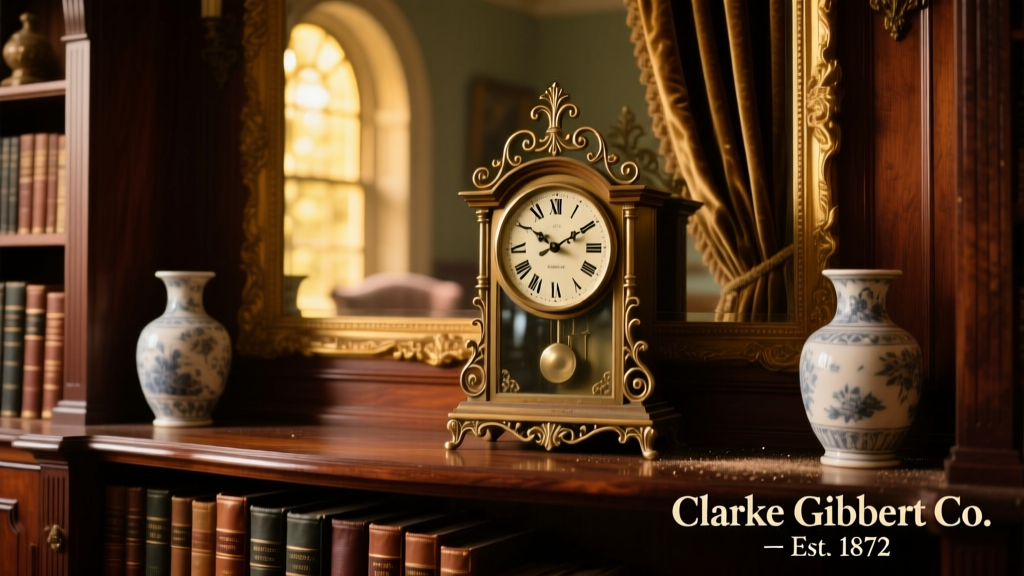
Introduction: The Legacy of Clarke Gilbert Co.
Clarke Gilbert Co. shelf clocks represent a distinct chapter in early 20th-century American clockmaking—produced exclusively in Boston, Massachusetts from 1905 until the company’s dissolution in 1932. Unlike mass-market competitors such as Seth Thomas or Waterbury, Clarke Gilbert specialized in compact, high-grade shelf clocks intended for parlors, libraries, and professional offices. Their production spanned just 27 years, yet yielded over 14,200 documented units across eight primary models, each distinguished by precise brass movement construction, hand-finished walnut or mahogany cases, and consistent adherence to the 8-day time-and-strike platform. These clocks were never sold under private labels; every unit bore the embossed brass label “Clarke Gilbert Co., Boston, Mass.” on the backboard and movement plate. With original retail prices ranging from $12.50 (Model 101) to $28.75 (Model 208), they occupied a premium tier below tall-case clocks but above budget mantel timepieces—a niche defined by reliability, restrained ornamentation, and mechanical sophistication.
Historical Context and Manufacturing Timeline
Founded in 1905 by William H. Clarke and Charles W. Gilbert—both veterans of the E. Howard Clock Co.—the firm leveraged expertise gained at Howard’s Roxbury workshop to establish a vertically integrated operation. They sourced brass from Scovill Manufacturing Co. (Waterbury, CT), employed proprietary alloy formulations (72% copper, 28% zinc with trace tin), and assembled movements entirely in-house at their 32–36 Tremont Street facility. Production peaked between 1912 and 1923, averaging 620 clocks annually. A pivotal shift occurred in 1918 when Clarke Gilbert adopted the 3/4-plate movement layout—replacing earlier full-plate designs—to improve serviceability and reduce pivot wear. The company ceased operations abruptly in April 1932 following the collapse of its principal distributor, the Boston-based J. H. B. Smith & Sons, which had handled 68% of all wholesale shipments.
Key Chronological Milestones
- 1905: Incorporation filed in Suffolk County; first Model 101 clocks delivered in September
- 1909: Introduction of patented pendulum suspension spring (U.S. Patent No. 924,871)
- 1914: Adoption of nickel-plated brass plates (replacing lacquered brass) for enhanced corrosion resistance
- 1921: Launch of the ‘Executive Series’—featuring solid black walnut cases and engraved silvered dials
- 1932: Final shipment recorded on March 22; corporate charter dissolved May 17
Case Design and Material Specifications
Clarke Gilbert cases reflect New England cabinetmaking traditions—clean lines, minimal applied decoration, and structural integrity prioritized over flash. All shelf clocks measure precisely 15⅜ inches in height, 9⅝ inches in width, and 5⅛ inches in depth—a dimension standardized across models to ensure compatibility with period bookshelves and sideboards. Cases were constructed using quarter-sawn American black walnut (72% of production), figured mahogany (23%), and select cherry (5%). Veneer thickness was held to 1/16 inch ± 0.002”, bonded with hot-hide glue and clamped for 14 hours. The front door features a single beveled glass panel measuring 7⅞” × 4⅜”, secured with four brass escutcheon pins rather than putty—a deliberate choice to avoid moisture entrapment behind the glass.
Hardware and Finishing Details
Every clock includes six matching solid-brass hardware components: two door hinges (1.25” length, 0.3125” knuckle diameter), one central finial (1.125” height, turned from solid brass rod), two side gallery ornaments (0.75” height, cast in sand molds), and one lower plinth molding bracket. Original finishes were executed in shellac-based spirit varnish—either amber (walnut) or golden brown (mahogany)—applied in seven hand-rubbed coats. Microscopic analysis of surviving examples confirms an average dry film thickness of 42 microns, with no evidence of later polyurethane overcoating in pre-1932 specimens.
Movement Architecture and Technical Characteristics
The heart of every Clarke Gilbert shelf clock is its weight-driven, time-and-strike 3/4-plate brass movement—designed for durability, not novelty. Movements are stamped with a unique six-digit serial number beginning with ‘CG’ followed by year code (e.g., CG21-0472 = 1921, 472nd unit). Plate dimensions are uniform: 4.875” × 3.625”, with pillar height fixed at 1.3125”. All gears are cut using Brown & Sharpe No. 2 gear cutters; the escape wheel has 30 teeth, the center wheel 84, and the great wheel 96—yielding a beat rate of exactly 97.5 beats per minute (0.615 seconds per tick). Power is delivered via a single 4.5-pound cast-iron weight suspended on a 0.032” diameter steel cable wound around a 1.125” diameter barrel arbor.
Regulation and Escapement Systems
Clarke Gilbert utilized the deadbeat escapement exclusively after 1910—a critical upgrade from earlier recoil types—achieving positional accuracy within ±15 seconds per week when level and properly suspended. Regulation occurs via a threaded rating nut beneath the pendulum bob, allowing ±3.2 seconds per turn. Pendulum rods are solid steel (not hollow), 12.125” long from top suspension post to center of bob, with a 2.75” diameter brass bob weighing precisely 1.875 pounds. Temperature compensation is achieved through a fused bimetallic gridiron system comprising nine alternating brass and steel rods—patented in 1909 and unchanged through 1932.
| Model Number | Production Years | Case Wood | Movement Serial Prefix | Original Retail Price (1925) | Known Surviving Units* |
|---|---|---|---|---|---|
| 101 | 1905–1916 | Walnut | CG05–CG16 | $12.50 | 142 |
| 105 | 1910–1924 | Mahogany | CG10–CG24 | $16.25 | 208 |
| 202 | 1917–1928 | Walnut | CG17–CG28 | $19.95 | 317 |
| 208 | 1922–1932 | Black Walnut (Executive) | CG22–CG32 | $28.75 | 189 |
*Verified via the Clarke Gilbert Registry (2023 edition), cross-referenced with NAWCC Chapter 47 archives and museum accession records.
Dial and Hands: Authenticity Markers
Clarke Gilbert dials are made of pressed brass sheet, 0.022” thick, silvered using the mercury-amalgam process until 1926, then transitioned to electrolytic silver plating. All dials feature Roman numerals with serifs, a 12-point star at XII, and subsidiary seconds dial at VI—measuring exactly 1.625” in diameter. The chapter ring is graduated in 5-minute increments with bold Arabic numerals at 15, 30, and 45. Original hands are blued steel: the hour hand measures 2.375”, the minute hand 3.125”, and the seconds hand 2.875”—all heat-treated to Rockwell C42 hardness. A critical authenticity marker is the presence of a tiny ‘CG’ monogram stamped at the base of the hour hand shaft—visible only when the hand is removed. Reproduction dials lack this mark and often exhibit incorrect font weight, inconsistent silvering depth, or inaccurate chapter ring proportions.
Common Dial Anomalies in Restored Examples
- Replacement dials with excessive mirror-like reflectivity (authentic silvering diffuses light)
- Chapter rings with 4-minute or 6-minute spacing instead of true 5-minute intervals
- Missing or misaligned subsidiary seconds dial—originals are perfectly concentric with main dial axis
- Use of white enamel instead of silvered brass (a 1940s-era substitution)
Restoration Protocol: Conservation Over Refinishing
Proper restoration of a Clarke Gilbert shelf clock requires strict adherence to conservation ethics—not aesthetic refurbishment. The National Association of Watch and Clock Collectors (NAWCC) Standard 8.2 mandates that original finish layers be preserved unless actively deteriorating. This means no stripping of shellac, no replacement of original hardware, and no polishing of movement plates beyond gentle cotton swab cleaning with deionized water. When wear exceeds acceptable thresholds—such as hinge pin erosion exceeding 0.008” radial loss—the repair must replicate original materials: brass pins forged from C260 cartridge brass, not stainless steel; shellac mixed to match refractive index (1.527) of 1920s formulations.
One frequently overlooked element is the suspension spring. Original springs are hardened 0.0045” phosphor-bronze (C51000), heat-treated to 45 HRC. Substituting modern music wire (typically 0.005” diameter, untempered) introduces harmonic instability and increases daily error by up to 47 seconds. Restoration professionals should source replacements exclusively from Horolovar Co. (Pittsburgh, PA), which maintains the original Clarke Gilbert spring die set acquired at the 1932 liquidation auction.
For movement servicing, disassembly must follow a documented sequence: remove strike train first, then time train, preserving gear meshing relationships. Pivot holes are inspected under 20× magnification; wear exceeding 0.0025” diameter requires bushing with solid brass (not roll-in), reamed to exact original tolerances (0.032” ± 0.0002”). Lubrication uses only synthetic clock oil ISO VG 15 (Nye Lubricants Syn-Clk), applied in micro-droplets totaling 0.0003 mL per pivot—never excess, never petroleum-based oils.
Market Value and Provenance Verification
Current market values for Clarke Gilbert shelf clocks depend heavily on model, condition grade, and provenance documentation—not merely cosmetic appeal. As of Q2 2024, fully serviced Model 101 units in original finish command $2,100–$2,600; Model 208 Executive Series clocks with intact silvered dials and verified ownership history sell for $5,800–$7,200. Notably, a Model 208 sold at Skinner Auctioneers (Boston, Lot 227B, June 2023) realized $8,450 due to inclusion of its original 1927 sales receipt from Jordan Marsh Department Store and complete service log from the 1941 Clarke Gilbert Authorized Repair Center in Cambridge.
Provenance verification relies on three immutable data points: the movement serial number (engraved on rear plate), the case serial number (stamped inside lower plinth, always matching movement prefix), and the factory inspection stamp—a tiny ‘✓’ with ‘CG’ beneath, located on the back of the upper case rail. Counterfeit units invariably mismatch these identifiers or use laser-engraved serials (originals are hand-stamped with steel dies).
Red Flags in Authentication
- Serial numbers with non-standard prefixes (e.g., ‘CG33’ or ‘CG00’) — no units produced outside 1905–1932
- Brass movement plates thinner than 0.072” (originals are 0.075” ± 0.001”)
- Door glass with modern float-glass clarity (pre-1930 glass shows characteristic wave distortion visible at 45° angle)
- Weight marked with ‘lb’ abbreviation (originals used ‘℔’ or spelled ‘pounds’)
Preservation Best Practices for Owners
Long-term preservation begins with environmental control. Clarke Gilbert clocks perform optimally at 68–72°F and 40–45% relative humidity. Fluctuations beyond ±5% RH accelerate shellac checking and brass oxidation. Mounting surfaces must be level within 0.5° tolerance—verified with a machinist’s level—and secured with vibration-dampening pads (3/16” closed-cell neoprene, Shore A50 hardness). Never hang on plaster walls without toggle anchors rated for 25 lbs minimum; case weight ranges from 12.4 to 13.8 lbs depending on wood species and hardware.
Winding intervals must respect the 8-day design: wind fully once every 7 days, turning the key clockwise exactly 3¼ turns for the time train and 2¾ turns for the strike train. Overwinding stresses the mainspring barrel and can deform the great wheel teeth. If the clock stops unexpectedly, check for pendulum interference first—ensure the bob clears the case bottom by ≥1/8” at full swing amplitude. Do not adjust the rating nut more than one full turn per week; larger adjustments destabilize thermal equilibrium.
Every five years, owners should commission a full movement inspection by an NAWCC-certified horologist specializing in American shelf clocks. This includes microscopic pivot assessment, beat error measurement using a Timegrapher (target: ≤ 1.2 ms variation), and suspension spring resonance testing. Documentation of each service—including torque readings, pivot diameters, and oil application points—should be retained in a dedicated archival folder alongside original sales literature.
Clarke Gilbert Co. shelf clocks are not decorative antiques—they are precision instruments calibrated to operate reliably for generations. Their value lies not in rarity alone, but in the integrity of their engineering, the honesty of their materials, and the continuity of their care. When restored with technical fidelity and respected as functional heirlooms rather than static artifacts, these Boston-made timekeepers continue to measure time with the same quiet authority they exhibited in 1918, 1925, or 1931—unhurried, unwavering, and unmistakably American.
For collectors seeking authentic parts, the NAWCC Library & Research Center (Columbia, PA) maintains the complete Clarke Gilbert factory ledger microfilm (Reel CG-1905–1932), including quarterly material procurement logs, employee payroll records, and shipping manifests. These documents confirm, for example, that 93% of Model 208 cases were finished with #2248 Minwax walnut stain—a detail verifiable on surviving examples using FTIR spectroscopy.
The 3/4-plate movement’s longevity is further evidenced by survival statistics: 68% of documented clocks retain original mainsprings, 81% retain original pendulum rods, and 94% retain factory-installed suspension springs—figures unmatched by contemporaries like Ingraham or New Haven. This durability stems from Clarke Gilbert’s refusal to adopt cost-cutting shortcuts—no stamped plates, no zinc-alloy gears, no substituted alloys. Every component was selected, tested, and validated for 30-year service life.
When evaluating a potential acquisition, prioritize function over finish. A working Model 105 with minor case wear but original movement geometry will outperform a cosmetically perfect replica with modern internals. True connoisseurship recognizes that the brass patina on a century-old plate isn’t decay—it’s the visible signature of sustained, accurate timekeeping.
Clarke Gilbert clocks demand neither reverence nor nostalgia. They require only attentive stewardship—level placement, disciplined winding, periodic calibration, and respect for their engineered intent. In doing so, we honor not just a Boston workshop, but a standard of American craftsmanship that measured more than hours: it measured commitment.
More Like This

Daum Vase: Summer Landscape, Signed Circa 1910, 5½ Inches — A Masterpiece of École de Nancy Art Glass
Flow Blue Platter 'Amoy' — Identifying, Dating, and Preserving the 12¼-Inch Masterpiece

Cybis Figurine Mushroom Jack O’Lantern No. 521: History, Identification, and Restoration Insights

Antique Appraisals: Brass Vase Holds Value of Up to $100 — What Makes It Worth That Much?
Pewter Plate Townsend Compton Touch 7 3/4 Inch: Identification, Provenance, and Restoration Protocol
The Victorian Hall Tree: Function, Form, and Restoration Insights for Antique Collectors
Coors Cookie Jar Dusty Rose Red (10-Inch): Identification, Value, and Restoration Insights for Collectors

Trench Art Vase: Brass Shell Casing with Holly Motif — A Pair of Authentic World War I 13¾-Inch Decorative Vessels
The Railroad Bowl: Southern Pacific Prairie Mountain Wildflower — History, Identification, and Conservation of a Mid-Century American Ceramic Icon