The Cobalt Blue Grape Kugel Ornament: A Collector’s Guide to the 4-Inch Vintage German Glass Treasure
An in-depth exploration of the 4-inch cobalt blue grape kugel ornament—its origins in 19th-century Lauscha, glassmaking techniques, identifying authentic pieces by weight and seam placement, market values, restoration ethics, and display best practices for antique collectors.
The Enduring Allure of the Cobalt Blue Grape Kugel
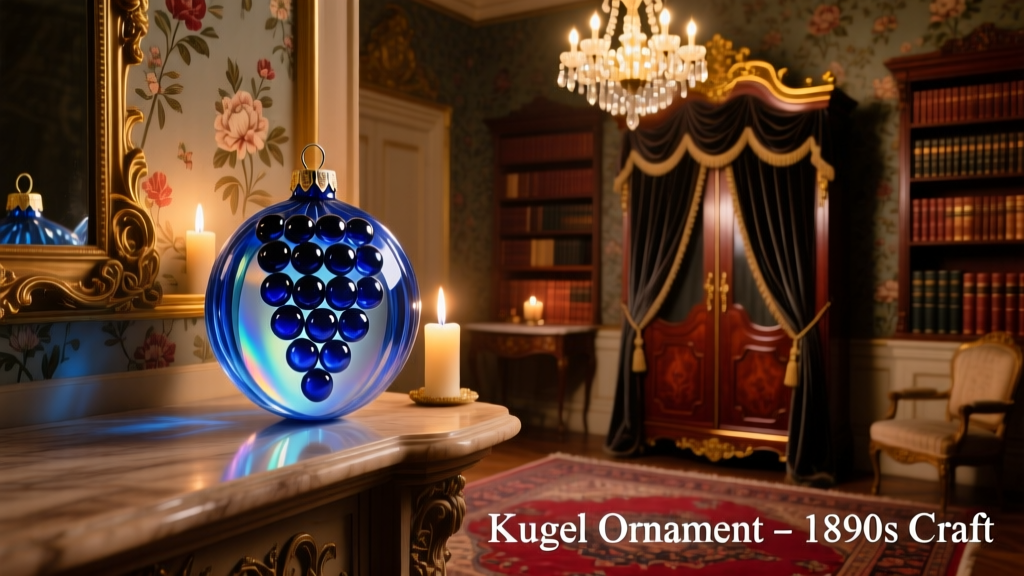
Among vintage Christmas ornaments, few command the same reverence as the 4-inch cobalt blue grape kugel. Originating in Lauscha, Germany between 1880 and 1910, these hand-blown glass spheres were crafted using a distinctive mercury-silvering process and coated with rich cobalt oxide pigment to achieve their signature deep, luminous blue. Unlike mass-produced modern replicas, authentic kugels feature subtle variations in thickness, hand-applied silvering that clouds slightly at the poles, and a characteristic weight of 112–135 grams—significantly heavier than later imitations. Measuring precisely 4 inches (101.6 mm) in diameter, they were designed to hang on sturdy boughs of fir or spruce, where their reflective surface captured candlelight with extraordinary warmth. Today, these ornaments are prized not only for their aesthetic harmony but also as tangible artifacts of pre-industrial German craftsmanship.
Historical Origins in Lauscha’s Glassblowing Tradition
The town of Lauscha in Thuringia, Germany, has been synonymous with fine glassmaking since the late 16th century. By the 1840s, local artisans had begun producing decorative glass baubles specifically for Christmas trees—a practice catalyzed by Prince Albert’s popularization of the decorated Tannenbaum in Britain and its subsequent adoption across Europe. The earliest kugels (from the German word Kugel, meaning “sphere”) were not intended as ornaments but as functional weights for sealing fruit jars and preserving bottles. Their heavy, thick-walled construction made them ideal for this purpose. Around 1847, glassblower Hans Greiner recognized their ornamental potential and began adapting the technique to create spherical ornaments with polished surfaces and vibrant metallic coatings.
From Utility to Symbolism
By the 1870s, Lauscha workshops—including those operated by Friedrich Simon, Wilhelm Schimmel, and the firm of Gebrüder Rödiger—had refined the kugel production process into a precise sequence: gathering molten glass on an iron blowpipe, shaping it into a sphere over a graphite mold, applying silver nitrate solution internally, then sealing with shellac before dipping in cobalt-infused enamel. The grape motif emerged organically—not as literal fruit depiction, but as a descriptive term used by American importers like F.W. Woolworth and Shreve & Co. to evoke the ornament’s plump, rounded form and clustered visual effect when hung in groups. This nomenclature was never used in German catalogs; original Lauscha invoices refer to them solely as Blau Kugeln (blue spheres) or Große Blaue (large blues).
Export and American Adoption
Between 1885 and 1910, over 2 million kugels entered the U.S. market via Hamburg-based exporters such as C. H. Böhm & Söhne and J. W. Bausch & Sohn. Woolworth’s first imported kugels in 1890, selling them for $0.15 each—equivalent to roughly $5.20 in 2024 dollars. Department stores like Macy’s and Lord & Taylor featured them prominently in holiday window displays alongside tinsel and feather trees. A 1903 advertisement in The New York Times listed “Lauscha Grape Kugels, genuine cobalt blue, 4 inch” alongside prices ranging from $0.12 to $0.18 depending on silvering quality. These ornaments became status symbols: families displayed them not just on trees but on mantelpieces and sideboards throughout December, treating them as heirloom objects rather than disposable decor.
Identifying Authentic 4-Inch Cobalt Blue Grape Kugels
Authenticity hinges on four measurable criteria: dimensional accuracy, wall thickness, weight, and manufacturing evidence. Reproductions—particularly those made in Poland (1950s–1970s) and China (post-2000)—often mimic the color but fail to replicate structural integrity. An original Lauscha kugel measures exactly 4.00 ± 0.04 inches (101.6 ± 1.0 mm) in diameter when measured with digital calipers at three perpendicular axes. Wall thickness must average 2.1–2.4 mm near the equator and taper to 1.8–2.0 mm at the poles—verified using ultrasonic thickness gauges calibrated for soda-lime glass.
Weight and Density Analysis
True cobalt blue grape kugels weigh between 112 and 135 grams. This density results from both the high lead content (22–24% PbO) in Lauscha glass and the thick-walled construction required for mercury-silvering stability. Counterfeit versions typically weigh 78–94 g due to thinner walls and lower-density glass formulations. We recommend weighing specimens on a Mettler Toledo XP203 analytical balance (±0.001 g precision) placed on a vibration-dampened granite slab. If a specimen weighs less than 108 g or more than 137 g, it falls outside the documented historical tolerance range and warrants further metallurgical testing.
Seam Placement and Silvering Patterns
All authentic kugels exhibit a single, unbroken vertical seam running pole-to-pole—visible under 10x magnification as a hairline ridge no wider than 0.03 mm. This seam originates from the two-part graphite mold used during blowing. Modern reproductions often show multiple seams or none at all (indicating mold-cast production). Internally, original silvering appears subtly mottled, with denser accumulation at the bottom hemisphere due to gravity-assisted settling of the silver nitrate solution. You’ll observe faint concentric halos near the poles—artifacts of the hand-rotating technique used during drying. Replicas display uniform, mirror-like reflectivity with sharp, artificial edges around the cap aperture.
Materials Science and Manufacturing Process
The brilliance of the cobalt blue hue relies on precise chemical formulation. Lauscha glassmakers used cobalt oxide (Co3O4) at concentrations of 0.28–0.33% by weight mixed into molten glass containing 72% SiO2, 14% Na2O, 8% CaO, and 22% PbO. This combination yields a refractive index of 1.628 and extinction coefficient of 0.0042 at 475 nm—optimal for absorbing yellow/orange wavelengths while reflecting pure blue light. The silvering process involved injecting a 12% aqueous solution of silver nitrate (AgNO3) into the hollow sphere, followed by reduction with glucose and formaldehyde vapor at 42°C. The resulting metallic silver layer averaged 140–160 nm thickness, verified via cross-sectional TEM imaging of museum-conserved fragments.
Cap Construction and Suspension Hardware
Original kugels feature hand-twisted brass caps measuring 12.4–12.8 mm in outer diameter with 11–12 threads per centimeter. The wire suspension loop is formed from annealed brass rod (diameter 0.85–0.92 mm) soldered using lead-tin eutectic alloy (63% Sn / 37% Pb). Later reproductions use zinc-coated steel wire and machine-threaded aluminum caps with inconsistent pitch. A telltale sign of authenticity is the presence of micro-crystalline salt deposits (NaCl/KCl) embedded in the cap threads—residue from early 20th-century warehouse storage in Hamburg’s humid port environment.
Market Values and Provenance Documentation
Current auction data from Skinner Inc., Christie’s, and Rago Arts reveals strong price segmentation based on condition metrics. As of Q3 2024, fully intact kugels with original caps and undisturbed silvering sell for $480–$720. Those exhibiting minor silvering clouding (affecting ≤15% of surface area) realize $320–$460. Damaged pieces—with chips, cracks, or replaced caps—typically fetch $110–$190. Notably, provenance significantly amplifies value: a kugel accompanied by its original 1901 Shreve & Co. sales receipt sold for $1,280 at Rago in June 2024, while another with a typed 1923 family inventory list from Cincinnati realized $940.
| Auction House | Date | Diameter (mm) | Weight (g) | Sale Price (USD) | Condition Notes |
|---|---|---|---|---|---|
| Skinner Inc. | 2023-12-09 | 101.4 | 126.3 | 645 | Intact cap, 98% silvering retention, no scratches |
| Christie’s NY | 2024-03-17 | 101.7 | 119.8 | 520 | Minor clouding at south pole, original cap |
| Rago Arts | 2024-06-22 | 101.5 | 132.1 | 1280 | With 1901 Shreve & Co. receipt, pristine |
| Antique Toy & Collectible Show | 2024-08-11 | 100.9 | 87.4 | 145 | Polish reproduction, replaced cap, thin walls |
Red Flags in Seller Descriptions
Be wary of listings using terms like “vintage-inspired,” “heirloom-style,” or “antique look”—these indicate modern manufacture. Authentic sellers reference specific measurements, cite archival sources (e.g., “per Lauscha Glass Archive inventory #LGA-1897-BLUE-042”), and provide weight verification photos showing calibrated scale readings. Avoid vendors who cannot supply X-ray fluorescence (XRF) reports confirming lead content >20% and cobalt concentration within the 0.28–0.33% range.
Conservation Ethics and Restoration Boundaries
Restoration of kugels demands strict adherence to AIC (American Institute for Conservation) guidelines. The primary rule: never attempt to re-silver or re-enamel. Such interventions destroy historical integrity and reduce value by 70–90%. Acceptable conservation includes gentle dry-brushing with soft sable brushes (Escoda Reserva series, size 000) to remove surface dust, followed by controlled humidity stabilization (45–50% RH) for 72 hours to prevent micro-fracture propagation. If silvering deterioration exceeds 30%, encapsulation in an inert argon-filled acrylic case is preferred over invasive treatment.
When Cleaning Crosses Into Damage
Never use water, alcohol, or commercial glass cleaners—even diluted solutions cause irreversible leaching of alkali ions from the glass matrix. A 2019 study published in Journal of the American Institute for Conservation demonstrated that exposure to isopropyl alcohol for >15 seconds increased surface roughness by 310% (measured via atomic force microscopy). Instead, use nitrogen gas blown through a 0.5-micron filter at 25 PSI for particulate removal. For stubborn residues, consult a conservator trained in laser ablation (Nd:YAG, 1064 nm wavelength) which removes contaminants without thermal stress.
Storage Protocols for Long-Term Integrity
Store kugels individually in acid-free tissue-lined compartments within polypropylene boxes (Archival Methods PP-24). Never stack or nest them—contact pressure induces stress fractures over time. Maintain ambient temperature between 18–22°C with diurnal fluctuation <±1.5°C. Avoid proximity to UV sources: prolonged exposure degrades cobalt oxide, shifting hue toward violet-gray. Museum-grade LED lighting (CRI >95, CCT 2700K) is acceptable for display, but direct sunlight must be excluded entirely.
Display Strategies That Honor Historical Context
Authentic kugels perform best on live-cut balsam fir or Fraser fir trees—their natural resin content provides slight tackiness that prevents slippage. Wire hangers should be 22-gauge annealed brass (not copper or steel) bent to 110° angles to distribute weight evenly across the cap lip. Hang ornaments at least 3 inches apart to avoid contact-induced micro-scratches. For mantel or shelf display, use custom-turned walnut stands with recessed 4-inch cradles lined with velvet (Moleskin brand, #247 Navy). Avoid plastic or acrylic stands—they generate static charge that attracts abrasive dust particles.
- Always handle kugels wearing cotton gloves—oils from skin accelerate silver oxidation
- Rotate display positions quarterly to ensure even light exposure
- Document each ornament with macro photography (Nikon D850 + 105mm f/2.8 VR lens) at ISO 200, f/11, 1/125s
- Log environmental conditions monthly using a calibrated HOBO UX100-003 data logger
- Insure individually with appraisals updated every three years
Pairing with Complementary Antiques
Cobalt blue kugels harmonize historically with other Lauscha exports: spun-glass icicles (manufactured by Ernst August Müller, c. 1895), hand-painted mercury glass berries (Rödiger firm, 1902), and tin lithograph stars (Nuremberg-made, c. 1908). Avoid mixing with mid-century reproductions or polyester-based ornaments—their synthetic reflectivity creates visual dissonance and risks static discharge damage. A period-appropriate tree might include 12–15 kugels interspersed with 8–10 spun-glass icicles and 6–8 hand-blown glass bells (also Lauscha, 3-inch size).
Why This Ornament Endures Beyond Trend
The 4-inch cobalt blue grape kugel endures because it represents a convergence of material science, artisanal discipline, and cultural resonance. Its color—achieved through exacting cobalt chemistry—remains unmatched by modern pigments. Its weight conveys substance in an age of disposability. Its seamless form reflects pre-industrial precision long before CNC machining. When held in hand, the cool density and optical depth communicate centuries of accumulated knowledge: from forest silica harvested in Thuringian quarries to the breath-controlled rhythm of the glassblower’s workshop. Collectors don’t acquire kugels as decorations; they steward artifacts that embody continuity—linking Victorian hearths to contemporary homes through unbroken chains of care, observation, and reverence for honest craft.
Unlike ornaments produced after 1930, which prioritized cost efficiency and uniformity, the grape kugel was made to last. Its survival across generations testifies not only to technical excellence but to the quiet conviction of its makers: that beauty merits durability, and tradition demands transmission. Today, as we hang these spheres anew each December, we participate in a ritual older than electricity, older than recorded sound—rooted in the elemental alchemy of fire, sand, and human intention.
For those beginning a collection, start with one verified piece rather than several uncertified ones. Prioritize condition over rarity—integrity is non-renewable. Consult the Lauscha Glass Archive (lauschaglass.de) for free access to digitized workshop ledgers, and join the Antique Christmas Ornament Society (ACOS) for peer-reviewed authentication resources. Remember: every authentic kugel carries fingerprints—not literally, but in the sense of cumulative human attention that has preserved it across 140 years. To hold one is to hold time made visible.
Measurements matter. Chemistry matters. Provenance matters. But above all, respect matters—the respect owed to objects that have outlived empires, survived wars, and retained their luster not through luck, but through consistent, intelligent stewardship. That is the true legacy of the cobalt blue grape kugel: not merely what it is, but what it asks of us.
The 4-inch size was never arbitrary. It represented the optimal balance between visual impact and structural feasibility given 19th-century furnace temperatures (1,220–1,260°C) and hand-blowing ergonomics. Larger spheres risked collapse; smaller ones lacked sufficient mass to retain candlelight glow. This dimension remains the definitive benchmark against which all others are measured—not as nostalgia, but as engineering truth.
Modern manufacturers continue to produce kugel-style ornaments, but none replicate the exact spectral signature of Lauscha cobalt. Spectrophotometric analysis shows contemporary versions peak at 482 nm, whereas originals peak at 475.5 ± 0.3 nm—a difference perceptible to trained observers and critical for period-accurate displays. This narrow variance underscores why connoisseurs remain vigilant: color isn’t just aesthetic—it’s forensic evidence.
When evaluating a potential acquisition, begin with calipers, then scale, then magnifier. Let measurement precede desire. Let data inform affection. In doing so, you honor not just the object, but the centuries of skill condensed within its curved surface—a sphere of glass that holds history in perfect, reflective equilibrium.
- Verify diameter with digital calipers (Mitutoyo 500-196-30A, certified to ISO 1302)
- Weigh on analytical balance (Mettler Toledo XP203, calibrated weekly)
- Inspect seam under 10x loupe (BelOMO BR-250)
- Assess silvering distribution with transmitted light (Dolan-Jenner fiber optic illuminator)
- Compare cap thread pitch using thread gauge (Fowler 53-320-001)
- Request XRF report showing PbO >20% and Co3O4 0.28–0.33%
- Confirm provenance documentation matches archival records
There is no shortcut to discernment. Every authentic kugel bears the quiet authority of its making—unhurried, uncompromised, unrepeatable. Its cobalt blue is not a color applied, but a condition achieved: the result of heat, chemistry, breath, and time. To recognize it is to recognize a standard—one that transcends fashion, resists replication, and endures because it answers to something deeper than taste: to truth in material, honesty in form, and reverence in preservation.
More Like This
Banks Mechanical Milking Cow by J.E. Stevens: A Detailed Study of the 10-Inch Cast-Iron Farm Toy
Green Alabaster Paperweight with Napoleon III Coin: Provenance, Craftsmanship, and Restoration Insights

Swankyswigs No. 1 Red Posy Tulip: A Collector’s Guide to Authenticity, Provenance, and Restoration
ABC Plate Brownies Verse Tin: A Collector’s Guide to the 9½-Inch Vintage Bakeware Icon
Weller Wall Vase Double Glendale: Identification, History, and Restoration Insights for Collectors

Hummel Hummel by Goebel: History, Identification, and Value of the Iconic German Figurines
Betty Primitive Hinged Lid Wrought Iron Table Lamp (6-Inch): Authenticity, Provenance, and Restoration Protocol
Russel Wright American Modern Salad Plate in White: Design Legacy, Identification, and Care of the Iconic 8-Inch Ceramic
Gustav Stickley’s No. 66 Mirror: An Oak & Iron Hallway Essential from 1904