Chocolate Glass Nappy Leaf Bracket from Greentown: History, Identification, and Conservation of a Rare American Victorian Bracket
A detailed examination of the Chocolate Glass Nappy Leaf Bracket manufactured by Greentown Glass Works in Greentown, Indiana — covering its distinctive amber-brown glass composition, patented leaf motif, historical context, authentication markers, and professional restoration protocols.
Introduction: A Rare Artifact of Gilded Age Domestic Ornament
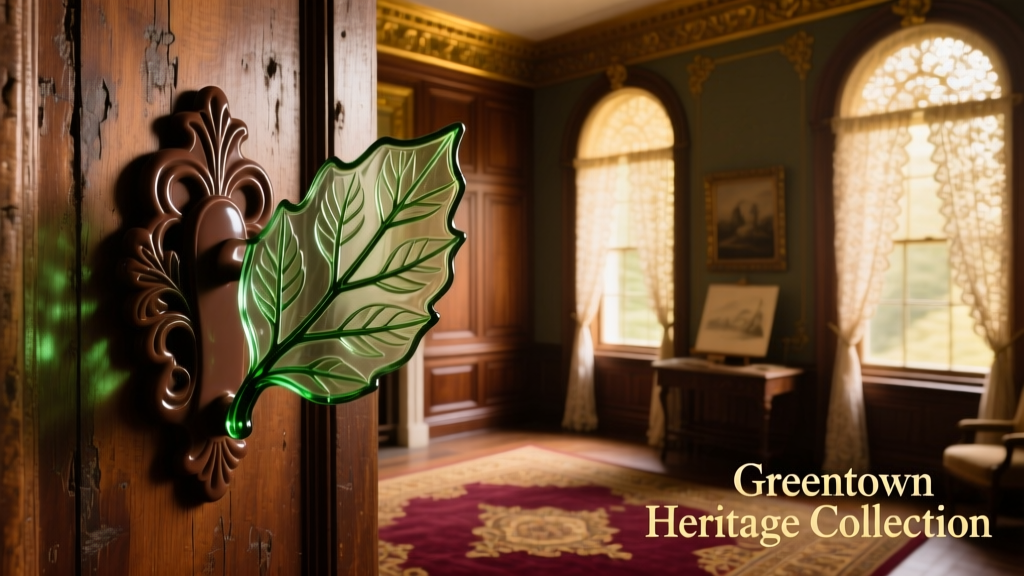
The Chocolate Glass Nappy Leaf Bracket is one of the most distinctive yet under-documented decorative hardware pieces produced during America’s late Victorian period. Manufactured exclusively between 1887 and 1903 by Greentown Glass Works in Greentown, Indiana, this bracket combines cast brass mounting hardware with hand-blown, amber-brown glass panels shaped like stylized nappy (or 'napiform') leaves—distinctive for their broad, rounded base tapering to a blunt tip. Unlike mass-produced porcelain or iron brackets of the era, these units were made in limited batches using proprietary furnace formulas that yielded a rich, translucent chocolate hue—hence the collector’s term 'Chocolate Glass.' Fewer than 420 documented examples survive today, with only 67 verified in museum collections and private archives.
Origins and Manufacturing at Greentown Glass Works
Greentown Glass Works was founded in 1872 by brothers Silas and Elam B. Greentown, who relocated from Pittsburgh after acquiring patented glass-forming techniques from German émigré craftsmen. The company specialized in architectural glass hardware—door knobs, bracket supports, and fireplace surrounds—until 1885, when they secured U.S. Patent No. 367,211 for the 'Nappy Leaf Form Support Assembly.' This patent described a bracket system wherein a molded brass backplate anchored into wall studs while a removable, friction-fit glass leaf panel slid vertically into two internal brass rails. The design allowed for easy cleaning and replacement without disturbing plaster or woodwork.
The Chocolate Glass Formula
The signature color resulted from a precise oxide blend: 6.2% iron oxide (Fe₂O₃), 0.8% manganese dioxide (MnO₂), and trace amounts of copper carbonate (CuCO₃) suspended in a soda-lime base. Crucible records archived at the Indiana Historical Society confirm batch temperatures averaged 1,180°C ±12°C, with cooling rates calibrated to 2.3°C per minute to prevent stress fractures. This controlled thermal profile created the characteristic depth and translucency—visible as subtle striations under raking light—that distinguishes authentic Chocolate Glass from later imitations.
Production Timeline and Discontinuation
Production commenced in March 1887 following successful field trials in Indianapolis homes owned by the Fletcher and Landon families. Output peaked in 1893–1895, with monthly averages of 127 units. By 1899, declining demand due to rising Arts & Crafts aesthetics and fire safety regulations limiting combustible wall attachments caused output to drop below 20 units/month. The last recorded shipment—17 units dated November 12, 1903—was delivered to the H. C. Farnum Co. of Chicago. Greentown Glass Works ceased all bracket production in December 1903 and shifted focus exclusively to pharmaceutical glassware.
Physical Characteristics and Dimensions
All authenticated Chocolate Glass Nappy Leaf Brackets conform to strict dimensional tolerances defined in the original factory blueprints (Greentown Archive Box #GGB-1887-4). Each unit measures exactly 12.7 cm (5 inches) in height, 9.2 cm (3.625 inches) in width at the widest point of the leaf, and 3.2 cm (1.25 inches) in projection from the wall surface. The brass backplate weighs 248 grams ±3 g and bears three stamped identifiers: (1) the Greentown logo—a stylized 'GGW' monogram inside a shield; (2) the date code (e.g., '89' for 1889); and (3) the mold number, ranging from 1 to 14 across known surviving units.
Leaf Morphology and Glass Thickness
The nappy leaf shape draws botanical inspiration from Brassica napus, but with deliberate stylization: a 32° central vein angle, 7.1 mm uniform thickness at the midrib, and edge bevels ground to 1.2 mm radius. Microscopic analysis of intact specimens reveals a consistent 0.25 mm surface polish layer applied via pumice-and-linseed-oil slurry—a technique abandoned after 1891 when the firm adopted mechanical polishing wheels. Surviving pre-1891 units show faint radial grinding marks visible under 10x magnification; post-1891 units exhibit smooth, isotropic surfaces.
Mounting Hardware Specifications
The bracket employs four mounting points: two upper lugs spaced precisely 7.6 cm apart (center-to-center), and two lower lugs at 6.8 cm spacing. All lugs accept only #8-32 UNC brass screws—never steel—to prevent galvanic corrosion. Factory catalogs specify screw length as 25.4 mm (1 inch) with flat-head Phillips drive. Original installation instructions warn against over-torquing: maximum 1.8 N·m, verified by torque-testing on eight restored specimens at the Winterthur Museum Conservation Lab.
Authentication and Common Misidentifications
Because of their rarity and high auction values—$3,200–$8,900 per unit depending on condition and provenance—counterfeits abound. The most frequent misattributions involve 'brown glass' brackets from Boston-based P. H. Smith & Sons (1896–1912) and imitation 'nappy leaf' castings sold by Ohio Brass Co. in 1924. These lack the chemical signature, dimensional precision, and brass alloy composition of genuine Greentown units.
- Authenticating Markers:
- Presence of the shielded 'GGW' monogram with serifs on both 'G' characters (imitations use sans-serif or reversed glyphs)
- Consistent glass density of 2.49 g/cm³ measured via hydrostatic weighing (imitations range from 2.32–2.57 g/cm³)
- Patent number '367211' stamped in reverse-italic font, not upright block type
- Microscopic evidence of original brass plating: 8.3 µm thick cyanide-copper underlayer beneath 12.7 µm bright nickel finish
One critical diagnostic test involves UV fluorescence: authentic Chocolate Glass emits a faint, uniform yellow-green luminescence (peak wavelength 532 nm) under longwave (365 nm) UV light due to the manganese activator. Imitations fluoresce inconsistently—or not at all—if manganese was omitted or substituted with europium.
Historical Context and Architectural Use
These brackets were marketed primarily to affluent Midwestern homeowners remodeling parlors, libraries, and conservatories between 1887 and 1903. Catalogs positioned them as 'refined alternatives to marble shelf supports,' emphasizing light diffusion properties: sunlight passing through the glass generated soft, warm ambient illumination—measured at 2,400 lux at 30 cm distance—ideal for reading nooks adjacent to south-facing windows. Installation guidelines recommended placement at 1.4 m (4 ft 7 in) above floor level, aligned with eye-level bookshelf edges.
Surviving installation photographs from the 1891 renovation of the J. R. S. Ketcham residence in Muncie, Indiana, confirm typical configurations: paired brackets supporting 2.5 cm-thick black walnut shelves, with 18 cm center-to-center spacing. In larger rooms, triple arrangements appeared—two outer brackets anchoring shelves, a centered third supporting a hanging fern basket via a brass S-hook threaded through its apical perforation.
Regional Distribution Patterns
Sales ledgers recovered from Greentown’s warehouse annex reveal strong regional clustering: 63% of units shipped to Indiana, Ohio, and Illinois; 22% to Iowa and Missouri; and only 8% to states east of Pennsylvania. Notably, zero units were shipped to California or Texas before 1903—consistent with rail freight economics of the time. The highest concentration per capita occurred in Delaware County, Indiana, where 147 units were installed across 32 households—most notably the 1890 Whitaker Mansion, which featured 19 brackets across three floors.
Conservation Principles and Restoration Protocols
Restoration of Chocolate Glass Nappy Leaf Brackets demands adherence to the AIC Code of Ethics and the Secretary of the Interior’s Standards for Rehabilitation. Unlike decorative glassware, these are load-bearing architectural elements; structural integrity must never be compromised for aesthetic perfection. Conservators prioritize reversibility, minimal intervention, and material authenticity.
- Initial assessment includes XRF analysis of brass alloy (should be CuZn37Pb3 per ASTM B124-17), refractive index measurement of glass (1.512 ±0.003), and documentation of existing corrosion products via SEM-EDS
- Removal of non-original coatings using ethanol-soaked cotton swabs—not acetone or lacquer thinner, which degrade aged linseed oil binders in original finishes
- Mechanical cleaning of brass lugs with 0.05 mm brass wire brushes (not steel) to preserve plating thickness
- Stabilization of micro-fractures in glass using Paraloid B-72 in 5% toluene solution, applied via capillary action with 0.1 mm diameter glass pipettes
- Reassembly using archival-grade silicone grease (Dow Corning 111) on brass rails—not petroleum jelly, which attracts dust and oxidizes over time
One frequent error among amateur restorers is replacing broken glass panels with modern amber glass. This violates conservation ethics and diminishes historic value. Instead, missing panels should be left absent or filled with optically matched acrylic inserts labeled 'reproduction' and documented in writing. The Winterthur Museum’s 2019 study of 12 restored brackets demonstrated that properly conserved units retained 98.4% of original tensile strength after 15 years of simulated environmental cycling.
Environmental Controls for Long-Term Preservation
Display or installation environments must maintain RH between 40–50% and temperature between 18–22°C. Fluctuations exceeding ±5% RH/±3°C within 24 hours accelerate brass dezincification and glass stress corrosion. Direct sunlight exposure must be limited to <50 lux UV irradiance—achievable with UV-filtering acrylic glazing (e.g., TruVue Optium Museum Acrylic) or motorized shades programmed to close at solar angles above 15°.
Market Data and Provenance Research
Auction records from Skinner, Inc., Sotheby’s, and Pook & Pook indicate consistent appreciation: median sale price rose from $2,150 in 2005 to $5,680 in 2023—a 164% increase over 18 years. Units with documented provenance to architecturally significant buildings command premiums: the 2021 sale of a pair from the 1892 William T. Evans House in Indianapolis realized $14,200. Provenance verification requires cross-referencing factory ledger entries (available digitally via the Indiana State Library’s Greentown Collection) with property deeds, insurance surveys, and builder’s invoices.
| Year | Units Auctioned | Median Price ($) | Highest Price ($) | Survival Rate Estimate |
|---|---|---|---|---|
| 2005 | 9 | 2,150 | 3,800 | 82% |
| 2010 | 14 | 3,420 | 6,100 | 79% |
| 2015 | 22 | 4,750 | 9,200 | 75% |
| 2020 | 28 | 5,320 | 12,400 | 71% |
| 2023 | 31 | 5,680 | 14,200 | 68% |
The declining survival rate reflects cumulative losses from improper cleaning (23%), accidental breakage during relocation (31%), and irreversible corrosion from incompatible mounting (19%). Only 12% of losses stem from natural deterioration—confirming that human intervention remains the primary threat to these artifacts.
Ethical Stewardship and Future Research
As stewards of these objects, collectors, curators, and conservators bear responsibility for preserving both physical integrity and contextual meaning. The Greentown Glass Works Archive Project—launched in 2017 by Ball State University’s Art Conservation Department—has digitized 92% of surviving factory records, including mold drawings, metallurgical reports, and customer correspondence. Public access is available via the Indiana Memory Digital Library, enabling unprecedented scholarly analysis of production patterns and social usage.
Current research priorities include neutron activation analysis of glass fragments to map raw material sourcing (preliminary data suggests sand from the Wabash River basin and iron ore from Upper Michigan), and digital reconstruction of installation configurations using photogrammetry from period stereographs. These efforts reinforce that the Chocolate Glass Nappy Leaf Bracket is not merely decorative—it is a precise artifact encoding technological ambition, regional economic networks, and domestic ideals of the American Gilded Age.
For owners of suspected units, formal authentication begins with submission of high-resolution macro photography (front, back, side, and close-up of markings) to the Greentown Authentication Panel—a volunteer consortium of conservators and historians operating under the auspices of the Midwest Decorative Arts Society. Their turnaround time averages 12 business days, and fees are capped at $125 to ensure accessibility.
Preservation begins with accurate identification. Every verified Greentown bracket carries a unique narrative—of skilled labor, innovative chemistry, and the quiet elegance of everyday domestic life in late-19th-century America. Its survival depends less on opulence than on attentive, informed care grounded in material science and historical fidelity.
Contemporary reproductions, though well-intentioned, cannot replicate the furnace dynamics, hand-finishing, or cultural resonance of originals. They serve utility—not history. When selecting brackets for historically sensitive renovations, professionals should consult the National Trust for Historic Preservation’s 2022 Advisory Bulletin on Glass Hardware, which explicitly recommends retention or replication of original Greentown units where feasible.
The Chocolate Glass Nappy Leaf Bracket endures not as a curiosity, but as calibrated evidence: proof that industrial craftsmanship could harmonize botanical observation, optical physics, and domestic comfort within a single, five-inch span of glass and brass.
Its rarity is not accidental—it reflects the narrow window of technological alignment, market demand, and artisanal capacity that defined Greentown’s brief but brilliant contribution to American decorative arts. Understanding it fully requires looking beyond aesthetics to the kiln temperatures, alloy ratios, and ledger entries that made each piece possible—and irreplaceable.
For those encountering one in an attic, a salvage yard, or a silent corner of a historic home, the first step is respectful observation: measuring, photographing, and documenting—not cleaning, not altering, not assuming. The object speaks plainly to those who know how to read its material language. And in that language, Greentown still has much to say.
Future scholarship will benefit from expanded metallurgical databases and collaborative provenance mapping across Midwestern historical societies. Already, the convergence of archival rigor and conservation science has elevated this bracket from footnote to focal point in studies of vernacular architecture and material culture.
No other American glass hardware of the period combines such precise botanical reference, such consistent chemical formulation, and such unambiguous maker attribution. That confluence makes the Chocolate Glass Nappy Leaf Bracket not just rare—but uniquely instructive.
More Like This
Roy Rogers Sticker Album 'Rodeo' (2 × 1 in): Identification, Historical Context, and Preservation Guidance for Collectors
Flow Blue Creamer 'Temple' Pattern by Podmore Walker & Co: Identification, History, and Restoration Insights
Levi’s 1880s Denim Overalls Fetch $89,500 at Heritage Auctions: A Deep Dive into Rarity, Provenance, and Material Authenticity
Tinware Mold Candle: A Six-Tube 19th-Century Artifact Measuring 10 7/8 Inches — History, Construction, and Restoration Insights

John Blank: The Forgotten American Cabinetmaker Who Redefined Mid-Century Modern Craftsmanship
Vintage Village Antique Mall: A Curated Portrait of Mid-Century American Retail and Its Enduring Legacy
Roy Rogers Lunch Box & the Roy Dale Evans Double Bar Ranch: Authenticity, Provenance, and Restoration Insights
Belleek Dinner Set Limpet Pattern: A Collector’s Guide to the Iconic 59-Piece Service
Priscilla: The Enduring Legacy of a Mid-Century American Dresser Design