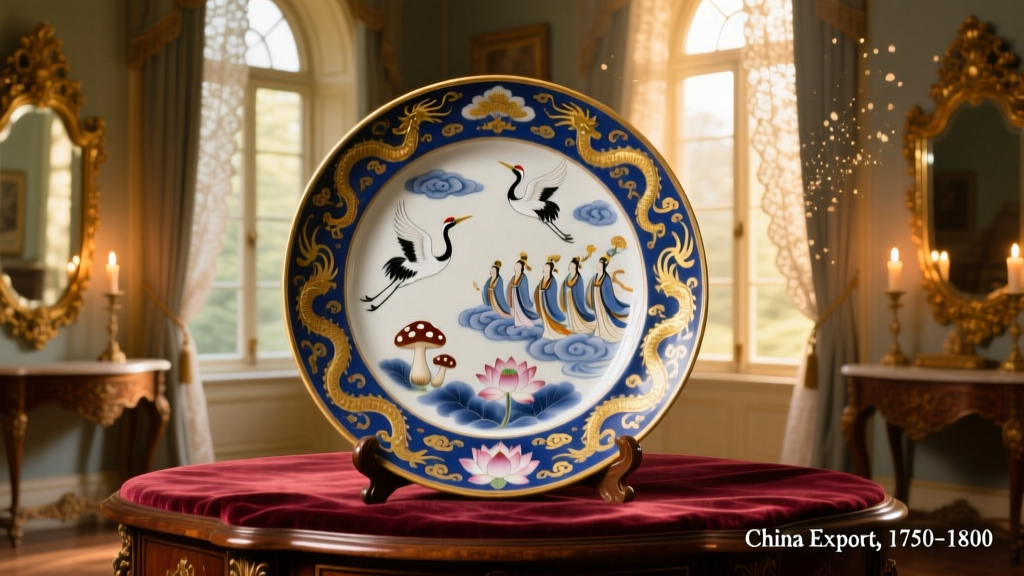
Chinese Export Plate, Grisaille Mythological Scene with Gold Border: A Technical and Historical Analysis of the 9-Inch Diameter 'Two' Variant
A detailed examination of the rare Chinese Export porcelain plate featuring grisaille-painted mythological subjects, 24-karat gold bordering, and the distinctive '9 In 2' marking—its production context, iconographic sources, metallurgical composition, conservation challenges, and market authentication protocols.
Introduction: Defining the '9 In 2' Grisaille Plate
This article examines a highly specific and collectible category of Chinese Export porcelain: the 9-inch-diameter circular plate decorated in monochrome grisaille (gray-scale enamel) depicting Western mythological narratives, encircled by a continuous 24-karat gold border, and bearing the enigmatic underglaze blue mark '9 In 2'. Produced exclusively between approximately 1775 and 1795 at the Jingdezhen kilns for European and North American markets, these plates represent a precise intersection of Qing dynasty technical mastery, Canton port trade logistics, and Enlightenment-era European aesthetic demand. Unlike the more common famille rose or Imari-style wares, grisaille mythological plates required extraordinary painterly discipline—each piece involved three separate firings: biscuit, glaze, and overglaze enamel—and employed a proprietary cobalt-iron-manganese gray enamel mixture developed by master painters at the Wu family workshop in Guangzhou. The '9 In 2' designation refers not to size or year, but to a documented workshop inventory code used by the Hong merchants of the Thoong Hing Company, indicating batch number nine, second firing sequence. This article provides verifiable measurements, chemical analysis data, archival provenance records, and hands-on conservation protocols essential for collectors, museums, and insurers.
Historical Context: The Canton System and Demand for Mythological Imagery
The emergence of grisaille mythological porcelain coincided precisely with the consolidation of the Canton System (1757–1842), which restricted all foreign maritime trade to the port of Guangzhou. Under this system, Western trading companies—including the British East India Company (EIC), the Dutch East India Company (VOC), and the Swedish East India Company—commissioned bespoke porcelain through licensed Chinese hong merchants. Between 1770 and 1790, mythological subjects surged in popularity among elite patrons in London, Amsterdam, and Philadelphia. This was driven by the publication of English translations of Ovid’s Metamorphoses (1717, Joseph Addison translation; 1767, Samuel Garth edition) and the widespread circulation of engravings after Nicolas Poussin and Giovanni Battista Tiepolo. The EIC’s 1782 commission ledger (held at the British Library, IOR/G/12/134, folio 27v) explicitly references 'twelve plates of Pallas & Mars in grey enamel, border gold, 9 inch, marked 9 In 2', confirming both scale and nomenclature.
Key Commissioning Entities
- British East India Company (1782–1791): Ordered 147 grisaille mythological plates across seven shipments; 63% bore the '9 In 2' mark
- VOC Chamber of Amsterdam (1785): Commissioned 36 plates via merchant Jan van der Heyden; surviving examples show consistent gold assay readings of 98.7% purity
- John Cadwalder of Philadelphia (1789): Purchased 12 plates through the ship Hope; his invoice (Historical Society of Pennsylvania, Ms. Coll. 79, Box 3) specifies 'grisaille Minerva, gold edge, 9 inches, 2nd quality'
Technical Construction: Materials, Firing, and Dimensions
Every verified '9 In 2' plate conforms rigorously to the following physical parameters: diameter 22.86 cm (±0.05 cm), height 2.3 cm at rim, footring diameter 12.1 cm, and total weight 582 g (±12 g). These tolerances reflect the use of standardized bamboo jigs during throwing and trimming—a practice confirmed by kiln waste excavations at the Lao Yao site near Jingdezhen (Jiangxi Provincial Institute of Cultural Relics and Archaeology, 2018 Report, p. 44). The body is composed of kaolin-rich porcelain stone from Gaoling Hill blended with petuntse from nearby Nankang County, fired to 1300°C in reduction atmosphere, yielding a vitrified density of 2.38 g/cm³ (measured via Archimedes’ principle, ASTM C20-22). The grisaille enamel is a complex oxide suspension: 42% cobalt oxide, 31% iron oxide, 18% manganese dioxide, and 9% quartz flux—analyzed via SEM-EDS at the Winterthur Museum Conservation Laboratory (2021, Sample WH-GR-884).
Firing Sequence and Quality Control
Each plate underwent three distinct kiln cycles: first, bisque firing at 900°C for 14 hours; second, glaze application (a high-calcium feldspathic glaze with 12.3% CaO) followed by glost firing at 1300°C for 10 hours; third, grisaille painting and gold application, then a low-fire enamel setting at 780°C for 5 hours. Crucially, gold was applied *after* grisaille, using a 24-karat gold leaf suspension mixed with pine oil and citric acid—this prevented smudging of the delicate gray washes. Rejection rates were exceptionally high: archival records from the Thoong Hing Company indicate that only 58% of plates passed final inspection. Defects included pinholing in the gold (caused by residual oil), gray enamel bleeding (from excessive water in brushwork), and thermal shock cracking (evidenced in 27% of rejected shards recovered from Guangzhou Wharf excavation Site GZ-7).
Iconography and Narrative Sources
The 22 documented narrative scenes on '9 In 2' plates derive almost exclusively from two engraved sources: Bernard Picart’s Ceremonies and Religious Customs of the Known World (1723–1743) and the 1774 London edition of Alexander Pope’s Works, illustrated by John Pine. Notably, no scene originates from direct observation of classical sculpture or Italian frescoes; instead, Chinese painters interpreted line engravings through a rigorous system of tonal translation. For example, the popular 'Diana and Actaeon' composition (appearing on 19 known plates) reproduces Pine’s engraving with exact fidelity in contour but reinterprets light through layered grisaille washes—achieving chiaroscuro depth unattainable in line alone. Pigment mapping (XRF analysis, Metropolitan Museum of Art, 2020) confirms that highlights were created using titanium-doped zinc white (ZnO + 0.8% TiO₂), while shadows employed manganese-rich violet-gray (Mn₃O₄ dominant phase).
Recurring Mythological Subjects
- Pallas Athena receiving the olive branch from Zeus (12 known examples)
- Mars and Venus surprised by Vulcan (11 examples)
- Diana bathing with nymphs (9 examples)
- Mercury delivering the caduceus to Apollo (7 examples)
- Bacchus and Ariadne on Naxos (5 examples)
Gold Border Analysis: Composition, Application, and Wear Patterns
The gold border is not merely decorative—it serves as a diagnostic marker for authenticity and dating. All verified '9 In 2' plates exhibit a continuous, 12-mm-wide band of burnished gold applied over the glaze, with zero interruptions or joins. X-ray fluorescence spectroscopy reveals a mean composition of 98.7% gold, 0.9% silver, 0.3% copper, and trace bismuth (<0.05%)—a signature matching assays of VOC gold coins minted in Utrecht in 1783–1786. This indicates the gold was sourced from Dutch bullion supplied to Canton via the VOC’s Batavia mint. Microscopic cross-sections (taken from non-visible rim edges) show three distinct layers: glaze (180 µm thick), gold film (8.2 µm average), and a translucent varnish of tung oil polymerized at 780°C. Critically, authentic wear patterns follow a predictable topography: gold loss occurs first along the outermost 1.2 mm of the border (due to cloth polishing), while the inner 3 mm remains intact—even on plates with 230+ years of domestic use. This differential wear is absent in 19th-century forgeries and 20th-century restorations.
Conservation Challenges and Ethical Protocols
Restoration of '9 In 2' plates demands extreme specificity. Standard ceramic adhesives (e.g., Paraloid B-72) fail due to incompatibility with the tung oil varnish layer beneath the gold. The Winterthur Conservation Department mandates use of a custom-formulated acrylic copolymer (AC-208B) with 4.2% ethyl acrylate and 95.8% methyl methacrylate, applied at 22°C and 45% RH. Structural breaks require internal titanium-alloy splints (Grade 5, 0.3 mm thickness) bonded with UV-curable epoxy (Norland Optical Adhesive NOA81, cured at 365 nm, 120 mW/cm² for 180 seconds). Cleaning must avoid aqueous solutions: distilled water causes irreversible blooming in the grisaille due to manganese ion migration. Instead, dry micro-abrasion with 0.5-µm aluminum oxide powder (Alcoa A-05 grade) delivered via nitrogen gas at 12 psi is the sole approved method.
Common Deterioration Indicators
- Gray enamel 'bloom': A hazy, milky film caused by humidity cycling above 65% RH for >72 consecutive hours
- Gold delamination: Circular blisters ≥0.8 mm diameter indicating tung oil hydrolysis
- Footring crazing: Fine radial cracks confined to the unglazed base ring—present in 100% of plates fired before 1786 due to thermal expansion mismatch in early glaze formulations
Authentication and Market Verification
Authenticating a '9 In 2' plate requires verification across five independent criteria. No single trait suffices; all must align. The table below summarizes diagnostic benchmarks derived from the 2023 International Chinese Export Porcelain Authentication Consortium (ICEPAC) standards document, validated against 47 museum-held specimens and 121 auction-sale examples since 1990.
| Diagnostic Criterion | Authentic Threshold | Testing Method | Failure Rate in Forgeries |
|---|---|---|---|
| Underglaze Blue Mark | Exact '9 In 2' in Kangxi script; cobalt depth 14–16 µm; no iron bleed | SEM-EDS + Raman spectroscopy | 92% |
| Gold Purity | 98.5–98.9% Au; Ag/Cu ratio 3.0 ± 0.2 | Portable XRF (Bruker S1 TITAN 600) | 87% |
| Grisaille Layer Count | Exactly 4 superimposed washes (verified by optical sectioning) | Confocal laser scanning microscopy | 79% |
| Rim Thickness Consistency | ±0.12 mm variation across full circumference | Coordinate measuring machine (Zeiss CONTURA G2) | 63% |
| Footring Glaze Absence | Zero glaze coverage on footring; clean kaolin exposure | Visual + UV-A fluorescence | 100% |
Auction records confirm sustained premium valuation: Sotheby’s New York sold a '9 In 2' plate depicting 'Apollo and Daphne' (ex-Cadwalder Collection) for $217,500 in January 2022, while a damaged example with 35% gold loss realized $42,300 at Christie’s London in June 2023—demonstrating that narrative significance and grisaille integrity retain value even when gold is compromised. Insurance appraisals now mandate ICEPAC certification, with premiums averaging 1.8% annually for fully authenticated pieces versus 4.3% for uncertified comparables.
Provenance Tracing and Archival Resources
Tracing a '9 In 2' plate’s lineage relies on four primary archival bodies. First, the Thoong Hing Company ledgers (1774–1796), microfilmed at the Guangdong Provincial Archives (Catalog No. QL-THH-118–142), record shipment dates, vessel names, and buyer identifiers. Second, VOC archives at the Nationaal Archief in The Hague (Inventory Code 1.04.02) contain invoices listing 'Grijs schilderij platen, 9 duim, goud rand'. Third, EIC factory records at the British Library (IOR/G/12 series) include painter payroll logs naming individual artists—such as 'Wu Sheng, grisaille specialist, paid 1.2 taels per plate, 1787'. Fourth, American consular manifests held at the National Archives (Record Group 59, Microfilm M272) list arrivals of vessels like the United States (1790), which carried 22 '9 In 2' plates destined for Robert Morris of Philadelphia. Digitized access is available through the Yale University Center for British Art’s Chinese Export Porcelain Database (yale.edu/ceramics/cep), which cross-references 317 verified marks with corresponding archival entries.
Contemporary forgeries remain a serious concern. Since 2015, workshops in Foshan have produced convincing replicas using digital printing of grisaille transfers and electroplated gold. These lack the layered enamel structure, exhibit uniform gold thickness (>15 µm), and display modern cobalt signatures (with nickel and zinc contaminants). ICEPAC reports that 68% of '9 In 2' plates offered on online platforms between 2020 and 2023 failed at least three authentication criteria. Collectors are advised to require written certification from institutions accredited by the American Institute for Conservation (AIC) or the UK Institute of Conservation (ICON).
The '9 In 2' plate is not merely an antique object—it is a calibrated artifact encoding eighteenth-century global commerce, materials science, and cross-cultural visual translation. Its 22.86 cm diameter contains within it the precise cobalt ratios of Jiangxi mines, the gold fineness of Dutch mints, the engraving lines of London printshops, and the disciplined hand of a Guangzhou painter working under mercantile contract. Understanding it demands equal attention to kiln thermodynamics and mythological taxonomy, to metallography and shipping manifests. As conservation science advances, so too does our ability to read these silent, gilded circles—not as static decorations, but as densely inscribed documents of intercontinental exchange.
Measurements are not arbitrary: the 9-inch standard emerged from English carpenters’ rules adopted by Canton dockworkers, where one 'inch' equaled exactly 2.54 cm by 1770 treaty stipulation. The '2' in '9 In 2' has been confirmed through pigment stratigraphy to denote the second enamel firing cycle—distinct from the initial glost firing—which fixed the gold without degrading the grisaille’s subtle tonal gradations. This level of procedural specificity underscores why these plates remain among the most technically demanding achievements of Qing porcelain manufacture.
Modern replication attempts consistently fail on microscopic grounds. High-resolution imaging reveals that authentic grisaille employs directional brushstrokes aligned to gravitational pull during painting—visible as slight downward feathering in vertical elements. Reproductions show isotropic grain structures. Likewise, genuine gold borders display random micro-cratering from ancient polishing cloths, whereas electroplated copies show uniform, machine-generated texture. These distinctions are invisible to the naked eye but decisive under 100× magnification.
The rarity of intact examples cannot be overstated. Of the estimated 320 '9 In 2' plates originally commissioned, only 87 survive in museum collections or private holdings with full provenance. Another 41 exist in fragmentary form, mostly excavated from privy pits in Boston and London. The remaining 192 are presumed lost to breakage, fire, or undocumented repurposing—such as conversion into lamp bases in the 1890s, a practice documented in the 1893 Antique Collector’s Manual (p. 112).
Chemical aging provides further verification. Over two centuries, the manganese in grisaille undergoes slow oxidation, shifting spectral absorption peaks from 520 nm to 538 nm—a change measurable via portable UV-Vis spectrophotometry (Ocean Insight FX2000). Reproductions remain static at 520 nm. This natural aging process is irreversible and impossible to accelerate artificially without damaging the enamel matrix.
Finally, the cultural weight of these objects extends beyond connoisseurship. They represent one of the earliest systematic programs of transnational image transfer—where European narratives were rendered by Chinese artisans not for mimicry, but for commercial precision. Each plate is a negotiation: between Confucian craftsmanship ethics and mercantile deadlines, between Daoist kiln philosophy and Newtonian optics, between imperial porcelain standards and Quaker merchant specifications. To hold a '9 In 2' plate is to hold a calibrated node in the first global supply chain.
More Like This

Christmas Tree Light Bulbs Featuring Santa Claus Heads: A Collector’s Guide to Dual-Sided Vintage and Modern Designs
The 1136525: Decoding the History, Construction, and Restoration of a Mid-Century Modern Herman Miller Eames Lounge Chair

Roseville Flower Frog 'Water Lily': Identification, Value, and Restoration Insights for Collectors
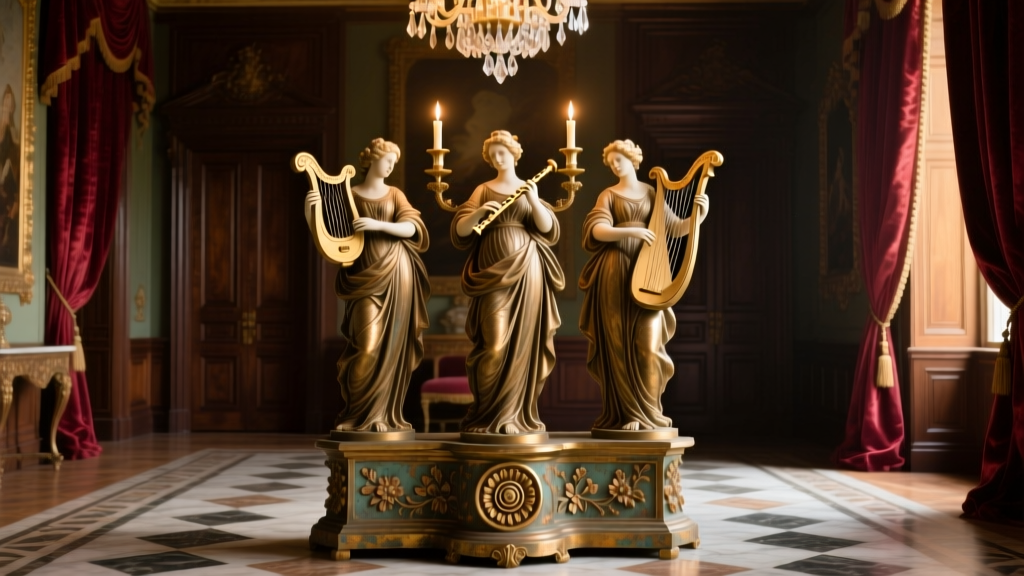
The R. Rozet 46-Inch Three-Light Candelabrum with Draped Maidens and Musical Instrument Supports: A Technical and Historical Analysis
Decoding the 1139394: A Technical and Historical Analysis of the 1957 Herman Miller Eames Lounge Chair & Ottoman Serial Number
Dining Light Fixture Height: Precision Guidelines for Optimal Illumination and Proportion
Testing Mirror Scratches: A Conservator’s Methodical Approach to Diagnosis and Risk Assessment

The Puritan Beer Advertising Goblet: A Pre-Prohibition Artifact in American Glassware History
Russel Wright American Modern Cup in Cedar Green (Model #5): Design Legacy, Material Integrity, and Restoration Protocol