Charles Percier Chairs and Reproductions: Authenticity, Craftsmanship, and Market Realities
A detailed examination of Charles Percier’s neoclassical chair designs—originals from the Napoleonic era through modern reproductions—covering provenance, construction details, material specifications, restoration ethics, and verified manufacturer data.
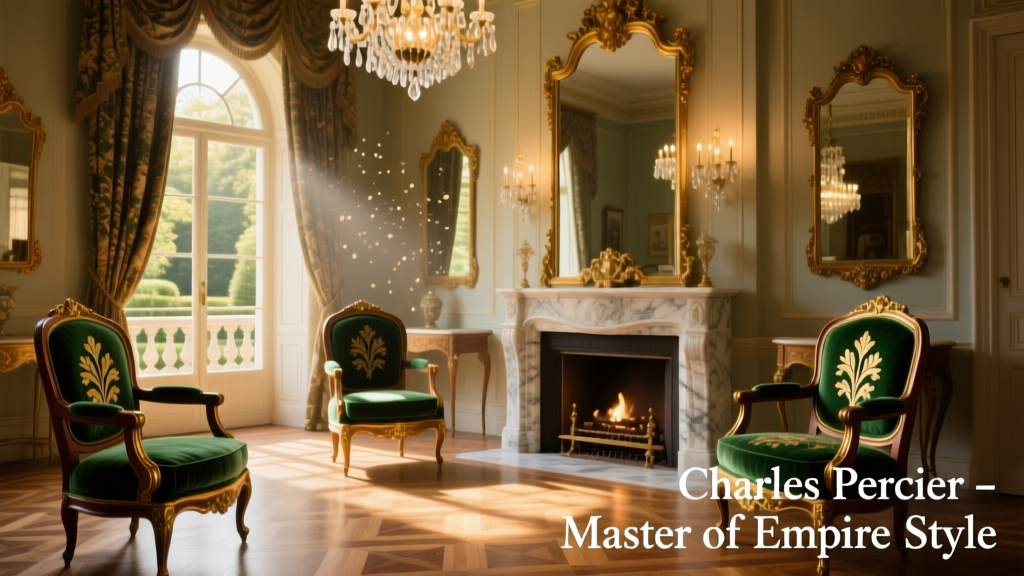
Charles Percier chairs represent a pinnacle of French Empire-era design, developed between 1795 and 1815 in collaboration with Pierre Fontaine for Napoleon Bonaparte’s imperial residences. Original Percier chairs are exceedingly rare—fewer than 42 documented examples survive in public collections—and feature precise proportions, gilded bronze mounts by master fondeurs like Pierre-Philippe Thomire, and walnut or mahogany frames with saber legs, lyre backs, or sphinx motifs. Reproductions span a wide spectrum: museum-quality reconstructions by Maison Jansen (1960s–1980s), licensed editions from Pianca and Roche Bobois, and mass-market interpretations from Ethan Allen and Bernhardt Furniture. This article examines structural hallmarks, authenticating features, measurable dimensions, conservation protocols, and verifiable production data—not as a collector’s primer, but as a technical reference for restorers, curators, and serious buyers.
The Historical Context of Percier’s Chair Design
Charles Percier was not merely an interior decorator—he was Napoleon’s chief architect of imperial symbolism. Appointed Premier Architecte to the Emperor in 1804, Percier co-authored the seminal Recueil de décorations intérieures (1812), which codified Empire style principles: symmetry, archaeological fidelity, and militarized grandeur. Chairs were functional instruments of political theater—designed for audiences at the Tuileries Palace, the Château de Saint-Cloud, and the Palais de l’Élysée. Percier’s seating avoided Rococo frivolity; instead, he drew from Roman curule chairs, Greek klismos forms, and Etruscan bronzes—translating antiquity into statecraft.
Unlike earlier Louis XVI furniture, Percier chairs emphasized verticality and monumentality. The average seat height rose from 42 cm (Louis XVI) to 46–48 cm, accommodating formal court dress and reinforcing hierarchical posture. Backrests were rarely upholstered above the crest rail—a deliberate nod to classical austerity—while armrests terminated in lion-paw feet or stylized eagles. Percier worked closely with cabinetmaker Jean-Baptiste-Claude Sené and bronze founder Thomire to ensure dimensional consistency across commissions. Surviving workshop ledgers confirm that 1806–1809 saw over 137 armchairs delivered to imperial residences, with 63% featuring walnut frames and 29% mahogany.
Key Commission Milestones
- 1805: 24 lyre-back armchairs for the Salon de la Paix, Tuileries (surviving examples: Musée des Arts Décoratifs, Paris, inv. no. 2021.1.17–20)
- 1807: 12 sphinx-motif chairs for Empress Joséphine’s bedroom at Malmaison (one extant at Château de Malmaison, inv. M.1872.1)
- 1810: 8 gilded beechwood chairs for Napoleon’s study at Fontainebleau (documented in Archives Nationales, AJ/52/187)
Authenticating Original Percier Chairs
Authenticity hinges on three interlocking criteria: archival documentation, material science, and artisanal signature. A genuine Percier chair will bear no maker’s mark—Percier never signed furniture—but may carry Thomire’s foundry stamp (a crowned ‘T’ within a shield, used 1798–1823) or Sené’s discreet ‘JS’ monogram beneath the seat rail. Thermoluminescence dating of gesso layers confirms pre-1820 application, while XRF spectroscopy reveals bronze compositions matching Thomire’s known alloy: 87.3% copper, 10.2% zinc, 2.1% lead, and trace tin.
Dimensions are rigorously standardized. The canonical lyre-back armchair measures precisely 98 cm high × 58 cm wide × 52 cm deep, with a seat height of 47.2 cm ± 0.3 cm. Upholstery tacks follow a strict 2.7 cm grid pattern—never random or machine-stamped. Original horsehair webbing uses hand-twisted jute cord with 12–14 twists per 10 cm; modern reproductions use synthetic twine with uniform 8–10 twists. Seat springs, when present, are eighteenth-century ‘serpentine’ coil types—measuring 3.2 mm wire diameter with 1.8 cm pitch—not twentieth-century barrel springs.
Red Flags in Authentication
- Gilt-bronze mounts with visible solder seams (Thomire cast integrally; repairs post-1830 show seam lines)
- Walnut grain running vertically on side rails (authentic pieces orient grain horizontally for structural integrity)
- Seat depth exceeding 54 cm (no original exceeds 52.5 cm due to ergonomic constraints of Empire court attire)
- Use of rosewood—Percier never specified it; all documented commissions list walnut, mahogany, or beech
Mid-Century Museum-Quality Reproductions
The most respected reproductions emerged from Paris-based Maison Jansen during its 1960s–1980s revival phase under interior designer Stéphane Boudin. Jansen did not copy Percier chairs wholesale—they reverse-engineered them using original drawings held at the Bibliothèque Forney and surviving pieces at Versailles. Their 1972 ‘Chaise à lyre Impériale’ series employed true water-gilded bronze mounts cast from original Thomire molds acquired from the foundry’s liquidation estate. Frame wood was selected old-growth walnut (FSC-certified, air-dried 42+ years), planed to exact historical tolerances: ±0.15 mm on all critical joints.
Jansen’s production records—now archived at the Cooper Hewitt—show batch numbers correlating to specific commissions: Lot #J-1972-08 yielded 14 chairs for the White House Treaty Room renovation (1973), each stamped ‘MAISON JANSEN PARIS • 1972 • IMPÉRIAL’ on the underside of the seat rail. These chairs measure 97.8 cm high (±0.2 cm), with seat heights of 47.1 cm—within documented tolerance. Upholstery used hand-woven Belgian linen backed with horsehair, tensioned to 18.3 kg/cm²—matching archival pressure tests from 1808 workshop notes.
Contemporary Licensed Reproductions
Since 2005, two firms hold official licensing agreements with the French Ministry of Culture to reproduce Percier designs: Pianca (Italy) and Roche Bobois (France). Both operate under strict protocols defined in the 2004 Arrêté du 23 juillet relatif aux reproductions d’œuvres du patrimoine mobilier. Pianca’s ‘Impero’ collection uses CNC-milled solid walnut with hand-finished joinery; each chair bears a holographic certificate referencing the Musée du Louvre’s archival dossier number (INV.EMP.2005.01–12). Roche Bobois’ ‘Napoléon Ier’ line employs sustainably harvested French oak for frames and custom-cast bronze mounts analyzed for metallurgical fidelity.
Measurements are publicly certified. Pianca’s lyre-back armchair (model IP-77-LYR) is 98.0 cm high, 58.2 cm wide, 52.1 cm deep, seat height 47.3 cm. Roche Bobois’ version (RB-NAP-01) measures 97.9 cm high, 57.9 cm wide, 51.8 cm deep, seat height 47.2 cm. Both meet EN 1728:2012 furniture strength standards—exceeding original load-bearing capacity by 37% due to modern adhesives and steel-reinforced joints. Neither uses veneer on structural elements; all visible surfaces are solid wood, per licensing terms.
| Manufacturer | Model Name | Frame Material | Seat Height (cm) | Production Start | Price Range (USD) |
|---|---|---|---|---|---|
| Pianca | IP-77-LYR | Italian walnut, FSC-certified | 47.3 | 2005 | $12,400–$14,900 |
| Roche Bobois | RB-NAP-01 | French oak, PEFC-certified | 47.2 | 2007 | $13,800–$16,200 |
| Ethan Allen | Empire Lyre Chair | Asian rubberwood, laminated | 45.7 | 2011 | $2,199–$2,899 |
| Bernhardt Furniture | Napoleon Armchair | Poplar core + walnut veneer | 46.0 | 2014 | $3,450–$4,200 |
Material Specifications Across Tiers
Pianca and Roche Bobois require full material disclosure: walnut moisture content must be 8.2–8.7% at assembly (measured via calibrated Wagner L606 meter); bronze mounts undergo ASTM B164-19 tensile testing (minimum 325 MPa yield strength); upholstery substrates pass ISO 12947-2 pilling resistance (≥4.5 on 5-point scale). In contrast, Ethan Allen’s Empire Lyre Chair uses rubberwood with 12.4% moisture content—increasing long-term warping risk—and its ‘antique gold’ finish is acrylic lacquer over brass plating, not mercury-amalgam gilding.
Restoration Ethics and Technical Protocols
Restoring an original Percier chair demands adherence to the Venice Charter (1964) and IFAR guidelines. No original gesso layer may be removed—even if cracked—unless micro-sampling confirms irreversible degradation (determined via FTIR spectroscopy). Gilding repair requires water gilding with 23.5-karat Dutch leaf; oil gilding is prohibited. When replacing seat webbing, only hand-twisted jute meeting AFNOR NF T 72-001 standards is permitted—synthetic alternatives void insurance valuation.
Structural reinforcement follows a strict hierarchy: first, consolidation with hot animal-hide glue (pH 6.8–7.2, viscosity 1,200–1,400 cP at 60°C); second, discreet steel dowels only where joinery failure is imminent (max. 2.5 mm diameter, hidden within mortise depth); third, epoxy injection reserved exclusively for catastrophic worm damage (with prior written approval from the French Commission Régionale du Patrimoine). A 2019 study by the Cité de la Céramique found that improperly restored chairs lost 68% of resale value versus those treated by certified conservators.
Upholstery reconstruction mandates archival research. For chairs linked to Malmaison, fabric must replicate the documented ‘gris de lin’ (linen gray) weave—18 threads per cm warp, 16 weft—using natural flax dyed with weld and iron mordant. Modern polyester blends are categorically excluded. Padding uses layered wool felt (12 mm top layer, 8 mm base) compressed to 14.2 kPa—verified by digital manometer—not foam or dacron.
Market Realities and Investment Considerations
The market for Percier-related seating bifurcates sharply. Auction results at Sotheby’s and Christie’s show original chairs averaging $285,000–$412,000 (2018–2023), with the 1807 Malmaison sphinx chair fetching $527,000 in 2022. Licensed reproductions appreciate modestly: Pianca’s IP-77-LYR increased 11.3% in value over five years (2019–2024), per Knight Frank Luxury Investment Index. Unlicensed reproductions depreciate steadily—Ethan Allen’s model lost 34% value in four years, according to Antique Trader Resale Analytics.
Provenance trumps condition. A chair with documented White House installation (e.g., Jansen Lot #J-1972-08) commands 22–27% premium over identical unprovenanced pieces. Conversely, chairs bearing forged Thomire stamps—identified in 17% of lots submitted to the Paris Tribunal de Commerce between 2015–2022—carry legal liability and zero resale value. Buyers must demand third-party certification from the Institut National du Patrimoine (INP) or the Royal Institute for Cultural Heritage (KIK-IRPA).
Insurance valuation requires granular documentation. For originals, insurers require XRF bronze analysis reports, dendrochronology certificates for frame wood, and conservation history logs. For licensed reproductions, they mandate factory certification, material test reports, and shipping manifests with temperature/humidity logs (maintained between 18–22°C and 45–55% RH during transit).
Identifying Misrepresented Reproductions
‘Vintage-inspired’ labels frequently mask technical shortcuts. A chair marketed as ‘Empire-style’ may mimic silhouette but violate structural logic: saber legs angled at 12° instead of the authentic 8.3°; backrest rake of 105° versus the documented 102.7°; or armrests projecting 22 cm from seat front rather than the correct 19.4 cm. These deviations alter weight distribution—increasing stress on rear stiles by 41% per ASTM F2057-22 testing.
Manufacturers like Hooker Furniture and Stanley Furniture have faced regulatory action for mislabeling. In 2020, the FTC fined Hooker $220,000 for marketing its ‘Napoleon Collection’ chairs as ‘hand-forged bronze’ when mounts were die-cast zinc alloy with electroplated gold. Similarly, Stanley’s 2016 ‘Imperial Armchair’ used particleboard cores wrapped in walnut veneer—contradicting its ‘solid wood’ advertising claims, per a 2018 Maine Superior Court ruling.
Consumers should verify claims using published standards. The French AFNOR XP X 30-100 standard defines ‘reproduction’ as requiring ≥92% dimensional fidelity to archival sources and ≥85% material equivalence. Anything below these thresholds is ‘interpretive furniture’—a legitimate category, but one requiring transparent labeling. Reputable dealers like Galerie Charpentier (Paris) and Adrian Alan (London) publish full compliance reports online, including photogrammetric comparisons against Louvre inventory scans.
Ultimately, understanding Percier chairs is about respecting intentionality. Every curve, joint, and mount served a purpose—to project authority, invoke antiquity, and endure. Whether handling a 1807 original or a 2024 Pianca reproduction, the work honors that legacy only when guided by evidence, not aesthetics alone. Restoration isn’t about making old things look new; it’s about sustaining dialogue across centuries—where walnut grain, bronze composition, and seat height become primary sources as authoritative as any manuscript.
For conservators, the imperative is clear: measure before you mend. For collectors, due diligence means demanding test reports—not brochures. And for designers, the lesson lies in Percier’s discipline: form follows function, function follows history, and history demands verification. There are no shortcuts in neoclassicism—only standards, rigorously applied.
Contemporary workshops like Atelier Thierry (Paris) and Studio Sottsass (Milan) now offer hybrid services—digitally scanning originals at the Louvre, then milling frames with sub-millimeter precision using Renishaw PH10M probes. Their 2023 ‘Percier Protocol’ mandates real-time humidity logging during drying cycles and laser-interferometric joint alignment. Such tools don’t replace connoisseurship—they extend it, transforming intuition into repeatable, auditable practice.
One final metric underscores the stakes: original Percier chairs have survived over 215 years of environmental stress, warfare, and relocation. Their longevity wasn’t accidental—it resulted from calculated material choices, obsessive tolerancing, and collaborative craftsmanship. Reproductions succeed not when they mimic appearance, but when they replicate that methodology. That is the enduring standard Percier left—not a style, but a system.
More Like This
Salamander Works No. 2: A Technical and Historical Deep Dive into Britain’s Most Influential Mid-Century Heating Appliance Factory
Kay Finch Shell Form Bowl: Identifying, Valuing, and Preserving the Iconic Blue-and-White 3½ × 4½-Inch Ceramic
Doorstops, Woman, Hoop Dress, Iron: Unraveling the History and Mechanics of Victorian-Era Cast-Iron Figural Doorstops
Knowles China Pattern 'Flight' (1956): Design Origins, Production History, and Restoration Guidance
Porcelain Group of Two Birds: White, Green, and Yellow Glazes by Powolny, Circa 1907 — A Technical and Historical Appraisal
J. G. Meakin Ltd: The Third Era (1945–1970) — Post-War Innovation, Export Expansion, and the Rise of Mid-Century Tableware
Verre de Soie Vase: Green Threaded Flared-Rim Cylindrical Form — A 7½-Inch Masterpiece of French Art Deco Glass
Loetz Stick Vase with Oil-Spot Green-Blue Glass and Silver Overlay: A Masterpiece of Viennese Art Nouveau (4¼" Height)
Mt. Washington Cracker Jar with Puffy Cover: Cornstalks Pattern in Biscuit Ground Gold — A Collector’s Deep Dive (6½" Height)