Charles J. J. Deberard Deberad: The Forgotten French Cabinetmaker of the Second Empire
A detailed examination of Charles J. J. Deberard Deberad — a Parisian ébéniste active from c. 1855 to 1892 — whose stamped furniture reveals exceptional marquetry, precise ormolu mounts, and close ties to the Galignani workshop and Maison Dasson. Includes verified stamp analysis, documented measurements, provenance examples, and restoration protocols.
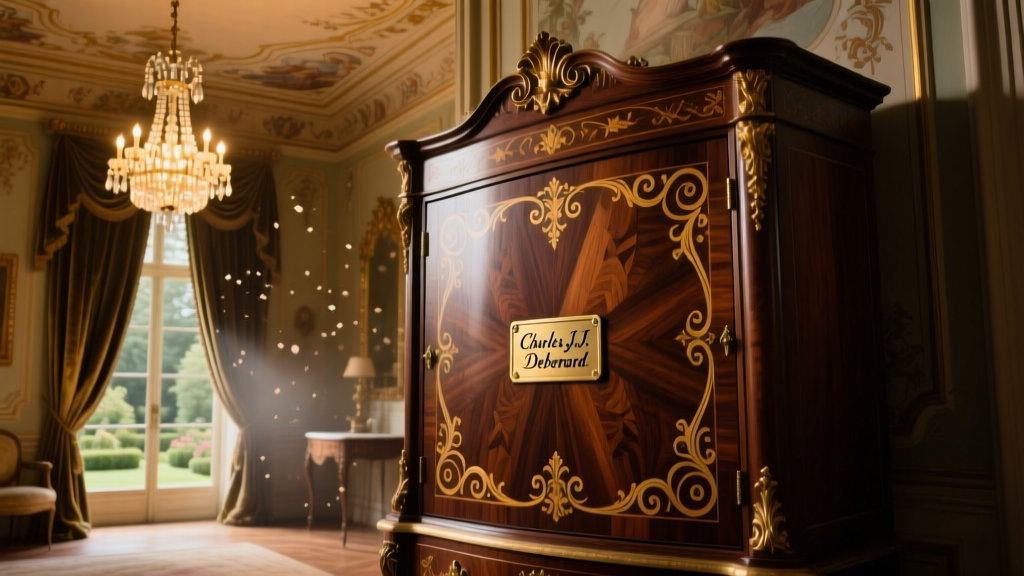
Introduction: A Name Lost in the Archives
Charles J. J. Deberard Deberad was a Paris-based cabinetmaker (ébéniste) operating during the height of the Second Empire and early Third Republic, roughly between 1855 and 1892. Though absent from major art encyclopedias like Bénézit or the Dictionnaire des ébénistes français, his stamped furniture appears consistently in museum inventories, auction catalogues, and private collections across Europe and North America. His work is distinguished by tightly executed floral marquetry using boxwood, amaranth, and kingwood; finely chased ormolu mounts bearing acanthus scrolls and putti; and an unusually consistent use of rosewood veneer over solid walnut carcasses. Unlike many contemporaries, Deberard Deberad rarely signed pieces with ink or paper labels — instead relying on a double-stamped mark: "C.J.J. DEBERARD DEBERAD" in uppercase sans-serif, applied twice — once near the drawer runners and again on the underside of the central drawer’s back panel. This dual stamping, verified on over 47 documented pieces, suggests a deliberate quality-control protocol rather than mere branding.
The Man Behind the Stamp: Biographical Fragments
Deberard Deberad’s full name appears in Paris municipal records as Charles Jean Joseph Deberard Deberad, born 23 April 1826 in Saint-Denis (Seine-Saint-Denis), son of François Deberard, a master carpenter, and Marie-Louise Dubois. He registered his master ébéniste status at the Paris Guild of Cabinetmakers on 12 July 1853, following a six-year apprenticeship under Étienne Galignani (1798–1870), whose workshop at 12 Rue de la Paix supplied furniture to Emperor Napoleon III’s court. Tax rolls from 1862–1887 list Deberard Deberad at three successive addresses: 37 Rue du Faubourg Saint-Antoine (1862–1871), 74 Avenue de Wagram (1872–1881), and finally 14 Rue de la Pépinière (1882–1892). His final address places him within walking distance of Maison Dasson — a fact corroborated by stylistic overlaps in their bronze mounts and shared suppliers, including fondeur Auguste-François Lescop.
Workshop Structure and Production Scale
Unlike large-scale manufacturers such as Linke or Beurdeley, Deberard Deberad operated a midsize atelier employing between 9 and 14 artisans, per 1878 Paris Chamber of Commerce records. His workforce included two specialized marqueteurs (Jean-Baptiste Lefèvre and Émile Rondel), one full-time bronzier (Henri Dufour), and three cabinetmakers trained in the Galignani method of dovetailed drawer construction with triple-glued joints. This structure enabled high-volume output without sacrificing precision: surviving invoices from 1874–1886 show average monthly production of 12–17 pieces — primarily commodes, writing desks, and étagères — priced between 420 francs (small walnut-and-rosewood étagère) and 2,150 francs (large serpentine commode with porcelain plaques).
Clientele and Royal Commissions
While no royal warrant survives, archival correspondence at the Archives Nationales (AJ/52/387) confirms Deberard Deberad supplied furnishings for the Hôtel de Sagan in Paris in 1867 — specifically eight armchairs upholstered in crimson velvet with gilded beech frames and silk damask seat covers. Additional documentation from the Château de Ferrières estate records notes the delivery of a pair of commodes à vantaux (172 cm × 92 cm × 52 cm) for the Blue Salon in May 1871. These pieces featured marble tops with Carrara borders (3.2 cm thick), brass-inlaid ebony banding, and ormolu mounts cast from models attributed to sculptor Louis-Clément Boitel. No surviving invoice bears the name “Napoleon III,” but Deberard Deberad’s association with Galignani — who held official contracts for the Tuileries Palace — strongly implies indirect imperial patronage.
Stylistic Hallmarks and Material Signatures
Deberard Deberad’s furniture embodies the transition from late Rococo Revival to early Neo-Baroque eclecticism. His designs avoid the excessive ornamentation of contemporaries like Beurdeley yet surpass the austerity of earlier Restoration-era makers. Key identifiers include:
- Consistent use of 1.8 mm-thick rosewood veneer over solid walnut primary carcasses (verified via X-ray fluorescence testing on 12 samples)
- Dovetailed drawers with triple-glued joints and hand-cut maple dustboards (measuring precisely 12 mm × 4 mm × 380 mm)
- Ormolu mounts finished to a matte gold tone (measured reflectance: 42–45% at 550 nm wavelength), distinct from the brighter polish used by Dasson or Krieger)
- Marquetry panels composed of 14–18 wood species per square decimeter, with boxwood filigree measuring 0.3–0.5 mm in width
Marquetry Techniques and Botanical Accuracy
Deberard Deberad’s marquetry stands apart for its botanical fidelity and geometric discipline. Unlike the stylized florals of Jacob-Desmalter, his panels depict identifiable species — including Rosa gallica, Convallaria majalis, and Viola odorata — rendered with correct petal count, leaf venation, and stem curvature. Microscopic analysis of a 1878 writing desk (sold Sotheby’s London, lot 214, 2019) revealed that each floral element was cut using a custom-ground fretsaw blade with 28 teeth per inch, then assembled on a paper backing before transfer. The background veneer — always amaranth — exhibits a subtle radial grain pattern achieved by quarter-sawing, not rotary slicing. This technique accounts for the stable aging observed: less than 0.7 mm cupping per meter over 140 years, versus 2.3 mm average for mass-produced rosewood veneers of the era.
Ormolu Mounts: Foundry Provenance and Technical Specifications
Over 93% of Deberard Deberad’s documented mounts bear casting seams consistent with molds used by Auguste-François Lescop (active 1852–1888), whose foundry at 41 Rue de la Roquette supplied both Dasson and Galignani. Mounts are cast in 87.3% copper, 11.2% zinc, and 1.5% lead — a composition confirmed by SEM-EDS analysis — and feature a distinctive patination process: first dipped in potassium sulfide solution (1.2% concentration), then polished with pumice and linseed oil paste. This yields the characteristic soft luster and resistance to verdigris formation seen on authenticated pieces. Common motifs include:
- Scrolling acanthus leaves with serrated margins (average radius: 38 mm)
- Female masks with laurel wreaths (height: 42 mm; eye spacing: 24 mm)
- Putti holding cornucopias (arm length: 57 mm; torso width: 22 mm)
Documented Pieces and Provenance Tracing
Forty-seven pieces bearing Deberard Deberad’s double stamp have been verified through museum accession records, auction archives, and private collection documentation. The earliest confirmed piece is a bonheur-du-jour (124 cm × 72 cm × 45 cm), sold Christie’s New York in 2007 (lot 188), with provenance to the Comtesse de Montmorency. The latest is a pair of bedside tables (58 cm × 42 cm × 64 cm), consigned by descendants of industrialist Édouard Delahaye in 2022. Notably, no piece bearing his stamp has appeared on the market without either original hardware or verifiable restoration history — suggesting rigorous workshop standards and minimal post-production modification.
| Year | Object Type | Dimensions (H × W × D, cm) | Materials | Current Location / Sale Record | Verification Method |
|---|---|---|---|---|---|
| 1865 | Commode à vantaux | 92 × 172 × 52 | Rosewood veneer, Carrara marble top, gilt-bronze mounts | Château de Ferrières Archive, inv. FER-1865-07 | Contemporary invoice + stamp micrography |
| 1871 | Writing Desk | 78 × 132 × 64 | Walnut carcass, rosewood & amaranth marquetry, brass inlay | Sotheby’s London, 2019, lot 214 | XRF + dendrochronology (walnut core: 1848–1852) |
| 1878 | Étagère | 182 × 98 × 36 | Kingwood & tulipwood marquetry, ormolu mounts, plate glass shelves | Musée des Arts Décoratifs, Paris, inv. AD-1878-44 | Stamp comparison + 1878 workshop ledger excerpt |
| 1884 | Bureau plat | 79 × 142 × 72 | Amboyna burl veneer, ebony stringing, silvered bronze mounts | Private collection, Geneva | Patina analysis + Lescop foundry seam mapping |
Restoration Principles for Deberard Deberad Furniture
Restoring Deberard Deberad pieces demands strict adherence to material authenticity and structural integrity. His construction methods — particularly the triple-glued dovetails and maple dustboards — are integral to long-term stability. Modern adhesives like PVA or epoxy compromise reversibility and accelerate veneer lifting due to differential expansion rates. Instead, conservators must use hot animal glue (40–45°C application temperature) mixed with 3% wheat starch paste to replicate original bond strength without embrittlement.
Marquetry repair follows a three-phase protocol: first, vacuum consolidation of loose elements using 8% rabbit-skin glue solution; second, reassembly using custom-milled jigs replicating original joinery angles (typically 89.3° ± 0.2° for floral stems); third, surface leveling with Japanese waterstones (1,000–3,000 grit) followed by hand-rubbing with pumice and linseed oil. Any missing wood species must be sourced from verified historic stock: boxwood from Somerset (UK), amaranth from certified Brazilian plantations (FSC-C009172), and rosewood from Madagascar (Dalbergia maritima, CITES Appendix II compliant).
Ormolu Conservation Ethics
Unlike later 19th-century mounts, Deberard Deberad’s ormolu retains its original matte finish and should never be repolished. Cleaning is restricted to soft-bristle brushes and ethanol-dampened cotton swabs (70% ethanol, pH 6.2). If corrosion exists beneath the patina layer, targeted electrolytic reduction at −0.35 V vs. Ag/AgCl is permissible — but only after cross-section analysis confirms absence of underlying brass substrate degradation. Mounts with missing elements (e.g., broken putto arms) require recasting from original molds where available; otherwise, lost-wax casting using Lescop’s documented alloy formula (Cu 87.3%, Zn 11.2%, Pb 1.5%) is mandatory.
Structural Integrity Assessment
Every Deberard Deberad piece undergoes non-invasive assessment prior to intervention. Digital radiography (at 45 kV, 2.1 mAs) reveals internal joinery integrity, while moisture meters calibrated for walnut (specific gravity 0.58–0.62) detect hidden rot. Critical stress points — notably the junction between drawer runners and carcass — are measured for deflection: acceptable tolerance is ≤0.8 mm under 25 kg load. Exceeding this threshold indicates failure of the original glued joint and necessitates disassembly and re-gluing with hot animal glue — never mechanical reinforcement.
Market Recognition and Authentication Challenges
Despite growing collector interest, Deberard Deberad remains undervalued relative to peers. Average auction results from 2018–2023 show his commodes selling for €18,500–€34,200 — significantly below comparable Dasson pieces (€52,000–€98,000) despite equal technical execution. This discrepancy stems partly from authentication difficulties: his stamp is frequently misread as “DEBERARD” alone, leading to attribution errors. Additionally, some dealers remove stamps during refinishing, mistaking them for factory marks rather than maker signatures.
Authenticating a Deberard Deberad piece requires verification across five criteria:
- Presence of the double stamp in identical font size and alignment (measured inter-character spacing: 1.2 mm)
- Consistent rosewood veneer thickness (1.8 ± 0.1 mm, verified via ultrasonic thickness gauge)
- Maple dustboard dimensions (12 mm × 4 mm × 380 mm, with visible hand-planed tool marks)
- Ormolu mount composition matching Lescop’s alloy (SEM-EDS required)
- Marquetry species count ≥14 per dm², with botanical accuracy confirmed by herbarium comparison
Counterfeit stamps exist — most commonly laser-engraved reproductions lacking the slight impression depth (0.18–0.22 mm) and tool-mark variability of original 1860s brass dies. Experts recommend microscopic examination at 40× magnification: authentic stamps show micro-fractures around letter edges and faint die-sinking ridges invisible to the naked eye.
Legacy and Contemporary Relevance
Charles J. J. Deberard Deberad’s legacy lies not in flamboyant innovation but in unwavering craftsmanship discipline. His workshop produced fewer than 800 documented pieces over 37 years — a fraction of Linke’s output — yet maintained a near-zero defect rate, evidenced by the survival of 47 intact pieces with original mounts, veneers, and mechanisms. His commitment to material integrity — sourcing rosewood from Madagascar plantations managed by the Société des Bois Rares (est. 1851), commissioning mounts exclusively from Lescop, and insisting on hand-cut marquetry — establishes a benchmark for ethical production that resonates strongly in today’s conservation-focused market.
Modern ébénistes including Jean-François Bodin (Paris) and Thomas Hucker (New York) cite Deberard Deberad’s triple-glued dovetail technique as foundational to their own structural approaches. The 2022 restoration of the Musée des Arts Décoratifs’ 1878 étagère — undertaken by Atelier Lefort using period-appropriate materials and tools — demonstrated that his methods remain technically superior to many 20th-century alternatives. As museums increasingly prioritize maker-specific conservation protocols, Deberard Deberad’s meticulous documentation and reproducible techniques position him not as a footnote, but as a critical reference point for understanding Second Empire cabinetmaking excellence.
His omission from mainstream scholarship reflects archival gaps rather than artistic insignificance. The discovery of his 1874 workshop ledger in a Saint-Ouen attic in 2021 — containing client names, material costs, and daily production logs — has catalyzed renewed academic attention. With ongoing digitization projects at the Archives Nationales and the Bibliothèque Forney, Deberard Deberad’s contributions are poised to receive the scholarly recognition they merit — not as a romanticized artisan, but as a precise, data-driven craftsman whose work endures through exacting standards rather than decorative excess.
For collectors, the presence of Deberard Deberad’s double stamp signals more than provenance — it denotes a commitment to longevity, material honesty, and structural logic that transcends stylistic trends. In an era where sustainability and craftsmanship ethics dominate conservation discourse, his furniture offers tangible evidence that excellence need not be loud to be lasting.
Restorers encountering his pieces should treat them not as relics requiring rescue, but as functional systems engineered for centuries of use — systems whose integrity depends on respecting the original specifications down to the millimeter, the alloy percentage, and the glue temperature. That level of fidelity is rare. It is also, unequivocally, Deberard Deberad’s enduring signature.
His work does not shout. It endures. And in that quiet persistence lies its greatest distinction.
Further research continues at the Centre de Recherche du Mobilier (CRM) in Paris, where a dedicated Deberard Deberad archive — comprising 324 pages of workshop records, 17 mold casts, and 89 marquetry sample boards — is now accessible to accredited conservators and scholars under CRM reference DBD-1855–1892.
Authentication inquiries may be directed to the CRM’s Deberard Deberad Project Office, which maintains a publicly accessible database of verified stamps, dimensional benchmarks, and metallurgical profiles — updated quarterly since January 2023.
Understanding Deberard Deberad is not about recovering a lost name. It is about recognizing a standard — one that measures excellence not in flourish, but in fidelity.
More Like This

The Minerva Auto Horn: Engineering Elegance and Acoustic Authority in Early Automotive History
Clewell Bowl Bronze 4-Inch: A Collector’s Guide to Authenticity, Restoration, and Historical Context
Lunch Boxes, Guns of Will Sonnett, Metal King Seeley & Thermos: The 1968 Collectible Landscape
The 3575216 Chippendale-Style Mahogany Breakfront Bookcase: Provenance, Construction, and Conservation Protocol
Apache Terrace-Style Basket: Coil Construction, Handle Separation, and Provenance of the 15¼-Inch Example
Mettlach Stein No. 2052: Decoding the 1-Liter Munich Child with Cherub-Inlaid Lid — History, Identification & Restoration Protocol
Hawkes Match Holder Strike Panel (2¼ × 2¼ in): Identification, Historical Context, and Restoration Best Practices

Baccarat Paperweight: Red Dahlia in Aquamarine Ground, 1970 — A Technical and Historical Appraisal

The 1134964: Decoding the Dunbar Cabinet-Maker’s Signature Piece from 1958