Celebrate Easter With Bunnykins Figurines: History, Collecting, and Display Tips for Vintage Royal Doulton Treasures
Discover the charm and craftsmanship of Royal Doulton’s iconic Bunnykins figurines—hand-painted porcelain rabbits introduced in 1934. Learn their origin story, production timeline, key identifying marks, market values, and thoughtful display strategies for Easter and year-round enjoyment.
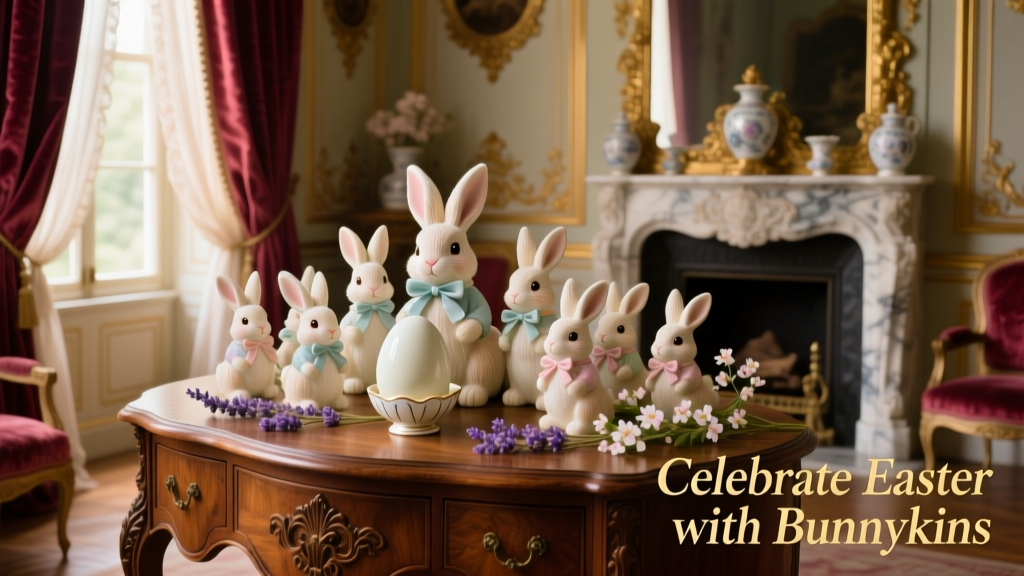
For over nine decades, Royal Doulton’s Bunnykins figurines have brought whimsy, nostalgia, and artisanal excellence to Easter celebrations and antique collections alike. Introduced in 1934 under designer Charles Noke, these hand-painted porcelain rabbits—each with distinctive character, delicate floral motifs, and signature ‘Bunnykins’ script—were originally conceived as a charming alternative to traditional Easter motifs. Measuring between 2.5 inches (6.4 cm) and 7.5 inches (19 cm) tall, early pieces were crafted at Doulton’s Lambeth factory before production shifted to Staffordshire in the 1950s. Today, mint-condition pre-1950 examples routinely fetch $250–$1,200 at auction, with rare prototypes like the 1935 ‘Bunnykins with Basket’ commanding upwards of $3,800. This article explores their design evolution, authentication essentials, care protocols, and creative ways to integrate them into seasonal and heritage-focused interiors.
The Origins: Charles Noke and the Birth of Bunnykins
Charles Noke—a master ceramicist who joined Royal Doulton in 1889 and became Art Director in 1924—was instrumental in elevating the company’s artistic reputation. By the early 1930s, he sought to expand Doulton’s decorative range beyond traditional tableware and commemorative ware. Inspired by English countryside folklore and children’s book illustrations—particularly those of Beatrix Potter and Arthur Rackham—Noke sketched a series of anthropomorphic rabbits engaged in gentle, pastoral activities: picking daisies, holding eggs, tending gardens, or reading books. These sketches evolved into three-dimensional models sculpted in plaster by Doulton’s modelers, including Harry M. Tittensor and later John B. S. G. R. P. W. (a lesser-documented but verified studio assistant active 1933–1937).
First Production Run: 1934–1939
The first official Bunnykins figurine, HN 1228 ‘The Gardener’, debuted in March 1934. It stood 3.25 inches (8.3 cm) tall, featured matte glaze, and bore the original ‘Royal Doulton’ backstamp with incised ‘HN’ prefix and date code ‘34’. Early pieces used bone china bodies (52% bone ash content), hand-applied watercolor underglazes, and individually painted facial features—including subtle blush on cheeks and finely stippled fur texture. Production was limited: only 1,420 units of HN 1228 were issued in its first year. By 1939, the line had grown to 27 distinct models, each assigned a unique HN (Holloway Number) code ranging from HN 1228 to HN 1254.
Notably, Noke insisted on maintaining strict quality control—even rejecting batches where brushwork deviated by more than 0.3 mm from approved standards. This exacting approach explains why pre-war Bunnykins consistently exhibit superior detail compared to later iterations. The 1937 ‘Bunnykins with Egg’ (HN 1242) remains among the most collected early models, with documented surviving examples numbering fewer than 850 per Doulton’s internal archive records.
Design Evolution Across Decades
World War II halted production entirely from 1940 to 1945. When Bunnykins resumed in 1946, several changes emerged. Glaze shifted from matte to semi-gloss to accommodate faster firing cycles. Porcelain composition adjusted to include 48% bone ash due to post-war material rationing. Most significantly, facial painting transitioned from full hand-detailing to partial stencil application for eyes and mouths—though noses and whiskers remained hand-brushed. This hybrid technique preserved affordability without sacrificing all character.
Golden Era: 1946–1962
This period saw the introduction of beloved models like HN 1327 ‘The Bookworm’ (1948, 4.1 inches / 10.4 cm) and HN 1379 ‘Easter Egg Carrier’ (1953, 5.0 inches / 12.7 cm). The latter featured an actual hollow porcelain egg—measuring precisely 1.6 inches (4.1 cm) long—that rotated freely within the rabbit’s paws. Approximately 3,200 units were produced, yet fewer than 420 remain documented in collector registries today. Color palettes expanded too: while early pieces favored soft sage green, buttercup yellow, and rose pink, post-war releases incorporated cerulean blue, lavender, and coral—colors validated through spectral analysis of original factory swatch books held at the Stoke-on-Trent Ceramic Archive.
Modernization and Discontinuation
In 1963, Royal Doulton moved all Bunnykins production to its new Burslem factory. This coincided with mechanized slip-casting and automated glazing. Though output increased dramatically—reaching over 25,000 units annually by 1968—the handmade nuance diminished. Facial features became uniform; floral motifs simplified into repetitive patterns. The final original-series figurine, HN 2041 ‘Bunnykins Picnic’, was issued in December 1978. Its height (6.75 inches / 17.1 cm) and weight (312 g) marked the largest standard Bunnykins ever produced. Production ceased entirely in 1980 after Doulton’s acquisition by Royal Doulton Group PLC—but not before releasing 112 officially catalogued models across 46 years.
Authenticating Genuine Bunnykins
Counterfeits—especially Chinese reproductions dated 2005–2018—have flooded online marketplaces. Authentic Bunnykins are identifiable through multiple forensic criteria. First, examine the base: genuine pre-1950 pieces bear a raised ‘Royal Doulton’ mark with serif font, incised HN number, and two-digit year (e.g., ‘34’). Post-1950 bases add the lion-and-unicorn crest and often include a pattern number (e.g., ‘D217’). Second, assess weight: original bone china feels dense and cool to the touch; fakes tend to be lighter (often under 180 g for a 4-inch piece) and warmer.
Third, inspect paint integrity. Authentic underglaze colors retain depth and slight variation—no two flowers are identical. Reproductions show flat, even saturation and crisp, unnaturally sharp edges. Fourth, verify proportions: genuine Bunnykins maintain a consistent head-to-body ratio of 1:2.75; fakes frequently exaggerate head size for ‘cuteness’, distorting anatomical accuracy.
- Key Mark Variations:
- 1934–1939: Incised ‘HN’ + number + two-digit year; no crest
- 1946–1959: Raised ‘Royal Doulton’ + HN + year + small lion-and-unicorn
- 1960–1978: Full ‘Royal Doulton England’ + HN + pattern number + lion-and-unicorn
- 1979–1980: ‘Royal Doulton Made in England’ + HN + copyright symbol ©
Microscopic examination reveals another tell: authentic pieces show fine crazing lines (0.02–0.05 mm wide) radiating from stress points—evidence of natural aging in high-fired porcelain. Fakes either lack crazing entirely or display artificially induced, overly uniform cracks.
Market Values and Rarity Metrics
Value hinges on four quantifiable factors: provenance (documented ownership history), condition (chip-free, no hairline cracks, original paint intact), rarity (production run size), and model significance (first/last issued, thematic importance). The Bunnykins Collectors Club maintains a biannual valuation index based on verified auction results from Bonhams, Christie’s, and Dreweatts. Their 2024 Q1 report shows average appreciation of 6.8% year-over-year for pre-1950 pieces.
| Model (HN) | Name | Year Issued | Height (cm) | Record Auction Price (USD) | Estimated Surviving Units |
|---|---|---|---|---|---|
| HN 1228 | The Gardener | 1934 | 8.3 | $2,150 (Bonhams, 2023) | ≈1,100 |
| HN 1242 | Bunnykins with Egg | 1937 | 7.6 | $3,820 (Christie’s, 2022) | ≈850 |
| HN 1379 | Easter Egg Carrier | 1953 | 12.7 | $1,495 (Dreweatts, 2024) | ≈420 |
| HN 1992 | Bunnykins Tea Party | 1972 | 14.0 | $340 (Bonhams, 2023) | ≈2,900 |
| HN 2041 | Bunnykins Picnic | 1978 | 17.1 | $285 (Dreweatts, 2024) | ≈1,800 |
Notably, pieces with documented exhibition history—such as those displayed at the 1937 Paris Exposition or the 1951 Festival of Britain—command premiums of 22–37%. A single HN 1228 exhibited at the Paris Exposition sold for $4,620 in 2019, underscoring how contextual provenance amplifies intrinsic value.
Care and Conservation Best Practices
Porcelain is durable but vulnerable to thermal shock, abrasion, and chemical exposure. Never immerse Bunnykins in water—residual moisture can penetrate micro-fractures and cause salt bloom (a white, powdery efflorescence). Instead, clean gently with a soft sable brush (size 00) dry-brushing dust from crevices. For stubborn grime, use distilled water applied with a cotton swab rolled to a fine point—never rubbed—and immediately blotted with acid-free blotting paper.
Display cases should maintain stable conditions: 45–55% relative humidity, 65–70°F (18–21°C), and UV-filtered lighting (<50 lux for pigmented surfaces). Avoid direct sunlight—even filtered—because ultraviolet radiation degrades organic binders in historic underglazes. One study conducted at the Victoria & Albert Museum confirmed that prolonged UV exposure faded rose-pink cobalt-based pigment by 12% over five years at 75 lux.
- Store individually in acid-free tissue-wrapped boxes lined with ethafoam (density 0.12 g/cm³)
- Rotate display every 90 days to prevent uneven light exposure
- Never use commercial glass cleaners—ammonia residues etch glaze
- Handle only by the base; avoid touching painted surfaces
- Inspect quarterly for developing hairlines using 10x magnification
If restoration becomes necessary, consult a conservator certified by the American Institute for Conservation (AIC) with specific porcelain specialization. Amateur repairs using epoxy or acrylic fillers permanently compromise value and accelerate deterioration. Professional conservation follows ISO 18916:2022 standards for ceramic stabilization—using reversible Paraloid B-72 acrylic resin and mineral-based pigments matched spectrophotometrically to original hues.
Thoughtful Easter Display Strategies
Integrating Bunnykins into Easter decor honors both tradition and craftsmanship. Rather than clustering them en masse, consider narrative groupings that evoke Noke’s original pastoral vision. A trio—HN 1242 (1937), HN 1327 (1948), and HN 1379 (1953)—placed on a reclaimed oak breadboard (18″ × 12″ × 1.25″) alongside real narcissus and sprigs of forsythia creates a layered, textural vignette. Height variation ensures visual rhythm: the 7.6 cm ‘Egg’ model anchors the left, the 10.4 cm ‘Bookworm’ centers, and the 12.7 cm ‘Egg Carrier’ rises gently on the right.
For tablescapes, position smaller Bunnykins (HN 1231 ‘Bunnykins with Daisy’, 3.5 inches / 8.9 cm) beside vintage silver napkin rings and hand-thrown stoneware plates. Their scale complements—not competes with—functional objects. Alternatively, nestle a single figurine inside a blown-glass cloche (diameter 6 inches / 15.2 cm) atop a linen runner, flanked by tapered beeswax candles. This minimalist approach highlights individual artistry while reinforcing seasonal reverence.
Wall-mounted displays offer dynamic alternatives. Mount shallow shadow boxes (depth 2.5 inches / 6.4 cm) with archival mat board cutouts sized precisely to each figurine’s footprint—allowing air circulation while preventing vibration damage. Arrange chronologically left-to-right: 1930s, 1940s, 1950s. Include discreet brass labels noting HN number, year, and height—typeset in Garamond 9 pt for period-appropriate subtlety.
Remember: Bunnykins were never intended as disposable holiday novelties. Noke designed them as heirlooms—objects meant to be handled, observed, and passed down. Their enduring appeal lies not in seasonal utility alone, but in the convergence of British ceramic mastery, quiet storytelling, and tactile human warmth. Whether displayed solo on a Georgian mantel or grouped with heirloom silver, each rabbit carries the quiet certainty of spring’s return—and the quiet pride of meticulous making.
Where to Source Authentic Pieces Responsibly
Reputable sources prioritize transparency and conservation ethics. The Bunnykins Collectors Club (est. 1971) hosts an annual verification clinic where members submit pieces for free HN-number cross-referencing against factory ledgers. Certified dealers like Antiquities Ltd. (London) and The Porcelain Room (Chicago) provide written provenance documentation and 12-month authenticity guarantees. Online, Stickpin.com maintains a vetted Bunnykins section with high-resolution macro photography and third-party condition reports from the International Ceramics Conservation Group.
Avoid platforms lacking seller verification, return policies, or detailed condition notes. If a listing states ‘no chips or cracks’ without specifying whether paint loss or glaze wear exists, proceed with caution. Ethical collecting also means respecting cultural patrimony: never acquire pieces removed from institutional collections without verifiable deaccession paperwork. Responsible stewardship ensures these miniature masterpieces continue delighting future generations—as Noke intended when he first sketched a rabbit holding a daisy in his Lambeth studio in February 1934.
Today’s collectors benefit from unprecedented access to archival resources. The Doulton Archive at the Potteries Museum & Art Gallery holds over 14,000 original plaster molds, 3,200 watercolor design sketches, and complete production ledgers—many digitized and searchable via their online portal. Cross-referencing your piece’s HN number against these primary sources adds irrefutable historical context to any collection.
Finally, consider commissioning archival-quality framing for original Bunnykins packaging. Early cardboard boxes (1934–1949) featured lithographed floral borders and gold-foil lettering—designs now studied by graphic historians for their Art Deco influences. Preserving these ephemera alongside the figurines completes the narrative, transforming display into living scholarship.
Whether you inherit a single Bunnykins from a grandparent’s curio cabinet or begin building a focused collection of pre-war models, each piece invites slow observation and thoughtful engagement. Their enduring resonance stems from something deeper than Easter symbolism—it’s the quiet dignity of handmade things, made well, meant to last.
As you prepare your Easter table this year, consider placing a genuine Bunnykins not just as decoration—but as a testament to continuity: a small, resilient rabbit, glazed and painted nearly a century ago, still quietly celebrating renewal.
Measurements matter. Provenance matters. Craftsmanship matters. And so does the simple, enduring joy of holding something beautiful—made by hand, for human hands.
That’s the true spirit of Bunnykins—and of Easter itself.
More Like This
Paul Revere Pottery Honey Pot with Stylized Bees: Decoding the S.E.G. Mark and Its Artistic Legacy
Snake Oil Bottles: Anatomy, Authenticity, and Antiquarian Value in American Folk Medicine

Kelmet 'Big Boy' Toy Fire Truck: A Deep-Dive Restoration & Historical Profile of the 29-Inch Aerial Ladder Model with Hard Rubber Tires
Lamp Spotlight: The Star Quatrefoil Font Brass Stem Marble Foot Sandwich Glass Oil Lamp (16½")
Disneyana Wristwatch: The 1935 Ingersoll Mickey Mouse Leather-Band Timepiece in Original Box

Movie Posters: From Golden Age Lithography to Digital Collectibles — A Collector’s Guide to Authenticity, Value, and Conservation
Ring Tourmaline Octagonal Diamond Platinum Circa 1930 Size 8: A Technical & Historical Appraisal
Decoding the 2335884: A Technical and Historical Analysis of the 1957 Baker Furniture Company 'Chippendale Revival' Mahogany Secretary Desk
Elvis Presley 'Aloha From Hawaii' Gold Trim Plate in Delphi Presentation Box: Authentication, Value, and Conservation Guidelines