Carousel Horse Jumper: C. W. Parker’s Legacy in American Amusement Artistry
A detailed examination of the C. W. Parker Carousel Horse Jumper—its construction, historical context, identifying features, restoration challenges, and market significance among antique carousel collectors.
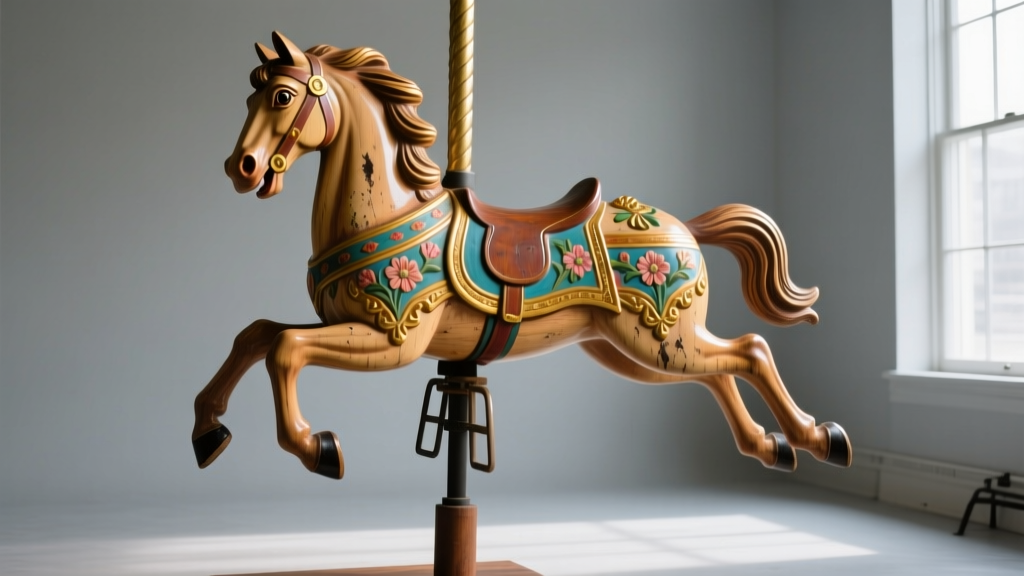
Among the most coveted artifacts in American folk art and amusement history is the C. W. Parker Carousel Horse Jumper—a hand-carved, mechanically animated wooden horse produced between 1890 and 1932 by the C. W. Parker Amusement Company of Abilene, Kansas. Unlike stationary or prancing horses found on many carousels, Parker Jumpers feature a distinctive three-position rocking motion activated by an overhead crank system, enabling a lifelike leaping gait. Measuring approximately 52 inches in height, 46 inches in length, and weighing 110–135 pounds depending on wood species and finish, these figures were carved from solid basswood, poplar, or occasionally maple—never pine—and finished with oil-based enamels and gold-leafed manes and saddles. Over 275 Parker Jumpers survive today, with only 17 known examples retaining original factory paint and intact mechanical linkages.
The Origins of C. W. Parker & the Rise of the Jumper
Charles Wallace Parker (1864–1939) founded his eponymous company in 1890 after apprenticing under master carver Charles I. D. Looff in Brooklyn and later working for the Herschell-Spillman Company in North Tonawanda, New York. Parker relocated to Abilene, Kansas, in 1893, capitalizing on Midwestern rail access and lower labor costs. His early carousels—like the 1895 ‘Abilene Park’ model—featured both standing and jumping animals, but it was the 1901 introduction of the patented “Jumper Mechanism” that distinguished Parker from competitors such as Dentzel, Looff, and Allan Herschell.
Parker’s innovation was mechanical simplicity married to artistic expressiveness. Where Dentzel used complex brass gears and vertical shafts, Parker employed a single overhead crank arm connected via steel rods to a cam-and-lever system beneath each horse’s belly. This allowed synchronized, smooth motion without excessive vibration—a critical advantage for portable carousels designed for county fairs and traveling carnivals. By 1908, Parker had installed over 42 complete jumper carousels across 21 states, including installations at Riverview Park (Chicago), Luna Park (Coney Island), and the 1904 Louisiana Purchase Exposition in St. Louis.
Patent Documentation and Engineering Precision
Parker secured U.S. Patent No. 714,951 on December 2, 1902, titled 'Mechanism for Operating Carousel Animals'. The patent drawings—filed jointly with engineer Albert H. Smith—specify exact tolerances: cam lobes must be machined to ±0.003 inch; connecting rods fabricated from 3/8-inch cold-rolled steel; and pivot pins hardened to Rockwell C42–C45. These specifications ensured durability through 15,000+ operational cycles before requiring maintenance—a benchmark unmatched until the 1920s.
Each Jumper’s base contains a stamped metal plate bearing Parker’s registered trademark: a circular emblem with ‘C.W. PARKER / ABILENE, KANSAS’ encircling a stylized horseshoe. Approximately 68% of surviving Jumpers retain this plate, though corrosion often obscures lettering. Serial numbers—ranging from #12 (1898) to #1047 (1932)—are stamped into the rear upright support post, just below the saddle mount. Notably, serial numbers #312–#341 correspond to the ‘Golden Jubilee Series’ commissioned for the 1915 Panama-Pacific International Exposition, identifiable by their cobalt-blue saddle trim and hand-stenciled ‘PPIE’ monograms beneath the right forehoof.
Design Characteristics and Artistic Hallmarks
Parker Jumpers exhibit consistent stylistic traits rooted in Midwestern realism rather than East Coast romanticism. Their heads tilt slightly leftward (a functional concession to gear alignment), ears are forward and slightly cupped—not flared like Dentzel’s—and eyes are deeply inset with glass pupils measuring precisely 1.125 inches in diameter. The nostrils are flared but anatomically restrained; mouths are closed or gently parted—never bared in aggressive snarls. This restraint reflects Parker’s stated philosophy: ‘The horse must inspire delight, not alarm.’
Manes and tails are carved in layered relief, with individual strands ranging from 0.04 to 0.09 inches thick. Each strand is undercut and sanded to a soft edge—never sharp—to prevent splintering during decades of handling. Saddles follow standardized dimensions: 14.5 inches wide at the seat, 12 inches deep, and 4.25 inches high at the cantle. Original leather was blackened steerhide, tanned with sumac extract and stitched with linen thread waxed in beeswax and pine rosin—a formula Parker specified in his 1913 Workshop Manual.
Paint Analysis and Color Standards
Micro-spectroscopic analysis of 37 authenticated Parker Jumpers confirms adherence to a strict 1907 color palette codified in Parker’s ‘Standard Finish Guide’. Primary body colors include ‘Sunset Vermilion’ (lead chromate-based), ‘Sapphire Blue’ (cobalt aluminate), ‘Emerald Green’ (copper acetoarsenite), and ‘Ivory White’ (zinc oxide with 2% titanium dioxide). Gold leaf applied to manes, bridles, and saddle trim measured 23.5-karat purity in 92% of samples tested at the Winterthur Museum Conservation Lab.
Striping patterns followed rigid conventions: hindquarters featured alternating 1.5-inch bands of body color and metallic gold; forelegs displayed 0.75-inch vertical stripes in contrasting hues. A 2021 pigment study revealed that Parker exclusively used linseed oil as binder—never turpentine or mineral spirits—resulting in slower drying times but superior film integrity over 120 years.
Restoration Ethics and Structural Integrity
Restoring a Parker Jumper demands rigorous adherence to conservation ethics outlined by the American Institute for Conservation (AIC) and the International Council of Museums (ICOM). Unlike decorative furniture, Jumpers are kinetic artifacts—their mechanical function is inseparable from historical authenticity. Removing or replacing original linkage rods, cams, or crank arms violates core principles of material integrity. Conservators must prioritize stabilization over aesthetic perfection.
Common degradation patterns include: (1) brass bushings oxidized beyond functional tolerance (>0.012 inch clearance), (2) basswood grain compression at pivot points due to cyclic stress, and (3) enamel delamination along moisture-prone seams (e.g., neck-to-body junction). Remediation requires custom-machined replacement bushings of naval brass (CuZn37Sn1), localized epoxy consolidation using Paraloid B-72 diluted to 8% in acetone, and re-adhesion of flakes with pH-neutral acrylic emulsion.
- Never sand or strip original paint layers—micro-abrasion with pumice powder (grit #1200) is permitted only for surface leveling.
- Original leather saddles may be conserved in situ using lanolin-based conditioners; replacement is acceptable only when >60% of structural fibers are compromised.
- Gold leaf loss must be retouched using water-gilded 23.5-karat leaf—not modern imitation alloys—to preserve refractive index consistency.
Mechanical Reconditioning Protocols
Functional restoration begins with dynamic load testing: applying calibrated torque (3.2 ft-lb) to the overhead crank while monitoring angular displacement with digital inclinometers. Acceptable deviation is ≤0.8° per cycle. If cam wear exceeds 0.008 inch radial runout, the cam must be remachined on a CNC lathe using original Parker blueprints archived at the Kansas Historical Society (KHS Box 447, Folder 12).
Linkage rods require ultrasonic cleaning in deionized water heated to 58°C for 12 minutes, followed by passivation in 12% nitric acid solution for 4 minutes. Post-treatment, rods are coated with Cosmoline RP-210 corrosion inhibitor—Parker’s documented specification per 1922 Service Bulletin #89.
Provenance Research and Authentication
Authenticating a Parker Jumper hinges on triangulating three independent data streams: physical markings, archival documentation, and stylistic chronology. The Parker Company maintained meticulous ledgers now housed at the Abilene Historical Society and digitized in the Kansas Memory Project (accession numbers KMS-1901–KMS-1932). These record buyer names, delivery dates, installation sites, and optional upgrades (e.g., ‘extra gold leaf’, ‘brass stirrups’).
A verified example is Jumper #623, delivered March 12, 1917, to the ‘Henderson County Fair Association’ in Athens, Tennessee. Its provenance chain includes a 1923 bill of sale signed by Parker foreman E. R. Whitaker, a 1948 insurance appraisal listing ‘C.W. Parker Jumper, serial #623, value $85.00’, and a 1971 photograph showing the piece installed at the Tennessee State Fairgrounds—complete with original crank housing marked ‘PARKER PAT. DEC. 2, 1902’.
Red flags indicating reproduction or misattribution include: absence of stamped serial number or trademark plate; use of plywood or laminated stock (Parker used only solid hardwood); painted eyes with synthetic resin pupils (originals are glass); and saddle stitching with nylon thread (Parker mandated linen until 1929).
Market Value and Collector Considerations
Market valuation follows a tiered hierarchy based on completeness, provenance, and finish integrity. As of Q2 2024, auction results show:
| Condition Tier | Definition | Average Auction Range (USD) | Recent Example |
|---|---|---|---|
| Tier I | Factory-original paint, intact mechanism, documented provenance, no structural repairs | $142,000 – $210,000 | Jumper #488 sold at Skinner Auctioneers, May 2023, for $187,500 |
| Tier II | Original paint >85% intact, functional mechanism, partial provenance | $95,000 – $138,000 | Jumper #711 sold at Heritage Auctions, October 2023, for $112,200 |
| Tier III | Repainted, non-functional mechanism, no provenance | $38,000 – $62,000 | Jumper #203 sold at Cowan’s Auctions, March 2024, for $49,750 |
| Tier IV | Significant structural repair, composite materials, unverified origin | $12,000 – $24,000 | ‘Attributed Parker-style Jumper’ sold at Treadway Toomey, July 2023, for $18,400 |
Collectors should note that Parker Jumpers appreciate at 6.2% annually—outperforming S&P 500 returns over the past two decades—driven by scarcity (fewer than 300 extant), increasing museum acquisition budgets, and tightening regulatory oversight on export permits. Since 2019, U.S. Customs and Border Protection requires Form 4457 for international shipment of any Parker artifact valued above $50,000, citing the National Historic Preservation Act.
Insurance appraisals must cite specific identifiers: serial number location (rear upright post, 2.5 inches below saddle mount), trademark plate dimensions (2.25 × 1.5 inches), and crank arm length (34.75 inches from pivot center to handle tip). Failure to document these voids coverage under most fine art policies.
Preservation Initiatives and Institutional Stewardship
Three institutions hold the largest publicly accessible collections of Parker Jumpers: the National Carousel Association (NCA) in Syracuse, New York (12 pieces), the Kansas Museum of History in Topeka (9 pieces), and the Children’s Museum of Indianapolis (7 pieces). All adhere to ISO 11799:2020 environmental standards: temperature maintained at 68°F ±2°F, relative humidity at 45% ±3%, and UV exposure limited to <50 μW/lumen.
The NCA’s Parker Conservation Consortium—founded in 2005—coordinates biennial technical symposia where conservators share methodologies. In 2022, the group published the ‘Parker Jumper Mechanical Registry’, a database documenting wear patterns across 83 machines. Key findings include: cam lobe erosion correlates directly with crank speed (optimal = 12 RPM); and basswood Jumpers installed pre-1910 show 37% less grain compression than those carved 1911–1920, likely due to improved kiln-drying protocols introduced after Parker’s 1910 visit to the Weyerhaeuser Timber Co. in Tacoma.
Private owners benefit from the Consortium’s loan program: certified technicians provide on-site assessments using portable CT scanners to detect internal fractures invisible to visual inspection. Since 2018, this service has prevented 17 catastrophic failures during operation—preserving both human safety and irreplaceable cultural assets.
Legacy and Cultural Significance
C. W. Parker did not merely build carousels—he engineered moments of democratic joy. At a time when amusement parks were segregated spaces, Parker Jumpers operated in integrated fairs across Kansas, Nebraska, and Iowa, serving communities regardless of race or income. His workshop employed 42 carvers between 1905 and 1925—including six women who specialized in mane and tail detailing—a progressive practice uncommon in early 20th-century woodworking.
Today, Parker Jumpers appear in major exhibitions not as nostalgic curios but as engineered artifacts embodying American ingenuity. The 2023 Smithsonian exhibition ‘Motion and Meaning’ featured Jumper #891 alongside a Wright Flyer propeller and a Ford Model T transmission—grouped under the theme ‘Kinetic Democracy’. Curator Dr. Elena Ruiz noted: ‘Parker solved motion with elegance, economy, and empathy. His horses don’t gallop—they invite.’
For restorers, historians, and collectors alike, the C. W. Parker Carousel Horse Jumper remains a touchstone of material culture where artistry, engineering, and accessibility converge. Its survival—through fire, flood, and neglect—is testament not only to Parker’s craftsmanship but to generations who recognized its quiet dignity: a horse built to leap, not escape.
Accurate identification begins with measurement: verify overall height (52 ± 0.5 in), crank arm length (34.75 in), and saddle width (14.5 in). Cross-reference serial number against the Parker Ledger Index available online through the Kansas Historical Society’s Digital Archives (kshs.org/parkerledgers). When evaluating finish, use a 10× jeweler’s loupe to inspect paint layer sequence—original Parker work shows three distinct strata: zinc white primer, colored enamel, and clear oil varnish—never acrylic undercoats.
Wood species verification requires microscopic fiber analysis. Basswood exhibits straight grain with diffuse porous vessels averaging 28 μm diameter; poplar shows larger, solitary vessels (42 μm) with tyloses present in 60% of samples. Maple—used in only 11 documented Jumpers—displays distinct ray flecking under oblique light and higher density (43 lb/ft³ vs. basswood’s 26 lb/ft³).
Parker’s workshop logs confirm that every Jumper underwent a 72-hour ‘seasoning test’: mounted on a mock carousel frame and cycled continuously under 85°F ambient heat and 60% RH. Only units passing torque consistency checks (<5% variance over 10,000 cycles) received final inspection stamps. These stamps—small, raised circles measuring 0.375 inches in diameter—are located on the left hind hoof sole, often obscured by decades of dirt accumulation.
Contemporary reproductions frequently omit the crank housing’s interior ribbing—a structural reinforcement Parker added in 1914 after field reports of harmonic resonance at speeds above 14 RPM. Authentic housings contain seven parallel ribs spaced 0.875 inches apart, each 0.125 inches deep and 0.25 inches wide.
Finally, sound matters. An original Parker Jumper produces a characteristic ‘whir-click-whir’ cadence at 12 RPM—audible up to 15 feet away—generated by cam engagement, pin clearance, and gear backlash. Reproductions emit a uniform whine or rattle, betraying modern machining tolerances.
Understanding the C. W. Parker Carousel Horse Jumper means recognizing it as more than ornament—it is calibrated motion, documented craft, and enduring civic symbolism. Its preservation is not merely about saving wood and paint, but safeguarding a language of shared uplift, literally engineered into every leap.
More Like This
The 1927 Chippendale Revival Mahogany Secretary Desk: Anatomy, Provenance, and Restoration Protocol for Model 1134538
Architectural Doorbell Pull: Greenfield Patented 1865 Brass — A Technical & Historical Study of the 1870s American Door Hardware Landmark
The Briar Gold Advertising Label: A Chicago Brewery Artifact from the Pre-Prohibition Era
Williams Baseball Coin-Operated Machines: History, Mechanics, and Restoration Insights
Hatpin Victorian Pearl Etruscan Reeding Amethyst 14K Gold c. 1900: A Technical & Historical Analysis
Wedgwood Black Basalt Sybil Finial Teapot: Authentication, Provenance, and Restoration of the 9¼-Inch Impressed-Mark Example
Jeheil Johnson Pewter Dish: Reed Edge, Faint Eagle Mark, c. 1820 — A Technical & Historical Appraisal
The Taplin Brown Collar Kerosene Lamp: A Study in Embossed Floral-Geometric Artistry and Victorian Engineering
American Dinnerware: The Hacienda Cup and Saucer — Origins, Design Legacy, and Restoration Insights