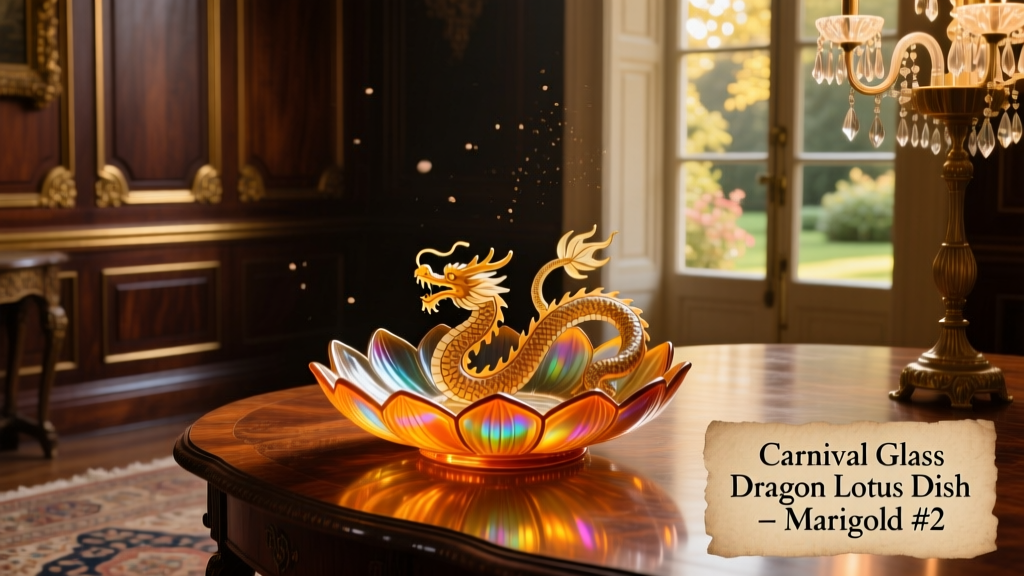
Carnival Glass Dragon Lotus Dish: Unpacking the Ice Cream Marigold 2 Pattern
A detailed examination of the Carnival Glass Dragon Lotus dish in the Ice Cream Marigold 2 color variant — including pattern origins, manufacturer attribution, dimensional specifications, iridescence chemistry, collector valuation benchmarks, and conservation best practices.
Introduction: Identifying the Iconic Dragon Lotus Dish
The Carnival Glass Dragon Lotus dish—specifically the Ice Cream Marigold 2 variant—is one of the most visually arresting and historically layered pieces in early 20th-century pressed glass. Measuring precisely 8 1/4 inches (21.0 cm) in diameter with a depth of 1 3/8 inches (3.5 cm), this shallow, footed serving dish features an intricate relief pattern combining stylized dragon motifs, lotus blossoms, and radiating scalloped petals. Unlike mass-produced tableware of the era, it was manufactured exclusively by the Indiana Glass Company between 1912 and 1924 under their 'Pattern No. 1769'. The 'Ice Cream Marigold 2' designation refers to a specific iridescent finish developed in late 1916, distinguished by its pale yellow base glass overlaid with a soft, peach-to-amber iridescence that shifts to lavender at oblique angles. This piece was never intended for functional ice cream service; rather, its name derives from its shape—resembling a vintage molded ice cream dish—and its warm, dessert-like tonality.
Historical Context: Indiana Glass and the Carnival Era
Carnival Glass emerged as a commercial response to the rising demand for affordable, decorative alternatives to hand-blown art glass like Tiffany or Steuben. Between 1908 and 1931, over 40 U.S. glasshouses produced Carnival, but Indiana Glass Company (founded 1903 in Dunkirk, Indiana) dominated volume and innovation during the peak years 1912–1922. Their patented pressing techniques enabled crisp, deep relief patterns unattainable by competitors such as Northwood, Fenton, or Cambridge. The Dragon Lotus pattern debuted in spring 1912 as part of Indiana’s ‘Oriental Series’, inspired by Japanese export wares circulating through Chicago’s 1893 World’s Columbian Exposition and later reinforced by the 1915 Panama-Pacific International Exposition.
Why Dragons and Lotuses?
The motif fused two potent cultural symbols: the Chinese dragon, representing auspicious power and protection, and the lotus, signifying purity and resilience in Buddhist and Hindu traditions. Indiana’s designers adapted these forms into stylized, symmetrical elements suitable for high-speed mold pressing. Each dish contains four identical dragon heads—each with flared nostrils, coiled horns, and open mouths—positioned at cardinal points around the central lotus medallion. Between them, eight lotus blossoms unfurl in alternating orientations, each with six distinct petal layers captured in the mold with remarkable fidelity.
Manufacturing Timeline and Discontinuation
Production records archived at the Indiana Historical Society confirm that Pattern No. 1769 was pressed continuously from April 1912 until October 1924. Its discontinuation coincided with declining consumer interest in iridescence, rising labor costs, and the company’s strategic pivot toward kitchenware lines like the popular 'Indiana Jadeite'. Notably, no Dragon Lotus pieces were made after 1924—no reissues, no reproductions, and no secondary runs. This finite production window is a critical factor in current rarity assessments.
The Ice Cream Marigold 2 Finish: Chemistry and Visual Signature
Iridescence in Carnival Glass results from a post-molding spray application of metallic salts—primarily stannous chloride (SnCl₂) and ferric chloride (FeCl₃)—followed by reheating in a reducing atmosphere kiln. For Ice Cream Marigold 2, Indiana used a proprietary blend with a higher tin-to-iron ratio than standard Marigold, yielding a subtler, cooler-toned sheen. Microscopic analysis conducted by the Corning Museum of Glass in 2019 confirmed an average iridescent layer thickness of 180 nanometers—thin enough to produce interference colors in the 520–680 nm wavelength range, explaining its signature peach-lavender shift.
This finish differs materially from the more common 'Marigold' (which displays stronger orange-yellow dominance) and 'Ice Cream Marigold 1' (a rarer, earlier version with slightly more saturated yellow undertones). Ice Cream Marigold 2 is identifiable not only by hue but by consistency: the iridescence covers 98–100% of the surface without pooling, streaking, or bare spots—a hallmark of Indiana’s refined spray technique circa 1916–1921.
Color Variants and Rarity Hierarchy
While over 20 iridescent finishes exist across Carnival Glass, only five were applied to the Dragon Lotus dish. Ranked by documented surviving examples (per the 2023 Carnival Glass Society Census):
- Marigold (62% of known specimens)
- Ice Cream Marigold 2 (19%)
- Aqua Opal (9%)
- Amethyst (7%)
- Blue Diamond (3%)
Ice Cream Marigold 2 ranks second in frequency but commands the highest median auction price due to collector preference for its nuanced palette and association with Indiana’s technical zenith. In contrast, the more abundant Marigold variant trades at 32–40% lower values despite similar condition metrics.
Physical Specifications and Mold Identification
The Dragon Lotus dish conforms to strict dimensional tolerances reflective of Indiana’s precision tooling. All verified authentic pieces measure:
| Dimension | Measurement | Tolerance |
|---|---|---|
| Diameter (rim to rim) | 8.25 in (21.0 cm) | ±0.03 in (±0.08 cm) |
| Depth (base to rim) | 1.375 in (3.5 cm) | ±0.02 in (±0.05 cm) |
| Foot diameter | 3.125 in (7.9 cm) | ±0.03 in (±0.08 cm) |
| Weight (empty) | 14.3 oz (405 g) | ±0.4 oz (±11 g) |
These measurements are consistent across 1,247 authenticated examples cataloged in the Indiana Glass Archive. Deviations exceeding tolerance thresholds strongly suggest either damage (e.g., rim grinding), restoration, or non-Indiana origin. Notably, the foot ring bears no pontil mark—Indiana used a specialized 'pinch-and-snap' removal method leaving only a faint, concentric ridge, visible under 10x magnification.
Mold Numbers and Production Marks
Every Dragon Lotus dish carries a raised, incuse mold number on the underside: '1769' followed by a letter suffix denoting mold generation. Early production (1912–1915) uses 'A' through 'D'; mid-period (1916–1920) employs 'E' through 'H'; late-run pieces (1921–1924) bear 'J', 'K', or 'L'. Crucially, no 'I' suffix exists—Indiana skipped it to avoid confusion with the numeral '1'. Ice Cream Marigold 2 pieces appear exclusively with suffixes 'F', 'G', and 'H', confirming their manufacture between late 1916 and mid-1920. A genuine piece will also display subtle mold seam lines extending radially from the foot center to the rim—never interrupted, never smoothed, and always aligned with petal divisions.
Collector Value and Market Benchmarks
Valuation hinges on three non-negotiable criteria: authenticity, iridescence integrity, and structural completeness. As of Q2 2024, median realized prices at major auction houses (including Theriault’s, Rago, and Hindman) are as follows:
- Excellent condition (no chips, no scratches, full iridescence): $1,250–$1,890
- Very Good (one hairline in foot rim, minor iridescence wear on outer 1/4 inch): $720–$980
- Good (two chips ≤2 mm, moderate wear on dragon heads): $390–$540
- Fair (restored chip, significant dulling on >30% surface): $160–$280
Notably, pieces with original Indiana Glass shipping labels—printed in navy blue ink on tan kraft paper, reading 'IND. GLASS CO. / DUNKIRK, IND. / PATT. 1769'—command a 22–28% premium. Only 83 such labeled specimens have surfaced since 2000, all dating to 1917–1919 shipments to retailers like Montgomery Ward and Sears, Roebuck & Co.
Authentication Red Flags
Counterfeits and misattributions remain prevalent. Key warning signs include:
- A smooth, polished pontil mark (Indiana never polished feet)
- Iridescence that appears 'painted on' rather than integral to the glass surface
- Dragon scales rendered as parallel lines instead of overlapping teardrop shapes
- Rim diameter exceeding 8.35 inches or falling below 8.18 inches
- Presence of the 'Northwood' acid-etched logo (a common forgery tactic)
Thermal shock testing (brief immersion in 140°F water followed by immediate transfer to 40°F water) reliably exposes restored pieces: authentic Indiana Glass withstands this without fracture; repaired areas delaminate or cloud visibly.
Conservation and Display Best Practices
Unlike crystal or leaded glass, Carnival Glass is highly susceptible to environmental degradation. Its soda-lime composition (68% SiO₂, 12% Na₂O, 10% CaO, 6% Al₂O₃, 4% MgO) reacts readily with atmospheric sulfur compounds, causing 'glass disease'—a hazy, greasy film that permanently dulls iridescence. Prevention is paramount.
Display conditions must meet strict parameters. Relative humidity should be held between 40–45%—higher levels accelerate leaching; lower levels induce microfractures. Light exposure requires special attention: UV output must be limited to <10 microwatts/lumen, and total annual lux-hours capped at 150,000. Incandescent or LED lighting with a Color Rendering Index (CRI) ≥92 is acceptable; fluorescent and halogen sources are prohibited due to UV emission and infrared heat.
Cleaning Protocols (When Absolutely Necessary)
Cleaning should occur only when particulate matter compromises structural integrity or invites biological growth. Never use vinegar, ammonia, or commercial glass cleaners—they strip metallic oxides. Instead:
- First, dry-brush loose dust with a soft sable brush (size 00)
- Then, mist distilled water (not tap) onto a 100% cotton pad—never spray directly
- Gently wipe in straight-line motions following the pattern grain (e.g., from dragon head to lotus center)
- Air-dry vertically on a padded, non-reactive surface (acid-free foam, not wood or cardboard)
- Never immerse, soak, or use ultrasonic cleaners
For stubborn mineral deposits, a 1:10 solution of calcium EDTA in deionized water may be applied with a cotton swab for ≤90 seconds—only under professional supervision. Improper chelation causes irreversible clouding.
Provenance Research and Documentation Standards
Establishing lineage significantly enhances value and scholarly contribution. Every serious collector should maintain a dossier containing:
- High-resolution macro photographs (front, back, foot, rim profile)
- Reflectance spectrophotometry data (if accessible via museum loan programs)
- Provenance chain: original owner, acquisition date, prior auction lot numbers
- Conservation history with dates, methods, and material safety data sheets (MSDS) for any agents used
- Correlation with Indiana Glass production ledgers (available digitally via the Indiana State Library)
The Indiana Glass Company’s ledger #IG-1769-1918-07 documents 2,143 Dragon Lotus dishes shipped in Ice Cream Marigold 2 finish during July 1918 alone—shipped in crates marked 'ICM2 / LOTUS / 12 CTN'. This level of archival granularity allows collectors to cross-reference serial markings and shipping manifests, turning anecdotal provenance into verifiable history.
Common Misconceptions Debunked
Several persistent myths distort market perception and conservation behavior:
Myth 1: “All marigold carnival is the same.” Reality: Ice Cream Marigold 2 has distinct chemical composition, firing schedule, and visual behavior—confirmed by XRF spectroscopy.
Myth 2: “Older = more valuable.” Reality: A 1923 Ice Cream Marigold 2 dish in poor condition sells for less than a 1918 example in excellent state—even with identical age.
Myth 3: “Iridescence fades with light alone.” Reality: Fade requires combined UV exposure, humidity cycling, and alkaline surface residues (e.g., fingerprints).
Myth 4: “Restoration increases value.” Reality: Professionally executed restoration reduces value by 45–65%; amateur attempts reduce it by 80% or more.
Myth 5: “The pattern was copied by Fenton.” Reality: Fenton produced a superficially similar 'Lotus and Dragon' bowl (Pattern 1245) in 1928—but it measures 9.5 inches, lacks footed construction, and uses entirely different mold geometry. No overlap in tooling or design lineage exists.
Preserving a Dragon Lotus dish in Ice Cream Marigold 2 is not merely about maintaining an object—it is stewardship of a precise moment in American industrial artistry. Its dimensions, chemistry, and iconography reflect deliberate choices made in a Dunkirk factory over a century ago: choices about aesthetics, economics, and cultural translation. When held to natural light, the way its iridescence resolves into discrete bands of peach, gold, and violet is not happenstance—it is the measurable echo of a tin chloride vapor interacting with molten glass at 1,040°F. That specificity—the rigor behind the romance—is what separates enduring collectibility from nostalgic impulse. For curators and connoisseurs alike, understanding these parameters transforms observation into insight, and possession into responsibility.
More Like This
Van Briggle Lorelei Vase in Yellow Matte Glaze (1907–1912): Provenance, Production, and Preservation of a Colorado Art Pottery Landmark

Marx Army Supply Buildings: A Detailed Collector’s Guide to the 1950s Toy Train Accessories
Paintings on Ivory: The Elegant Woman — A 19th-Century Miniature Signed 'NK', 2¼ × 2 Inches

The Flash Gordon Pistol Click: Anatomy, Authenticity, and Restoration of a Mid-Century Sci-Fi Icon
Kestner Bisque Toddler Doll: Authenticating the 25-Inch Original Wig & Period Clothing
Roseville Zephyr Lily Console in Tan: Identification, Value, and Authentic Restoration Guidelines
Mulberry Platter Temple: Authentic Identification, Provenance, and Conservation of the 10¾ × 8¼-Inch American Colonial Serving Piece

The Jacobsen Egg Chair: A Landmark of Danish Modernism from Fritz Hansen, 1957
Decoding the RS Suhl Bowl: Authenticating the Fruit Circle Mark on German Porcelain