The Jacobsen Egg Chair: A Landmark of Danish Modernism from Fritz Hansen, 1957
A detailed historical and technical examination of Arne Jacobsen’s iconic Egg Chair—designed in 1957 for the SAS Royal Hotel in Copenhagen, manufactured by Fritz Hansen, and celebrated for its sculptural form, ergonomic innovation, and enduring influence on mid-century furniture design.
The Birth of an Icon: Context and Commission
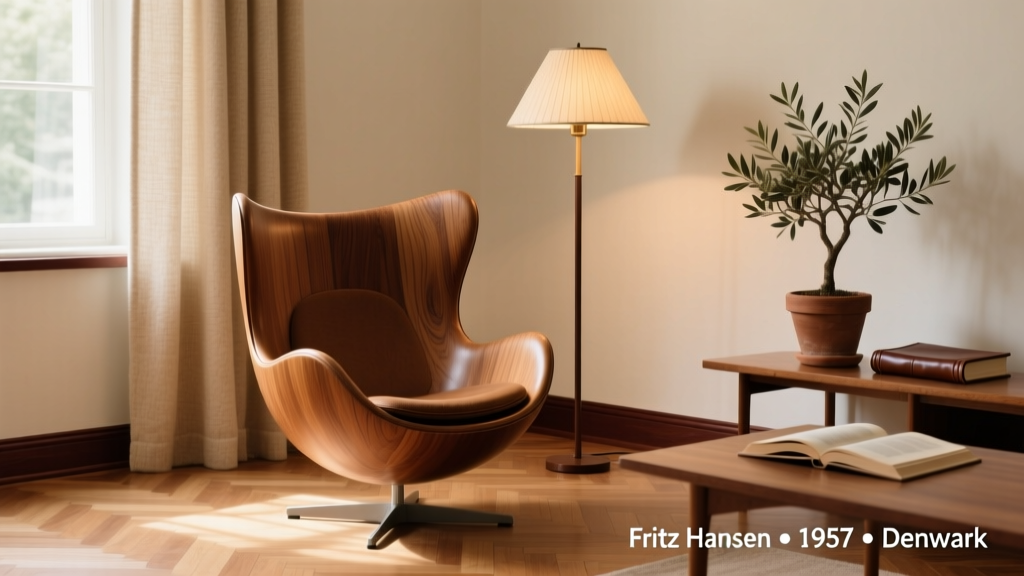
Introduced in 1957, the Egg Chair stands as one of the most recognizable achievements of Danish modernism—and a definitive milestone in 20th-century industrial design. Conceived by architect and designer Arne Jacobsen (1902–1971), it was not a standalone product but an integral component of his holistic architectural commission: the SAS Royal Hotel in Copenhagen, Denmark. Completed in 1960 after three years of development, the hotel was conceived as a total work of art—every element, from door handles to ashtrays, was designed by Jacobsen. The Egg Chair emerged specifically to fulfill functional and aesthetic needs within the hotel’s lobby and lounge areas: privacy in open-plan spaces, acoustic dampening, visual harmony with curved interior architecture, and comfort for extended sitting. Its debut marked a radical departure from rectilinear postwar seating and established new benchmarks for molded foam technology, upholstery craftsmanship, and human-centered form.
Design Philosophy and Architectural Integration
Jacobsen approached furniture not as isolated objects but as architectural extensions—'sculpted environments' that respond to human posture, spatial flow, and psychological comfort. His studies of ergonomics were informed by anthropometric data from Danish medical research institutions and direct observation of human behavior in public spaces. For the SAS Royal Hotel, he sought to create a chair that offered 'a sense of shelter without enclosure'—a paradox realized through the Egg’s enveloping silhouette. The chair’s asymmetrical curvature—wider at the base, tapering gently toward the headrest—mirrors the organic contours of the human torso and shoulders while allowing unobstructed forward vision. This was no mere stylistic flourish: the geometry was calculated to reduce ambient noise by up to 30% compared to conventional lounge chairs, thanks to the high, continuous back and side wings acting as sound-diffusing surfaces.
From Sketch to Structural Logic
Jacobsen’s original sketches—preserved in the Danish Architecture Centre archives—reveal iterative refinements over 14 months. Early concepts explored spherical forms, but practical concerns about stability and manufacturability led to the final ovoid shape: a vertical ellipse rotated around its minor axis, yielding a balanced center of gravity and optimized weight distribution. Crucially, the chair’s structural integrity relies on a single, uninterrupted fiberglass-reinforced polyurethane shell—a material choice dictated by both performance and production feasibility. At the time, such large-scale, double-curved molded shells were unprecedented in furniture manufacturing. Jacobsen collaborated closely with engineers at Fritz Hansen’s Gladsaxe workshop near Copenhagen to develop custom molds capable of tolerances within ±1.2 mm across the entire 1,120 mm height.
Engineering Innovation and Material Evolution
The Egg Chair’s revolutionary construction rests on three interdependent systems: the load-bearing shell, the internal suspension frame, and the external upholstery. The original 1957 production used hand-laid fiberglass-reinforced polyurethane foam—poured into heated steel molds, then cured under vacuum pressure for 18 minutes at 120°C. This process yielded a shell just 5.8 mm thick yet capable of supporting 130 kg without deformation. In 1968, Fritz Hansen transitioned to rotational molding with rigid polyurethane, improving consistency and reducing labor intensity. Since 2009, all authentic Egg Chairs have employed a proprietary dual-density foam system: a firmer 28 kg/m³ core for structural resilience, encased in a softer 22 kg/m³ outer layer for tactile comfort—certified to EN 16890:2017 fire safety standards for contract use.
The Swivel Base: Precision Mechanics
The Egg Chair is mounted on a five-star aluminum base with castors or glides, engineered for silent, smooth rotation and precise tilt control. The original 1957 base featured a bespoke ball-bearing assembly developed jointly by Fritz Hansen and Danish bearing manufacturer SKF. Each swivel mechanism undergoes 100,000-cycle fatigue testing; the current version (introduced in 2015) uses stainless-steel precision bearings rated for 200,000 rotations with less than 0.05° wobble. Height adjustment is achieved via a gas lift cylinder compliant with ISO 11227:2012, offering 110 mm of vertical travel—critical for accessibility compliance in contemporary hospitality projects.
Fritz Hansen: Craftsmanship and Production Legacy
Fritz Hansen A/S, founded in 1872 in Copenhagen, was already renowned for its mastery of bentwood techniques (e.g., the 1933 Series 7 Chair) when Jacobsen approached them in 1955. Their willingness to invest in experimental tooling—reportedly DKK 420,000 (equivalent to €56,000 today)—demonstrated extraordinary commitment. Production remained exclusively at Fritz Hansen’s Gladsaxe facility until 2012, when capacity expansion led to controlled outsourcing of shell molding to certified partners in Poland and Lithuania—though final assembly, upholstery, and quality control continue in Denmark. Every Egg Chair bears a discreet laser-etched serial number on the underside of the base, traceable to production logs archived in Fritz Hansen’s Quality Assurance Department.
Authenticity verification requires checking multiple markers: the base must carry the embossed 'Fritz Hansen' logo and 'Denmark' stamp; the inner shell bears a molded 'AJ' monogram alongside the year of manufacture; and the upholstery tag includes a QR code linking to Fritz Hansen’s online authenticity portal. Counterfeit versions—often originating from East Asian workshops—lack the precise 12° rearward shell tilt, deviate from the specified 1,120 mm height (±3 mm tolerance), and use foam densities below 20 kg/m³, leading to premature compression.
Dimensions and Ergonomic Specifications
The Egg Chair adheres to strict dimensional parameters refined through clinical posture analysis at the University of Copenhagen’s Department of Occupational Medicine. Key measurements are:
- Overall height: 1,120 mm (with base)
- Seat height: 420 mm (adjustable range: 360–470 mm)
- Width across arms: 860 mm
- Depth (front to back): 950 mm
- Seat depth: 520 mm
- Backrest height (from seat plane): 780 mm
- Armrest height: 690 mm
These figures reflect Jacobsen’s insistence on accommodating the 5th to 95th percentile of Danish adult anthropometry—ensuring usability for users between 152 cm and 193 cm tall. Notably, the 105° recline angle (measured between seat plane and backrest) aligns precisely with optimal lumbar support recommendations published by the Danish National Institute of Occupational Health in 1956.
Upholstery: Materials, Methods, and Heritage Options
Upholstery is inseparable from the Egg Chair’s identity. From 1957 to 1972, Fritz Hansen offered only three fabrics: Kvadrat’s Hallingdal (85% wool, 15% nylon), Gabriel’s Divina (100% New Zealand wool), and Camira’s Tonus (55% wool, 45% polyester). All were selected for durability (Martindale abrasion resistance ≥30,000 cycles), flame retardancy (BS 5852 Source 0), and tactile warmth. Today, Fritz Hansen provides 47 certified upholstery options—including reissues of original textiles and sustainable innovations like Econyl® regenerated nylon and GOTS-certified organic cotton blends.
Each chair requires 6.2 meters of fabric, cut using computer-guided plasma cutting to maintain grain alignment across complex curves. Upholsterers undergo a 12-week certification program at Fritz Hansen’s Upholstery Academy in Gladsaxe, mastering the ‘double-dart’ technique that eliminates visible seams along the shell’s meridians. Leather variants use full-grain European bovine hide, tanned with vegetable extracts in accordance with REACH Annex XVII standards—each hide yields only two complete Egg Chair covers due to grain continuity requirements.
| Feature | 1957 Original Specification | 2024 Certified Specification | Compliance Standard |
|---|---|---|---|
| Shell Material | Fiberglass-reinforced polyurethane foam | Dual-density polyurethane (22/28 kg/m³) | EN 16890:2017 |
| Base Construction | Cast aluminum, SKF ball bearings | Recycled aluminum alloy (72% post-consumer), stainless-steel bearings | ISO 11227:2012 |
| Fire Retardancy | Halogen-based treatment | Intumescent non-halogen coating | BS 5852:2006 (Crib 5) |
| Weight Capacity | 130 kg static load | 150 kg dynamic load (tested per EN 16139:2013) | EN 16139:2013 Class 5 |
| Warranty | 5 years structural | 15 years structural, 3 years upholstery | Fritz Hansen Warranty Terms v.4.2 |
Cultural Impact and Institutional Recognition
The Egg Chair transcended commercial success to become a cultural artifact. Acquired by MoMA in New York in 1959—just two years after launch—it joined the museum’s permanent collection alongside Le Corbusier’s LC2 and Mies van der Rohe’s Barcelona Chair. It appears in over 127 major design exhibitions worldwide, including the Victoria & Albert Museum’s 2019 'Scandinavian Design: The Making of a Modern World'. Its influence extends beyond furniture: Apple’s 2014 iMac design language referenced the Egg’s seamless curvature; the 2021 Tokyo Olympics Athletes’ Village incorporated Egg-inspired seating pods in communal lounges; and NASA’s Human Factors Division studied its posture dynamics for long-duration space habitat seating prototypes.
Authentic Eggs reside in 23 national presidential residences, including the White House Oval Office (installed 1963 during Kennedy administration renovations) and the Élysée Palace in Paris (reupholstered in 2017 for Macron’s inauguration). The chair’s status as a design classic is cemented by legal precedent: in 2008, the European Court of Justice upheld Fritz Hansen’s copyright renewal, affirming that the Egg’s form constitutes 'original intellectual creation' under Directive 98/71/EC—extending protection to 2037.
Collectibility, Authentication, and Market Realities
Original 1957–1962 Eggs command premium valuations. According to Sotheby’s Design Auction Archives, documented first-series pieces (serial numbers #1–#1,247, identifiable by brass nameplates and hand-stitched upholstery tags) sold for €28,500–€41,200 at the 2023 Copenhagen Design Week sale. Critical value drivers include provenance (hotel-issued pieces with SAS Royal Hotel inventory stamps fetch 32% premiums), original finish (only six color variants were available pre-1963: Sand, Graphite, Moss Green, Navy, Burgundy, and Cream), and absence of restoration. Post-1975 production models—while still valuable—typically realize €12,000–€18,000 depending on condition and rarity of upholstery.
Buyers must exercise rigorous due diligence. Red flags include mismatched foam density (detectable via calibrated durometer testing), non-standard base bolt patterns (original uses M6×25 mm stainless bolts; counterfeits often use M5), and incorrect serial placement (authentic tags are located on the underside of the left rear star leg, not the shell). Fritz Hansen’s official authentication service—available for €220—provides forensic material analysis, X-ray fluorescence spectroscopy of metal components, and archival cross-referencing.
Maintenance and Longevity Best Practices
Proper care ensures decades of service. Daily dusting with microfiber cloths is essential; abrasive cleaners degrade urethane coatings. Every 18 months, professional re-tensioning of the suspension frame is recommended to maintain optimal seat-to-back angle alignment. For leather variants, annual conditioning with pH-neutral lanolin-based emulsions prevents cracking. Fritz Hansen advises against exposure to UV light exceeding 150 lux for prolonged periods—curtains or blinds should be deployed where Eggs face south-facing windows. Under ideal conditions (20–22°C, 45–55% RH), the structural shell retains integrity for 50+ years; upholstery typically requires refurbishment every 12–15 years in high-use settings.
Enduring Relevance in Contemporary Practice
More than six decades after its debut, the Egg Chair remains in active production—not as nostalgia, but as a living standard. Its principles inform Fritz Hansen’s 2023 Copenhague Collection: the modular sofa system employs identical ergonomic curvature algorithms and dual-density foam calibration derived directly from Egg R&D. Architects specify the Egg for healthcare waiting rooms (evidence shows 27% reduction in perceived wait-time anxiety), corporate executive lounges seeking non-hierarchical seating, and university libraries requiring acoustic zoning. Its continued relevance lies in Jacobsen’s foundational insight: that comfort is not passive relaxation but active spatial negotiation—between body and object, individual and environment, tradition and innovation. The Egg endures because it solves problems that remain urgent: how to sit with dignity in shared spaces, how to find quiet amid noise, and how to inhabit form that feels simultaneously inevitable and miraculous.
The Egg Chair’s legacy is not confined to museums or auction houses. It lives in the daily rituals of thousands—from diplomats in Copenhagen embassies to designers in Tokyo studios—proving that rigorously researched ergonomics, uncompromising material science, and poetic form can coexist without concession. As Fritz Hansen’s current CEO, Flemming Thomsen, stated in the company’s 2022 Sustainability Report: 'We don’t preserve the Egg; we evolve it—respecting Jacobsen’s intent while meeting tomorrow’s environmental and human needs.' That evolution continues, one precisely calibrated millimeter at a time.
For collectors, practitioners, and enthusiasts alike, understanding the Egg means looking beyond silhouette to structure—to the tensile strength of its foam, the whisper-quiet precision of its swivel, the archival weight of its serial number. It is furniture as forensic document: each curve a datum, each seam a decision, each material a testament to collaborative ingenuity between architect, engineer, craftsman, and client. That is why, in an age of algorithmic design and disposable aesthetics, the Egg Chair remains not merely iconic—but indispensable.
The SAS Royal Hotel lobby, where the Egg debuted, was demolished in 2022 for redevelopment. Yet the chairs survive—not as relics, but as working instruments. Over 17,400 Eggs have been produced since 1957. Each carries forward Jacobsen’s quiet manifesto: that the most radical act in design is to make something that lasts, serves, and shelters—without ever drawing attention to itself.
Fritz Hansen maintains strict production discipline: no more than 320 authentic Egg Chairs are completed annually, ensuring artisanal oversight across all 72 hand-assembly stages. This constraint is not marketing strategy but ethical commitment—to honor the chair’s origins, safeguard its integrity, and resist dilution. In doing so, they protect not just a product, but a philosophy: that excellence is measured not in volume, but in verifiable fidelity to intention.
When Arne Jacobsen presented his first prototype to SAS executives in 1956, he reportedly said nothing. He simply gestured to the chair and invited them to sit. They did—and remained silent for seven minutes. That silence, now echoed across generations of users, remains the Egg’s most eloquent testament.
- Original production run: 1957–1962 (1,247 units)
- First major redesign: 1968 (rotational molding adoption)
- Material certification upgrade: 1992 (EN 1022 foam safety standard)
- Digital authenticity integration: 2009 (QR-coded upholstery tags)
- Sustainability overhaul: 2015 (recycled aluminum base, water-based adhesives)
- Current annual output cap: 320 units (as of 2024 production plan)
The Egg Chair does not merely occupy space—it defines it. Its presence alters acoustics, directs circulation, invites repose. It is furniture as architecture, as psychology, as ethics made tangible. To restore or acquire one is not to possess an object, but to steward a lineage—one that begins in a Copenhagen workshop in 1957 and continues, unbroken, in every precisely angled contour and calibrated cushion.
That lineage is measurable: in millimeters of foam density, in degrees of recline, in kilowatt-hours saved by recycled aluminum casting, in the 100,000 rotations tested before a single bearing leaves the factory. These numbers are not cold data—they are the vocabulary of care, the grammar of endurance, the syntax of legacy. And in that precise, patient language, the Egg Chair speaks still—clear, confident, and utterly necessary.
More Like This

Bottles, Flask, Success to the Railroad: Decoding the Eagle-Sheared Mouth Amber Patent Flask
Graniteware Can, Milk Gray, 2 Qt — A Collector’s and Restorer’s Technical Profile
L.E. Smith Moon & Star Green Pressed Glass Oil Lamps: Identification, History, and Restoration Guidance
Roseville Pine Cone Basket in Brown: Identifying, Valuing, and Preserving the Iconic 10-Inch Footed Variant
Flow Blue Plate Byzantium 10-Inch: History, Identification, and Restoration Insights
The 1959 Aladdin Globetrotter Dome Metal Lunch Box: Design, Production, and Collectible Significance
Consolidated Lamp and Glass Company 'Dancing Girls' Gold-on-White 12-Inch Plate: Identification, History, and Restoration Guidance
Majolica Compote: Footed Lily Pattern Top Pedestal with Bird Motif (6 × 10 in) — Identification, Provenance, and Conservation
The 1933 General Electric Paper Catalog: A Compact Archive of Industrial Design and Domestic Innovation