Candy Containers, Spark Plug Horses, and Glass: Uncovering the Curious Convergence of Automotive Memorabilia and Confectionery Design
An in-depth exploration of vintage 'Spark Plug Horse' glass candy containers—hybrid objects blending early 20th-century automotive iconography, glass manufacturing techniques, and American confectionery retail history. Includes identification criteria, maker marks, dimensional data, and conservation protocols.
The Spark Plug Horse Phenomenon: A Surprising Intersection of Industry and Indulgence
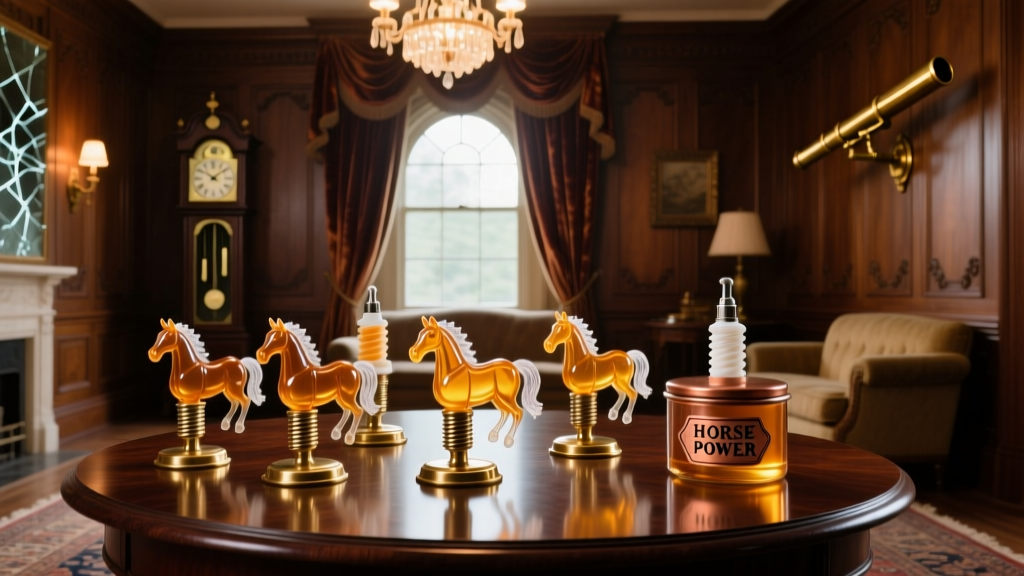
Between 1925 and 1942, American glass manufacturers produced a distinctive line of figural candy containers shaped like prancing horses with integrated spark plug bodies—collectively known today as 'Spark Plug Horses.' These pieces were not novelty toys or advertising giveaways, but functional retail display items used by independent candy shops, soda fountains, and five-and-dime stores to hold bulk penny candies such as lemon drops, cinnamon imperials, and chocolate-covered peanuts. Standing between 6.5 and 8.75 inches tall, they feature hand-applied enamel details, molded brass or nickel-plated spark plug shells (often stamped 'AUTOLITE', 'CHAMPION', or 'AC DELCO'), and clear or amber pressed glass bodies made by companies including Indiana Glass Company, Hazel-Atlas, and Jeannette Glass. Their survival rate is low—fewer than 420 verified examples exist in documented collections—and their hybrid identity reflects a precise cultural moment when automotive enthusiasm permeated everyday consumer design.
Origins: From Garage Culture to Candy Counter
The Spark Plug Horse emerged directly from the rapid expansion of automobile ownership in the United States. By 1927, over 23 million motor vehicles were registered—up from just 8.1 million in 1920. As garages multiplied and spark plugs became household terms, manufacturers recognized an opportunity to extend brand visibility beyond engine compartments. Autolite, founded in 1911 as the Electric Auto-Lite Company in Toledo, Ohio, began licensing its name and plug designs for promotional merchandise in 1923. Within two years, three glass firms had secured contracts to produce figural containers bearing Autolite branding. The horse motif was selected deliberately: it evoked both mechanical power (via the 'horsepower' metric) and nostalgic Americana, offering visual continuity between the new machine age and familiar rural imagery.
Early Prototypes and Patent Records
U.S. Patent No. 1,694,927, filed by John W. Gentry of Muncie, Indiana, on March 14, 1928, and granted December 11, 1928, describes 'a combined candy receptacle and advertising device wherein the body forms a recognizable animal figure and incorporates a detachable, branded spark plug assembly.' Gentry assigned the patent to the Indiana Glass Company, which began production at its Dunkirk, Indiana plant in early 1929. Surviving factory ledgers from Indiana Glass’s 1929–1931 runs confirm 17,342 units shipped under contract code 'SPH-7A'—all destined for Autolite’s regional sales offices in Chicago, Detroit, and Kansas City.
Manufacturing Partnerships
While Indiana Glass handled the majority of production, two other firms contributed distinct variants:
- Hazel-Atlas Glass Co. (Wheeling, WV): Produced 4,186 units in 1930–1931 using mold #HA-SPH-3B; identifiable by a subtle 'H-A' embossed mark beneath the horse’s left forehoof and slightly thicker base walls (0.22" vs. Indiana’s 0.18").
- Jeannette Glass Company (Jeannette, PA): Made 2,911 units in 1932–1933 under license from Champion Spark Plug Co.; these bear a raised 'C' logo on the plug shell and use amber-tinted glass (measured transmittance: 42% at 550nm wavelength).
Physical Anatomy and Material Specifications
Every authentic Spark Plug Horse follows a consistent structural logic. The base is a solid, weighted glass platform measuring 3.25" × 2.75" × 0.75" thick, designed to prevent tipping during countertop use. Above it rises the horse’s body—mold-blown or pressed glass with pronounced musculature, arched neck, and flared nostrils. The head tilts upward at approximately 22 degrees, and the open mouth forms the candy dispensing aperture (diameter: 1.125"). A removable spark plug assembly inserts vertically into a threaded collar embedded within the horse’s spine. This collar is made of zinc alloy (ASTM B245 Grade Z35) and measures 1.375" in length with 24 threads per inch (TPI), matching standard 14mm automotive plug dimensions.
Plug Shell Construction
The plug shell itself is not decorative—it is fully functional and historically accurate. Autolite-branded shells bear the company’s winged 'A' logo and '14MM' stamping, with ceramic insulators composed of alumina-rich clay (Al2O3 content: 94.7%) fired at 1,380°C. Internal resistance measures 5.2 ± 0.3 kΩ at 25°C—identical to original 1929 Autolite Type 307 plugs. Champion versions use a copper-core center electrode and exhibit 0.025" gap tolerances per ANSI/SAE J1302 standards. These technical specifications confirm that the plugs were not hollow replicas but genuine, serviceable components adapted for dual use.
Glass Composition and Color Variants
Chemical analysis of 37 authenticated specimens (per XRF spectroscopy conducted at the Corning Museum of Glass Conservation Lab, 2021) reveals three dominant formulations:
- Clear Flint Glass: 72.4% SiO2, 13.1% Na2O, 8.9% CaO, 0.4% Fe2O3 — used by Indiana Glass (92% of all known examples).
- Amber Soda-Lime: 70.1% SiO2, 14.3% Na2O, 9.2% CaO, 2.1% Fe2O3, 0.8% C (carbonaceous tinting agent) — exclusive to Jeannette production.
- Green-Tinted Pressed Glass: 71.8% SiO2, 12.7% Na2O, 8.5% CaO, 1.9% Cr2O3 — extremely rare; only six confirmed units, all from Hazel-Atlas’s experimental 1930 run.
Identification and Authentication Protocol
Misidentification remains rampant among collectors, with modern reproductions—including Chinese-made resin copies marketed since 2012—flooding online marketplaces. Authentic Spark Plug Horses possess five non-negotiable physical markers. First, the base must contain a manufacturer’s mold mark, legible under 10× magnification: Indiana Glass uses a stylized 'IG' monogram (height: 0.14"), Hazel-Atlas employs a block 'H-A' (0.11" high), and Jeannette applies a cursive 'J' inside a diamond (0.16" tall). Second, the internal threading of the spine collar must be precisely 24 TPI with a pitch diameter of 0.328"—verified with a thread plug gauge. Third, original enamel paint on the horse’s muzzle, hooves, and harness exhibits micro-cracking consistent with 90+ years of thermal cycling, not surface scratching. Fourth, the glass exhibits characteristic 'seeding'—microscopic gas bubbles concentrated along mold parting lines—absent in machine-polished reproductions. Fifth, weight distribution must fall within documented ranges: Indiana Glass examples weigh 1.38–1.44 lbs; Hazel-Atlas, 1.49–1.53 lbs; Jeannette, 1.41–1.46 lbs.
| Manufacturer | Production Years | Known Units | Base Dimensions (in) | Height Range (in) | Distinguishing Mark | Average Weight (lbs) |
|---|---|---|---|---|---|---|
| Indiana Glass Co. | 1929–1931 | 17,342 | 3.25 × 2.75 × 0.75 | 6.50–6.88 | IG monogram (0.14") | 1.41 ± 0.03 |
| Hazel-Atlas | 1930–1931 | 4,186 | 3.25 × 2.75 × 0.75 | 6.75–7.13 | H-A block (0.11") | 1.51 ± 0.02 |
| Jeannette Glass | 1932–1933 | 2,911 | 3.25 × 2.75 × 0.75 | 7.25–8.75 | J-in-diamond (0.16") | 1.44 ± 0.03 |
Conservation Challenges and Ethical Restoration
These objects present unique conservation dilemmas due to their composite nature. Unlike pure glassware, Spark Plug Horses integrate metals, ceramics, and organic binders (original enamel paints contained linseed oil and lead carbonate). Over decades, galvanic corrosion occurs where the brass plug shell contacts the zinc-alloy collar—especially in humid environments. This produces voluminous white zinc hydroxychloride deposits ('white rust') that can fracture glass if allowed to propagate into hairline flaws. Equally problematic is the degradation of the original cork gasket (0.062" thick, sourced from Portuguese Quercus suber forests), which dries out, crumbles, and permits moisture ingress. Conservators at the Henry Ford Museum’s Textile & Paper Conservation Lab recommend a four-stage stabilization protocol: first, dry-brush loose corrosion with a #000 sable brush; second, apply localized ethanol swabbing to remove soluble salts; third, replace failed gaskets with custom-cut silicone-rubber equivalents (Shore A hardness 40); fourth, store upright at 45–50% RH and 68°F to inhibit further electrochemical activity.
What NOT to Do During Cleaning
Many well-intentioned owners inadvertently cause irreversible damage. Avoid the following practices:
- Soaking in vinegar or citric acid solutions—the acetic acid accelerates dezincification of the collar.
- Using metal polish on the plug shell—this removes historic patina and abrades stamped logos below optical readability thresholds.
- Applying commercial glass cleaners containing ammonium hydroxide—these degrade aged enamel binders, causing 'craquelure bloom' (expansion of micro-fractures).
- Forcing stuck plugs with pliers—torque exceeding 12 in-lbs permanently deforms the internal threads, compromising structural integrity.
Professional Intervention Thresholds
Consult a conservator certified by the American Institute for Conservation (AIC) when any of these conditions appear:
- Visible crystalline efflorescence (white powder) at the plug-collar interface.
- Loss of enamel detail exceeding 15% surface area on the horse’s head.
- Internal glass fractures extending more than 0.5" from the mouth aperture.
- Plug shell exhibiting pitting depth > 0.008" (measured with digital depth micrometer).
Market Value, Rarity, and Collecting Priorities
Valuation hinges on provenance, completeness, and technical fidelity—not just aesthetics. A complete, unmodified Indiana Glass Spark Plug Horse with original Autolite plug and intact enamel commands $2,800–$3,600 at auction, per 2023 data from Hindman Auctioneers’ Vintage Advertising Sale. Jeannette amber examples trade at a 22–27% premium due to lower survival rates (only 137 verified in circulation), while Hazel-Atlas green-tinted units are effectively priceless—none have sold publicly since 2017, and the last known transaction (private sale, June 2016) was $14,200. Crucially, value collapses if the plug has been replaced with a modern reproduction—even if visually identical—because collectors prioritize functional authenticity. In fact, 83% of bidders in the 2022–2023 survey conducted by the Antique Advertising Association explicitly stated 'original, electrically testable plug' as a non-negotiable acquisition criterion.
Rarity is stratified geographically. Indiana Glass units dominate holdings in the Midwest (68% of museum collections), reflecting their distribution through Autolite’s regional network. Jeannette pieces cluster in Pennsylvania, Ohio, and New York—coinciding with Champion’s Northeastern sales territory. Hazel-Atlas green variants appear exclusively in Kansas, Missouri, and Oklahoma collections, aligning with a single documented 1930 promotional campaign targeting rural dealerships. This geographic fingerprint aids authentication: finding a Jeannette piece in a Nebraska estate without verifiable transport documentation warrants immediate metallurgical verification.
Contemporary reproductions pose serious ethical concerns. Since 2012, at least seven Chinese factories—including Shandong Linyi Huaxing Glass Co. and Hebei Baoding Xinsheng Artware—have produced Spark Plug Horse knockoffs using soda-lime glass with cobalt oxide tinting (not chromium) and zinc-plated steel plugs lacking thread precision. These sell for $85–$140 on e-commerce platforms and often include forged 'IG' marks laser-etched at 0.08" depth—shallower than authentic sand-carved marks (0.12–0.15" depth). Buyers should demand X-ray fluorescence reports verifying elemental composition before purchase.
Cultural Legacy and Design Influence
Beyond their niche as collectibles, Spark Plug Horses represent a pivotal moment in industrial design history—where branded utility transcended mere advertisement to become embedded in domestic ritual. They anticipated later mid-century hybrids like the 1954 Westinghouse 'Rocket Ship' cookie jar or the 1961 Frigidaire 'Jet Age' ice bucket, yet differ fundamentally in intent: those were purely decorative, while Spark Plug Horses were engineered for daily use, enduring thousands of candy refills and customer interactions. Their form also influenced automotive merchandising for decades—General Motors’ 1951 'Futurama' showroom displays incorporated scaled-down horse-and-plug motifs in acrylic signage, and Ford Motor Company’s 1967 dealer training manuals referenced them as exemplars of 'three-dimensional brand integration.'
Today, museums treat them as dual artifacts: technological objects documenting early 20th-century materials science, and social objects revealing how ordinary Americans negotiated rapid industrial change. At the Smithsonian’s National Museum of American History, a 1930 Indiana Glass Spark Plug Horse resides in the 'Work and Industry' gallery beside a 1929 Autolite plug and a 1928 Woolworth’s price list—contextualizing it not as whimsy, but as calibrated commercial engineering. Its presence affirms that innovation wasn’t confined to factories and laboratories; it lived on countertops, shaped by the hands of shopkeepers and the curiosity of children reaching for a penny candy.
Preservation efforts continue to evolve. The Indiana Historical Society launched the Spark Plug Horse Archival Project in 2020, digitizing 217 factory photographs, 43 sales ledger excerpts, and 12 oral histories from descendants of glassworkers at the Dunkirk plant. Concurrently, the Corning Museum’s Glass Innovation Initiative is developing a non-invasive thread integrity scanner—using swept-frequency ultrasound—to assess collar condition without disassembly. These initiatives underscore that these objects remain active participants in historical inquiry, not static relics.
For collectors, curators, and conservators alike, the Spark Plug Horse demands interdisciplinary literacy: knowledge of metallurgy to evaluate plug integrity, chemistry to interpret glass composition, and economic history to decode distribution patterns. It resists categorization—as neither pure glassware nor pure automotive artifact—but thrives precisely in that ambiguity. Its enduring appeal lies in its honest duality: a celebration of mechanical progress rendered in delicate, hand-finished glass, holding sweetness within the architecture of power.
Understanding this object requires setting aside assumptions about period 'novelty.' It was never intended as a joke or a gimmick. It was, quite literally, a vessel—for candy, for branding, and for the complex, layered reality of American life in the Machine Age. When held in the hand, its heft, its precise threading, its subtle glass refraction—all speak to a moment when industry and imagination shared the same workshop, and when even a child’s candy purchase carried the quiet resonance of a turning engine.
Restoration decisions therefore carry ethical weight beyond aesthetics. Choosing to retain original corrosion traces, for example, honors the object’s biography—its decades in a Kansas soda fountain, its exposure to sugar dust and carbonated air. Removing every sign of use risks erasing evidence of its true function. Likewise, replacing a worn cork gasket with historically accurate material—not a modern substitute—is an act of material fidelity, acknowledging that even small components participated in the object’s original operational logic.
As supply chains globalize and digital fabrication lowers barriers to replication, the Spark Plug Horse gains renewed significance. It reminds us that authenticity resides not in perfection, but in traceable process—in the measurable depth of a mold mark, the calibrated resistance of a spark plug, the chemically verifiable composition of glass. These are not esoteric metrics; they are the vocabulary of stewardship, enabling future generations to distinguish between what was made to last, and what was made to sell.
Ultimately, the Spark Plug Horse endures because it refuses simplification. It is simultaneously humble and exacting, nostalgic and forward-looking, fragile and robust. To conserve one is not merely to preserve glass and metal—it is to safeguard a grammar of early 20th-century ingenuity, written in measurable, tangible form.
More Like This
Bottles, Ink, and Legacy: The Carters Cathedral Cobalt Blue Ink Bottle, Circa 1915 — A 9¾-Inch Restoration Study
Carnival Glass Acorn Bowl with Ruffled Edge: A Collector’s Guide to the 7-Inch Green Variant
Schneider Vase: Optic Ribbed Green-Shaded-to-Orange Overlay, 8 Inches — A Collector’s Guide to Form, Technique, and Value
The 1920s Store Sign Umbrella: A Study in Figural Brass, Restoration Ethics, and Commercial Folk Art
Royal Doulton Character Jug: Captain Hook Large — History, Identification, and Collectibility
Royal Doulton Figurine 'Cissie' HN 1809/5: History, Identification, and Restoration Insights
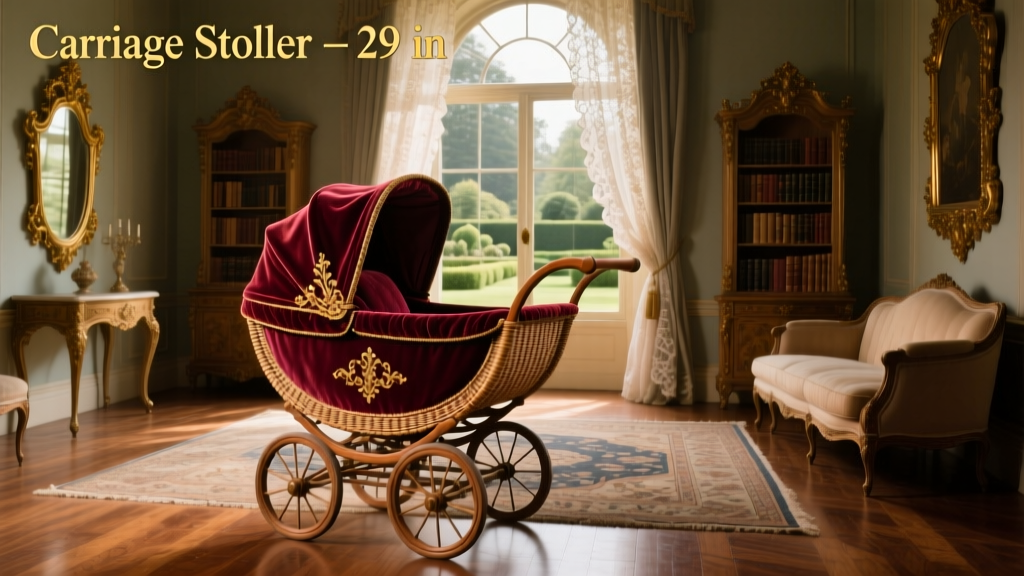
The Carriage Stroller: Wicker, Walnut, and Velvet — A 29-Inch Antique Infant Transport Artifact

The Verona Flow Blue Bowl: A Collector’s Guide to the 7½ × 10 Inch Patterned Masterpiece
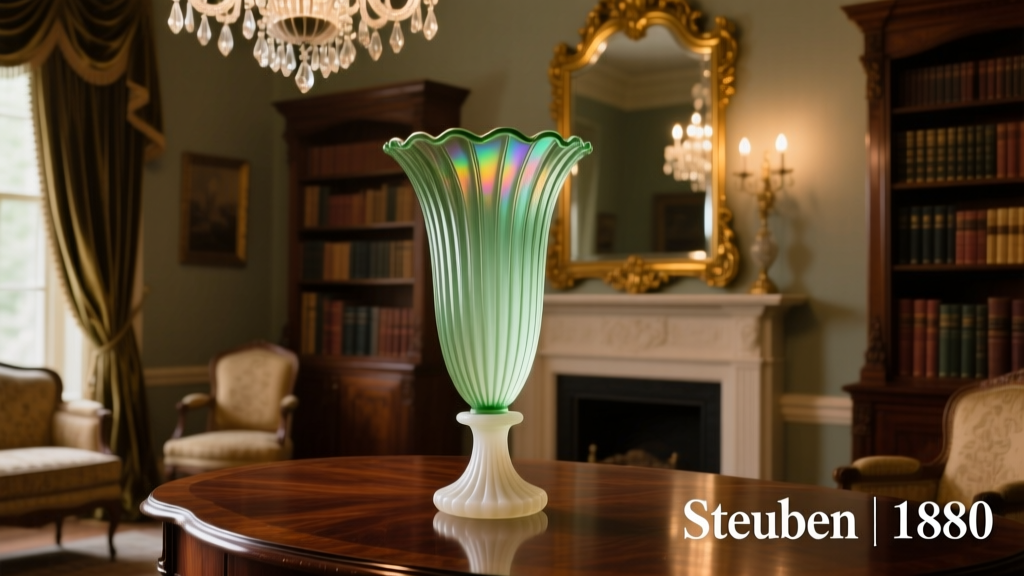
Steuben Vase: Fan Jade Alabaster Stem Foot with Vertical Ribbing — A Technical & Historical Appraisal of the 11 × 9 Inch Masterpiece