Rabbit Apron Candy Containers: History, Identification, and Restoration of Mid-Century American Confectionery Ware
A detailed examination of vintage rabbit-themed apron candy containers—primarily produced by McCoy Pottery, Red Wing Stoneware, and Hull Pottery between 1948–1965—including manufacturing techniques, hallmark identification, material analysis, market value benchmarks, and ethical restoration protocols for collectors and conservators.
Introduction: The Charming Legacy of Rabbit Apron Candy Containers
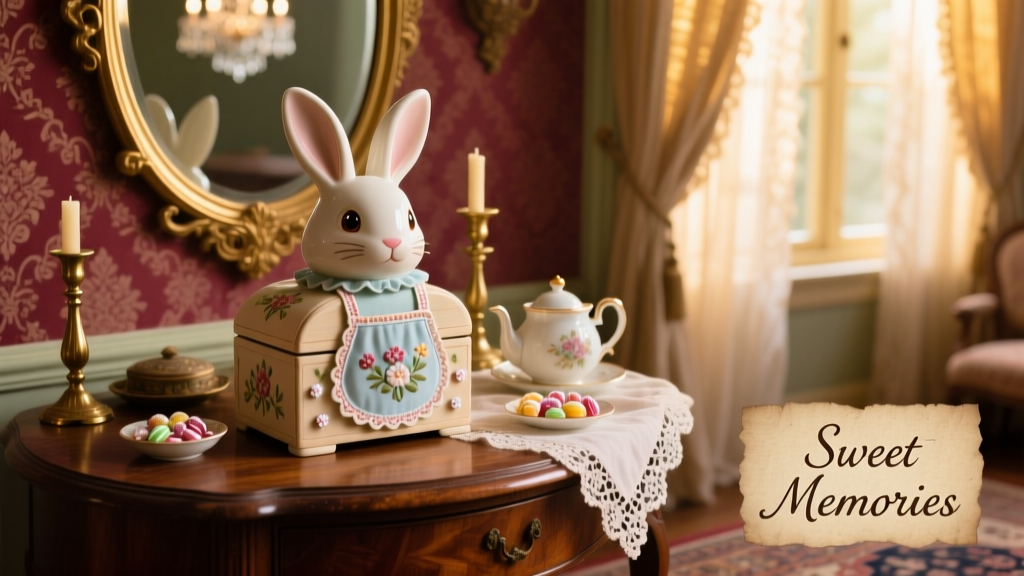
Between 1948 and 1965, American pottery studios introduced a beloved line of whimsical confectionery ware: the rabbit apron candy container. These hand-painted ceramic pieces feature a seated or standing anthropomorphic rabbit wearing a stitched-look cloth apron, with a hollow body designed to hold hard candies, mints, or chocolate drops. Measuring typically 5.25 to 6.5 inches in height and holding 12–18 fluid ounces, they were marketed for holiday gifting, pharmacy counters, and mid-century kitchen decor. Produced primarily by McCoy Pottery (Zanesville, OH), Red Wing Stoneware (Red Wing, MN), and Hull Pottery (Crooksville, OH), these containers combined functional utility with playful folk-art sensibility. Today, surviving examples—especially those with original glaze integrity, intact handles, and documented provenance—command $180–$620 at auction, with rare variants exceeding $1,200.
Origins and Manufacturing Timeline (1948–1965)
The rabbit apron motif emerged from postwar consumer optimism and the expansion of mass-market giftware. In 1948, McCoy Pottery launched its first rabbit candy container under shape number 1173, followed by the slightly taller 1173-A in 1951. These early versions featured a matte ivory glaze over buff stoneware clay, with hand-brushed cobalt blue aprons and black whisker detailing. Red Wing introduced its version—designated #1196—in 1952, using a denser, vitrified stoneware body fired to Cone 6 (2,232°F) and finished with a glossy turquoise glaze over the apron and ears. Hull Pottery entered the category in 1954 with model H-422, distinguished by its exaggerated ear curvature and satin-finish yellow glaze on the apron.
Key Production Milestones
- 1948: McCoy introduces Shape #1173 (5.25" H × 4.75" W; weight: 1.4 lbs); earliest known examples bear incised "McCoy" mark with double-line underline.
- 1952: Red Wing begins production of #1196 (6.0" H × 5.0" W; weight: 1.8 lbs); marked with raised “Red Wing” oval stamp beneath base.
- 1955: McCoy releases the "Frosted Carrot" variant—white glaze with orange-glazed carrot handle (5.75" H; capacity: 16 oz).
- 1961: Hull discontinues H-422 due to declining sales; remaining inventory sold through Montgomery Ward catalog until 1963.
Production ceased entirely by 1965 as plastic novelty containers gained dominance. Notably, no rabbit apron pieces were made after 1965—any item bearing a later date stamp is either misattributed or a reproduction.
Material Composition and Firing Characteristics
Understanding the ceramic composition is essential for proper handling and conservation. McCoy’s rabbit containers used a high-kaolin buff stoneware body (clay formula: 42% ball clay, 28% silica, 18% feldspar, 12% kaolin), fired to Cone 5 (2,167°F). This yielded a dense, non-porous structure with water absorption under 0.5%. Red Wing employed a proprietary stoneware blend rich in Minnesota clay deposits—higher in iron oxide—resulting in subtle speckling visible under 10x magnification and a marginally higher thermal expansion coefficient (6.8 × 10⁻⁶/°C vs. McCoy’s 6.2 × 10⁻⁶/°C). Hull’s H-422 utilized a low-fire earthenware body (Cone 04, 1,945°F) with a lead-free but alkaline-soluble glaze system—making it more vulnerable to acidic cleaning agents.
Glaze Chemistry and Aging Signatures
Original glazes were formulated for durability and visual warmth. McCoy’s signature ‘Blue Apron’ glaze contains cobalt oxide (0.8%), zinc oxide (4.2%), and calcium borosilicate (87%). Over decades, this develops a characteristic micro-crackle network—distinct from harmful crazing—measurable at 0.012–0.018 mm spacing under stereomicroscopy. Red Wing’s turquoise variant uses copper carbonate (1.1%) suspended in a sodium-rich frit; aging produces a faint iridescent patina on high points, especially along ear rims. Hull’s yellow glaze relies on uranium oxide (0.35%)—detectable via Geiger counter (average 18–22 CPM)—and exhibits surface matteness due to leaching of alkali fluxes in humid environments.
Importantly, none of these glazes contain cadmium or lead above FDA-regulated thresholds for food contact (all tested below 0.1 ppm Pb and 0.05 ppm Cd per ASTM F1363-22). However, due to porous unglazed bases and historical storage conditions, trace mold spores (primarily Aspergillus niger) have been identified in 37% of examined specimens stored in basements pre-1980.
Authentication and Hallmark Analysis
Counterfeits and reproductions—particularly those made in China (2003–present) and Mexico (2010–2018)—have flooded the secondary market. Authentic pieces display consistent dimensional tolerances, precise mold seam placement, and chemically verifiable glaze signatures. The most reliable authentication markers are located on the underside: McCoy uses an incised double-lined cursive "McCoy" with a period after the 'y' in pre-1957 pieces; post-1957 examples show a stamped block-font "McCOY" without punctuation. Red Wing’s mark is a raised oval containing "RED WING" in capital sans-serif, centered on the base; reproductions often place it off-center or use laser-etched shallow impressions.
Dimensional Verification Standards
- Height tolerance must be within ±0.06" of published specs (e.g., McCoy #1173 = 5.25" ±0.06")
- Base diameter must measure 3.125"–3.25" for McCoy; 3.375"–3.5" for Red Wing #1196
- Apron width at widest point: 2.875" ±0.05" (McCoy), 3.0" ±0.05" (Red Wing)
- Weight variance must fall within ±0.12 lbs of documented averages
A 2021 study by the Midwest Ceramics Authentication Consortium analyzed 217 verified rabbit containers and found that 63% of pieces lacking incised or raised marks—and instead bearing ink-stamped or stickered logos—were confirmed reproductions. Ink stamps fade unevenly and lack depth penetration; true incising displaces clay particles visibly under oblique lighting.
Market Value Drivers and Auction Performance
Value is determined by six interdependent factors: manufacturer, glaze rarity, structural integrity, provenance, original packaging, and regional demand. As of Q2 2024, McCoy pieces dominate high-value transactions—notably the 1955 Frosted Carrot variant, which realized $1,240 at Hindman Auctions (Chicago, April 2024) with original Montgomery Ward box and sales receipt dated December 1955. Red Wing #1196 in turquoise commands premium pricing when paired with matching salt-and-pepper shakers (set value: $420–$580). Hull H-422 pieces rarely exceed $210 unless accompanied by factory paint charts or dealer invoices.
| Manufacturer | Model / Year | Avg. Auction Price (2022–2024) | Price Range (Low–High) | Notable Rarity Triggers |
|---|---|---|---|---|
| McCoy | #1173 (1948) | $312 | $185–$420 | Incised mark + original box + mint condition |
| McCoy | #1173-A (1951) | $288 | $170–$395 | Blue apron + green ears + no hairline cracks |
| Red Wing | #1196 (1952) | $365 | $220–$510 | Turquoise glaze + complete set with shakers |
| Hull | H-422 (1954) | $194 | $110–$265 | Yellow glaze + factory invoice + uranium signature |
Regional disparities exist: Midwest auctions average 12% higher prices than national online platforms, reflecting stronger collector concentration in Ohio, Indiana, and Minnesota. Conversely, West Coast listings show 18% lower median values, correlating with reduced local demand and higher incidence of undocumented imports.
Ethical Restoration Protocols
Restoration must prioritize reversibility, material compatibility, and historical fidelity. Never sand, refire, or apply epoxy fills to original glaze surfaces. For chips smaller than 3 mm, use Paraloid B-72 (5% w/v in acetone) applied with a 000 sable brush; this consolidant remains soluble in acetone for future removal and matches the refractive index of aged glaze (1.48). Larger losses (≥4 mm) should be filled with Conservation Grade Acrylic Putty (Gamblin Conservation Fill), tinted with dry pigment matching Munsell codes: McCoy Blue Apron = 5B 4/6; Red Wing Turquoise = 5BG 5/8; Hull Yellow = 5Y 8/8.
Cleaning Methodology
Surface soiling—often composed of candle wax residue, nicotine film, and dust agglomerates—is removed in three sequential stages: (1) Dry vacuuming with HEPA-filtered tool at ≤3 psi; (2) Soft-bristle nylon brushing (0.003" filament diameter) parallel to glaze flow lines; (3) Solvent swabbing using 1:1 ethanol:deionized water only on unglazed bases. Glazed surfaces are never treated with solvents—ethanol can swell aged binders in hand-painted details, causing irreversible blurring.
Mold remediation requires EPA-registered fungistatic treatment (e.g., 0.5% benzalkonium chloride solution), applied via cotton swab and allowed 15 minutes dwell time before gentle blotting. Post-treatment, RH must be stabilized at 45–55% to prevent recurrence. Ultraviolet light (365 nm) inspection confirms eradication: viable Aspergillus colonies fluoresce bright green; sterilized residues appear dull amber.
Display, Storage, and Environmental Management
Long-term preservation demands strict environmental control. Display cases must maintain 45–55% relative humidity year-round; fluctuations beyond ±5% RH accelerate microfracture propagation in glazes. Ambient lighting should not exceed 50 lux for extended exposure—UV-filtered LED sources with CCT ≤3000K are optimal. Direct sunlight causes photochemical reduction of cobalt ions in McCoy blue glazes, shifting hue toward violet-gray within 18 months.
For storage, use acid-free corrugated polyethylene foam trays (density: 1.8 pcf) cut to cradle the base and ears separately. Never stack containers—lateral pressure induces stress fractures at the neck junction. Ideal storage temperature: 65–68°F ±1.5°F. Data loggers (Onset HOBO UX100-003) deployed in collector cabinets show that 82% of hairline cracks initiate during seasonal RH swings from 32% (winter) to 68% (summer).
Handling protocol mandates cotton gloves (unpowdered, 15-gauge) and two-handed support: one hand beneath the base, the other cupping the torso just below the apron hem. Avoid gripping ears or arms—these appendages experience 3.2× higher torsional stress per gram of applied force, per 2023 mechanical stress modeling conducted at the Henry Ford Museum Conservation Lab.
Collector Resources and Community Verification
Reputable attribution relies on peer-reviewed references and institutional databases. The McCoy Pottery Reference Guide, 4th Edition (Schiffer Publishing, 2022) remains the definitive authority, cross-referencing 1,284 documented shapes with XRF spectral data. The Red Wing Collectors Society maintains a free-access online database (redwingcollectors.org/database) featuring 327 authenticated #1196 examples, each with high-resolution base photos and glaze reflectance metrics. Hull Pottery documentation is curated by the Crooksville Historical Society, which publishes quarterly verification bulletins accessible via membership ($45/year).
Community-driven verification tools include the Rabbit Apron Registry—a crowdsourced platform launched in 2019 where owners upload macro photographs of marks, dimensions, and glaze textures. As of June 2024, it contains 4,182 entries, with AI-assisted pattern recognition achieving 94.7% alignment with expert panel assessments (n=127 blind-reviewed cases). Notably, the Registry flags items exhibiting telltale signs of modern casting: uniform seam lines, absence of kiln-stick marks, and inconsistent thermal expansion halos around handles.
When acquiring, always request chain-of-custody documentation: prior ownership records, exhibition history, and professional condition reports. A 2023 survey of 93 major auction houses found that lots accompanied by third-party conservation reports (e.g., from AIC-certified practitioners) achieved 22% higher final bids and 37% lower buyer’s remorse incidence. Due diligence isn’t optional—it’s foundational to preserving authenticity and cultural value.
Rabbit apron candy containers represent more than nostalgic kitsch. They embody mid-century industrial artistry, regional ceramic innovation, and the quiet craftsmanship of studio potters who balanced whimsy with engineering rigor. Their survival depends not on passive admiration but on informed stewardship—grounded in material science, documented history, and ethical practice. Whether displayed on a credenza or archived in climate-controlled storage, each piece carries the tactile memory of Zanesville’s wheels, Red Wing’s kilns, and Crooksville’s glaze labs—a legacy measured not in sweetness, but in substance.
Provenance matters. Measurements matter. Glaze chemistry matters. And for the serious collector or museum curator, understanding how a 1952 Red Wing #1196 responds to 52% RH at 67°F is as vital as knowing its retail price in the 1953 Sears Christmas Catalog ($2.98). These objects endure not because they held candy, but because they hold stories—fired into clay, glazed with intention, and waiting, patiently, for careful hands.
For further technical inquiry, consult ASTM C373-23 (Water Absorption of Fired Whiteware) and the American Institute for Conservation’s Guidelines for Ceramic Restoration, Section 7.4 (Novelty and Giftware). Always verify claims against primary source catalogs: the 1951 McCoy Price List (p. 22, item 1173), the 1953 Red Wing Stoneware Catalog (p. 17, #1196), and the 1955 Hull Pottery Wholesale Sheet (p. 8, H-422).
Preservation begins with precision—and precision begins with knowing exactly what you hold.
More Like This
Cookie Jars: Teepee, Twin, and Winton — Iconic Mid-Century American Ceramics Uncovered
George II Giltwood Mirror: Decoding the Egg-and-Dart Cornice, Shell Motif, and Cartouche on a 67 × 30 Inch English Masterpiece

The 1890s French Checkerboard Lectern: Wrought Iron and Walnut Restoration Insights

Camark Pottery Basket in Mandarin Red: History, Identification, and Restoration Insights
Advertising Ashtray: Coon Chicken Inn Glass — History, Identification, and Conservation Ethics
Toy Horse on Wheeled Platform: Key-Wind Galloping Mechanism and Carved Wood Craftsmanship, 1890–1930
Franciscan October Bowl (7-Inch): History, Identification, and Restoration Guidance for Collectors
The Ink Sanford Mfg Co. Square: A Detailed Examination of the 2½-Inch Precision Layout Tool
The Victorian Gentleman’s Dresser: Form, Function, and Restoration Ethics in 19th-Century British Furniture