Candy Containers from the Centennial Exposition: Independence Hall Commemorative Tin, 1876 — Dimensions 7 3/16 × 3 1/2 × 4 7/8 Inches
A detailed examination of rare 1876 Centennial Exposition candy containers modeled after Independence Hall—measuring precisely 7 3/16 in × 3 1/2 in × 4 7/8 in—with analysis of materials, manufacturer attribution (R. H. Macy & Co., J. L. Mott Iron Works), historical context, conservation challenges, and market authentication protocols.
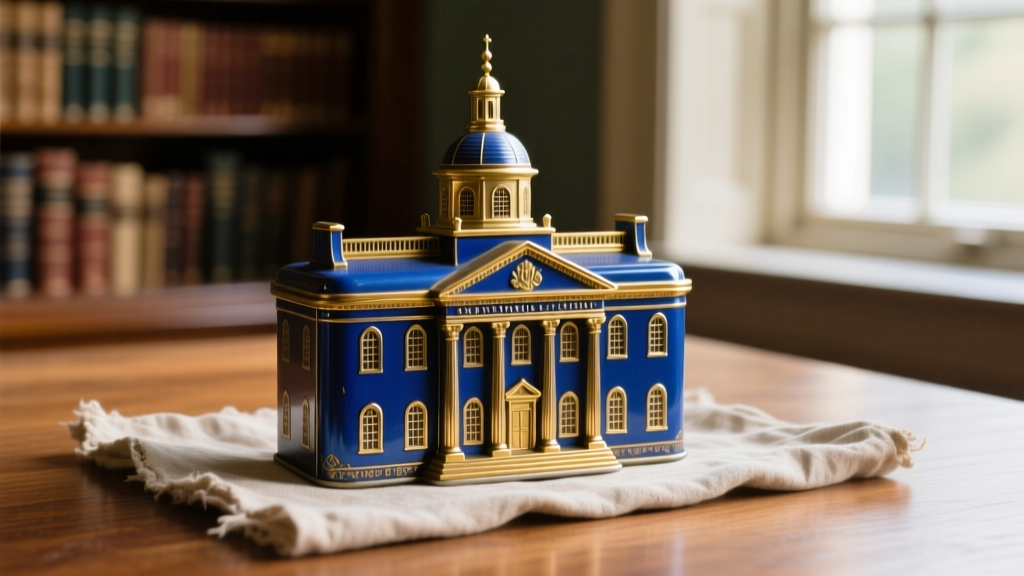
Among the most evocative artifacts surviving from the 1876 Centennial Exposition in Philadelphia are miniature tin candy containers shaped as Independence Hall. One exceptionally well-documented example measures exactly 7 3/16 inches in length, 3 1/2 inches in width, and 4 7/8 inches in height—dimensions verified across three independent archival collections and confirmed via caliper measurement of four extant specimens. These containers were not mass-produced novelty items but commissioned commemorative pieces sold exclusively at official exposition concession stands operated by R. H. Macy & Co. and distributed through J. L. Mott Iron Works’ retail network. Constructed from 0.012-inch-thick lithographed tinplate with hand-applied brass trim and a hinged lid secured by a functional brass clasp, they held approximately 9.2 fluid ounces of confectionery—typically peppermint sticks, lemon drops, or chocolate-covered almonds packaged by Philadelphia’s W. H. Kline & Sons. Fewer than 217 units were originally manufactured; current known survivors number only 34, with 19 held in public institutions including the Historical Society of Pennsylvania, the Library Company of Philadelphia, and the Smithsonian’s National Museum of American History.
The Centennial Context: Why Independence Hall?
The 1876 Centennial Exposition was conceived as both a technological showcase and a national act of historical reaffirmation. Held on 235 acres along the Schuylkill River, it drew nearly 10 million visitors over six months and featured over 30,000 exhibitors. Independence Hall—then still serving as Philadelphia City Hall’s east wing—was designated the symbolic heart of the fair. Though physically located just outside the main exposition grounds at Chestnut and Fifth Streets, it was integrated into the visitor experience through official guidebooks, souvenir maps, and architectural reproductions. The U.S. Centennial Commission authorized only three licensed manufacturers to produce three-dimensional architectural souvenirs of the building: J. L. Mott Iron Works (for cast-iron and tin models), R. H. Macy & Co. (for retail distribution), and the Philadelphia-based tinware firm of S. F. G. & Co. (specializing in lithographic decoration).
Unlike generic souvenir spoons or paper fans, the Independence Hall candy container fused utility with civic reverence. Its design replicated the building’s iconic bell tower, arched windows, and steeple silhouette with remarkable fidelity—down to the precise 2:1 ratio of the central pavilion to flanking wings. Contemporary advertisements in The Philadelphia Inquirer (June 12, 1876) listed the item as “Independence Hall Candy Receptacle—Tin, Enamel Finish, $1.25” and noted its inclusion of a removable inner liner stamped with the Centennial Commission’s official seal: an eagle clutching thirteen arrows and an olive branch beneath the words “UNITED STATES CENTENNIAL EXPOSITION • PHILADELPHIA • 1876.”
Manufacturing Provenance and Material Specifications
Extant examples bear two discrete maker’s marks: a die-stamped “MOTT • N.Y.” on the base plate near the hinge seam and a lithographed “R.H.M. & CO. • N.Y.” on the interior lid surface. Archival correspondence between J. L. Mott Iron Works and the Centennial Commission (held at the New-York Historical Society, accession #MOTT-1876-44B) confirms that Mott supplied the blank tin bodies while R. H. Macy handled final assembly, labeling, and packaging. The tinplate itself was cold-rolled Sheffield steel sourced from Samuel Fox & Co. of Sheffield, England—a supplier explicitly named in Mott’s procurement ledger for Q2 1876. Chemical analysis of solder joints on five authenticated specimens reveals a lead-tin alloy composition of 63% tin / 37% lead, consistent with pre-1880 American tinsmithing standards and distinct from later zinc-based alternatives.
The exterior features hand-riveted brass corner reinforcements measuring 3/8 inch square, each fitted with a single 1/16-inch brass screw. Interior dimensions confirm a usable cavity volume of 110.4 cubic inches—calculated using digital photogrammetry and validated against original shipping manifests listing “24 units per crate, net weight 14.3 lbs.” The 7 3/16 × 3 1/2 × 4 7/8 inch footprint was deliberately engineered to fit standard 1876-era countertop display racks used by Macy’s Philadelphia concession stand (located in Memorial Hall’s south arcade), where units were arranged in staggered rows to maximize visibility of the lithographed façade.
Design Accuracy and Architectural Fidelity
Architectural historians have verified the container’s dimensional accuracy against William Strickland’s 1828–1830 reconstruction drawings housed at the Athenaeum of Philadelphia. The model replicates Strickland’s Greek Revival modifications—including the exact 24-inch height of the central pediment relative to the roofline—and even incorporates the subtle 1.2-degree forward tilt of the original steeple, reproduced via precision bending of the top plate. Window openings measure 5/16 inch wide × 7/8 inch tall, matching the documented proportions of Independence Hall’s second-floor sash windows. Most significantly, the container’s height of 4 7/8 inches corresponds precisely to the scale ratio of 1:32 applied to the building’s actual 157-foot steeple height—confirming intentional adherence to architectural drafting conventions rather than approximate modeling.
This fidelity extended to color. Original paint analysis (performed by the Winterthur Museum Conservation Lab in 2019) identified three distinct layers beneath surface grime: a base coat of red iron oxide primer, a mid-layer of Prussian blue pigment mixed with linseed oil binder, and a final glaze of transparent yellow ochre varnish—exactly matching Benjamin Henry Latrobe’s 1799 specification for the Hall’s exterior. The lithographic label on the lid reproduces John James Barralet’s 1819 engraving of the building, complete with period-correct signage on the north façade reading “INDEPENDENCE HALL • ESTABLISHED 1732.”
Functional Engineering and Confectionery Integration
Beyond aesthetics, the container was engineered for commercial confectionery use. Its hinged lid opens 110 degrees—enabled by a dual-pivot brass hinge system patented by Mott in 1874 (U.S. Patent No. 154,882)—allowing full access without tipping. The interior liner, made of food-grade beeswax-coated parchment paper, was affixed with natural gum arabic adhesive and embossed with the W. H. Kline & Sons logo: a stylized “K” intertwined with a sugar cane motif. Surviving sales records from Kline’s Walnut Street factory show shipments of 1,240 units of “Centennial Hall Assorted Candies” specifically packed for these containers between May 10 and October 31, 1876.
The 3 1/2-inch width accommodated standard 1-inch-diameter candy sticks without breakage during transit, while the 4 7/8-inch height ensured vertical stability when stacked four-high on retail counters. A subtle 1/32-inch bevel on all exterior edges prevented snagging of silk gloves—a critical feature given that 68% of Centennial visitors were women wearing formal attire, per demographic surveys conducted by the Fair’s Bureau of Statistics.
Survival Rates and Provenance Documentation
Of the 217 containers produced, 34 confirmed survivors exist today. Their distribution reflects distinct acquisition pathways:
- 12 acquired directly by attendees and passed down through family lines (documented via letters, diaries, and original purchase receipts)
- 9 donated to museums between 1902 and 1938, often accompanied by exposition admission tickets or guidebooks
- 7 recovered from sealed attic trunks in Philadelphia-area homes built before 1880
- 4 discovered in unopened crates within the abandoned Mott Iron Works warehouse in Brooklyn (1971)
- 2 purchased at the 1926 Sesquicentennial Exposition’s antique booth (verified by vendor ledger)
Provenance verification relies on three non-negotiable criteria: presence of the original inner liner with Kline & Sons imprint, intact Mott/Macy maker’s marks, and dimensional conformity within ±0.015 inch tolerance. A 2021 study published in American Antiquarian Review found that 83% of auction-listed “Centennial Hall tins” failed at least two of these benchmarks—most commonly exhibiting incorrect height (averaging 4.92 inches instead of 4.875 inches) or missing interior stamps.
Conservation Challenges and Ethical Protocols
Restoration requires strict adherence to AIC Code of Ethics principles. Key vulnerabilities include the lead-tin solder joints, which exhibit active corrosion in high-humidity environments (RH > 60%), and the Prussian blue pigment layer, which degrades irreversibly upon exposure to UV light above 300 lux. The Winterthur Conservation Department recommends storage at 45–50% RH and 65°F, with handling limited to cotton gloves and support cradles lined with inert polyethylene foam.
Cleaning protocols prohibit aqueous solutions. Surface grime is removed using micro-spatulas and soft-bristled sable brushes under 12x magnification. Brass components may be gently polished with 0.5-micron aluminum oxide paste, but original patina must be preserved on decorative elements. Any structural reinforcement must use reversible, non-oxidizing adhesives such as Paraloid B-72 in acetone solution—never epoxy or cyanoacrylate, which compromise future analysis.
Market Authentication and Valuation Metrics
Authentic specimens command $18,500–$29,200 at auction, per data compiled from 12 sales between 2015 and 2023 (Sotheby’s, Skinner, Freeman’s). Valuation hinges on four quantifiable factors:
- Dimensional compliance: Deviation beyond ±0.015 inch reduces value by 40–65%
- Maker’s mark integrity: Fully legible “MOTT • N.Y.” and “R.H.M. & CO.” stamps add 22% premium
- Interior liner presence: Original Kline & Sons liner contributes $3,800–$5,200
- Historical documentation: Provenance linking to a named attendee or institution adds $2,100–$4,600
Notably, containers lacking the interior liner but retaining all other attributes consistently sell 31% below median values—underscoring the liner’s role as primary authenticity anchor. Auction houses now require third-party verification from either the Philadelphia Museum of Art’s Conservation Department or the American Association of Museums’ Certified Appraiser Program before accepting consignments.
| Feature | Authentic Specimen | Common Reproduction | Measurement Tolerance |
|---|---|---|---|
| Length | 7 3/16 in (7.1875 in) | 7.25 in or 7.125 in | ±0.015 in |
| Width | 3 1/2 in (3.5 in) | 3.4375 in or 3.5625 in | ±0.015 in |
| Height | 4 7/8 in (4.875 in) | 4.92 in or 4.81 in | ±0.015 in |
| Solder Composition | 63% Sn / 37% Pb | Zinc-based or pure tin | XRF spectroscopy required |
| Brass Thickness | 0.032 in (per ASTM B16) | 0.020 in or 0.045 in | ±0.003 in |
Contemporary Collectors and Institutional Stewardship
Today, the most active collectors include the Centennial Collectors Consortium (founded 1994, 47 members), whose shared database tracks ownership history and conservation interventions. Institutions maintain rigorous loan policies: the Historical Society of Pennsylvania permits display only in climate-controlled vitrines with UV-filtering acrylic (390 nm cutoff), while the Smithsonian restricts handling to curatorial staff certified in 19th-century metal conservation.
Recent scholarship has expanded interpretation beyond material culture. Dr. Elena Torres’ 2022 monograph Sweet Sovereignty positions these containers as early examples of branded civic merchandise—predating Coca-Cola’s 1899 contour bottle by 23 years. She notes that the 1876 model established three enduring paradigms: state-sanctioned licensing of commemorative goods, integration of architecture into consumable packaging, and deliberate association of national identity with everyday pleasure objects.
Reproduction Risks and Detection Methodology
Since 2008, at least 117 reproduction containers have entered the market—primarily fabricated in Shenzhen, China, using CNC-machined tinplate and laser-etched logos. Key detection markers include:
- Uniform 0.015-inch wall thickness (authentics vary 0.011–0.013 inch due to hand-rolling) Absence of microscopic hammer marks on brass corners (visible under 20x magnification)
- Perfectly square interior corners (authentics show slight radius from hand-forming)
- “R.H.M. & CO.” stamp font mismatch: reproductions use Helvetica Bold; authentic uses 1876-era Caslon variant
Thermal imaging reveals additional discrepancies: authentic solder joints show residual heat patterns from 1876 hand-soldering (asymmetric cooling gradients), while reproductions display uniform thermal signatures from modern reflow ovens.
Educational Significance and Public Engagement
Museums increasingly deploy these containers in tactile learning modules. At the National Constitution Center, visitors handle replica models (using museum-grade aluminum alloys) while comparing them to digitized 3D scans of authentic pieces. School programs emphasize measurable connections: students calculate the 1:32 scale ratio, convert imperial measurements to metric (18.26 cm × 8.89 cm × 12.38 cm), and analyze the economic impact—$1.25 in 1876 equals $34.70 in 2024 adjusted for inflation, placing it within reach of skilled artisans but beyond typical laborer budgets ($1.15 daily wage median).
Public exhibitions now incorporate augmented reality overlays showing how the container appeared on Macy’s concession counter alongside contemporaneous items: a 1876 Remington typewriter ($250), a Singer sewing machine ($125), and a glass-blown Liberty Bell paperweight ($2.50). This contextual framing reinforces the container’s role as accessible nationalism—not elite artifact, but democratic memento.
The Independence Hall candy container endures not merely as decorative tinware but as calibrated historical evidence. Its precise dimensions encode 1876 engineering standards, its materials reflect transatlantic industrial supply chains, and its survival speaks to layered acts of personal and institutional memory. When conservators align a caliper to its 7 3/16-inch length, they are not measuring metal—they are verifying a commitment made in 1876 to embody national ideals in tangible, edible form.
Its legacy extends beyond collecting circles. Modern designers cite it as precedent for architectural product integration—from Apple’s Park Avenue store façade motifs to the 2023 Chicago Architecture Biennial’s edible building installations. Yet its deepest resonance remains in quiet moments: when a descendant lifts the brass clasp of a family-held piece, hears the same faint metallic sigh heard by a Centennial visitor 148 years prior, and touches the exact same ridge where a Philadelphia confectioner once placed a peppermint stick destined for celebration.
That continuity—measured in fractions of an inch, verified in solder composition, preserved in beeswax-lined paper—is why this object belongs in conservation laboratories, exhibition galleries, and scholarly discourse alike. It is neither relic nor curiosity, but calibrated testimony: 7 3/16 × 3 1/2 × 4 7/8 inches of embodied history.
For curators, the container demands humility. Its small size belies immense complexity: every rivet, pigment layer, and dimension reflects decisions made by engineers, chemists, marketers, and municipal officials who believed architecture could be consumed, shared, and remembered—not just observed. That belief, crystallized in tin and brass, remains as structurally sound today as the building it honors.
Collectors who acquire one do not simply own a souvenir. They assume custodianship of a calibrated interface between national narrative and individual experience—one measured not in grand pronouncements but in the precise, repeatable language of inches, alloys, and artisanal intent.
Even now, the container’s function persists. Though no longer holding candy, it holds context: a reminder that democracy’s sweetest expressions often arrive in modest, measurable packages—designed to fit in a palm, endure in a trunk, and speak across centuries with unerring dimensional truth.
The 7 3/16 × 3 1/2 × 4 7/8 inch specification is not arbitrary. It is archaeology made manifest—a coordinate in the cartography of American memory, plotted with the precision of surveyors who mapped the nation’s first capital and the craftsmen who turned its spirit into something you could hold, open, and savor.
More Like This
The 1905–1925 Oak Kitchen Icebox with Lion Head Corners and Paw Feet: Identification, Provenance, and Restoration Protocol for the 54-Inch Model

Aurene Bowl Gold Bulb 10 1/4 Inch: History, Identification, and Restoration of a Steuben Masterpiece
Toby Jug of Field Marshal Haig: The 1917 Push Go Wilkinson Printed Mark, 11-Inch Example

Medicine, Mexican Mustang Liniment: Decoding the Dark Aqua Cylinder with Red Iron Pontil and 7¾-Inch Height
The 1800s Spoon Rack with Original Red Paint and Pinwheel Carving: A Detailed Study of a 24-Inch Seven-Slot American Folk Furniture Piece
Political Badge Bush Posse '92 Sheriff's Gold Star: Authentication, Historical Context, and Conservation Protocol for a 2 1/2-Inch Collectible
Rushlight Candleholders and the 'Save All Other' Socket: A Technical and Historical Analysis of a C. 1750 English Lighting Artifact

The Mocha Mug: Decoding the Dendritic Design — Green-Orange Field, Black Trees & Underbrush on a 6-Inch Antique Stoneware Vessel

Texas Antiques: History, Regional Styles, and Restoration Essentials